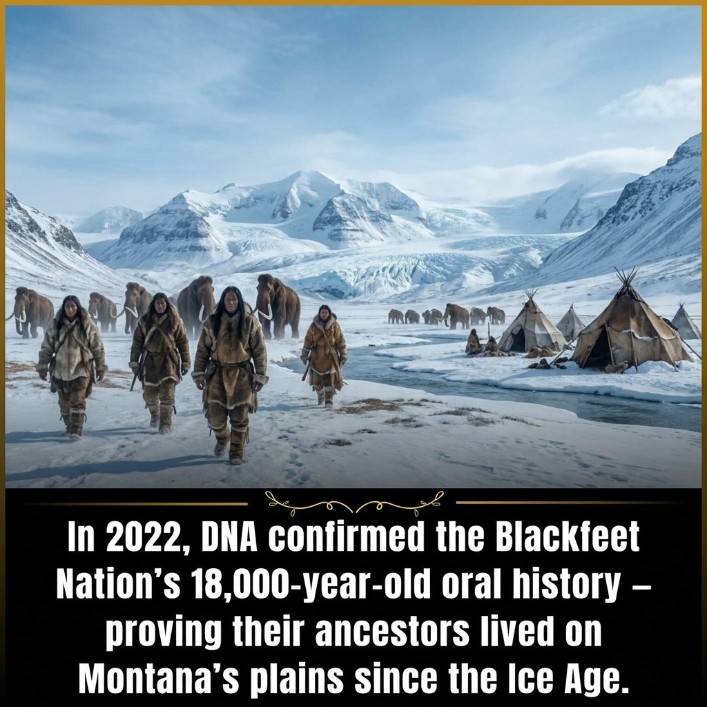
For generations, the Blackfeet Nation has told a story: their ancestors had roamed the Montana plains for nearly 18,000 years—long before settlers arrived, before maps were drawn, and before fences divided the land. These accounts, preserved through oral traditions, ceremonies, and intergenerational storytelling, were central to Blackfeet identity. They conveyed not only the people’s historical presence but also lessons about survival, ethical living, and the deep connection between humans and the land. Yet for centuries, historians outside the community dismissed these stories as myth, assuming that oral histories were unreliable, that the claims of such ancient settlement could not be factual.
In 2022, however, science finally caught up. DNA analysis revealed that the Blackfeet’s lineage diverged from other Indigenous groups approximately 18,000 years ago. This remarkable discovery aligned perfectly with the oral histories that the Blackfeet had carefully preserved for millennia. What the community had long asserted through storytelling and ritual was not mere legend—it was an empirically supported fact. The findings confirmed that the Blackfeet Nation had indeed occupied Montana’s plains since the late Ice Age, surviving dramatic environmental changes, migratory pressures, and the later upheavals of colonization.
This confirmation is far more than a minor scientific detail. It validates a form of knowledge that has survived entirely without written records. The stories, songs, and ceremonial teachings passed from elders to children over thousands of years carried accurate, detailed information about migration patterns, ecological cycles, and ancestral connections to specific landscapes. Each story functioned as both historical record and cultural guide, encoding a complex understanding of land, community, and human survival. For the Blackfeet, storytelling was never merely entertainment; it was a vital tool for preserving identity and ensuring the continuity of knowledge across generations.
Every hill, river, and valley in Blackfeet territory holds memories tied to specific narratives. Oral traditions taught which areas were sacred, which animals could be hunted at certain times, and how to navigate both environmental and social landscapes. This intimate knowledge ensured survival and maintained the spiritual and cultural coherence of the community. The 2022 DNA study demonstrated that these narratives were far more than symbolic; they were historically and biologically verifiable, carrying truth that science could now observe alongside cultural practice.
The revelation also challenges conventional assumptions about the ways knowledge is validated and preserved. Western academic traditions often prioritize written records as the ultimate proof of history, dismissing oral histories as anecdotal or imprecise. The Blackfeet example illustrates that oral traditions can encode highly accurate historical, environmental, and genealogical information over vast spans of time. These findings encourage scholars, educators, and policymakers to reconsider the value of oral history as a legitimate and vital form of evidence. It is a call to recognize that knowledge can exist in multiple forms—written, spoken, observed, and performed—and that each form can preserve truth in different but complementary ways.
Beyond scientific validation, the confirmation of the Blackfeet’s 18,000-year presence reinforces cultural pride and identity within the community. For Blackfeet youth, it provides tangible affirmation of their heritage and a strengthened connection to ancestors and land. It assures the community that the stories, teachings, and practices preserved over countless generations are not only culturally meaningful but historically accurate. This empowerment helps preserve language, ceremony, and tradition, ensuring that future generations continue to carry forward a rich legacy of knowledge and belonging.
The Blackfeet Nation’s story exemplifies the enduring power of human memory and community-based knowledge. Oral histories survived centuries of upheaval, including displacement, colonial violence, forced assimilation, and systematic erasure of Indigenous voices. Despite these pressures, the community maintained continuity in knowledge, culture, and presence on the land. The DNA confirmation demonstrates the resilience of these practices and underscores the remarkable ability of oral traditions to transmit complex information accurately across thousands of years.
Moreover, the findings highlight the interplay between human culture and science. Rather than undermining oral history, the DNA analysis corroborates and amplifies it, showing that Indigenous knowledge systems can align with modern scientific methods. This integration of tradition and technology provides a model for collaboration, demonstrating that scientific inquiry can respect and validate cultural knowledge rather than supplant it. For educators, researchers, and policymakers, it underscores the importance of engaging Indigenous communities as partners in knowledge production, honoring both historical wisdom and contemporary expertise.
The significance of this discovery extends beyond the Blackfeet Nation itself. It challenges society to recognize the importance of oral history worldwide. Across cultures, Indigenous and marginalized communities have preserved knowledge without written records, often under extreme pressures. The Blackfeet example demonstrates that such knowledge is not only credible but can reveal insights into human migration, settlement patterns, and cultural continuity over millennia. It encourages respect for diverse epistemologies and validates ways of knowing that have historically been overlooked or dismissed.
Spiritually and culturally, the validation resonates deeply. The Blackfeet view the land, their ancestors, and their teachings as inseparable. Sacred sites, rivers, mountains, and plains are living repositories of memory and identity. Knowing that their ancestral presence has been scientifically confirmed strengthens these connections and affirms the enduring relevance of ceremonial and ethical practices rooted in land stewardship, communal responsibility, and intergenerational guidance. It is a confirmation that their worldview, preserved over millennia, corresponds to historical reality.
Finally, the 2022 findings invite broader reflection on the relationship between human memory, culture, and science. They remind us that history is not confined to written records or textbooks but lives in stories, songs, and practices passed down across generations. The Blackfeet story demonstrates the accuracy and sophistication of Indigenous knowledge, challenging societies to listen, learn, and integrate these voices into our understanding of human history. It calls for humility, respect, and recognition that oral traditions are not merely symbolic—they are a vital archive of human experience, capable of guiding, teaching, and inspiring across centuries.
By confirming what the Blackfeet had always known, science did not eclipse culture; it honored it. It highlighted the profound truth embedded in oral history and reaffirmed the inseparable bond between people and place. As the Blackfeet continue to preserve, share, and celebrate their heritage, this scientific validation provides both a source of pride and a powerful reminder of the enduring power of memory, story, and culture. Their ancestors’ presence in Montana, stretching back 18,000 years, is now undeniable—an enduring testament to resilience, identity, and the remarkable capacity of human knowledge to survive and thrive across millennia.
The revelation of the Blackfeet Nation’s 18,000-year presence in Montana is not merely a historical or scientific milestone; it is a profound affirmation of human memory, resilience, and cultural continuity. For millennia, the Blackfeet had preserved this knowledge through oral traditions, ceremonial practice, and communal storytelling. Their elders taught each generation about migration patterns, sacred sites, seasonal cycles, and ethical responsibilities—all encoded within narratives that interwove spiritual, ecological, and historical truths. These stories functioned as both education and cultural preservation, ensuring that despite upheaval, displacement, and colonial pressures, the community retained an intimate connection with the land and their ancestry.
Oral history is a complex system that preserves far more than events; it maintains genealogies, ecological knowledge, and moral frameworks. In Blackfeet culture, storytelling serves as a tool for survival. It teaches the locations of safe hunting grounds, the behaviors of animal populations, and the changes in river courses and weather patterns over time. Each story carries lessons about cooperation, community responsibility, and respect for both people and the natural world. The 2022 DNA confirmation shows that these oral accounts, preserved over 18,000 years, encode accurate historical and environmental information. For the Blackfeet, this scientific alignment does not supersede their stories—it validates them, reinforcing the wisdom and authority of elders whose teachings had always been central to cultural life.
The broader implications of this discovery extend far beyond the Blackfeet Nation itself. Historically, Indigenous knowledge systems have been dismissed by Western academic paradigms, which privilege written records and archival documentation over oral traditions. The confirmation of 18,000 years of continuous Blackfeet ancestry challenges this hierarchy, demonstrating that oral histories are reliable, precise, and capable of preserving knowledge across immense spans of time. This insight invites scholars, educators, and policymakers to reconsider how knowledge is defined and validated. It underscores the importance of collaboration between scientific inquiry and Indigenous epistemologies, highlighting that the preservation of culture, identity, and historical truth can occur through multiple modalities.
This finding also strengthens the Blackfeet Nation’s claims to sovereignty and ancestral lands. Indigenous communities have faced centuries of displacement, treaty violations, and systematic erasure from their traditional territories. Legal disputes over land rights and natural resources frequently require proof of historical presence and continuity. The DNA evidence, corroborated by centuries of oral history, provides an unprecedented form of documentation that underscores the deep-rooted connection between the Blackfeet people and their ancestral landscape. Mountains, rivers, and plains are not merely geographical features—they are living repositories of history, memory, and cultural identity. The affirmation of this enduring presence reinforces ethical obligations regarding land stewardship, cultural preservation, and recognition of Indigenous sovereignty.
Education and curriculum development are another critical domain impacted by this revelation. In many schools, Indigenous histories are often fragmented, generalized, or overlooked entirely. Integrating the Blackfeet Nation’s story of continuous 18,000-year occupancy into classrooms can profoundly shift perspectives. Students gain an understanding of human presence in North America that is both scientifically and culturally grounded. They learn to appreciate the sophistication and accuracy of oral traditions, seeing storytelling not as folklore but as an essential method of knowledge transmission. By merging scientific evidence with cultural memory, educators can foster cross-cultural understanding and respect, challenging assumptions about historical validity and the sources of human knowledge.
Cultural resilience is a central theme highlighted by this discovery. The Blackfeet Nation survived countless disruptions, including colonial expansion, forced relocation along the Trail of Tears, assimilationist boarding schools, and systematic suppression of language and traditions. Yet, through oral histories, ceremonies, and communal practices, the Blackfeet maintained continuity of identity and knowledge. The alignment of these long-held stories with scientific evidence demonstrates the effectiveness and sophistication of these cultural practices. It reinforces the idea that resilience is embedded in knowledge transmission, ethical teaching, and community cohesion—values that have allowed the Blackfeet people to endure for millennia.
This revelation also underscores the symbiotic relationship between culture and environment. The ancestors of the Blackfeet lived through the late Ice Age, adapting to glaciers, climate shifts, and changing ecosystems. Oral traditions captured these experiences, detailing environmental cues, migration patterns, and survival strategies. Each story encoded empirical observations about the land and its resources, blending them seamlessly with ethical guidance and communal narratives. The 2022 DNA confirmation validates the presence of these ancient populations, showing that oral traditions preserved knowledge with remarkable precision across thousands of years. It highlights the intertwined nature of culture, memory, and environmental adaptation.
The significance of this discovery is further amplified by its implications for how society values knowledge systems. Indigenous oral histories have historically been undervalued or dismissed in academic, legal, and social contexts. The Blackfeet example demonstrates that oral knowledge can be as accurate and reliable as written records, if not more resilient over time. It challenges the assumption that knowledge requires documentation in books or archives and underscores the need for inclusive approaches to historical research. By validating oral traditions scientifically, this study promotes the recognition of Indigenous perspectives as equally credible sources of historical, environmental, and cultural knowledge.
Spiritually, the confirmation reinforces deep connections between people, ancestors, and land. For the Blackfeet, the physical landscape embodies cultural memory and identity. Mountains, rivers, and valleys are sacred not only for their natural features but for the ancestral presence and experiences encoded within them. Scientific validation strengthens these spiritual understandings, confirming that the knowledge transmitted through ritual, ceremony, and oral storytelling corresponds with empirical evidence. This alignment of spiritual and scientific truth enhances cultural pride and reinforces ethical relationships with the environment, ensuring that traditional practices continue to guide contemporary life and governance.
The 2022 findings also serve as a model for collaboration between Indigenous communities and scientific institutions. Researchers worked in consultation with Blackfeet leaders, respecting cultural protocols, ensuring informed consent, and prioritizing community benefit. This ethical approach contrasts with historical research practices that exploited Indigenous knowledge and populations. By involving the community in study design, analysis, and dissemination, the research affirms tribal sovereignty and provides a template for future projects. It demonstrates that science can support, rather than undermine, Indigenous knowledge, fostering partnerships that enhance understanding while respecting cultural authority.
This discovery also raises broader questions about the validation of oral histories worldwide. Across cultures, Indigenous and marginalized communities have preserved histories, genealogies, and ecological knowledge through oral traditions. These practices are often dismissed in favor of written documentation. The Blackfeet story illustrates that oral history can maintain accuracy over vast temporal scales, preserving complex knowledge about ancestry, environment, and social structure. Recognizing the validity of oral histories encourages more equitable treatment of Indigenous knowledge systems in academic, educational, and legal contexts, fostering respect for diverse ways of knowing.
The Blackfeet Nation’s story also provides inspiration for younger generations. Seeing that their ancestral narratives are confirmed by modern science instills pride, confidence, and motivation to engage with their cultural heritage. It strengthens language preservation, ceremonial practice, and community cohesion. Young Blackfeet can witness the tangible connection between memory, identity, and ancestral presence, reinforcing that their culture, knowledge, and land are inseparable. This empowerment encourages continuity of traditions, mentorship, and storytelling, ensuring the survival of knowledge for future generations.
In conclusion, the 2022 DNA confirmation of the Blackfeet Nation’s 18,000-year presence in Montana is a transformative moment in history, science, and culture. It validates millennia of oral history, strengthens claims to ancestral lands, fosters intergenerational pride, and challenges assumptions about how knowledge is preserved and recognized. It demonstrates the resilience, sophistication, and continuity of Indigenous cultural practices and offers a model for integrating oral traditions with scientific inquiry. Beyond its empirical significance, this revelation is a celebration of human memory, storytelling, and the enduring connection between people and place—a powerful reminder that history is not only written in books but carried in the hearts, minds, and voices of those who have lived it across countless generations.
The validation of the Blackfeet Nation’s oral history through DNA evidence also carries profound implications for understanding the dynamics of memory, storytelling, and identity. Oral traditions, often criticized by Western scholarship as anecdotal or unreliable, are in fact intricate systems of knowledge transmission. The Blackfeet’s stories, passed from elder to youth over millennia, contained information not only about lineage and migration but also about survival strategies, environmental observation, and ethical frameworks. These narratives were dynamic, adapting to changing circumstances while preserving core truths about identity, belonging, and relationship to the land. The scientific confirmation of these narratives demonstrates that oral history is not merely symbolic; it can encode precise, verifiable knowledge that endures across vast spans of time.
This discovery challenges conventional hierarchies of knowledge that have historically privileged written records over oral accounts. For centuries, historians, anthropologists, and policymakers dismissed Indigenous oral histories, often labeling them as myth or folklore. The 2022 findings with the Blackfeet Nation illuminate the limitations of this perspective. When oral tradition is preserved carefully within a community and transmitted across generations, it can maintain remarkable accuracy, offering insights that align with scientific and archaeological data. This calls for a re-evaluation of how knowledge is defined, validated, and taught, encouraging the inclusion of oral histories as equally credible sources of historical understanding.
The cultural and spiritual significance of the Blackfeet DNA findings is equally powerful. Indigenous cosmologies frequently link people, ancestors, and land in ways that are inseparable. For the Blackfeet, each mountain, river, and valley is imbued with memory, and the landscape itself functions as a living archive of ancestral presence. Knowing that their lineage in Montana stretches back 18,000 years validates these spiritual and cultural understandings, reinforcing a sense of continuity and belonging. It strengthens the ethical frameworks embedded in their traditions, which emphasize stewardship of the land, respect for community, and the interconnection between humans and the natural world. This alignment of science and cultural knowledge affirms the Blackfeet worldview while offering broader society a model for integrating multiple epistemologies.
The implications for education and public understanding are significant. Historically, Indigenous peoples have been marginalized in curricula, often reduced to caricatures or historical footnotes. By integrating the story of the Blackfeet Nation’s 18,000-year presence into educational frameworks, teachers can offer students a more complete and nuanced understanding of human history. It presents a case study in which oral tradition, cultural practice, and scientific evidence converge, allowing students to explore the richness of Indigenous knowledge systems and the longevity of human settlement in North America. Such education promotes empathy, respect, and cultural literacy, challenging stereotypes and fostering recognition of Indigenous contributions to history and society.
This revelation also underscores the resilience of the Blackfeet Nation. Despite centuries of forced relocation, assimilationist policies, and cultural suppression, the community preserved their stories and traditions, ensuring the survival of identity and knowledge. Boarding schools, which attempted to sever cultural transmission, were largely ineffective at erasing these deeply rooted narratives. The DNA confirmation validates the efficacy of these practices, showing that oral history can maintain integrity and accuracy over tens of thousands of years. It is a testament to the perseverance and adaptability of Indigenous cultures, demonstrating that knowledge is not only transmitted but can thrive under adversity.
The 2022 findings highlight the importance of collaborative research between Indigenous communities and scientific institutions. Researchers who worked with the Blackfeet Nation approached the study with respect, ensuring that cultural protocols were followed, consent was informed, and community benefit was prioritized. This ethical model contrasts with historical practices in which Indigenous knowledge was often exploited or misrepresented. By collaborating with the community, researchers validated Indigenous authority over knowledge while producing results that are scientifically rigorous. This partnership exemplifies how science and tradition can be integrated, producing outcomes that honor both empirical investigation and cultural integrity.
On a broader level, the findings invite reflection on the role of memory in shaping human understanding of history. The Blackfeet Nation’s oral traditions are an example of how memory, storytelling, and communal practice can preserve truth across vast temporal spans. These narratives encode knowledge about migration, environmental adaptation, social organization, and cultural values. The alignment of this memory with DNA evidence demonstrates that human knowledge is not confined to written records; it can persist in spoken and performed forms, embedded within communities, rituals, and collective consciousness. Recognizing this challenges prevailing assumptions about what constitutes evidence and highlights the sophistication of Indigenous knowledge systems.
The Blackfeet story also has implications for reconciliation and intercultural understanding. The confirmation of their ancestral presence provides a tangible acknowledgment of history and reinforces the legitimacy of their claims to land and cultural heritage. It encourages broader society to respect Indigenous knowledge and narratives, creating opportunities for dialogue, education, and collaboration. For Indigenous communities worldwide, the Blackfeet example serves as a powerful precedent: oral traditions carry weight, accuracy, and authority, and their validation by scientific methods demonstrates that Indigenous knowledge is both historically credible and culturally vital.
Finally, the Blackfeet Nation’s 18,000-year history offers inspiration for future generations. For young Blackfeet, knowing that their oral history aligns with scientific evidence strengthens cultural pride and identity. It encourages continued engagement with language, storytelling, and ceremonial practices, ensuring that these traditions endure. It also provides a model of resilience, showing that knowledge, memory, and culture can survive and thrive even under extreme pressures. For non-Indigenous audiences, the story underscores the need to listen to marginalized voices, recognize the validity of alternative knowledge systems, and respect the deep wisdom embedded in oral traditions.
The confirmation of the Blackfeet Nation’s ancestral presence is, ultimately, a story of continuity, survival, and human ingenuity. It affirms that oral history is not only a vessel for cultural expression but also a precise, enduring record of human experience. It validates the Blackfeet Nation’s identity, strengthens claims to ancestral lands, and demonstrates the profound ways in which culture, memory, and science can intersect. Their story reminds us that history is not solely written in books or inscribed on paper—it lives in stories, songs, rituals, and collective memory passed down through generations. By listening to these stories and honoring their truth, society gains a richer, more complete understanding of human history and the enduring legacy of Indigenous peoples.