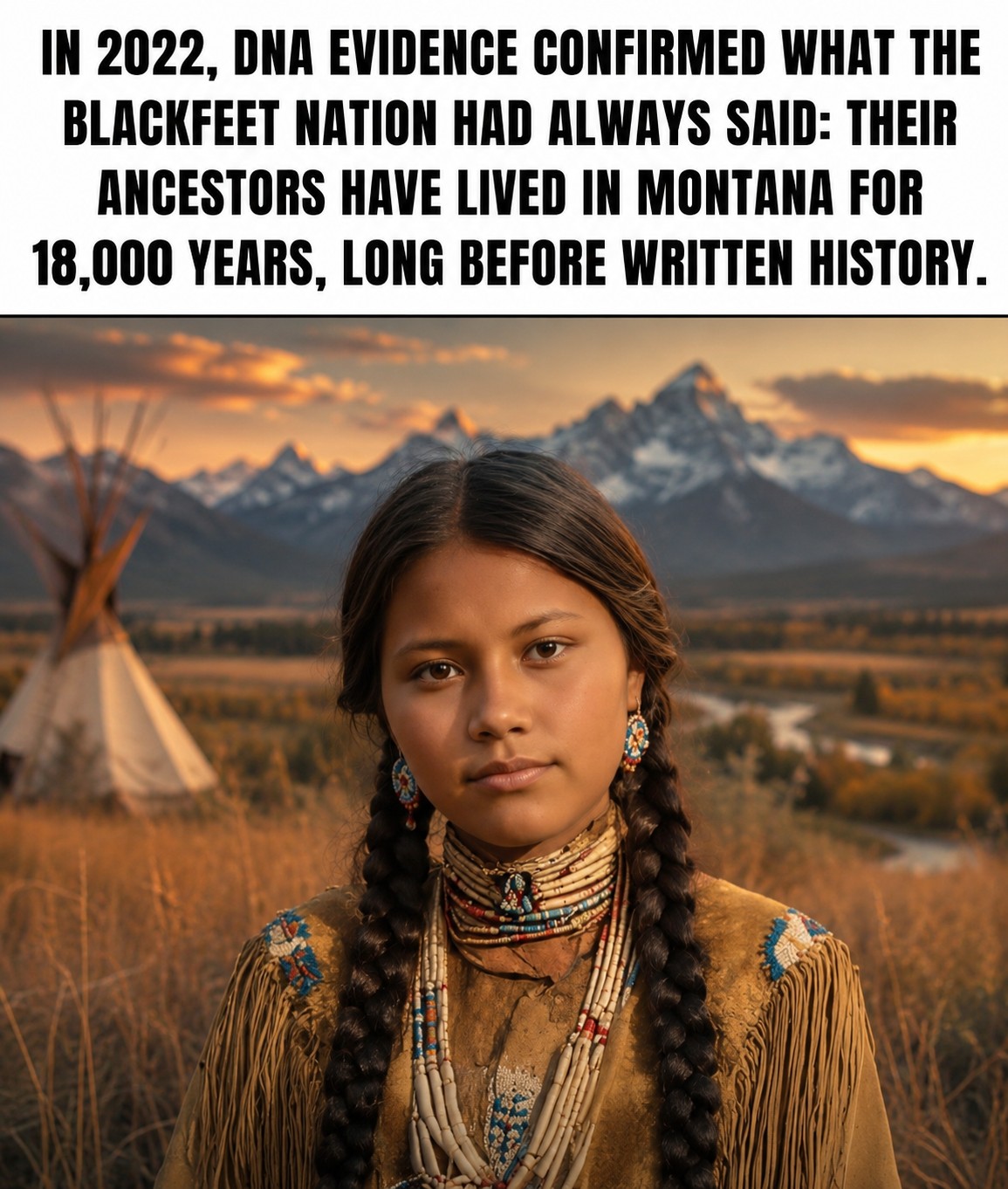
For generations, the Blackfeet Nation has passed down a profound story: their people have lived on the plains of what is now Montana since time immemorial. Long before maps were drawn, fences were erected, or settlers arrived, the Blackfeet inhabited this land, hunting, trading, and sustaining their communities in intimate connection with the landscape. This story, preserved through oral traditions, ceremonies, and cultural practice, was a central part of Blackfeet identity—a living memory that defined who they were, where they belonged, and how they understood the world.
Oral history, the primary vehicle for transmitting knowledge among the Blackfeet, has always been deeply respected within the community. Elders told stories that linked individuals to ancestors, to rivers, mountains, and the cycles of the seasons. These stories conveyed knowledge about survival, ethics, and cultural values. They preserved history across generations without the need for written documentation, carrying truths about land, relationships, and identity. For the Blackfeet, the landscape itself was a record of ancestral presence, each river bend, mountain peak, and valley imbued with stories of generations past.
For decades, historians outside the community questioned the timelines presented in these oral traditions. Some assumed the Blackfeet migrated into Montana more recently, framing Indigenous narratives through a lens of skepticism or colonial assumptions. The rich oral histories that had preserved identity and history for centuries were sometimes dismissed as myth or legend, undermining the authority of Indigenous knowledge. Yet within the Blackfeet Nation, these stories were never in doubt. They were the threads of identity, the proof of belonging carried across millennia by memory, ritual, and shared knowledge.
Then, in 2022, science caught up. A groundbreaking DNA study analyzed genetic material from members of the Blackfeet Nation, seeking to understand the ancestry and migration patterns of Indigenous peoples in North America. The results were astonishing: the Blackfeet had lived in Montana for approximately 18,000 years. Their lineage diverged from other Indigenous groups during the late Ice Age, aligning with early migrations across North America. What science confirmed, in precise terms, the Blackfeet had always known. Their oral history was not myth—it was memory encoded in culture, preserved in stories, ceremonies, and community life.
The significance of this discovery extends far beyond academic interest. It validated the authority of oral history as a legitimate record of human experience, challenging centuries of skepticism and privileging of written documentation. For the Blackfeet Nation, the DNA evidence affirmed a profound truth: their stories of ancestral presence and continuity were not merely symbolic but factual. This intersection of science and tradition illustrates a remarkable alignment between two different systems of knowledge—one ancestral and oral, the other modern and analytical—each confirming the other in powerful ways.
The Blackfeet people are part of the wider Blackfoot Confederacy, historically recognized as expert horsemen, hunters, and stewards of the plains. They developed intricate knowledge of the land, its resources, and the ecological patterns of their environment. Their survival and prosperity depended on precise knowledge, careful observation, and cooperation across generations. Oral traditions were central to transmitting these skills, blending practical information with ethical and spiritual teachings. In this way, the land and its history were inseparable from culture and memory, and the stories of ancestral presence were a core component of communal life.
What makes this revelation even more compelling is that the Blackfeet’s oral history was preserved without the benefit of written records or modern technology. Across thousands of years, these stories survived migrations, conflicts, epidemics, and the pressures of colonization. Generations of storytellers—elders, teachers, and cultural leaders—ensured the continuity of knowledge, carefully embedding historical, genealogical, and geographical information into narratives that could be remembered and retold. This oral preservation demonstrates the sophistication, resilience, and reliability of Indigenous methods of knowledge transmission.
The 2022 DNA study did not merely confirm ancestral presence; it elevated the Blackfeet’s cultural memory to broader recognition. For centuries, Indigenous knowledge systems were dismissed or marginalized in academic, political, and social contexts. Now, science provided evidence that oral histories, carefully preserved over millennia, contained precise information about population continuity, migration patterns, and ancestral connections to the land. This breakthrough has significant implications for how societies evaluate different forms of historical knowledge and challenges assumptions that written records are inherently superior to oral traditions.
The validation of Blackfeet oral history also reinforces cultural pride and identity within the community. For young Blackfeet, this confirmation provides tangible evidence of their deep roots in the land, strengthening the sense of belonging and continuity with ancestors. It affirms that their stories, ceremonies, and teachings are not merely symbolic or cultural artifacts but accurate repositories of historical truth. This empowers the community to preserve, celebrate, and transmit these stories with confidence, knowing that the knowledge they carry is both culturally and scientifically recognized.
Moreover, the story of the Blackfeet Nation offers a compelling example of how oral history can intersect with modern technology to enrich understanding. DNA analysis, radiocarbon dating, and other scientific techniques provide new tools for exploring human history, but when combined with Indigenous narratives, they create a more complete and nuanced picture of the past. In Montana, this integration of tradition and science highlights the value of collaboration, respect, and acknowledgment of multiple knowledge systems in uncovering and honoring human history.
The Blackfeet’s story also raises broader questions about respect for oral histories worldwide. Across cultures, Indigenous and marginalized communities have preserved their histories, genealogies, and scientific knowledge through oral traditions. Often, these forms of knowledge have been undervalued in Western academic frameworks, which prioritize written documentation and empirical records. The Blackfeet example demonstrates that oral history is not merely anecdotal but can preserve accurate, testable information across thousands of years, deserving recognition, protection, and integration into scholarly and educational contexts.
For the Blackfeet Nation, ancestral memory is inseparable from land, culture, and identity. The mountains, rivers, and plains of Montana are not only physical landscapes but living records of human experience, linking contemporary communities with ancestors who walked, hunted, and thrived across these territories for millennia. The 2022 DNA confirmation strengthens this connection, providing an additional layer of validation that reinforces cultural continuity and the moral claim to ancestral lands. It is a powerful reminder that belonging is not defined solely by political boundaries or written records but by the persistence of knowledge, memory, and communal life.
Finally, the Blackfeet story invites reflection on the broader implications of integrating oral history and modern science. It demonstrates the potential for collaboration across knowledge systems, highlighting that respect for Indigenous perspectives enriches scientific understanding. It challenges historians, educators, and policymakers to recognize the value of cultural memory, to listen to communities that have preserved knowledge for millennia, and to honor the accuracy and significance of these narratives.
In the case of the Blackfeet Nation, science and culture intersected in a profoundly validating way. The people who had always known their deep connection to Montana finally received recognition from modern science. Yet the story is not merely about confirmation—it is about respect, continuity, and the enduring power of human memory preserved through culture. It shows that oral history is not a supplement to knowledge but a critical form of evidence, capable of surviving thousands of years, shaping identity, and guiding generations.