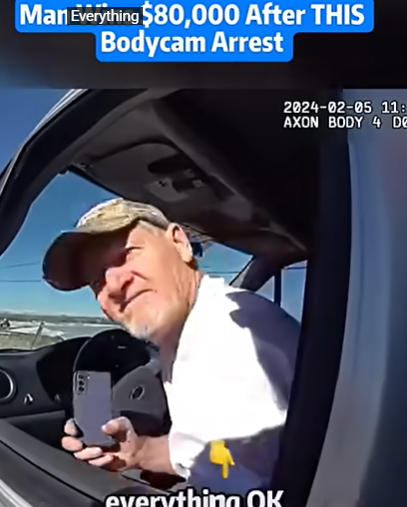
A citizen named Barry found himself at the center of a tense police encounter after he witnessed something he believed was wrong: a police officer speeding past him without emergency lights or sirens. To Barry, the moment looked like a clear example of hypocrisy. Ordinary drivers are expected to follow speed limits, stop when police pull them over, and accept consequences when they violate traffic laws. But in this case, Barry believed the officer was breaking the same rules he was supposed to enforce. Instead of simply letting it go, Barry decided to follow the police car and document what happened next.
The situation began with Barry noticing the officer’s vehicle moving quickly without any obvious emergency signal. No lights were flashing, and no siren was sounding. From Barry’s point of view, there was no visible reason for the officer to be driving at that speed. That detail mattered to him because emergency lights and sirens are what usually tell the public that an officer is responding to an urgent call. Without those signals, Barry believed the officer was simply speeding like any other driver might. The difference, in Barry’s mind, was that an ordinary driver would likely be stopped and cited for the same behavior.
Barry followed the officer and later parked ahead of the area where the officer had pulled over another vehicle. He began recording with his phone, apparently intending to collect evidence for a complaint. His goal was not to interfere with the original traffic stop, but to document the officer’s conduct and gather identifying information. Recording police in public has become increasingly common, especially when citizens believe they are witnessing misconduct or unfair treatment. For Barry, the phone camera became a way to hold the officer accountable.
Once the officer finished the first traffic stop, he turned his attention to Barry. Instead of leaving the area or ignoring Barry’s recording, the officer approached Barry’s vehicle. That moment changed the entire situation. What began as Barry recording from a distance quickly became a direct confrontation between the citizen and the officer. Barry asked for the officer’s name and badge number, explaining that he wanted to file a complaint about the speeding. From Barry’s perspective, this was a reasonable request. He had seen something he believed was improper and wanted the officer’s identifying information.
The officer, however, responded by demanding Barry’s driver’s license, registration, and insurance. That demand immediately created conflict. Barry did not believe he had done anything that required him to provide his documents. He argued that he had not committed a traffic violation and that recording the police in a public place was legal. In his view, asking for the officer’s name and badge number should not have turned him into the subject of an investigation. He believed he was exercising his rights, not breaking the law.
Barry refused to hand over his documents, and the officer insisted that he comply. The disagreement became a battle over authority and legal boundaries. Barry repeatedly asked for a supervisor or sergeant to come to the scene. This request suggested that he did not trust the officer to handle the situation fairly. He wanted a higher-ranking officer present to review what was happening and, possibly, to prevent the situation from escalating. Asking for a supervisor is something many citizens do when they believe an officer is acting improperly or when they feel an encounter is becoming unfair.
The officer maintained that Barry was obstructing. That accusation became the central point of the confrontation. From the officer’s point of view, Barry’s refusal to provide documents and follow commands may have been seen as interfering with police duties. From Barry’s point of view, he was not obstructing anything because the original traffic stop had already ended and he was simply recording from a public place. The two sides had completely different interpretations of the same moment. One saw lawful documentation and complaint activity. The other saw noncompliance and obstruction.
As the encounter continued, the officer warned Barry that he would be arrested if he did not comply. The officer also warned him that he could be tased if he refused to step out of the vehicle. Those warnings increased the tension dramatically. A conversation that began with Barry asking for a name and badge number had now become a threat of arrest and force. For Barry, the situation likely felt like retaliation. He had tried to report what he believed was officer misconduct, and now he was being ordered to provide documents and exit his vehicle under threat of arrest.
Barry continued to argue that he had done nothing wrong. He repeated that he had not committed a traffic violation and that he had a right to record. His refusal was based on principle. He believed that if he gave in, he would be accepting the officer’s authority to demand documents without cause. That kind of standoff is risky because even when a citizen believes they are right, refusing an officer’s commands can quickly lead to arrest. The roadside is rarely the place where legal arguments are fully settled. Those arguments often get decided later in court or through complaints and lawsuits.
The situation highlights one of the most difficult parts of police-citizen encounters: the difference between what a person believes their rights are and what an officer decides to do in the moment. Barry believed he was legally permitted to record and ask for identifying information. The officer believed Barry’s behavior justified a demand for documents and eventually an arrest warning. When those beliefs collide, the citizen is often in the weaker position in the moment, even if later review supports their side. Officers have immediate authority on the street, while citizens often have to challenge that authority afterward.
The video notes that Barry later won an $80,000 settlement following the arrest. That detail is important because it suggests that the case did not end with the roadside confrontation. Barry’s claims were apparently serious enough to result in compensation. A settlement does not always mean every claim is proven in court, but it does show that the incident had legal consequences beyond the arrest itself. For Barry, the settlement likely represented recognition that the encounter had gone too far or that his rights had been violated in some way.
The encounter raises questions about accountability. If a police officer speeds without emergency lights or sirens, citizens may reasonably wonder whether officers are held to the same standards as everyone else. Police sometimes have reasons to move quickly without fully activating lights or sirens, depending on department policy and the nature of a call. But to a member of the public watching from the road, an officer speeding with no visible emergency signal can look unfair. Barry’s reaction came from that perception of unfairness. He saw what he believed was a violation and wanted to report it.
The officer’s response also raises questions. When a citizen asks for an officer’s name and badge number to file a complaint, the interaction does not have to become confrontational. Officers can often provide identifying information and move on, especially if the citizen is not physically interfering with police work. In this case, however, the officer demanded Barry’s documents and framed his conduct as obstruction. That decision escalated the encounter and turned Barry from a complaining citizen into a person facing arrest.
For many viewers, the key issue would be whether Barry was actually obstructing. Recording police from a public location is generally treated as a protected activity when the person recording is not interfering with the officers’ duties. But the line between recording and interfering can become disputed. If a person is too close, blocks movement, distracts officers during an active stop, or refuses lawful commands, officers may claim obstruction. Barry, however, appears to have believed that he was parked separately, recording from his own vehicle, and not preventing the officer from completing the initial traffic stop.
The fact that the officer approached Barry after finishing the first traffic stop may strengthen Barry’s view that he was not interfering. If the original stop had already concluded, then Barry might argue that there was nothing left for him to obstruct. He was simply waiting to ask for identifying information. The officer, on the other hand, may have viewed Barry’s decision to follow, park nearby, and record as suspicious or disruptive. That difference in interpretation is exactly why supervisor involvement could have helped calm the situation.
Barry repeatedly asked for a sergeant or supervisor, which suggests he wanted a third party to step in before things got worse. A supervisor can sometimes reduce tension by reviewing the facts, clarifying policy, and making sure both the officer and citizen understand what is happening. In many police encounters, calling a supervisor is not required just because a citizen asks, but it can be useful when an interaction is escalating. In this case, the request for a supervisor became part of Barry’s attempt to protect himself from what he believed was an improper demand.
The officer’s threat to arrest and tase Barry if he refused to step out of the vehicle made the scene feel more serious. Commands to exit a vehicle are not small matters. Once an officer orders someone out, refusal can quickly become the basis for additional charges or force. Barry’s refusal was tied to his belief that the stop itself was unlawful. But from the officer’s perspective, once he gave the order, Barry’s continued refusal became a direct challenge to his authority. This is the kind of moment where encounters can spiral quickly.
The video also reflects the broader tension between police accountability and police authority. Citizens have a right to question government behavior, file complaints, and document public officials. At the same time, officers are given authority to enforce laws and maintain control during traffic stops. Problems arise when an officer treats accountability efforts as interference, or when a citizen’s attempt to challenge an officer becomes a refusal to follow commands that may carry immediate consequences. The balance is delicate, and when it fails, lawsuits often follow.
Barry’s case is especially notable because he was not the person originally stopped by the officer. He was a third party who had observed the officer’s driving and decided to document the situation. That makes the officer’s demand for Barry’s license, registration, and insurance feel questionable to those who see Barry as a citizen observer rather than a traffic violator. Barry’s argument was simple: he had not been pulled over for a violation, so why was he being asked for documents? The officer’s answer was that Barry was obstructing, but Barry clearly rejected that explanation.
The settlement later attached to the incident gives the story a sense of vindication from Barry’s side. He believed the officer acted improperly, he resisted the demand for documents, he was arrested, and later he received $80,000. For viewers who support Barry, the settlement may appear to confirm that he was treated unfairly. For others, the incident may still be seen as a reminder that roadside confrontations are dangerous and that legal disputes should be handled after compliance. But the settlement makes it difficult to dismiss Barry’s complaint as meaningless.
This story also shows how phone cameras have changed the relationship between police and the public. In the past, a citizen who saw an officer speeding might have had little evidence beyond their own word. Now, citizens can record, document, and share encounters. That can be valuable for accountability, but it can also create friction when officers feel watched or challenged. Barry’s recording turned the incident into a documented dispute. Without the video, the details might have been known only through reports and statements.
The officer may have felt that Barry following him was unusual or suspicious. From a law enforcement perspective, a person following a police car and parking near a traffic stop could raise concerns. Officers are trained to be aware of their surroundings, especially during stops. However, suspicion alone does not automatically settle the question of whether Barry was legally required to provide documents. That is where the encounter becomes legally and morally complicated. The officer may have felt concerned, but Barry may still have had the right to observe and record.
The case also touches on public trust. When citizens see officers breaking traffic rules without explanation, it can damage confidence in law enforcement. People may feel that officers enforce rules on others while ignoring those same rules themselves. Even if the officer had a legitimate reason to drive quickly, failing to use lights or sirens can create confusion. Barry interpreted the speeding as hypocrisy, and his entire response grew from that perception. A simple explanation or professional exchange might have prevented the situation from becoming an arrest.
The officer’s refusal to simply provide his name and badge number, if that is how the scene unfolded, likely made Barry more determined to stand his ground. Many departments require officers to identify themselves when requested, especially during official interactions. When an officer resists giving that information or shifts the focus onto the citizen, it can make the citizen feel that the officer is avoiding accountability. Barry’s demand for identification was tied directly to his plan to file a complaint, and the officer’s response turned that complaint effort into a confrontation.
The emotional tone of the encounter is important. Barry likely felt angry because he believed he had witnessed wrongdoing. The officer likely felt challenged because a citizen had followed him and was recording. Both men entered the interaction with tension already present. Instead of de-escalating, the conversation moved toward commands, refusal, threats, and arrest. This is a common pattern in confrontational police videos: both sides become locked into their positions, and neither wants to be the first to back down.
The lesson from this incident depends on how someone views the balance of rights and compliance. One lesson is that citizens should be able to record police and file complaints without being punished. Another lesson is that confrontations with police can become risky very quickly, even when the citizen believes they are legally correct. A third lesson is that officers should handle citizen complaints with professionalism and avoid escalating unless there is a clear legal reason to do so. All three lessons can exist at the same time.
Barry’s later settlement suggests that taking legal action after the incident was more effective than trying to win the argument on the roadside. In the moment, he was arrested. Later, through the legal process, he received compensation. That pattern shows the reality of these encounters: the street is where power is exercised, but the courtroom or settlement process is often where accountability is decided. For Barry, the arrest may have felt like a defeat at the time, but the later settlement turned the incident into a broader statement about rights and police conduct.
The story is also a reminder that officers are public servants and that citizens have a legitimate interest in how they behave. When someone asks for an officer’s name and badge number, especially to file a complaint, that request should not automatically be treated as hostility. A calm response can preserve trust. A defensive response can destroy it. In this case, the officer’s reaction became the central issue, possibly more than the original speeding allegation.
For citizens, the incident shows the importance of knowing rights but also understanding risk. Recording police in public may be lawful, but encounters can still escalate. Asking for a supervisor may be reasonable, but it may not stop an officer from making an arrest. Refusing to provide documents may be based on principle, but it can still lead to immediate consequences if the officer decides the refusal is unlawful. Barry’s case ended with a settlement, but the process likely involved stress, time, and legal effort.
The $80,000 settlement became the final detail that shaped public understanding of the incident. Without it, the story might be seen as just another roadside argument between a citizen and an officer. With it, the story becomes an example of a citizen challenging police conduct and later receiving compensation. It suggests that Barry’s complaint had weight and that the arrest was not simply forgotten or accepted.
In the end, the encounter began with a simple observation: Barry saw a police officer speeding without lights or sirens. That observation led him to follow, record, and ask for identifying information. The officer responded by demanding Barry’s documents and accusing him of obstruction. Barry refused, insisting he had done nothing wrong and asking for a supervisor. The officer warned him that he could be arrested and tased if he did not comply. The situation escalated into an arrest, and later, according to the video, Barry won an $80,000 settlement.
What makes the story powerful is the way it captures the tension between accountability and authority. Barry believed he was holding an officer accountable for behavior that would get an ordinary driver in trouble. The officer believed Barry’s conduct crossed a line into obstruction or noncompliance. The conflict became bigger than a speeding allegation. It became a dispute over whether a citizen can question, record, and complain about police conduct without being treated as a suspect. Barry’s eventual settlement suggests that the consequences of that dispute did not end when the handcuffs came out. It became a case about rights, responsibility, and the importance of keeping police power within legal limits.
Barry’s experience also shows why calm professionalism matters so much during police encounters. If the officer had simply provided his name and badge number and explained his reason for speeding, the entire situation might have ended in a few minutes. Barry may still have filed a complaint, but the encounter likely would not have turned into threats, arrest, and a later settlement. Instead, the officer’s decision to demand documents shifted the focus away from the original speeding concern and onto whether Barry himself was doing something wrong.
For Barry, the arrest likely felt like punishment for questioning authority. He had seen behavior he believed was improper, followed the officer to document it, and asked for identifying information. From his perspective, he was acting as a concerned citizen, not a criminal. Being threatened with arrest and a taser for refusing to provide documents only made the situation feel more serious and unfair.
The case also reminds viewers that accountability often comes after the incident, not during it. In the moment, Barry could not force the officer to accept his argument. But later, through legal action, the situation was reviewed more carefully, and the settlement became the clearest sign that the encounter carried consequences.
Ultimately, the story is about more than one officer allegedly speeding. It is about whether citizens can question police conduct without fear of retaliation. Barry’s $80,000 settlement made the incident stand out as a reminder that recording, asking questions, and filing complaints are important parts of public accountability.