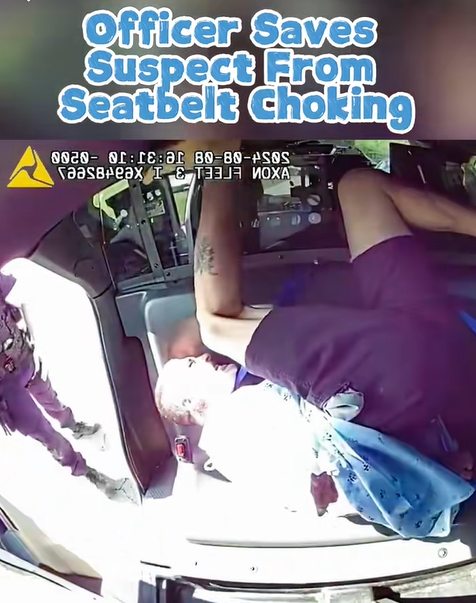
In a controversial and high-profile law enforcement encounter, bodycam footage reveals a series of dramatic events involving Officer Harris Jr. and a suspect named Kram, an incident that ultimately led to the officer’s termination and decertification. The encounter underscores the delicate balance officers must maintain between enforcing the law, protecting public safety, and responding to individuals in crisis. It begins with Kram, who had previously escaped from a hospital, claiming that he ingested aluminum-wrapped phenylephrine and fentanyl. Kram informed the transporting officers that if he died in custody, the responsibility would rest on them. Such statements presented a highly charged scenario in which the officers had to assess the threat of self-harm while simultaneously maintaining procedural control, highlighting the tension inherent in managing detainees with potential medical crises.
Initially, the officers appear to dismiss Kram’s claims, prompting him to escalate his behavior verbally, hurling insults, and physically attempting self-harm by choking himself with the police cruiser’s backseat seatbelt. This immediate threat to life required a rapid assessment of both medical and tactical interventions. Officer Harris Jr. took decisive action by pulling over the vehicle to safely intervene. Using sharp elbow strikes, he managed to loosen the locked seatbelt and free Kram from immediate danger. The incident reflects a scenario in which law enforcement must act quickly to prevent serious injury or death while working within the constraints of a confined environment, a situation that tests both judgment and procedural adherence.
Following the initial intervention, the encounter escalated further in a controversial maneuver now referred to in the footage as the “Taser CPR.” After being freed from the seatbelt, Kram briefly lost consciousness. In a highly debated and legally scrutinized move, Officer Harris employed his Taser repeatedly on Kram under the stated pretext of administering life-saving measures. The suspect regained consciousness immediately following the shocks. While the officer’s intent may have been to preserve life and prevent further self-harm, the method raised significant questions regarding proportionality, ethics, and the appropriate use of force. It demonstrates the fine line law enforcement officers must navigate between employing force to protect life and committing acts that can be construed as excessive or unlawful.
The aftermath of the incident further illuminates the complex consequences of both suspect behavior and officer actions. Kram, who already had active out-of-state warrants, was placed on a $25,000 bail with a mandatory GPS monitor. Despite these measures to ensure compliance and monitoring, public and administrative scrutiny quickly followed regarding Harris’ conduct. Complaints about the use of force, particularly the repeated Taser application, prompted a review by police leadership and ultimately led Chief Elliott to terminate Officer Harris. The case was also forwarded to the local prosecutor for further legal consideration. This sequence highlights how real-time decision-making under pressure can have long-lasting professional and legal ramifications, reinforcing the critical importance of training, protocol adherence, and accountability within law enforcement.
The narrative surrounding Officer Harris is further contextualized by his prior history. According to reports, Harris had been involved in a controversial May 2024 arrest that resulted in a death while in custody, a factor that compounded public and administrative concern regarding his conduct. By September 2024, after the review of multiple incidents and complaints, Harris’ police certification was officially revoked, effectively ending his law enforcement career. This timeline illustrates the cumulative impact of repeated incidents, procedural violations, and public scrutiny in shaping both individual accountability and institutional policy enforcement.
Analyzing the encounter through the lens of crisis management, several key themes emerge. First, the necessity of rapid assessment in life-threatening scenarios is evident: officers must determine the immediacy of risk and select interventions that are both safe and effective. Second, the interaction emphasizes the critical role of communication and coordination. In situations involving potential self-harm, verbal commands, reassurance, and clear instructions are essential components of de-escalation. Third, the encounter highlights the importance of proportional response: interventions must balance urgency with ethical, legal, and procedural considerations. In this case, the repeated Taser application raises questions about whether the force used was truly necessary or appropriate given the circumstances.
Beyond the immediate tactical and procedural dimensions, the incident underscores broader institutional and societal implications. The public response to the footage, the administrative review, and the legal consequences all reflect the demand for accountability in law enforcement. Communities expect officers to exercise authority judiciously, especially in high-risk scenarios where individuals may be vulnerable due to medical conditions, mental health crises, or active substance use. The Harris case serves as a potent example of how public trust, departmental oversight, and procedural rigor intersect, illustrating the consequences when perceived or actual deviations from standard practice occur.
Psychologically, the incident highlights the pressures faced by both officers and suspects in extreme situations. Kram’s threats of self-harm, physical struggle, and verbal aggression reflect the intense stress and fear experienced by individuals in crisis. For officers, the need to respond decisively while maintaining legal and ethical standards adds additional cognitive and emotional load. Bodycam footage provides critical insight into these dynamics, offering an unfiltered view of reactions, timing, and context that can inform training, policy development, and post-incident review. It also serves as a tool for accountability, ensuring that actions are documented and available for evaluation by supervisors, legal authorities, and, in some cases, the public.
The Harris incident further illustrates the importance of institutional mechanisms for monitoring and addressing repeated concerns with officer behavior. Prior incidents involving the same officer were factored into the ultimate decision to revoke certification, demonstrating how cumulative evaluation can protect public safety and reinforce professional standards. Such measures are critical to maintaining confidence in law enforcement, ensuring that patterns of misconduct are identified and addressed before more serious consequences occur. They also reinforce the principle that no individual is above oversight, and repeated lapses in judgment can result in termination and decertification, even for officers previously considered experienced or competent.
Training implications from this incident are significant. Law enforcement agencies can use cases like Harris’ as case studies in crisis intervention, de-escalation, and proportional use-of-force strategies. Emphasizing scenario-based training in which officers must navigate confined spaces, manage suspects with potential self-harm risks, and make split-second decisions under scrutiny can help reduce the likelihood of similar controversial incidents. Integrating bodycam footage into training allows officers to observe both effective and problematic responses, improving judgment, procedural adherence, and ethical decision-making.
Finally, the incident underscores the critical interplay between law enforcement authority, individual behavior, and public perception. The visual evidence captured on bodycams provides transparency, supports accountability, and helps contextualize actions for supervisors, the public, and the legal system. The termination and decertification of Officer Harris reflect the consequences of failing to exercise authority responsibly, particularly when actions intersect with vulnerable or high-risk individuals. The narrative serves as a reminder that professional conduct in policing encompasses legal compliance, ethical judgment, and the careful management of human behavior under stress, emphasizing that decisions made in moments of crisis can have profound and lasting ramifications for all parties involved.
The Officer Harris incident is a profound illustration of the high-stakes environment in which law enforcement operates, particularly when confronted with individuals exhibiting erratic, high-risk behavior. In this case, the suspect, Kram, presented a multifaceted challenge that combined physical risk, potential medical complications, and psychological volatility. From the outset, officers were dealing with a subject who had already demonstrated unpredictable behavior by escaping from a hospital and claiming ingestion of hazardous substances. Such claims placed officers in an ethically and procedurally complex position: they were tasked with ensuring the suspect’s safety while simultaneously maintaining custody and preventing harm to themselves and others.
The decision-making process in these scenarios is critical. Officers must rapidly assess the validity of threats, weigh the potential outcomes of intervention strategies, and determine how to apply force in ways that are both effective and legally defensible. In Kram’s case, the initial dismissal of his claims may reflect standard procedural skepticism, where officers are trained to distinguish between immediate threats and exaggerated or manipulative statements. However, the subsequent attempt at self-harm using the seatbelt escalated the situation into a tangible life-threatening crisis. The confined space of the cruiser exacerbated the difficulty of the situation, limiting maneuverability and increasing the risk of injury. Harris’ decision to pull over the vehicle to address the issue demonstrates an awareness of situational risk and an attempt to gain control over environmental variables, which is a critical component of tactical law enforcement training.
Once Kram was physically entangled with the seatbelt, Harris employed several sharp elbow strikes to free him, an intervention intended to prevent self-injury and restore the officer’s ability to maintain control of the suspect. While effective in this immediate sense, these actions also introduce nuanced discussions about the proportional use of force. The line between necessary intervention and excessive force can be extraordinarily thin in dynamic, high-pressure scenarios, particularly when the suspect’s movements pose both an immediate threat to themselves and potential procedural liability for officers. The bodycam footage offers invaluable insight into these split-second judgments, capturing both the efficacy and the controversy surrounding Harris’ methods. Observers can analyze posture, timing, and intent to evaluate whether actions were consistent with professional standards, which is a central component in reviewing incidents for accountability.
The subsequent episode, now often referred to in media coverage as the “Taser CPR” event, represents perhaps the most contentious element of this case. After Kram briefly lost consciousness, Harris utilized a Taser repeatedly while claiming to administer life-saving measures. This tactic raises profound ethical, legal, and procedural questions: was the use of a Taser medically appropriate? Did it constitute a proportional response to the immediate threat? Could alternative measures, such as direct physical CPR or emergency medical intervention, have mitigated risk without introducing the possibility of excessive force? The debate surrounding this action underscores the complexity officers face when attempting to preserve life in situations where conventional methods are impeded, constrained, or insufficiently rapid. From a legal perspective, this type of intervention invites scrutiny under both criminal and civil standards, particularly regarding potential claims of assault or misconduct.
The aftermath of the encounter provides a compelling case study in administrative accountability. Kram, who already had out-of-state warrants, was detained under a $25,000 bail with GPS monitoring. While this measure ensured post-incident compliance, it did little to mitigate the scrutiny Harris faced from the public, the media, and law enforcement leadership. Complaints regarding the incident quickly accumulated, demonstrating how individual actions can cascade into systemic repercussions. The rapid decision by Chief Elliott to terminate Harris’ employment highlights the seriousness with which law enforcement agencies approach allegations of procedural misconduct, particularly when prior history indicates a pattern of controversial behavior. By forwarding the case to the prosecutor, the department ensured that legal review paralleled administrative action, reinforcing the principle that oversight occurs across multiple domains and that accountability is comprehensive.
Harris’ prior record is a critical component in understanding the institutional and societal responses to this incident. Having been involved in a controversial May 2024 arrest that resulted in a jail death, Harris’ conduct was already under scrutiny. This prior incident contextualizes both the public and administrative reaction, illustrating how repeated questionable actions influence decisions about employment, certification, and legal consequences. By September 2024, Harris’ police certification was revoked, marking a permanent cessation of his career in law enforcement. This trajectory—from on-duty intervention to termination and decertification—underscores the cumulative impact of professional behavior on accountability and career outcomes, reinforcing the principle that sustained patterns of misconduct, rather than isolated events alone, are a decisive factor in long-term consequences.
Beyond the procedural and administrative dimensions, the Harris incident offers significant insights into the psychological dynamics of high-stakes policing. Officers are required to operate under extreme cognitive and emotional pressure, making rapid decisions that balance safety, legality, and ethical responsibility. In confined spaces, where suspects are volatile and immediate threats exist, these pressures are magnified. The interaction between Harris and Kram exemplifies the psychological burden inherent in such situations: officers must maintain composure while managing unpredictable behavior, potential medical crises, and the expectations of oversight from superiors and the public. Equally, suspects under duress, such as Kram, display heightened emotional responses, erratic behavior, and attempts to assert control over situations in ways that can complicate enforcement efforts. Analyzing these interactions provides critical insight for law enforcement training programs, emphasizing not only tactical skills but also situational judgment, emotional regulation, and crisis management.
Institutionally, the incident underscores the necessity of comprehensive training programs that integrate real-world scenarios, ethical decision-making, and crisis response techniques. Officers can benefit from structured simulations that replicate high-pressure situations similar to those encountered by Harris, allowing them to practice proportional interventions, de-escalation strategies, and appropriate life-saving measures under controlled conditions. Incorporating bodycam footage into training programs also enhances learning by providing visual evidence of effective and ineffective responses, promoting reflection, and facilitating discussion around the boundaries of authority and the safe application of force. By embedding these lessons into standard law enforcement education, agencies can reduce the likelihood of similar controversial encounters, safeguard the rights of individuals, and reinforce public trust.
The broader societal implications of the Harris case cannot be overstated. Incidents of perceived or actual misconduct by law enforcement officers directly influence public trust, community engagement, and perceptions of legitimacy. Communities expect officers to exercise authority with competence, restraint, and ethical judgment, especially in scenarios involving vulnerable individuals or medical emergencies. High-profile cases, like Harris’ repeated Taser application, become symbolic touchpoints for debates about police authority, use-of-force standards, and institutional accountability. They shape public discourse, influence policy reforms, and inform community expectations regarding transparency, oversight, and ethical conduct. Law enforcement agencies, therefore, must recognize the dual responsibility of protecting public safety while maintaining ethical and procedural standards that support long-term legitimacy.
Legally, the case illustrates the multi-layered dimensions of accountability. Officers may face administrative review, criminal investigation, civil liability, and professional certification consequences simultaneously. Harris’ termination and subsequent decertification, alongside potential legal review by prosecutors, exemplify this multi-dimensional accountability structure. Civil suits or public complaints may complement administrative action, emphasizing the interconnectedness of procedural, legal, and ethical accountability. Such frameworks are critical for reinforcing standards, protecting individual rights, and providing mechanisms for public recourse in cases of misconduct or questionable decision-making.
From a policy perspective, the Harris incident reinforces the necessity of clear guidelines for responding to self-harm attempts and medical crises in custody. Policies should delineate acceptable use-of-force protocols, emphasize non-lethal and medical interventions, and clarify escalation procedures in high-risk situations. Officers should receive targeted training in recognizing medical emergencies, understanding pharmacological threats, and employing life-saving techniques while maintaining legal and ethical boundaries. By integrating policy, training, and accountability mechanisms, law enforcement agencies can mitigate risks, enhance safety outcomes, and reduce public scrutiny associated with controversial incidents.
The narrative also emphasizes the human element inherent in policing. Both officer and suspect are operating under extreme psychological stress, constrained by environmental limitations and procedural obligations. Understanding these human dynamics—fear, frustration, urgency, and decision-making under pressure—is essential for evaluating both actions and outcomes. Behavioral analysis of interactions like Harris and Kram’s informs training, policy development, and procedural review, ensuring that officers are equipped to navigate complex scenarios with competence and integrity. Furthermore, examining these dynamics helps the public and policymakers appreciate the nuanced pressures officers face, while simultaneously holding them accountable for decisions that impact the safety, rights, and well-being of individuals in their care.
Finally, the Harris incident provides a framework for understanding the cascading consequences of individual decisions within law enforcement careers. An officer’s actions during a single incident can have profound and lasting effects on personal reputation, professional certification, public trust, and institutional credibility. In Harris’ case, repeated controversial actions culminated in career termination and decertification, demonstrating the cumulative nature of accountability. The incident also serves as a cautionary tale for other officers, illustrating how decisions made in moments of crisis are subject to intense scrutiny, legal review, and public evaluation.
Beyond the immediate tactical and procedural concerns, the Harris incident also underscores the critical importance of ethical decision-making under duress. Officers are trained to assess risk, respond to threats, and maintain safety, but real-world situations often present moral and ethical dilemmas that are not easily resolved through standard protocols. In this case, Harris faced a suspect actively attempting self-harm, making split-second decisions that would impact both the immediate safety of the individual and his own professional standing. The choice to use a Taser as a life-saving intervention—albeit controversial—demonstrates the tension between intent and perception: while the officer may have aimed to prevent further harm, the method employed raised serious questions regarding proportionality and appropriateness. Such scenarios highlight the necessity of robust ethical training that emphasizes not only procedural knowledge but also the principles of human dignity, proportionality, and accountability.
The role of documentation and objective evidence in shaping outcomes is another critical theme. The bodycam footage captured every aspect of the encounter in real time, providing a verifiable record that was essential in evaluating both the suspect’s actions and the officer’s response. In contemporary law enforcement, such tools are indispensable for transparency and accountability. They enable supervisors, legal authorities, and the public to assess the sequence of events without relying solely on subjective testimony. In Harris’ case, the footage was pivotal in highlighting both procedural successes and failures, influencing the decisions to terminate employment and revoke certification. It serves as a reminder that in high-stakes situations, objective documentation is as crucial as real-time decision-making, ensuring that accountability is grounded in verifiable facts rather than narrative interpretation.
The societal implications of this case extend beyond law enforcement alone. Public trust in policing institutions is shaped by both individual actions and systemic patterns of accountability. Incidents like Harris’ influence perceptions of institutional integrity, highlighting the delicate balance between enforcing authority and maintaining ethical standards. Communities rely on officers to act judiciously, particularly in situations involving vulnerable individuals or medical crises. Failure to exercise proportionality or restraint can erode confidence, increase public skepticism, and foster adversarial relationships between law enforcement and the citizens they serve. Conversely, transparent accountability measures—such as administrative review, legal proceedings, and the use of bodycams—can reinforce public trust, signaling that misconduct is not tolerated and that institutional safeguards exist to protect both the public and officers themselves.
Training implications are also significant. Scenarios like the Harris encounter underscore the need for scenario-based, experiential learning that integrates crisis intervention, mental health awareness, de-escalation techniques, and proportional use-of-force strategies. By simulating real-world high-stress situations in training environments, officers can practice ethical decision-making under pressure, understand the consequences of various interventions, and learn to balance immediate threat management with procedural and ethical constraints. Incorporating lessons from actual incidents, including bodycam analysis, can enhance the realism and applicability of training programs, preparing officers for the complex challenges they will face in the field.
Finally, the Harris incident emphasizes the importance of multi-layered accountability mechanisms. Administrative review, professional certification boards, criminal oversight, and public transparency all function together to ensure that law enforcement conduct aligns with legal, ethical, and procedural standards. By examining the full trajectory of Harris’ career—including prior incidents, the immediate handling of Kram, and subsequent review—stakeholders can better understand how accountability functions in practice, reinforcing the principle that law enforcement authority carries both responsibility and consequence. The incident serves as a cautionary tale, illustrating that high-pressure decisions, if not carefully managed and reviewed, can have long-lasting personal, professional, and societal impacts.