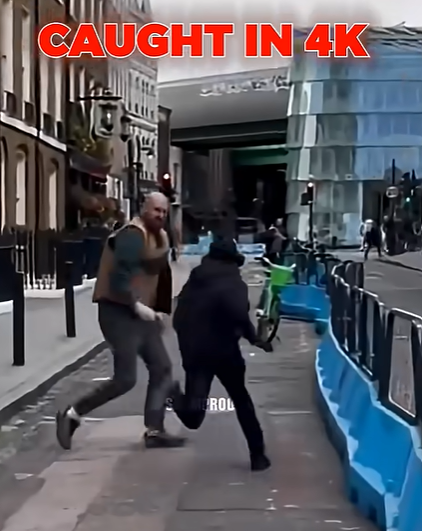
In a dramatic incident on the streets of London, a suspected pickpocket became the center of a tense confrontation after allegedly stealing a phone from an elderly woman. The event, captured on high-definition video, provides a vivid example of citizen intervention in a public crime scenario and highlights the complex dynamics of immediate response, bystander action, and crowd interaction. The sequence begins with the suspect fleeing down a sidewalk at speed, attempting to evade capture while the elderly victim and surrounding witnesses observe the situation. The suspect’s rapid flight creates a heightened sense of urgency, emphasizing the stakes inherent in street-level criminal activity and the immediate need for intervention to prevent further loss or escape.
As the suspect runs, a bystander—quickly assessing the situation and recognizing the risk to the elderly victim—steps forward to intervene. Employing both speed and leverage, the bystander successfully tackles the suspect to the ground near a row of construction barriers, creating a temporary containment and preventing immediate escape. This action reflects not only physical courage but also situational awareness, as the bystander must balance the need to restrain the suspect with the safety of themselves, the victim, and other bystanders in a crowded urban environment. The proximity of construction barriers further constrains movement, amplifying the intensity of the encounter and necessitating precise physical control to avoid injury.
Before the suspect can regain mobility, the elderly woman—the original victim—catches up to the scene, demonstrating remarkable resilience and determination. She immediately jumps onto the suspect’s back, locking him in a tight chokehold. This physical intervention reflects both a desire to reclaim agency and prevent further harm, while also leveraging the immediate leverage she can exert over a suspect in close proximity. The suspect’s vocal protests, including shouts of pain (“My neck!”), indicate both the efficacy of the hold and the high stakes of physical confrontation. Despite his resistance, the victim maintains control, exemplifying situational dominance achieved through both determination and precise physical technique, even under conditions of extreme stress.
The gathering of onlookers adds a critical social dimension to the event. As other pedestrians and witnesses arrive, they assist in securing the suspect, creating a collective effort that both stabilizes the situation and ensures that the intervention remains controlled until law enforcement arrives. This group response illustrates the emergent coordination that can occur in public settings, where multiple actors contribute to immediate crime mitigation. The actions of the elderly woman, the initial bystander, and the assembled crowd demonstrate a collaborative approach to citizen safety, highlighting the potential for public intervention to prevent escape or further criminal activity, while simultaneously emphasizing the inherent risks of such interactions.
From a legal and ethical perspective, this incident occupies a complex space. Citizen arrests, while permitted under certain conditions in the United Kingdom, require that reasonable force be applied and that actions are proportionate to the crime observed. In this case, the combination of the bystander tackle and the victim’s chokehold was motivated by the need to prevent escape and recover stolen property. However, such interventions carry inherent risks, including injury to both the suspect and the interveners. The video evidence serves as a critical record, providing law enforcement and courts with detailed documentation to assess the appropriateness and proportionality of the response, the sequence of events, and the conduct of all parties involved.
The psychological dimensions of the event are equally significant. The elderly victim’s rapid decision-making, physical courage, and assertive action reveal remarkable resilience under extreme stress, while the bystander’s immediate assessment and intervention highlight the role of situational awareness, quick judgment, and decisiveness in emergency scenarios. The suspect’s resistance, vocal protest, and attempt to regain mobility reflect typical behavioral responses when confronted with immediate physical restraint, demonstrating the interaction of fear, self-preservation, and aggression in high-stakes confrontations. Observing these dynamics provides valuable insights for law enforcement training, public safety education, and community awareness programs, highlighting how ordinary citizens can effectively—and safely—intervene when witnessing criminal activity.
The urban environment itself shapes the event in significant ways. The sidewalk, proximity to construction barriers, and the presence of multiple pedestrians all influence movement, leverage, and situational strategy. Environmental constraints both limit and define the physical possibilities for restraining the suspect, underscoring the importance of spatial awareness and improvisation in high-pressure scenarios. The actions of the elderly woman and bystander demonstrate effective adaptation to environmental constraints, leveraging available structures and positioning to maintain control while minimizing risk.
Beyond immediate physical intervention, the event emphasizes the importance of coordinated handover to law enforcement. While citizen action prevented the suspect from fleeing and ensured the recovery of the stolen property, police arrival is necessary to formalize arrest procedures, provide legal authority, and ensure procedural compliance. The successful containment of the suspect until official law enforcement officers arrived reflects a balance between proactive citizen engagement and respect for institutional authority, illustrating the interplay between public initiative and professional policing in urban crime management.
Finally, the incident serves as a broader societal lesson in community vigilance, resilience, and ethical responsibility. It demonstrates how individuals, even those who might be considered vulnerable, can act decisively to protect themselves and others when confronted with criminal activity. The collaboration between the victim, the bystander, and other pedestrians highlights the potential of coordinated, immediate civic response to mitigate harm, prevent crime, and assist law enforcement. At the same time, the situation underscores the need for awareness of legal boundaries, proportionality, and safety considerations, reminding citizens that intervention carries both responsibility and risk.
The citizen’s arrest in London presents a compelling case study in how ordinary individuals can intervene effectively in criminal incidents, yet it also highlights the complex considerations surrounding legality, ethics, and safety. At the core of this event is the alleged theft—a phone taken from an elderly woman by a fleeing suspect. Petty theft, while often classified as a low-level crime, can provoke high-stakes responses when vulnerability, speed, and physical threat converge. The combination of an elderly victim and a rapidly moving suspect elevates the situation from a mere property crime to an incident with the potential for serious injury, both to the victim and the interveners.
Immediately upon the theft, the suspect’s flight reflects an instinctual response aimed at evasion and self-preservation. Running down a crowded urban sidewalk introduces a series of variables: environmental obstacles, pedestrians, and construction barriers all create both opportunity and risk. The speed and unpredictability of the suspect’s movement increased the urgency for intervention, placing ordinary citizens in a position where split-second decision-making was required. The bystander who tackled the suspect to the ground demonstrated a remarkable level of situational awareness, judgment, and physical ability, understanding that failure to act could result in the suspect escaping and potentially harming the victim further or continuing the crime elsewhere.
The involvement of the elderly woman adds an extraordinary dimension to the event. Despite being a victim, she did not remain passive. Her immediate pursuit and physical intervention reveal remarkable courage and determination, as well as a heightened sense of personal agency and justice. By locking the suspect in a chokehold, she not only reclaimed possession of her property but also prevented the suspect from continuing to flee. Her action demonstrates an intuitive understanding of leverage and physical control in high-pressure circumstances, and it highlights how human instinct and situational knowledge can intersect to create effective intervention strategies. The suspect’s vocal complaints, notably “My neck!”, signal both pain and the reality of the force applied, yet they also underscore the necessity for proportionality and awareness in citizen-led interventions.
The presence of other bystanders who assisted until law enforcement arrived illustrates the emergent coordination that can occur in urban public spaces. Spontaneous cooperation among citizens, prompted by shared concern for safety and justice, reinforces the potential for community-based intervention to stabilize situations. Crowd dynamics in these scenarios are complex; multiple individuals engaging with a suspect can create both control and risk. Coordinated, calm, and ethically guided responses reduce the potential for injury and ensure that the intervention does not escalate into excessive force or chaos. The London incident exemplifies how communal responsibility and ethical action can intersect in real time, balancing the need to prevent crime with the imperative to minimize harm.
Legally, citizen’s arrests in the United Kingdom are permitted under specific conditions, notably when a person reasonably believes that an individual has committed an indictable offense. The arresting party is allowed to use reasonable force to detain the suspect, but such force must be proportional and not excessive. In this case, the actions of both the bystander and the elderly victim could be evaluated against these legal standards, taking into account the immediacy of the threat, the suspect’s resistance, and the environmental context. The video evidence provides critical documentation that allows law enforcement and legal authorities to assess compliance with statutory requirements, ensuring that the intervention is lawful while also protecting the rights of the suspect.
The incident also provides insight into the psychological responses of the individuals involved. The suspect’s flight behavior, vocal protests, and attempts to escape demonstrate typical human responses under stress: fear, self-preservation, and reactive aggression. Conversely, the bystander’s and victim’s interventions highlight cognitive and emotional processes associated with crisis response: situational assessment, rapid decision-making, courage under duress, and the willingness to engage physically to achieve a desired outcome. Studying these responses provides valuable lessons for law enforcement, public safety educators, and community training programs, offering insight into how ordinary individuals can respond effectively to criminal behavior while minimizing risk.
From a societal perspective, the incident underscores the role of civic engagement in maintaining public safety. While law enforcement has the authority and training to manage criminal behavior, community participation can enhance immediate responses, particularly in urban settings where officers may not be immediately present. This incident demonstrates the potential for responsible citizen intervention to act as a force multiplier, supporting law enforcement objectives and preventing further harm. However, it also highlights the importance of education, awareness, and ethical training for the public, as untrained or impulsive interventions can escalate conflicts, cause injury, or result in legal repercussions for those attempting to act.
The environmental context of the incident—the urban street with construction barriers—plays a significant role in shaping both the success and risks of the intervention. Narrow sidewalks, obstructions, and pedestrian traffic create challenges in terms of maneuvering and maintaining control over a suspect. The bystander and elderly woman’s ability to leverage these environmental constraints effectively demonstrates an intuitive adaptation to spatial limitations. Urban planning, public safety infrastructure, and the design of pedestrian zones can influence the outcomes of such incidents, providing opportunities for safer intervention or, conversely, creating hazards that complicate rapid response. The interplay of environmental factors and human action in this incident highlights the need for consideration of spatial design in public safety policy and urban management.
The role of video evidence in this incident cannot be overstated. The footage captures the entire sequence—from the suspect’s flight to the bystander tackle, the victim’s chokehold, and the arrival of law enforcement—providing an unambiguous record of events. In legal and administrative review, such evidence is invaluable: it clarifies the sequence of actions, the proportionality of force used, and the dynamics of resistance and compliance. Video documentation also serves a broader educational purpose, enabling public safety organizations, law enforcement agencies, and civic educators to analyze real-world interventions, understand effective strategies, and develop guidelines for safe citizen involvement in crime prevention.
Ethically, the London citizen’s arrest raises considerations regarding proportionality, restraint, and intent. While the actions of the bystander and victim were motivated by an immediate desire to prevent escape and recover stolen property, they involved physical force against a resisting individual. Ethical reflection requires acknowledging both the legitimacy of intervention to prevent crime and the moral responsibility to avoid unnecessary harm. The incident demonstrates that ethical decision-making in such scenarios involves rapid assessment of threat, risk, and context, with the objective of achieving justice while minimizing injury or escalation.
The aftermath of the incident likely involved law enforcement assessment of both the suspect and the citizens who intervened. Questions of legality, liability, and procedural adherence would be evaluated, ensuring that the citizens’ actions met the standards for lawful intervention. Such post-event reviews are critical in balancing the encouragement of civic engagement with the need to maintain public safety and prevent vigilante behavior. The incident thus illustrates a broader dynamic: effective citizen participation requires both courage and understanding of legal frameworks, highlighting the importance of public safety education, community awareness, and structured guidance for intervention in criminal scenarios.
Finally, this citizen’s arrest serves as a model for understanding how human behavior, situational awareness, environmental context, and ethical responsibility converge in high-pressure public incidents. The elderly woman’s resilience, the bystander’s decisiveness, and the coordinated support of onlookers demonstrate the potential for effective communal response to criminal activity. Simultaneously, the situation underscores the necessity of legal knowledge, ethical consideration, and risk awareness, reminding the public that interventions carry both responsibility and consequence. The London case exemplifies the potential for citizens to act decisively and effectively in crime prevention while highlighting the importance of training, guidance, and adherence to legal and ethical norms in ensuring that such interventions are both successful and responsible.
The London citizen’s arrest incident also provides a unique perspective on the interplay between age, vulnerability, and empowerment in public safety scenarios. The involvement of the elderly woman, a direct victim of theft, illustrates a remarkable demonstration of agency, resilience, and situational courage. While conventional narratives of crime intervention often emphasize the actions of trained law enforcement personnel, this case highlights how individuals, regardless of age or physical condition, can take effective action in protecting themselves and others when faced with immediate danger. Her physical intervention—jumping onto the suspect’s back and securing a tight hold—underscores both the human capacity for courage under duress and the intuitive use of leverage and strength to control an assailant, even in a scenario involving someone potentially younger and physically stronger.
This aspect of the incident has important psychological implications. Research into human stress responses suggests that extreme, high-stakes situations trigger a combination of fight-or-flight instincts, rapid cognitive appraisal, and instinctive problem-solving behaviors. In this case, both the elderly woman and the bystander were responding to immediate threats, demonstrating acute situational awareness, rapid decision-making, and effective use of available resources—including environmental features such as construction barriers—to achieve control over the suspect. The suspect’s response, consisting of attempts to escape, resistance, and vocal protest, is equally consistent with the fight-or-flight reaction and highlights the psychological dynamics inherent in confrontations. Analyzing these behaviors provides insight into how stress, perceived threat, and situational urgency shape human action, particularly in urban crime scenarios.
From a legal perspective, the incident raises important questions about the boundaries of citizen intervention. In the United Kingdom, citizens are permitted to perform arrests in certain circumstances, provided that the intervention is reasonable, proportionate, and directly connected to the observed criminal behavior. This creates a framework in which intervention is both lawful and morally justified, but it also imposes limits: excessive force, recklessness, or harm to the suspect beyond what is necessary to prevent escape or protect victims could result in legal repercussions for the interveners. In this case, the combination of the bystander tackle and the elderly woman’s chokehold would likely be evaluated in terms of proportionality and necessity. The fact that law enforcement arrived promptly and took formal custody of the suspect mitigates potential liability and reinforces the legitimacy of the intervention.
The urban environment played a crucial role in shaping both the strategy and the outcomes of this incident. The incident occurred on a sidewalk adjacent to construction barriers, which effectively constrained the movement of both the suspect and the interveners. Environmental features such as these can serve as both obstacles and tools in managing confrontations: they restrict movement and create potential hazards, but they also provide leverage points and containment opportunities for those seeking to control a fleeing or resistant individual. In this case, the bystander utilized these environmental constraints to secure the suspect temporarily, while the elderly woman exploited proximity and leverage to maintain control until law enforcement arrived. This demonstrates the importance of spatial awareness and adaptive strategy in high-stress public interventions.
Another significant dimension of the incident is the role of crowd dynamics and emergent cooperation. As the struggle unfolded, other pedestrians arrived at the scene and assisted in ensuring the suspect remained restrained until the arrival of officers. This spontaneous coordination reflects a form of collective social responsibility, wherein community members collectively mitigate risk, prevent escalation, and protect victims. Crowd participation, while beneficial in this case, also requires careful management to prevent injury, confusion, or over-escalation. Effective civic interventions thus balance decisiveness with situational awareness, emphasizing the importance of both individual initiative and collaborative engagement in maintaining public safety.
The incident further highlights the importance of technological documentation in contemporary public safety enforcement. The event was captured in high-definition video, providing clear, indisputable evidence of the sequence of actions taken by all parties involved—the suspect, the elderly woman, the bystander, and other onlookers. This visual record is invaluable for law enforcement, providing a basis for legal assessment, training, and review. It also serves as a public accountability tool, demonstrating transparency in the handling of criminal incidents. Footage allows evaluators to assess proportionality, verify compliance with legal standards, and distinguish between necessary intervention and potential misconduct. In doing so, it strengthens both the credibility of law enforcement response and the legitimacy of citizen involvement when conducted responsibly.
From a societal perspective, the incident illustrates the complex interaction between vulnerability, agency, and civic responsibility. The elderly woman’s direct involvement defies common assumptions about the limitations of age and physical capacity in crisis scenarios. Her actions demonstrate that individuals can assert agency even when physically or socially perceived as vulnerable, providing a powerful example of resilience and empowerment. Moreover, the incident serves as a public demonstration of communal responsibility: the bystander, the victim, and surrounding pedestrians each contributed to containing the suspect, reflecting the potential for collaborative civic engagement in maintaining safety in urban spaces.
The event also underscores important ethical considerations regarding the use of force by civilians. While the actions of the bystander and elderly woman were motivated by the need to prevent escape and recover stolen property, they involved physical restraint and potential harm to the suspect. Ethical assessment of these actions involves evaluating necessity, proportionality, and intent. Law enforcement guidance emphasizes that interventions should aim to prevent harm, maintain control, and ensure safety while avoiding unnecessary injury. In this incident, the interventions appear to meet these criteria: the suspect’s resistance was met with measured force, control was maintained without escalation, and the situation was stabilized until professional authorities assumed custody.
Finally, the London citizen’s arrest incident provides valuable lessons for public safety policy, community training, and civic awareness. It demonstrates the importance of public education regarding legal parameters for intervention, proportionality, and personal safety. Programs that teach citizens how to recognize threats, intervene safely, and coordinate with law enforcement can enhance the effectiveness of community-based crime prevention. Similarly, law enforcement can benefit from analyzing such incidents to understand the dynamics of civilian intervention, recognize effective community engagement strategies, and refine guidance for citizen involvement in criminal incidents.
In sum, the London citizen’s arrest encapsulates a remarkable convergence of human courage, situational awareness, environmental adaptation, legal frameworks, and ethical decision-making. It demonstrates how ordinary individuals, when acting decisively, responsibly, and in coordination with others, can effectively mitigate criminal behavior while maintaining public safety. The incident highlights the psychological, legal, and societal dimensions of civic intervention, emphasizing the importance of training, awareness, and proportionate action. By examining the incident in depth, stakeholders—including law enforcement agencies, policymakers, public safety educators, and community members—can derive critical lessons about how human behavior, environmental context, and ethical responsibility intersect in high-pressure public scenarios, ensuring that interventions are both effective and safe for all parties involved.