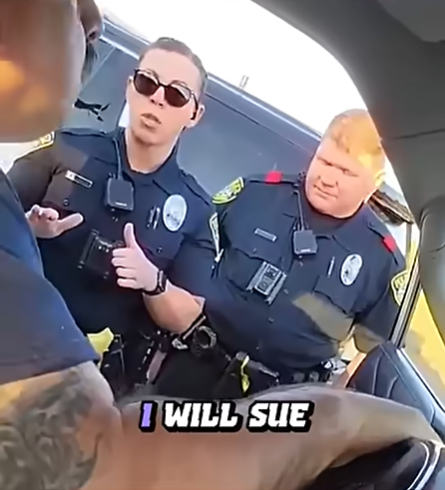
A heated traffic stop involving a driver identified in the video’s overlay text as a Marine veteran became a tense back-and-forth over identification, authority, and the limits of police procedure. What began as a disagreement between the driver and a female officer soon escalated into handcuffs, multiple officers on scene, a demand for a supervisor, and eventually a reversal when the supervisor arrived and ordered the driver released.
The encounter appears to begin with the driver already stopped and speaking with officers near his vehicle. The main point of conflict is clear from the start: the officers want him to provide identification, but he refuses. His argument is that he has not committed a crime, and because of that, he believes he is not legally required to hand over his ID. He repeats this position firmly, making it clear that he does not see the stop as justified and does not believe the officers have the authority to demand his identification under the circumstances.
The female officer, along with other officers present, takes the opposite position. They insist that he needs to comply with their instructions. From their perspective, they are conducting an investigation or handling a traffic stop, and they expect the driver to provide the requested information so they can complete their work. They warn him that refusing to cooperate or interfering with the investigation could lead to his arrest.
That disagreement creates the central tension of the video. The driver believes he is standing up for his rights. The officers believe he is refusing a lawful instruction. Both sides become locked into their positions, and the conversation grows more strained with each exchange. The driver does not want to give ground because he feels the officers are overstepping. The officers do not want to give ground because they believe his refusal is preventing them from doing their job.
As the argument continues, the driver remains firm. He does not provide the identification the officers are asking for. He questions their authority and continues to insist that he has done nothing wrong. His tone grows more frustrated, but his main argument stays the same: if there is no crime, there is no reason for him to be forced to identify himself.
The officers respond by escalating the stop. They instruct him to step out of the vehicle. That is a major turning point. A traffic stop can feel tense even when everyone remains seated and calm, but once officers order someone out of a vehicle, the situation becomes much more serious. The driver understands that the encounter is moving beyond a simple verbal disagreement. He becomes louder and more upset, criticizing the officers and making it clear that he believes they are handling the situation improperly.
Once he is out of the vehicle, officers place him in handcuffs. For the driver, this appears to confirm his belief that the officers are abusing their authority. He becomes even more vocal, demanding to know why he is being treated this way and calling for a supervisor. His frustration is not only about being stopped, but about being physically restrained after repeatedly saying he had not committed a crime.
The handcuffing changes the emotional tone of the encounter. Up to that point, it is a tense argument. Once the driver is placed in cuffs, it becomes a detention or arrest situation. The driver’s anger rises because he feels his rights have been violated. He loudly criticizes the officers, accusing them of being unprofessional and demanding accountability. His identity as a Marine veteran, mentioned in the overlay text, adds another emotional layer to the video because viewers may interpret his reaction through the lens of someone who believes he has served his country and now feels mistreated by authorities.
The officers, however, appear to be focused on maintaining control. From their standpoint, his refusal to provide identification and his continued argument may be viewed as noncompliance. They warn him that interference or refusal could result in arrest, and once he continues refusing, they follow through by placing him in handcuffs. Whether viewers agree with that decision or not, the video presents the officers as treating the refusal as serious enough to justify taking him into custody.
The driver continues demanding a supervisor. This is an important part of the encounter because it shows that he wants someone with higher authority to review what is happening. In tense stops, asking for a supervisor is often a way for a citizen to try to slow the escalation or challenge the conduct of the officers on scene. It does not always change the outcome, but in this case, it becomes the key moment.
When the police supervisor arrives, the energy of the scene shifts. The supervisor is not entering at the start of the argument. He is arriving after the driver has already refused identification, after officers have warned him, after he has been removed from the vehicle, and after he has been placed in handcuffs. The supervisor has to quickly assess what happened and decide whether the officers’ actions should continue.
After reviewing the circumstances, the supervisor intervenes. He orders the officers to release the driver from the handcuffs. That decision is significant because it suggests the supervisor does not believe the arrest or continued detention should proceed in that manner. The driver’s demand for a supervisor, which may have sounded repetitive or angry earlier, ends up producing the turning point he was asking for.
The release from handcuffs does not immediately calm the driver. In fact, it seems to strengthen his belief that he was right. Once freed, he continues to vent his frustration. He criticizes the initial officers, calling them unprofessional and making it clear that he believes they acted wrongly. From his point of view, being released after the supervisor’s arrival proves that the earlier escalation should not have happened.
The driver then asks for an incident report number. That request shows that he is thinking beyond the moment. He wants documentation. He wants a record of what happened. Asking for a report number is often the first step someone takes when they intend to file a complaint, request records, or follow up later. He is not simply trying to leave; he wants proof that the encounter occurred and that there is a paper trail connected to it.
The officers provide the paperwork, and the driver continues expressing anger. The confrontation has technically been resolved because he is no longer in handcuffs, but emotionally, it is not over. He still feels wronged, and the officers still have to stand there while he voices that frustration. The final moments of the video show him delivering a parting insult before the encounter ends.
What makes the video compelling is the tension between legal authority and personal rights. The driver believes he knows his rights and refuses to comply with what he sees as an unlawful demand. The officers believe they are entitled to the identification and treat refusal as obstruction or interference. The supervisor’s decision to release him introduces doubt about how the situation was handled by the initial officers.
The encounter also shows how quickly a traffic stop can escalate when both sides become rigid. The driver refuses to identify himself because he believes compliance would mean surrendering a right. The officers insist because they believe refusal prevents them from completing their investigation. Once each side locks into that position, the situation becomes less about conversation and more about control.
The driver’s tone grows sharp and confrontational, but that does not automatically mean his argument is invalid. At the same time, the officers’ commands carry authority, and refusing them during a traffic stop can create serious consequences. That is what makes these situations complicated. A person may believe they are legally correct, but the roadside is a difficult place to resolve that argument. Officers may act first and let the legal review happen later. That can leave the citizen feeling powerless in the moment, even if a supervisor later agrees that the stop was mishandled.
The supervisor’s intervention is the most important development because it prevents the situation from going further. Without the supervisor, the driver may have been transported, booked, or charged depending on how the officers chose to proceed. Instead, the supervisor steps in and orders the handcuffs removed, effectively de-escalating the encounter and stopping the arrest process.
That decision also creates an awkward situation for the officers who made the initial arrest. Once a supervisor tells them to release the driver, it suggests that the stop may not have been handled correctly or that the supervisor believes the threshold for arrest was not met. That does not necessarily mean the officers acted with bad intent, but it does mean their judgment was questioned in real time by someone above them.
The driver’s anger after being released is understandable within the context of the video. From his perspective, he was forced out of his vehicle and handcuffed for standing on a legal principle. He demanded a supervisor, and when the supervisor arrived, he was released. That sequence would make many people feel vindicated. His frustration continues because he likely feels the officers never should have taken the situation that far.
However, the driver’s final insult also shows how emotionally charged the encounter remained. Even after the immediate restraint ended, he was still upset enough to lash out verbally. That reaction may be satisfying to some viewers who believe he was wronged, while others may see it as unnecessary. Either way, it reflects the emotional intensity of being detained, handcuffed, and then released after a supervisor steps in.
The video also highlights the importance of professionalism during traffic stops. Officers are expected to remain calm even when citizens are angry or argumentative. Drivers are expected to follow lawful instructions, but they also have the right to question what is happening and request clarification. When either side becomes too focused on winning the argument, the risk of escalation increases.
In this case, the officers warned the driver that his refusal could lead to arrest. That warning gave him a choice: comply or continue refusing. He continued refusing because he believed the demand itself was improper. The officers then acted on their warning. But the supervisor’s later decision suggests that the situation may have required more careful judgment before handcuffs were used.
The presence of multiple officers can also affect the tone of a stop. For a driver, being surrounded by several officers can feel intimidating, especially when the disagreement is verbal and the driver believes he has not committed a crime. For officers, having multiple units present may feel like standard safety practice, especially when someone is refusing commands. Those two perceptions can exist at the same time and still create conflict.
The driver’s repeated demand for a supervisor is one of the clearest signs that he did not trust the officers on scene to handle the matter fairly. He wanted someone else to review the situation. In many encounters, that request may not immediately change anything. Here, it did. The supervisor’s arrival became the point where the stop moved away from escalation and toward resolution.
The incident also raises broader questions about how officers explain their authority during stops. If officers demand identification, citizens may ask why. A clear explanation can sometimes prevent an argument from growing. If the officer can state exactly what law or suspicion supports the request, the citizen may still disagree, but the interaction becomes more transparent. When the explanation is vague or feels like “because I said so,” the person being stopped may become more resistant.
The driver in this video appears to believe that the officers never clearly established a lawful reason for demanding his ID. That belief is what fuels his refusal. He is not refusing randomly; he is refusing based on his understanding of the law. Whether that understanding is fully correct depends on the specific facts and local law, but in the video’s narrative, the supervisor’s decision to release him gives weight to his argument.
The officers may have believed they were conducting a legitimate investigation. They may have believed that refusing to identify himself interfered with their work. But the supervisor’s decision suggests that, at minimum, the situation was not as straightforward as the arresting officers treated it. It may have required more patience, more explanation, or a different approach.
The handcuffs become a symbol of the conflict. To the officers, they may represent control and procedure. To the driver, they represent an unjustified violation of his freedom. When the supervisor orders them removed, the symbol changes again. The release becomes a public acknowledgment that the situation should not continue in that direction.
The driver’s request for an incident report number also shows why documentation matters. In a disputed encounter, people need reference numbers, names, badge numbers, or report details so they can follow up properly. Without documentation, the driver’s complaint would be harder to pursue. By asking for the paperwork, he is trying to preserve a record of the encounter.
The final insult at the end of the video may be the most emotionally messy part of the resolution. It shows that even when the legal issue is resolved, the human anger remains. The driver does not leave quietly because he does not feel the officers deserve a calm goodbye. He wants them to know exactly how he feels. That may not be polite, but it fits the emotional arc of the encounter.
This kind of video often divides viewers. Some will see the driver as standing up for his rights and refusing to be bullied. Others will see him as making the stop harder than it needed to be by refusing to provide ID. Some will focus on the supervisor’s decision as proof that the arresting officers were wrong. Others may argue that the driver’s attitude contributed to the escalation. The truth, as presented in the description, is that the stop became tense because both sides believed they were right and neither side backed down until the supervisor arrived.
The most constructive takeaway is that clarity and restraint matter. Officers should be clear about why they are making demands, especially when a citizen is questioning the legal basis. Citizens should understand that refusing commands during a traffic stop can lead to escalation, even if they believe they are correct. Supervisors can play an important role in reviewing tense situations before they become worse.
In this case, the supervisor’s arrival likely prevented a longer and more damaging outcome. By ordering the driver released, he brought the immediate conflict under control. That decision did not erase the driver’s anger, but it ended the physical restraint and allowed the situation to move toward documentation rather than continued arrest.
The video ultimately shows a traffic stop where authority was challenged, enforcement escalated, and supervision changed the outcome. The driver refused to provide identification because he believed he had committed no crime. Officers arrested him after warning that refusal could lead to consequences. A supervisor arrived, reviewed the scene, and ordered him released. The driver then demanded paperwork, criticized the officers, and left with one final insult.
It is a tense example of how quickly a roadside disagreement can become a larger confrontation when legal interpretation, personal pride, and police authority collide. It also shows why oversight matters. The supervisor’s decision became the turning point, proving that even within law enforcement, actions taken during a heated stop can be questioned and reversed. What began as a refusal to hand over ID ended as a dispute over professionalism, procedure, and accountability.
For the officers, the supervisor’s order likely created an uncomfortable moment. They had taken a firm position, removed the driver from the vehicle, and placed him in handcuffs. Then a higher-ranking officer arrived and effectively reversed that decision. Even if the supervisor did not openly criticize them in front of the driver, the message was clear enough: the situation did not need to continue as an arrest. That kind of correction can be difficult in the middle of a public encounter, especially when the person being detained immediately feels vindicated.
The driver’s continued frustration after being released also makes sense because the emotional impact of being handcuffed does not disappear the moment the cuffs come off. From his perspective, he had been treated like a suspect or criminal after insisting that he had done nothing wrong. He had been surrounded by officers, ordered out of his vehicle, restrained, and forced to wait for a supervisor to correct the situation. Even if the stop ended without him being taken away, the experience likely felt humiliating and infuriating.
The video also highlights how important tone can be during police encounters. A simple request can feel very different depending on how it is delivered. If a driver feels that officers are barking orders without explaining the reason, resistance can grow quickly. At the same time, if officers feel a driver is refusing every instruction and challenging their authority, they may become more forceful. That cycle can build fast, with each side reacting to the other’s tone rather than solving the actual issue.
The driver’s identity as a Marine veteran, as stated in the overlay, adds another layer to how viewers may interpret the scene. Some may see him as someone who values discipline, rights, and constitutional principles, making his refusal feel like a deliberate stand rather than random noncompliance. Others may feel that military service does not change the expectations during a traffic stop. Either way, the overlay frames him as someone with a background tied to service and authority, which makes the confrontation with police feel even more emotionally charged.
The supervisor’s role becomes the clearest example of de-escalation. Rather than continuing the argument, he assesses the situation and makes a decision that immediately lowers the tension. Removing the handcuffs changes the entire direction of the encounter. It gives the driver physical freedom, reduces the sense of threat, and prevents the stop from becoming a full arrest. Even though the driver remains angry, the most serious part of the confrontation is over.
Still, the release does not erase the need for answers. That is why the driver keeps pressing for paperwork. He wants a record because, in his view, the officers crossed a line. Without a report number, the encounter could feel like something that happened with no formal trail. With documentation, he has a starting point for follow-up.
The scene ends with the driver delivering a final insult, which shows that the conflict was resolved procedurally but not emotionally. He leaves with his freedom restored, but not with a sense that the officers fully acknowledged wrongdoing. The officers remain on scene, having been overruled by a supervisor and criticized by the driver. It is an uncomfortable ending, but a realistic one.
In the end, the encounter is a reminder that traffic stops depend heavily on communication, restraint, and clear legal grounding. When a driver questions authority and officers respond with escalation, the situation can quickly become bigger than the original reason for the stop. Here, the supervisor’s arrival prevented the matter from going further, but the damage to trust had already been done. The driver left angry, the officers faced criticism, and the video remained as a record of a stop where a demand for identification turned into a public dispute over rights, professionalism, and accountability.