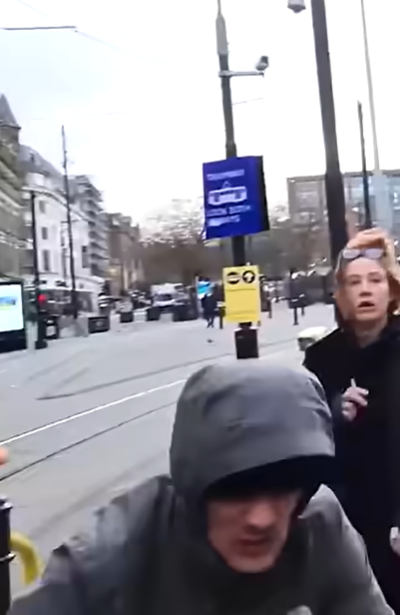
An aggressive confrontation on a city street took an unexpected turn when the man making threats suddenly became the one on the ground. What began as a tense exchange between a camera operator and an angry passerby ended almost instantly in embarrassment for the aggressor, after he lunged forward, lost his footing, and crashed onto the brick pavement before the situation could escalate any further.
The video appears to begin in the middle of a street interaction. A man is filming while speaking with a woman, and the atmosphere already seems uncertain. It is not clear what the original conversation is about, but the camera operator appears focused on the woman when another man enters the scene. This second man, wearing a grey hooded jacket and sweatpants, approaches with clear aggression. His body language suggests that he is not coming over to calmly ask a question or join the conversation. He appears irritated, confrontational, and ready to challenge the person holding the camera.
The arrival of the hooded man immediately changes the mood of the scene. Street encounters can become tense quickly, especially when one person is filming and another person feels provoked by the camera. Some people react strongly to being recorded, even in public spaces, and that reaction can turn a simple exchange into a confrontation. In this case, the hooded man does not appear to ask for space or explain himself calmly. Instead, he moves toward the camera operator aggressively and begins making threats.
The threat is direct. He tells the camera operator that he is going to break his jaw. That kind of statement instantly raises the stakes. It is not just an insult or a complaint. It is a clear threat of violence. The camera operator, however, does not back down. He responds firmly, saying, “No you won’t.” His response is short, calm, and defiant. He does not appear to run or panic. He stands his ground and refuses to be intimidated by the threat.
That brief exchange creates a moment of tension where it seems like the confrontation could become physical. The hooded man appears to be trying to dominate the situation through fear. He uses aggressive words, closes distance, and attempts to make the camera operator feel vulnerable. But the camera operator’s response shows that the threat is not having the intended effect. Instead of making him retreat, it seems to make him hold his position even more firmly.
Then the situation backfires in a way that is almost immediate. As the hooded man lunges forward, seemingly to attack or intimidate the person filming, he loses control of his own movement. His feet fail to keep up with his aggression. Instead of landing a blow or forcing the camera operator back, he trips over himself and slips on the pavement. In a split second, the person trying to look intimidating becomes the one falling.
The fall is sudden and dramatic. The man crashes onto the brick ground, and the tension of the confrontation breaks almost instantly. The moment that was supposed to show dominance instead becomes a humiliating mistake. He had stepped forward with the energy of someone trying to scare another person, but the movement completely works against him. His own momentum carries him down before he can do anything else.
What makes the moment stand out is the timing. The threat comes first. The camera operator says he will not do it. The aggressor lunges. Then, almost immediately, he falls. It is the kind of sequence that feels like instant consequences. He tries to escalate the situation, and before anyone else has to respond physically, his own body betrays him. The pavement does what the camera operator does not need to do.
The woman reacts quickly by dropping down to help him. Her reaction adds a human element to the scene. While the camera operator is focused on keeping distance and warning the man to stay away, the woman’s first instinct is to check on the person who fell. That contrast is interesting. One person sees him as a threat who just tried to attack or intimidate. Another person sees someone who is now sitting on the ground and may need help.
The hooded man, meanwhile, appears to sit there processing what just happened. Moments earlier, he was threatening violence. Now he is on the ground, forced to face the awkward reality of his own failed lunge. The fall interrupts whatever anger he had been building. Instead of continuing his threat, he has to recover from the embarrassment of falling in front of the very person he was trying to intimidate.
The camera operator tells him to stay away. That response is understandable. Even though the aggressor has fallen, the threat is not completely forgotten. A person who has just made a violent threat and lunged forward could still try again once they get up. The camera operator’s command is about maintaining distance and preventing another escalation. He is not inviting another round of confrontation. He is making it clear that the man should not come closer again.
The scene is tense, but it also carries a strange sense of irony. The man who came forward looking for a confrontation ends up being stopped not by another person, but by his own mistake. His threat collapses the moment he loses balance. The entire situation becomes a reminder that aggression can make people careless. When someone is focused on intimidation, they may stop paying attention to simple things like where their feet are, how fast they are moving, or whether the ground is stable.
The brick pavement plays a major role in the outcome. City sidewalks and streets can be uneven, especially when made of brick or stone. A rushed step, a sudden lunge, or poor footing can easily cause someone to slip or trip. The aggressor’s forward momentum makes the fall worse because he is already moving with force. He does not simply stumble in place. He lunges and then crashes down, turning his own aggressive movement into the reason he falls.
The camera operator’s calm response also matters. If he had reacted wildly, the confrontation might have become more chaotic. Instead, his simple “No you won’t” appears to challenge the threat without physically escalating. He holds his ground, and the aggressor’s own attempt to escalate becomes the thing that ends the moment. That kind of restraint can be important in tense public situations. Responding to aggression with equal aggression can make things worse. In this case, the camera operator does not need to do much because the aggressor’s own actions create the outcome.
The incident also shows how quickly public confrontations can turn unpredictable. One second, a person is making threats. The next, they are on the ground. People often imagine confrontations moving in a straight line: argument, threat, fight. But real situations are messier. A person can trip, hesitate, lose balance, or suddenly realize they made a bad decision. The unexpected can interrupt escalation before it reaches its worst point.
For viewers, the moment may feel satisfying because the aggressor’s threat is immediately undercut. He tries to create fear, but instead creates embarrassment for himself. That kind of instant reversal is why the video would likely attract attention online. People often react strongly to moments where someone acting aggressively suffers a quick and non-serious consequence. It feels like the situation corrects itself.
Still, the encounter is not only funny or embarrassing. It is also a reminder that threats can be serious. Telling someone you are going to break their jaw is not harmless, even if the threat fails. The camera operator had reason to be cautious, and his order for the man to stay away makes sense. The fact that the aggressor fell does not erase the fact that he had approached aggressively and attempted to intimidate someone.
The woman’s reaction helps keep the situation from becoming even more hostile. By moving to help the fallen man, she may also be preventing him from jumping back up and continuing the confrontation. Her attention shifts the moment away from attack and toward recovery. Even if she is connected to him or simply nearby, her instinct to help creates a pause. That pause may be what allows the situation to calm rather than restart immediately.
The aggressor’s position after the fall is important too. Sitting on the ground changes the power dynamic. A moment earlier, he was standing, moving forward, and threatening. After the fall, he is lower, slower, and visibly less in control. That physical change affects the emotional tone of the scene. The person who seemed dangerous now appears stunned and embarrassed.
The camera operator’s warning to stay away is the final boundary in the clip. It tells the aggressor that the confrontation is over and that he should not attempt to resume it. It also shows that the camera operator is still alert. He does not assume the man is harmless just because he fell. He keeps the focus on distance and safety.
The video also touches on the role of cameras in public confrontations. The presence of a camera can both document and intensify a situation. Some people become more aggressive when they realize they are being filmed. Others may feel safer filming because it creates a record of what happened. In this case, the camera captures the threat, the lunge, the fall, and the aftermath. Without the footage, the story might sound exaggerated. With the video, the sequence is clear.
The camera operator’s decision to continue filming may have helped protect him in a way. The aggressor’s words and actions were recorded, making it harder to deny the threat or claim the situation happened differently. At the same time, filming can make an already angry person more confrontational. That is one reason street filming can be unpredictable. The camera is not just a passive object; it can become part of the conflict.
The incident also highlights how aggression often depends on performance. The hooded man appears to be trying to project toughness. His words are meant to intimidate. His movement is meant to show dominance. But when the performance fails, the image collapses. Instead of looking powerful, he looks reckless. Instead of controlling the scene, he loses control of himself.
That is why the fall feels so immediate and symbolic. It is not just a physical slip. It is a collapse of the aggressive image he was trying to create. He wanted the camera operator to believe he was dangerous and in control. The pavement exposed the opposite. He was moving too fast, too emotionally, and without enough awareness of his own footing.
The camera operator’s words, “No you won’t,” also become more memorable because of what happens next. At first, it sounds like a challenge. After the fall, it almost sounds like a prediction. The aggressor said he would hurt him, the camera operator said he would not, and then the aggressor failed before reaching him. That sequence gives the clip its sharp irony.
The moment may also serve as a small lesson about self-control. Anger can push people to act before they think. When someone charges forward during an argument, they are often not considering the consequences, the environment, or how quickly things can go wrong. The hooded man’s fall is a simple example of how losing control emotionally can lead to losing control physically.
In a city street setting, there are many things that can make sudden movement risky. Pavement may be uneven. Shoes may not grip well. Brick can be slippery depending on weather, dust, or wear. The person may be off balance from turning quickly or moving too aggressively. A calm person usually adjusts to these things naturally. An angry person lunging forward may not.
The aftermath is quieter but still tense. The woman helps him, but the camera operator does not soften his boundary. That combination keeps the scene from becoming either purely comedic or fully dangerous. There is concern for the person who fell, but there is also a clear reminder that his behavior caused the situation. Helping him up does not mean excusing the threat.
The aggressor’s silence or stunned reaction after falling also tells its own story. He has to sit with the result of his own actions. He threatened someone, tried to move in aggressively, and ended up needing help. In that moment, there is very little he can say that would restore the intimidation he was trying to create. The fall has already changed the narrative.
For the camera operator, the experience likely felt both alarming and strangely validating. He was threatened, but the threat failed immediately. He stood his ground, and the aggressor’s attempt to act on the threat backfired. Still, he remains cautious because situations like this can restart quickly if the aggressive person feels embarrassed and wants to recover pride. That may be why he tells him to stay away instead of laughing too much or stepping closer.
Embarrassment can sometimes make aggressive people even angrier. A person who falls while trying to intimidate someone may feel humiliated and may want to regain control. Keeping distance is therefore the smartest response. The camera operator’s warning helps prevent the fallen man from turning embarrassment into a second attempt at confrontation.
The clip also reflects a broader truth about public disputes: the person who escalates is often the person who loses control first. The camera operator may have been involved in a tense conversation, but the hooded man is the one who makes the direct threat and lunges. His fall becomes a visible result of that loss of control. It shows how quickly the person trying to dominate a situation can become the person who needs help.
The woman’s role remains somewhat unclear, but her quick reaction suggests concern. She may know the man, or she may simply be nearby and responding instinctively. Either way, her movement toward him adds an emotional layer to the aftermath. While the camera operator is focused on keeping the threat away, she is focused on checking on the person who hit the ground. Both reactions make sense from their different positions.
The scene does not need a dramatic ending to be memorable. The confrontation is short, the threat is clear, the lunge is sudden, and the fall is immediate. That simplicity is what makes it effective. It is a complete story in just a few moments: aggression, confidence, failed attack, consequence, and warning.
The incident also shows that sometimes the best response to aggression is not to meet it with more aggression. The camera operator does not appear to throw a punch or chase the man. He stands firm, records, and keeps his distance. When the aggressor falls, the camera operator does not need to do anything except reinforce the boundary. That restraint helps keep the situation from becoming worse.
At the same time, the video should not be treated only as a joke. A threat of violence is still serious, and a public confrontation can become dangerous very quickly. The fact that the aggressor fell before causing harm does not mean the situation was harmless from the start. It means the escalation was interrupted by an unexpected mistake. If he had not slipped, the encounter might have played out very differently.
That is why the ending feels like a relief. The aggressor is on the ground, the woman is helping him, and the camera operator is telling him to stay back. The immediate threat has been stopped without the camera operator having to fight. No one needed to escalate further. The pavement, timing, and the aggressor’s poor footing ended the confrontation before it could become more serious.
In the end, the video is a striking example of aggression backfiring in real time. The hooded man approaches with threats, tries to intimidate the person filming, and then loses his footing at the exact moment he attempts to move forward. His own momentum brings him down. The woman rushes to help, while the camera operator keeps his boundary and tells him to stay away. What could have become a violent street confrontation instead turns into a moment of instant consequences, where the person trying to scare someone else ends up humbled by his own reckless movement.