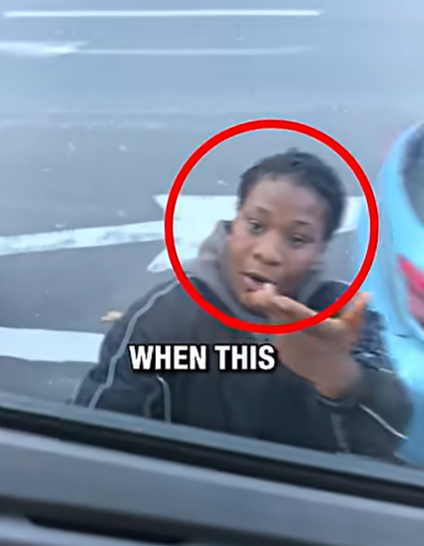
The video captures a road rage incident that begins with a common traffic frustration and quickly turns into a serious confrontation. According to the narration, the situation started when a truck driver honked at a woman after she cut into the emergency lane. What could have ended as a brief moment of irritation on the road became something much bigger because the woman chose not to drive away. Instead, she stopped her car, approached the truck, and began shouting aggressively at the driver. From that point on, the incident moved from a traffic disagreement into a public outburst with real consequences.
Road rage often begins with something small: a horn, a lane change, a brake check, a gesture, or a misunderstanding. On busy roads, drivers are already under pressure. People are late, tired, distracted, or impatient. A single honk can feel like an insult, even when it is meant as a warning. In this case, the truck driver reportedly honked because the woman entered the emergency lane, a space that is not meant for regular traffic. Emergency lanes exist for breakdowns, emergency vehicles, and safety situations. When drivers use them to cut through traffic, they create danger and frustration for everyone else. The honk may have been a reaction to unsafe driving, but the woman appeared to take it personally.
Her decision to stop and confront the truck driver is the turning point. Once she got out of her vehicle and walked toward the truck, she made the situation much more serious. A road is not a safe place for arguments. Vehicles are moving, emotions are high, and people do not always know who they are dealing with. Approaching another driver in anger can quickly become dangerous. Even if someone feels disrespected or believes they were unfairly honked at, leaving the vehicle to shout at another person usually makes everything worse. It turns a traffic moment into a face-to-face conflict.
The woman’s anger then escalated further. According to the narration, she repeatedly punched the truck’s side mirror until it broke. That act changed the incident from verbal aggression into property damage. Breaking someone’s mirror is not just a symbolic act of anger. A side mirror is a safety device. Truck drivers depend on mirrors to see surrounding traffic, blind spots, lane positions, and vehicles approaching from behind. Damaging a mirror can make it harder for the driver to operate safely, especially in a large vehicle where visibility is already limited. What may have felt like an emotional release for the woman created a real safety and legal problem.
The truck driver’s decision to record the incident is one of the most important parts of the story. Without footage, the event might have become a confusing argument between two drivers. One person might claim the other started it. Details could be disputed. The extent of the damage might be questioned. But because the truck driver recorded the woman, including her face and license plate, the situation became much clearer. The video created evidence. It showed who was involved, what happened, and how the confrontation unfolded. In the age of dashcams, phone cameras, and security footage, people often forget that public behavior can be documented from multiple angles.
That is one of the biggest lessons of the video: anger can feel private in the moment, but it may become public evidence afterward. The woman may have believed she was simply expressing rage at a driver who annoyed her. She may not have been thinking about cameras, license plates, police reports, insurance claims, or court consequences. But the recording changed everything. Once her face, vehicle, and actions were captured, the incident could follow her long after the emotions faded. A few minutes of rage became something that authorities could investigate.
According to the video’s narration, police tracked her down three hours later, leading to her arrest and a four-year prison sentence. Whether viewers know every legal detail or not, the message is clear: road rage can carry serious consequences. What begins as shouting can become property damage. Property damage can become criminal charges. Criminal charges can affect a person’s job, family, record, finances, and freedom. Many people lose control for a few moments without realizing that those few moments can reshape years of their life.
The phrase “road rage” can sometimes make these incidents sound casual or almost humorous, but there is nothing harmless about them. Road rage is emotional loss of control in one of the most dangerous environments people use every day. Cars and trucks are heavy machines moving at speed. Drivers need focus, patience, and judgment. When anger takes over, judgment disappears. A person may stop in a lane, block traffic, follow another vehicle, scream, throw objects, damage property, or drive aggressively. Each of those choices can endanger not only the two drivers involved but also everyone nearby.
The woman’s behavior in the video also shows how quickly someone can turn themselves from a frustrated driver into the person clearly in the wrong. At the beginning, she may have believed the truck driver was the problem because he honked at her. But by stopping, approaching the truck, shouting, and damaging the mirror, she made her own behavior the central issue. Even if she felt offended, her response became far more serious than the original honk. This is one of the traps of anger: it convinces people they are defending themselves, when in reality they are creating worse consequences for themselves.
The truck driver, in contrast, appears to have made a smarter choice by recording rather than physically engaging. In confrontations, especially on the road, the safest response is often to stay inside the vehicle, avoid escalating, and document what is happening if it is safe to do so. Recording can protect a person from false claims and provide evidence for police or insurance. It also avoids turning the situation into a physical fight. The driver did not need to win the argument in the moment. The footage did the talking afterward.
This matters because many road rage incidents become worse when both people decide to escalate. One person shouts, the other shouts louder. One person gets out, the other gets out too. Someone hits a mirror, someone pushes back. In seconds, a traffic disagreement can become violence, injury, arrest, or worse. The truck driver’s choice to record instead of retaliate helped keep the situation from becoming even more dangerous. It also gave authorities what they needed to respond later.
The broken mirror is also symbolic. In a literal sense, it is damaged property. But symbolically, it represents the woman’s loss of self-control. A mirror is meant to help a driver see what is around them. In that moment, she seemed unable to see the bigger picture around her own anger. She may not have seen the camera. She may not have seen the legal consequences. She may not have seen how unreasonable her behavior would look afterward. Road rage narrows a person’s focus until all they can see is the person they are angry at. That narrow focus can be destructive.
The emergency lane detail is important too. Emergency lanes are often misused by impatient drivers who want to skip traffic or avoid waiting. But those lanes exist for serious reasons. If an ambulance, fire truck, police vehicle, tow truck, or disabled car needs space, the emergency lane can be essential. A driver using it selfishly can block help, create hazards, or surprise other drivers who do not expect traffic there. If the woman cut into that lane, the truck driver’s honk may have been a warning, not an attack. Drivers often forget that a horn is not always an insult. Sometimes it is simply a tool to alert someone to danger.
Still, even if the honk felt rude, the proper response was simple: keep driving. Almost every road rage incident could be avoided by one person choosing not to engage. That choice can feel difficult because anger wants immediate expression. It wants the other person to know they were wrong. It wants justice in the moment. But the road is not the place to settle pride. The safest and smartest response is to breathe, let the other vehicle go, and continue. A person may feel irritated for a few minutes, but that is far better than facing arrest, legal fees, or a criminal record.
The video also shows how public accountability has changed because of cameras. In the past, a driver might damage property during a confrontation and leave before anyone could identify them. Today, that is much harder. Dashcams are common. Truck drivers often have cameras for safety and liability. Businesses have surveillance systems. Other drivers have phones. License plates can be recorded instantly. People who lose control in public are often surprised to learn how much of their behavior was captured. The woman in the video reportedly learned that very quickly when police tracked her down within hours.
There is also a lesson here about emotional regulation. Everyone gets angry while driving sometimes. Someone cuts you off. Someone drives too slowly. Someone honks. Someone blocks a lane. The feeling of frustration is normal. The problem is what a person does with that feeling. Emotional maturity means feeling anger without letting it control your actions. It means recognizing the moment when your body wants to react and choosing not to. On the road, that choice can protect your safety, your future, and other people’s lives.
One useful way to think about road anger is to ask whether the reaction will matter tomorrow. If someone honks at you, will it matter tomorrow? Probably not. If someone cuts you off, will it matter tomorrow? Usually not, as long as no crash happened. But if you get out of your car and damage someone’s vehicle, will that matter tomorrow? Absolutely. It may matter for months or years. Anger makes small things feel huge in the moment, but consequences often last much longer than the original insult.
The woman’s alleged arrest and sentence also show how the justice system can treat road rage as more than bad manners. Property damage, threats, aggressive behavior, and public endangerment can all become legal matters. People sometimes imagine that because an incident happens in traffic, it is not “real crime.” But the location does not make it less serious. If someone walks up to another person’s vehicle and breaks part of it, that can be treated as criminal damage. If the behavior includes threats or intimidation, the consequences can become even more serious depending on the circumstances.
The incident also affects the truck driver beyond the broken mirror. Being confronted aggressively while working or driving can be stressful and frightening. Truck drivers already have a demanding job. They manage large vehicles, long hours, traffic pressure, delivery schedules, and safety responsibilities. A damaged mirror can delay their route, create repair costs, and make them feel targeted. The emotional impact matters too. No one wants to be screamed at or attacked on the road simply for honking at unsafe behavior.
For other drivers watching the video, the lesson is practical: do not confront people on the road. If someone drives dangerously, create distance. If necessary, report the behavior safely. If someone approaches your vehicle aggressively, stay inside if possible, lock the doors, avoid arguing, and call for help. If you can record safely, the footage may be useful later. But do not turn the confrontation into a personal battle. Winning a shouting match is not worth risking injury or arrest.
The video also highlights how quickly pride can become expensive. The woman may have wanted to prove a point. She may have wanted to show the truck driver that he could not honk at her. But the result, according to the narration, was that she became the person facing consequences. Pride often tells people that backing down is weakness. In reality, backing down on the road is often wisdom. It takes more strength to control yourself than to break something in anger.
There is also a social media side to this story. Videos like this spread because they give viewers a clear before-and-after moral structure. Someone acts aggressively, not realizing they are being recorded. Evidence captures everything. Police later respond. The person faces consequences. This structure satisfies viewers because it feels like instant accountability. But it should also serve as a warning. The internet remembers moments people would rather forget. A few minutes of rage can become a viral identity.
At the same time, it is important not to reduce the woman to only one moment. People can make terrible decisions and still be more than that decision. But accountability still matters. Understanding that anger can overwhelm people does not excuse damaging someone’s property. Sympathy for human emotions does not remove responsibility for actions. The best lesson is not that the woman is simply a bad person, but that any person who allows anger to take full control can make a life-altering mistake.
The truck driver’s recording also reminds people that evidence is more powerful than argument. During the confrontation, the woman may have believed her yelling and aggression gave her control of the moment. But the recording quietly shifted control away from the argument and toward the facts. It captured what happened without needing to shout back. In many conflicts, the person who stays calm and documents the truth is in the stronger position.
The video’s ending, with police reportedly tracking her down within three hours, creates a sense of quick consequence. That speed matters because it shows how traceable people are when their license plate and face are visible. Leaving the scene does not mean escaping responsibility. In fact, leaving after damaging property can make the situation worse. The better choice, even after making a mistake, would be to stop, calm down, exchange information if needed, and accept responsibility. Running away or pretending it did not happen usually deepens the problem.
This road rage incident is ultimately a cautionary tale about control. The woman could not control that the truck driver honked. She could not control how embarrassed or angry she felt in that moment. But she could control whether she stopped, whether she approached the truck, whether she shouted, and whether she punched the mirror. Those choices were hers. The consequences followed from them. That is the hard truth of many public incidents: emotions may explain behavior, but choices create consequences.
The strongest message from the video is simple: never let a few seconds of anger make decisions for your whole future. A honk is temporary. Traffic is temporary. Frustration is temporary. But a criminal charge, an arrest, damaged reputation, legal costs, or prison sentence can last far beyond the moment. The road demands patience because everyone using it is vulnerable. Cars and trucks can be repaired, but lives, freedom, and peace of mind are harder to restore.
In the end, the video is memorable because it shows a complete collapse of judgment over something that could have been ignored. A honk became shouting. Shouting became property damage. Property damage became evidence. Evidence became police action. What started as a moment of traffic anger reportedly ended with serious legal consequences. That chain should make every driver pause. The next time someone honks, cuts in, or behaves badly on the road, the smartest response may be the simplest one: keep your hands on the wheel, keep your distance, breathe, and drive away.
Another important point is that road rage often gives people a false sense of justification. In the middle of anger, a person may feel completely convinced that they are right. They may think, “He disrespected me,” or “He had no right to honk,” or “I need to show him he cannot do that.” But being angry does not make a reaction reasonable. A honk may feel personal, but on the road it is often just a warning. Even if the truck driver sounded impatient or rude, the woman still had choices. She could have ignored it, continued driving, and let the moment disappear. Instead, she treated the honk like a challenge, and that decision turned a small traffic conflict into a serious incident.
This is one of the most dangerous parts of driving while angry: the mind begins to shrink the world down to one person, one insult, and one need to respond. The woman likely was not thinking about the truck driver’s camera, the license plate, the legal system, or the possibility of prison. She was focused only on the emotion of the moment. That emotional tunnel vision is what makes road rage so risky. People stop thinking about consequences and start acting on impulse. By the time they calm down, the damage is already done.
The incident also shows how quickly a person can lose control of the story. At first, the woman may have believed she was the one confronting the truck driver. She may have felt powerful standing outside the truck, shouting, and hitting the mirror. But the recording changed the power dynamic completely. The truck driver did not need to argue or match her aggression. The camera quietly captured everything. Her face, her vehicle, her plate, and her actions became the facts of the story. Once that evidence existed, she no longer controlled how the situation would be understood.
There is also a strong lesson here about the importance of staying inside your vehicle during confrontations. The moment someone gets out of their car to confront another driver, the risk increases. They are now exposed to traffic, vulnerable to retaliation, and more likely to act emotionally. Remaining inside the vehicle creates a physical boundary and gives the person more time to calm down. Driving away is not cowardice. In many road rage situations, it is the smartest and safest decision.
For truck drivers especially, mirrors are not minor accessories. A truck’s side mirrors are essential because large vehicles have significant blind spots. A broken mirror can make lane changes, turns, merging, and backing up much more dangerous. It can also take the truck out of service until repairs are made, costing time and money. So the woman’s act was not just an angry punch at a piece of glass or plastic. It affected the driver’s ability to work safely. That makes the damage more serious than it might appear to someone watching casually.
The reported punishment also reminds viewers that courts may look at the entire situation, not just the physical damage. They may consider aggression, public danger, threats, prior history, the cost of repairs, and whether the act created risk for others. A side mirror may seem like a small object, but when the damage happens during a hostile road confrontation, the legal consequences can become much larger. The road is a public space, and dangerous behavior there is treated seriously because it can affect many people beyond the two drivers involved.