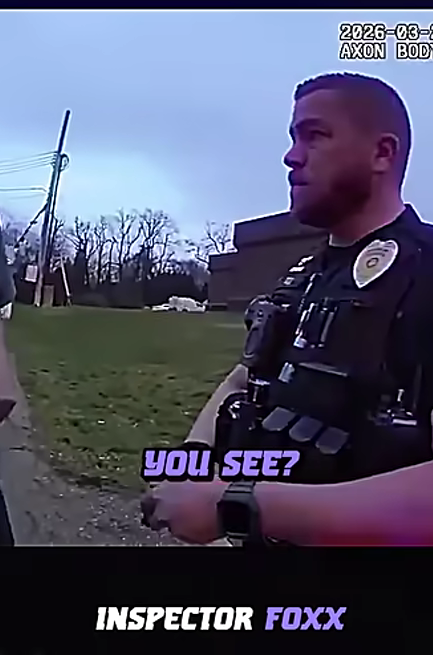
This video presents bodycam footage of a tense traffic stop that develops into a disagreement between two police officers regarding the legality and justification of a detention. The situation begins as a routine interaction but quickly escalates due to differing interpretations of the driver’s behavior and the appropriate legal response. The footage captures both the initial confrontation between the primary officer and the driver, as well as a later intervention by a second officer who provides clarification and challenges the validity of the arrest.
The incident begins when a police officer initiates a traffic stop and approaches a driver’s vehicle. From the outset, the officer appears firm and assertive in his communication, immediately instructing the driver to exit the vehicle. The officer states that the driver is being detained for disorderly conduct, explaining that the justification is based on alleged behavior observed prior to the stop. Specifically, the officer claims that the driver shouted an expletive at him and further asserts that he detected the smell of marijuana as the vehicle passed by.
These two claims form the basis of the officer’s decision to escalate the encounter from a stop into a detention. The assertion of disorderly conduct suggests that the officer believes the driver’s behavior meets the threshold for legal action beyond a simple traffic violation. The mention of marijuana odor introduces an additional layer of suspicion, which is often treated seriously in law enforcement contexts due to potential implications of drug-related activity.
However, the driver immediately challenges both aspects of the officer’s justification. He denies shouting any expletive at the officer and questions the plausibility of the claim regarding the smell of marijuana. The driver specifically argues that it would not be physically possible for the officer to detect such an odor from a passing vehicle, especially under the conditions described. His response reflects both disbelief and frustration, as he attempts to push back against what he perceives as an unfounded escalation.
Despite the driver’s objections, the officer maintains his position and continues the process of detaining him. The interaction becomes more formal at this stage, with the officer transitioning from verbal instructions to a clear declaration of arrest. The driver expresses resignation, suggesting that if the officer intends to proceed, he should either issue a citation or make the arrest official. This moment marks a clear shift from dispute to enforcement action, as the officer proceeds to place the driver under arrest.
The tone of the encounter is notably tense, with both parties firmly standing by their interpretations of the situation. The officer relies on his stated observations as justification, while the driver continues to dispute the validity of those claims. This type of disagreement is not uncommon in traffic stops, where subjective perceptions can play a significant role in how situations are evaluated in real time.
The dynamic changes significantly when a second officer arrives at the scene and becomes aware of the situation. Unlike the initial officer, the second officer takes a more measured approach and begins to assess the circumstances independently. After reviewing the basis for the detention, the second officer intervenes in the interaction, directly addressing the legality of the arrest.
The second officer explains that the driver’s alleged verbal outburst, even if it occurred, does not constitute a criminal offense in itself. He clarifies that individuals are legally permitted to express frustration or insult law enforcement officers, as such speech is generally protected under freedom of expression. This explanation reframes the initial justification for disorderly conduct, suggesting that verbal criticism alone does not automatically meet the threshold for arrestable behavior.
In addition to addressing the speech-related claim, the second officer also challenges the reliability of the assertion regarding the smell of marijuana. While not explicitly disputing the officer’s perception, the intervention emphasizes the importance of ensuring that any grounds for arrest are legally solid and defensible in court. The emphasis shifts from immediate enforcement to long-term legal sustainability, highlighting the difference between suspicion and actionable evidence.
The second officer ultimately advises that the detained driver should be released, using the phrase “cut him loose” to emphasize the recommendation. This statement reflects a concern that proceeding with the arrest under the current circumstances would not withstand judicial scrutiny. The advice is presented in a direct and practical manner, focusing on avoiding a situation that could later be dismissed or challenged in court due to insufficient legal justification.
This intervention creates a clear contrast between the two officers’ approaches. The initial officer appears focused on immediate interpretation of events and enforcement based on perceived behavior, while the second officer emphasizes legal standards, constitutional protections, and procedural caution. The difference in perspective highlights how law enforcement decisions can sometimes vary even among trained professionals when assessing the same set of facts.
The presence of conflicting interpretations within the same encounter adds complexity to the situation. It illustrates how discretionary judgment plays a significant role in policing, particularly during fast-moving interactions where decisions must be made quickly. The bodycam footage captures this divergence in real time, allowing viewers to observe how internal correction can occur even during an active enforcement situation.
The driver, throughout the encounter, maintains a consistent position of denial and resistance to the allegations. While his tone reflects frustration, he does not appear to engage in escalating behavior beyond verbal disagreement. His insistence on either being ticketed or formally arrested reflects an awareness of procedural outcomes and a desire for clarity regarding the officer’s intentions.
The resolution of the incident, as guided by the second officer’s intervention, underscores the importance of peer review and on-scene correction in law enforcement operations. The ability of one officer to reassess and challenge the actions of another demonstrates an internal mechanism for preventing potential legal or procedural errors from progressing further.
Overall, the video presents a layered interaction involving interpretation of behavior, legal standards, and intra-departmental correction. It highlights how quickly assumptions made during a traffic stop can be reassessed when additional perspectives are introduced. The final outcome emphasizes the importance of ensuring that enforcement actions are supported not only by immediate perceptions but also by clear and legally defensible reasoning.
To further understand the significance of this interaction, it is useful to place it within the broader context of traffic enforcement procedures and constitutional protections that guide police conduct during stops. Traffic stops are among the most common forms of police-citizen interaction, and they often require officers to make rapid judgments based on limited information. However, those judgments are still expected to align with legal standards that distinguish between suspicion, probable cause, and arrestable offenses.
In this case, the officer’s initial justification for detaining the driver rests on two separate claims: alleged disorderly conduct and suspected marijuana odor. Each of these claims carries different legal implications and evidentiary thresholds. Disorderly conduct typically requires behavior that is not only disruptive but also meets specific criteria defined by jurisdictional law. Simply using profanity toward an officer, while disrespectful, does not automatically satisfy those criteria in many legal systems due to First Amendment protections.
This distinction becomes central to the second officer’s intervention. By explicitly stating that citizens are allowed to “tell us off,” the second officer is reinforcing a well-established principle in constitutional law: that freedom of speech includes protection for offensive or critical language directed at government officials. While there are limits to speech in cases involving threats, incitement, or obstruction, general verbal criticism alone is not typically sufficient grounds for arrest.
The second claim—odor of marijuana—introduces a different category of enforcement justification. In many jurisdictions, the smell of marijuana can be considered probable cause depending on local laws and whether marijuana use is legal or decriminalized. However, even when such odor is used as justification, it is often expected that it be supported by additional indicators or corroborating circumstances. The driver’s challenge to the plausibility of detecting odor from a passing vehicle introduces reasonable doubt about the strength of that claim.
From a procedural standpoint, the interaction demonstrates how quickly an arrest decision can become legally vulnerable if not carefully grounded in articulable facts. The initial officer appears to transition rapidly from suspicion to arrest without fully addressing potential legal challenges to the basis of that decision. This is precisely the type of situation that can later result in suppression of evidence or dismissal of charges in court proceedings.
The second officer’s role in this scenario is particularly important because it reflects the concept of real-time peer correction. In law enforcement environments, officers are often trained to support one another, but also to intervene when an action may violate legal or procedural standards. This internal oversight mechanism is not always visible in public discussions of policing, yet it plays a critical role in maintaining accountability during field operations.
When the second officer instructs that the driver should be released, the language used is notably direct and unambiguous. The phrase “cut him loose” reflects an immediate recognition that continuing the detention would likely not be defensible under legal scrutiny. This kind of directive effectively halts the escalation of the situation and redirects the encounter away from enforcement and toward de-escalation.
The interaction also highlights the difference between perceived authority and legal authority. While the initial officer exercises situational authority by detaining the driver, that authority is not absolute. It must be continuously justified by lawful grounds. The second officer’s intervention serves as a reminder that authority within policing is conditional and subject to review, even in real time.
From the driver’s perspective, the experience illustrates the uncertainty that can arise during traffic stops when explanations are not clearly communicated or when justifications appear inconsistent. The driver’s repeated insistence on either receiving a ticket or being formally arrested suggests a desire for procedural clarity. In situations where individuals feel uncertain about the basis of detention, frustration and resistance—at least verbal resistance—can increase, even when no physical escalation occurs.
The bodycam footage itself plays a crucial role in documenting these interactions. Without recorded evidence, details such as tone, timing, and sequence of events could be subject to interpretation or dispute. Body-worn cameras provide an objective record that can later be reviewed by supervisors, legal teams, or oversight bodies. In this case, the footage allows for a clear reconstruction of how the decision to detain was made and how it was later reversed.
Another important aspect of this scenario is the psychological dynamic between the officers. The initial officer appears confident in his assessment, while the second officer approaches the situation with skepticism and caution. This difference in approach is not uncommon in field work, where individual experience, training background, and personal judgment can influence decision-making styles. Some officers prioritize immediate enforcement based on perceived indicators, while others prioritize legal defensibility and procedural caution.
The presence of disagreement between officers in the field is not inherently unusual, but the public visibility of such disagreements can shape how viewers interpret the professionalism and consistency of law enforcement practices. In this case, the disagreement ultimately results in a correction that prevents the continuation of a potentially flawed arrest.
The resolution of the incident—releasing the driver—serves as a practical example of how internal correction mechanisms can function without requiring external complaint or judicial intervention. It demonstrates that oversight can occur dynamically within the field environment itself, rather than only after the fact through formal review processes.
However, the incident also raises broader questions about decision thresholds during stops. At what point should an officer escalate from investigation to detention? How much weight should be given to subjective observations such as odor or tone of voice? And how should conflicting interpretations between officers be resolved in real time? These are questions that extend beyond this specific event and into the broader framework of policing standards and training.
Training protocols often emphasize the importance of articulable facts—specific, observable details that can justify enforcement actions. The effectiveness of such training depends on consistent application in the field, especially under pressure. When those standards are not uniformly applied, discrepancies such as the one seen in this video can occur.
The video also indirectly highlights the importance of constitutional literacy within law enforcement. Understanding the limits of enforcement authority, particularly regarding speech protections and evidentiary requirements, is essential for preventing overreach. The second officer’s explanation reflects this understanding and serves as a corrective reminder within the interaction.
In the final moments of the encounter, once the driver is released, the situation transitions from active enforcement to resolution. While the footage does not provide extensive detail about what follows afterward, the primary outcome is clear: the detention does not proceed, and the legal justification for arrest is effectively withdrawn on scene.
Ultimately, the video functions as an illustrative example of how quickly legal interpretations can shift during real-time enforcement. It shows how initial assumptions can be challenged, how peer intervention can correct course, and how constitutional principles can directly influence the outcome of a police encounter. Rather than presenting a single linear narrative, the footage reveals a layered process of decision-making, correction, and legal reconsideration that unfolds within a matter of minutes.
To conclude the analysis of this incident, it is also important to consider how communication clarity between officers can significantly influence the outcome of field encounters. In situations where multiple officers are present, the consistency of legal interpretation becomes essential to ensuring that enforcement actions remain aligned with departmental policy and constitutional standards. When one officer’s interpretation differs from another’s, as seen in this case, the presence of real-time correction can prevent further escalation and potential legal consequences.
The second officer’s intervention not only corrected the immediate situation but also reinforced an important principle of lawful policing: that enforcement decisions must remain flexible when new or more accurate information becomes available. This adaptability is critical in preventing wrongful detentions and maintaining procedural integrity. The ability to reassess and reverse an action, even after it has begun, reflects a system designed to prioritize legality over momentum.
Another factor highlighted by this interaction is the role of de-escalation language in shaping outcomes. The second officer’s calm and directive phrasing contrasts sharply with the more forceful tone used during the initial detention. This difference in communication style demonstrates how tone, wording, and approach can influence the trajectory of an encounter, even when the underlying facts remain unchanged. Clear, measured communication often contributes to stabilizing situations that might otherwise continue escalating.
Additionally, the incident underscores the importance of maintaining awareness of constitutional protections during everyday enforcement activities. While officers are tasked with maintaining public order, they must also operate within boundaries that protect individual rights. The reminder that verbal criticism of police is generally protected speech serves as a key point of legal education within the interaction, reinforcing limits that cannot be overridden by subjective offense or perceived disrespect.
The resolution of the encounter also illustrates how quickly accountability can be applied at the operational level. Instead of requiring prolonged external review before corrective action, the situation is addressed immediately through peer intervention. This immediacy is significant because it prevents unnecessary continuation of a potentially unlawful detention and reduces the likelihood of further legal complications.
Finally, the video demonstrates how bodycam footage continues to serve as an important transparency tool in modern policing. By capturing both the initial decision-making process and the corrective intervention, the footage provides a complete timeline that can be reviewed for training, accountability, and public understanding. It allows for a detailed reconstruction of events that might otherwise be interpreted differently depending on perspective.
Overall, the incident reflects a complex interaction between enforcement authority, constitutional rights, and real-time decision correction. While the initial detention was based on the officer’s interpretation of events, the subsequent intervention ensured that legal standards were properly applied before the situation progressed further. This balance between action and review is central to maintaining both effective policing and public trust.