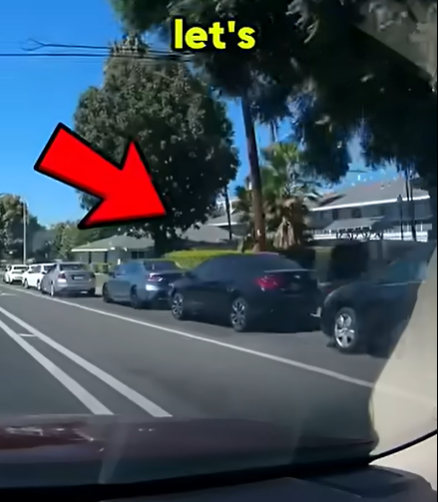
The video captures a perfect example of how reckless driving, impatience, and carelessness with cargo can combine into a dangerous and almost unbelievable roadside mess. What begins as an aggressive attempt by a pickup truck driver to bypass traffic quickly turns into a public hazard when the same driver, clearly in a hurry and ignoring basic safety precautions, loses a large load of pipes into the roadway. In just a few seconds, the driver’s effort to save time creates a much bigger problem not only for himself, but for everyone around him.
At the beginning of the clip, the pickup truck is already behaving in a way that signals impatience. Traffic appears to be moving more slowly than the driver wants, and instead of waiting in line with everyone else, the driver chooses to illegally use a designated bicycle lane to pass. That choice alone is dangerous. Bicycle lanes exist to create a protected space for cyclists, giving them a portion of the roadway where they can travel with less risk of being squeezed by larger vehicles. When a pickup truck enters that space to skip traffic, it immediately defeats the purpose of the lane and puts anyone who might be using it in danger.
The driver seems to be in a major hurry. That urgency can be seen not only in the decision to enter the bike lane, but also in the speed and force with which the truck continues forward. There is an aggressive quality to the movement, as though the driver has decided that the ordinary rules of traffic no longer apply because getting ahead matters more. It is a mindset many people have seen on the road before: the driver who believes their time is more important than everyone else’s, the driver who treats lane markings as optional, and the driver who thinks a brief shortcut will somehow solve their frustration.
But what makes the situation much worse is that the truck is carrying a large load of pipes in its open bed, and those pipes do not appear to be properly secured. That detail changes the clip from simple bad driving into something far more serious. Any vehicle carrying long, heavy materials has a responsibility to make sure the load is restrained correctly. Pipes can roll, slide, shift, and bounce if not tied down tightly. Their shape makes them especially dangerous because once they start moving, they can scatter unpredictably. A pickup truck carrying unsecured pipes is not just transporting cargo; it is carrying a potential roadside hazard if the driver does not take proper precautions.
The truck continues moving quickly, and as it accelerates around a bend, the laws of physics finally catch up with the driver’s choices. The turn places lateral force on the load, and because the pipes have not been secured properly, they begin to slide. In a well-loaded truck, straps, barriers, or other restraints would stop the movement immediately. Here, there seems to be little or nothing preventing the pipes from shifting. Once the load starts moving, the outcome becomes almost unavoidable.
The pipes slide out of the open truck bed and spill onto the road. It happens fast, but the effect is dramatic. Long pipes begin dropping and scattering across the pavement, turning the driver’s rushed maneuver into a chaotic scene. What was supposed to be a clever shortcut through traffic suddenly becomes a major hazard for every vehicle behind and around him. Instead of saving time, the driver has now created a roadway obstruction that could easily cause damage, panic, or even injury.
There is something deeply ironic about the moment. The driver appears to be in such a rush that he is willing to ignore traffic laws by using the bicycle lane, yet his own failure to secure the load properly causes him to lose much more time than he would have saved. Rather than passing traffic and continuing on his way, he ends up dropping cargo all over the road, likely forcing a stop, cleanup, and possibly involvement from other motorists or authorities. The very impatience that led him to break the rules is what creates the disaster.
The video serves as a vivid reminder that dangerous driving often involves more than one bad decision. Rarely does a serious road incident come from a single isolated mistake. More often, it comes from a pattern of carelessness. In this case, the pattern is clear. First, the driver chooses to speed past traffic rather than wait. Second, he chooses to do it by driving in a bicycle lane, a space not meant for his vehicle. Third, he does this while transporting a load that has not been properly secured. Fourth, he accelerates heavily around a bend without accounting for how the cargo will react. Each decision piles on top of the last one, and together they create the final result.
The bicycle lane aspect is especially troubling because it shows a willingness to treat safety infrastructure as an inconvenience. Bicycle lanes are created precisely because cyclists are vulnerable road users. Unlike drivers in enclosed vehicles, cyclists have no metal frame, airbags, or substantial protection. A pickup truck invading that space is intimidating even when no crash occurs. If a cyclist had been in the lane at the wrong moment, the consequences could have been much worse than spilled cargo. The driver seems lucky that the video description focuses on pipes scattering across the road rather than a collision with a person.
The cargo itself is another major point of concern. Pipes are not harmless objects once they leave a moving truck. Depending on their size and material, they can be extremely heavy, difficult to predict, and capable of causing serious damage. As they spill onto the road, they may bounce, roll, or slide across multiple lanes. Drivers behind the truck could be forced to brake suddenly, swerve, or risk running over the pipes. Even if the pipes do not directly hit another vehicle, they create a chain-reaction risk. One driver might slam on the brakes. Another might veer into a neighboring lane. A motorcyclist or cyclist could be especially endangered by the debris.
That is one of the most striking things about this kind of incident: the driver’s impatience does not just affect his own vehicle. It transfers risk to everyone nearby. A person who drives recklessly often imagines they are taking a risk only for themselves, but on public roads that is never true. Every impatient maneuver, every shortcut, every ignored safety step can put strangers in danger. Here, the pickup truck driver’s decisions scatter a roadway hazard across public lanes where completely uninvolved people may suddenly have to react.
The turn in the road is also important because it highlights how badly the driver misjudged the basic mechanics of carrying a load. Even a secured load must be handled with care during turns, acceleration, and braking. Long objects like pipes are especially prone to shifting because they can move together as a bundle and then roll once they separate. A bend in the road naturally pushes the cargo sideways. If the truck is moving too quickly, that force becomes stronger. A responsible driver carrying such material would likely take the bend more slowly, knowing that their cargo needs gentle handling. The aggressive speed suggests either ignorance, overconfidence, or simple disregard.
The scene also has a certain instant-karma quality to it, which is likely why videos like this spread so quickly. The driver behaves selfishly and dangerously in full view of other road users, only to have the consequences arrive almost immediately. There is no long delay, no distant aftermath. The same recklessness that helped him jump ahead in traffic causes his load to spill out moments later. For many viewers, there is a kind of rough justice in that. The driver tries to outsmart the road, and the road punishes him with an embarrassing, hazardous mess.
Still, the moment is not just satisfying in a poetic sense. It is genuinely dangerous. There is a tendency to laugh at videos where reckless drivers are humbled quickly, but the real danger should not be overlooked. Pipes scattered across the road could cause major damage. If another driver could not stop in time, the incident might escalate into crashes, injuries, or pileups. A truck load spilling in traffic is not simply embarrassing; it can become a serious emergency depending on the speed and density of surrounding vehicles.
The visual image of pipes scattering across the road is powerful because it turns the driver’s private mistake into a public event. What was once contained in the truck bed now spreads across the shared roadway, disrupting everyone. It is a perfect illustration of how poor preparation can spill over into public consequences. Something as basic as using the right straps or checking the load before leaving could have prevented the entire scene. But when drivers cut corners before even getting on the road, they are often the same drivers who cut corners once they are driving.
There is also a broader lesson here about the false logic of rushing. Many impatient drivers act as if every second matters, as if being delayed by traffic is some unacceptable injustice that must be overcome immediately. But rushing often produces exactly the opposite of what the driver wants. It creates new delays, bigger problems, and greater stress. In this clip, the pickup driver seems desperate to get ahead, yet his actions likely leave him far worse off than if he had simply stayed in traffic and driven carefully. Instead of arriving sooner, he may now be forced to pull over, recover the spilled pipes, deal with angry drivers, possibly answer to police, and perhaps even pay for damage.
The truck itself also plays a role in how the scene is perceived. Pickup trucks are often associated with carrying materials, tools, or work supplies. That means there is an extra expectation that the driver should know how to transport cargo safely. When someone uses a pickup truck for hauling, basic load security is part of the responsibility. Seeing a truck spill its pipes so dramatically suggests not just a momentary slip, but a failure in one of the most fundamental duties of carrying cargo. It is the kind of mistake that undermines confidence in the driver immediately.
The fact that the pipes are in an open truck bed matters too. Open beds are useful, but they also leave loads exposed and dependent on external restraint. Unlike cargo inside an enclosed van or trailer, items in an open pickup bed can shift out more easily if not secured. That means the driver has even less excuse for negligence. If you are using an open bed to transport long materials, you must expect that acceleration, braking, and turning will act on the load. Ignoring that reality is not just careless; it is dangerous.
The bicycle lane violation deserves repeated attention because it reflects an attitude, not just a single maneuver. Drivers do not accidentally use a bike lane to pass traffic at speed. That is an intentional act. It shows the driver has made a conscious choice to prioritize their own progress over the rules that protect others. In many reckless-driving videos, there is often a moment when a driver makes an impulsive but understandable mistake. Here, the use of the bike lane feels more deliberate and entitled. It suggests a person who sees traffic laws as obstacles rather than obligations.
It is also worth considering what the other drivers around the truck may have been thinking. Anyone sitting in the normal traffic lane likely watched this pickup swing into the bicycle lane and surge ahead, probably with a mix of annoyance and disbelief. Then, moments later, those same drivers likely watched the load spill across the road. From their perspective, it would have been an almost immediate confirmation that the reckless behavior was not only selfish but incompetent. The driver who was so desperate to get ahead has now become the source of a much larger disruption for everyone else.
The bend in the road almost acts like a test the driver fails. Up to that moment, the reckless shortcut is “working” in the narrowest sense: the truck is moving faster than the traffic. But the turn exposes the instability underneath the whole maneuver. The cargo was never under control. The truck was never being handled responsibly. The shortcut was built on bad judgment from the start. The bend simply reveals it in the most visible possible way.
There is also a strong symbolic contrast between the designated bicycle lane and the spilled pipes. Bicycle lanes are created to bring order and protection to the road. Secured cargo is part of keeping the roadway safe and predictable. The driver violates both principles at once. He invades a lane meant for vulnerable users and fails to keep his load contained. The result is a scene of total disorder: a large vehicle in the wrong place, cargo where it should never be, and a roadway transformed from organized traffic into a sudden hazard zone.
For anyone who works in transport, construction, delivery, or road safety, the clip likely feels painfully familiar in a different way. It shows exactly why regulations exist. Rules about load securement are not bureaucratic annoyances. They are based on repeated real-world incidents where loose cargo injured people, damaged property, or caused crashes. Likewise, rules about not driving in bicycle lanes are not cosmetic; they are there because mixing large motor vehicles with narrow cyclist spaces is inherently risky. The video condenses multiple safety lessons into one short, chaotic event.
The aftermath, though not described in detail, can be imagined clearly. The driver likely has no choice but to stop. The pipes are now all over the road. Traffic behind him may be interrupted even more than before. Some drivers may honk, stop, or attempt to go around the debris. The driver who was trying to beat traffic may now be the reason traffic becomes even worse. Depending on the location, police or traffic authorities may need to respond. If any vehicles were damaged or if the debris hit anyone, the situation could become even more serious. All of that grows out of a few seconds of impatience and neglect.
There is also a personal lesson in embarrassment. Many reckless drivers assume they will “get away with it,” that their illegal shortcut or unsafe maneuver will save time and go unnoticed. But when something goes wrong in such a public way, the embarrassment can be immediate and total. In this case, the driver likely becomes the center of attention for all the wrong reasons. Other road users, pedestrians, or even cyclists nearby would instantly see the cause of the mess. The driver’s attempt to look assertive or efficient is replaced by the image of someone who could not even keep their own load in the truck.
At a deeper level, the clip illustrates how impatience and negligence often travel together. A person who is careless about one rule is often careless about others. The driver who does not respect lane boundaries may also be the driver who does not check cargo properly. The driver who accelerates too hard around a bend may also be the driver who assumes nothing bad will happen. Recklessness is rarely isolated. It tends to form a mindset, and that mindset can make simple responsibilities seem optional until reality proves otherwise.
The pipes spilling from the bed function as a kind of instant exposure of that mindset. They reveal what the truck driver was carrying physically, but they also reveal what he was carrying behaviorally: overconfidence, impatience, disregard for others, and failure to prepare. Once the cargo hits the road, those traits become visible to everyone.
In the end, the video is not just about a pickup truck losing some pipes. It is about the consequences of selfish and careless choices behind the wheel. A driver illegally uses a bicycle lane to skip traffic, speeds forward in a hurry, fails to secure a heavy load properly, and then takes a bend too aggressively. The result is a dangerous spill that could have harmed others and certainly created chaos. The image is almost simple in its lesson: if you drive like the rules do not matter, the road has a way of proving that they do.
What the driver likely saw as a time-saving shortcut became a public demonstration of why safety rules exist in the first place. The bicycle lane was not there for him. The cargo needed to be strapped down. The bend required caution. Traffic required patience. He ignored all of those realities at once, and the roadway answered immediately. Instead of speeding past everyone and getting away cleanly, he left a trail of pipes across the street and turned his own rush into a preventable mess. It is a sharp reminder that on the road, arrogance and haste often collapse under their own weight — and sometimes, in this case, under the weight of a truck bed full of unsecured pipes.
The incident also shows how one selfish driving choice can create a chain reaction for everyone else. The pickup driver may have thought he was simply skipping a line of traffic, but the moment the pipes spilled, the entire road became involved. Drivers behind him now had to react to unexpected debris. People in nearby lanes had to slow down or avoid the scattered pipes. Anyone walking or cycling nearby could have been startled or put at risk. A decision that began as one person’s impatience quickly became a shared problem for everyone in the area.
What makes the situation even more frustrating is that it was completely avoidable. Securing cargo is not complicated when done properly. Long materials like pipes need to be tied down firmly, checked before driving, and handled with extra caution during turns. The driver should have known that accelerating around a bend with loose cargo in an open truck bed was a recipe for disaster. Even if the pipes seemed stable at first, movement, speed, and turning force can shift a load very quickly.
The pickup’s use of the bicycle lane makes the failure look even worse. If the driver had stayed in the regular traffic lane, he may have been moving slowly enough that the pipes would not have shifted so violently. But because he chose to speed past traffic in a lane not meant for him, he added more force and more risk to an already unsafe situation. The illegal shortcut did not just break a rule; it helped create the conditions for the spill.
There is also a clear contrast between the patience of the other drivers and the recklessness of the pickup driver. Everyone else appears to be waiting in traffic, accepting the delay even if it is inconvenient. The pickup driver decides he should not have to wait. That sense of entitlement is what makes the outcome feel so fitting. He tries to place himself ahead of everyone else, only to become the reason the road is blocked even more.