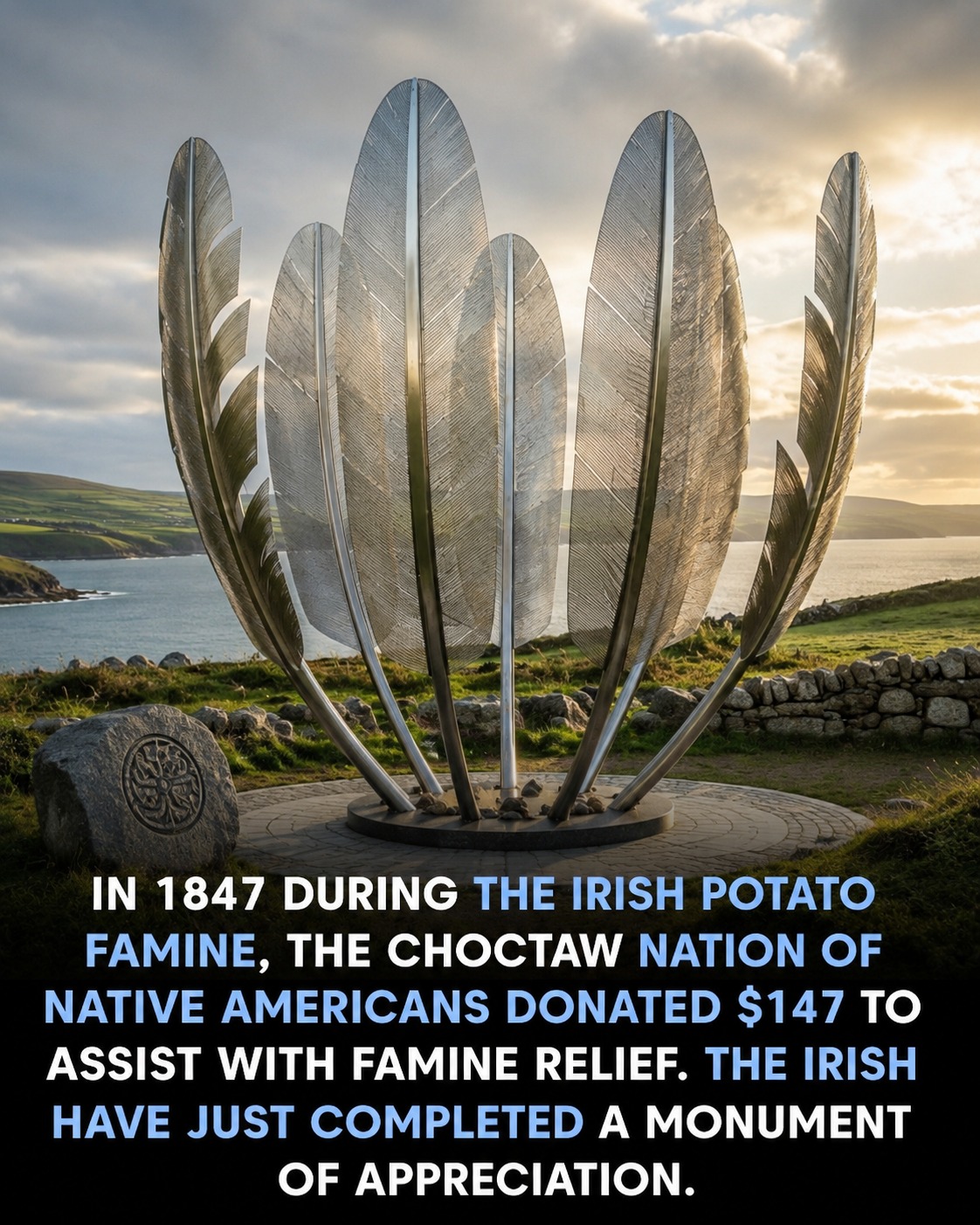
In 1847, during the height of the devastating Irish Potato Famine, the world witnessed one of the most extraordinary acts of empathy and cross-cultural solidarity in history. While millions of Irish people faced starvation due to the failure of potato crops and political neglect, a distant Native American community, the Choctaw Nation, reached out across continents with a remarkable gesture of generosity. The Choctaws themselves were no strangers to suffering. Having endured forced removal from their ancestral lands during the Trail of Tears in the 1830s, they had experienced displacement, hunger, and profound loss. Yet despite their own hardships, they mobilized resources to support people they had never met, raising $147 to aid famine relief efforts in Ireland—a sum that represented an enormous sacrifice given their circumstances.
The historical context of this generosity deepens its significance. The Trail of Tears had uprooted the Choctaw, along with other tribes, from their homelands in the southeastern United States to designated Indian Territory in present-day Oklahoma. Thousands perished along the journey due to disease, exhaustion, and exposure. Communities were fractured, and resources were scarce. In the wake of such hardship, the act of raising funds for another community halfway around the globe reflects not only extraordinary compassion but also a profound sense of moral responsibility that transcends personal suffering. The Choctaw Nation’s choice to help demonstrates the capacity for empathy to flourish even in contexts of extreme adversity.
The $147 contributed by the Choctaws may seem modest by modern standards, yet its value in the mid-19th century was significant, especially for a people grappling with displacement and resource scarcity. More importantly, the symbolic significance of the gift exceeded its monetary value. It represented a bridge of humanity connecting two communities separated by geography, culture, and circumstance. For the Irish people receiving aid, the Choctaw donation was a testament to the enduring spirit of generosity and moral conscience that transcends borders, illustrating that compassion is a universal human trait that can emerge even in the most challenging circumstances.
This act of solidarity remained largely unknown for generations, overshadowed by the magnitude of the famine and the enormity of suffering in both communities. Yet the story of the Choctaw’s generosity endured through oral histories, tribal records, and historical scholarship. Over time, it became a symbol of ethical responsibility, resilience, and the potential for cross-cultural empathy. The Choctaw contribution has been celebrated as an example of humanity at its best, offering lessons in morality, collective action, and the importance of recognizing shared vulnerability across different peoples and societies.
In recognition of this remarkable historical act, the Irish people undertook a powerful initiative to honor the Choctaw Nation. Over 150 years later, a monument was constructed to commemorate the generosity shown during the Irish Potato Famine. The monument, situated in a place of reflection and significance, serves as a tangible acknowledgment of the Choctaw’s empathy, courage, and moral vision. Its creation was not only an act of gratitude but also a public reaffirmation that acts of solidarity, no matter how distant in time or space, carry enduring moral weight. The structure itself, often shaped to symbolize growth, protection, or the continuity of human connection, becomes a site where history, memory, and moral reflection intersect.
The monument stands as a reminder that the capacity to act with compassion is not limited by circumstance or geographic proximity. The Choctaws, having suffered displacement, loss, and deprivation themselves, chose to extend aid across oceans, bridging differences of culture, language, and nationality. In doing so, they articulated a universal principle: that those who have endured suffering can, through generosity, affirm their shared humanity. This principle resonates today as a lesson in ethical responsibility and civic empathy, encouraging reflection on how individuals and communities respond to crises beyond their immediate borders.
Beyond its historical and symbolic importance, the Choctaw contribution and its commemoration highlight the often-overlooked narratives of Indigenous generosity and leadership. Indigenous peoples, frequently portrayed in popular histories as victims of colonization or passive figures, are also communities of resilience, moral vision, and proactive engagement. The Choctaw’s actions demonstrate that Indigenous peoples, even under extreme duress, have long acted with foresight, compassion, and a sense of global ethical responsibility. This act challenges narratives that marginalize or simplify Indigenous histories, showing that these communities have not only survived but actively shaped human understanding of justice, empathy, and solidarity.
The Choctaw Nation’s support of Ireland during the famine also underscores the interconnectedness of historical suffering. Both communities had endured displacement, oppression, and hardship—albeit in different contexts—and the gesture of support reflects a recognition of shared human vulnerability. This recognition forms the basis of cross-cultural empathy, illustrating that understanding and moral action can arise not solely from shared nationality or culture, but from an appreciation of the universal human experience of suffering and need. Such insights remain relevant today, providing a model for humanitarian and ethical action in contexts ranging from local communities to international crises.
Furthermore, the story emphasizes the importance of memory and commemoration. By constructing a monument to honor the Choctaw contribution, the Irish people acknowledged not just the act itself, but the ongoing relevance of historical empathy. Memory becomes an active agent, shaping contemporary understanding of morality, solidarity, and human interconnectedness. The monument is thus both a site of historical reflection and a guidepost for ethical behavior, signaling to present and future generations that acts of generosity can echo across time, inspiring continued acts of compassion and awareness.
This historical episode also sheds light on the Choctaw Nation’s enduring cultural strength. Despite the trauma of forced removal, disease, and marginalization, the Choctaw retained social cohesion, ethical frameworks, and mechanisms for communal decision-making. Their capacity to organize, mobilize resources, and extend aid in 1847 reflects a continuity of social values that sustained their communities through centuries of disruption. In this sense, the act of giving was both a moral and cultural affirmation—a demonstration that even under duress, the principles of community responsibility, solidarity, and moral leadership endure.
The ongoing recognition of the Choctaw’s contribution reinforces the importance of education in preserving and transmitting ethical and historical knowledge. Learning about this act in schools, cultural programs, and public discourse allows people to appreciate the global dimensions of human empathy. It teaches that acts of generosity, particularly from communities that themselves have suffered, carry profound significance and should be honored, remembered, and emulated. By integrating such narratives into collective memory, societies cultivate values of respect, compassion, and global solidarity.
Finally, the story of the Choctaw Nation and the Irish Famine serves as a timeless reminder that human compassion transcends borders, generations, and circumstance. It illustrates that even in moments of profound adversity, communities can act with foresight, empathy, and generosity, creating legacies that endure far beyond the immediate impact of their deeds. The monument stands as a testament to this truth, inviting reflection, gratitude, and the recognition of our shared humanity—a humanity that persists, even in the face of suffering, through acts of courage, generosity, and ethical commitment.
The Choctaw Nation’s extraordinary act of generosity in 1847 cannot be understood in isolation; it must be seen against the backdrop of a people who had themselves endured immense suffering. Only a little over a decade before, the Choctaws had been forcibly removed from their ancestral homelands in the southeastern United States along the Trail of Tears, a journey marked by starvation, exposure, disease, and death. Thousands perished during these forced relocations, and survivors were thrust into unfamiliar, often inhospitable lands. Their communities were fragmented, their resources depleted, and yet, despite these overwhelming challenges, they found it within themselves to act with empathy for others they had never met. This historical context elevates the $147 donation to Ireland from a simple monetary act into a profound symbol of shared human compassion and ethical responsibility.
The Irish Potato Famine, which began in 1845 and lasted several years, was itself one of the most devastating humanitarian crises of the 19th century. A fungal disease called Phytophthora infestans destroyed potato crops across Ireland, a country heavily reliant on potatoes for sustenance. Millions faced starvation and malnutrition, and countless families were torn apart by death or emigration. While the famine’s causes were primarily environmental, the British government’s policies exacerbated the disaster, resulting in inadequate relief and systemic neglect. It was against this backdrop of immense suffering that the Choctaw Nation’s donation arrived—a remarkable act of solidarity between two communities separated not only by geography but also by culture, history, and circumstance.
The significance of the Choctaw’s contribution extends beyond the immediate relief provided. The $147 they raised—equivalent to several thousand dollars today when considering the economic conditions and relative wealth of the tribe—represented a substantial sacrifice. The Choctaws were still struggling to rebuild their lives after removal, facing food shortages, limited access to resources, and the challenge of reconstructing their social and political institutions. The act of giving, therefore, was not an abstract gesture but a concrete decision to prioritize empathy over scarcity, generosity over survival. It reflects a profound moral consciousness and a recognition of shared humanity that transcends immediate self-interest.
The Choctaw Nation’s actions were also informed by their cultural values and spiritual beliefs. Among the Choctaws, and many other Native American nations, communal responsibility, reciprocity, and empathy for the suffering of others are central ethical principles. These cultural imperatives encouraged acts of generosity and solidarity, even in circumstances of limited resources. By supporting the Irish people during their time of extreme need, the Choctaws were embodying these principles, acting in accordance with deeply held moral and cultural obligations. In doing so, they created a lasting legacy of cross-cultural empathy that continues to be celebrated today.
The historical impact of this gesture is reflected in the enduring relationship between the Choctaw Nation and the Irish people. Over a century and a half later, the Irish constructed a monument to commemorate the Choctaw’s generosity, symbolizing the recognition of their selfless act. This monument not only honors a historical contribution but also embodies the broader ideals of international solidarity, empathy, and human interconnectedness. It serves as a reminder that even small acts of generosity can ripple across time and space, creating bonds between communities and inspiring future acts of compassion. The physical structure of the monument, often designed to evoke growth, protection, or unity, becomes a focal point for reflection, education, and commemoration, linking past actions to contemporary values.
The monument also provides an opportunity to explore the broader historical context of Indigenous generosity and moral leadership. The Choctaws were not alone in demonstrating compassion and ethical foresight; other Native American nations have a long history of providing aid and support in times of crisis, both within and beyond their communities. These acts are often underrepresented in mainstream historical narratives, which tend to focus on conflict, dispossession, and oppression. By highlighting these stories, historians and educators challenge simplified portrayals of Indigenous peoples, emphasizing the complexity, agency, and ethical engagement that have characterized Native communities throughout history.
Education and storytelling play a critical role in preserving the memory of the Choctaw contribution. Schools, museums, and cultural centers in both Ireland and the United States incorporate the story into curricula and public programming, ensuring that new generations understand the significance of this act of solidarity. The narrative teaches lessons about empathy, moral responsibility, and the potential for meaningful action even under adverse circumstances. It also underscores the importance of cross-cultural understanding and the recognition of shared human experience, demonstrating that acts of compassion need not be limited by geography or social boundaries.
The Choctaw donation and its commemoration also provide a lens through which to examine the intersection of historical trauma and ethical leadership. Both the Choctaws and the Irish had endured forms of systemic violence, displacement, and deprivation. By choosing to act with generosity, the Choctaws transformed their experience of suffering into a vehicle for empathy, demonstrating that resilience and moral courage often emerge most strongly in communities that have themselves been tested by adversity. This dynamic highlights the capacity of marginalized communities to assert agency, uphold ethical principles, and contribute meaningfully to global humanitarian efforts.
Beyond its historical and moral significance, the Choctaw contribution has broader implications for contemporary social and political discourse. It provides a powerful counter-narrative to the perception of Indigenous peoples as passive victims of colonization, emphasizing instead their capacity for leadership, ethical decision-making, and cross-cultural engagement. The story also invites reflection on contemporary issues of humanitarian aid, social responsibility, and global solidarity. By examining how a marginalized community responded to the suffering of others, scholars and policymakers can draw lessons about the universality of compassion and the importance of recognizing and supporting ethical agency across societies.
The enduring legacy of this gesture is evident in the continued celebration and recognition of the Choctaw Nation’s actions. Annual commemorations, cultural events, and public ceremonies honor the donation and the broader values it represents. These events provide an opportunity for dialogue, reflection, and education, reinforcing the moral and cultural lessons embedded in the historical narrative. They also serve to strengthen ties between communities, creating a shared sense of history and mutual respect that transcends centuries and continents.
In analyzing the Choctaw contribution, it is also essential to consider the economic and social conditions that made the act so remarkable. The Choctaws had been stripped of their homelands, subjected to forced relocation, and were in the process of rebuilding their communities in unfamiliar territories. They faced food insecurity, poverty, and the challenge of reestablishing governance and social cohesion. Yet they chose to allocate scarce resources to assist people in a distant land, demonstrating that moral vision and empathy are not dependent on abundance but can flourish even in scarcity. This aspect of the narrative underscores the profound ethical significance of their decision.
The Choctaw Nation’s donation also resonates in contemporary global contexts, serving as a model for humanitarian solidarity. In an era marked by displacement, famine, and global crises, the story illustrates that compassion can transcend borders, cultures, and immediate self-interest. It highlights the ethical imperative to recognize shared vulnerability and to act in ways that alleviate suffering, reinforcing principles of moral responsibility that remain relevant today. By commemorating the donation through monuments and public recognition, societies affirm the enduring value of empathy and solidarity as guiding principles for human action.
Finally, the Choctaw donation and its monument serve as enduring symbols of interconnectedness, historical memory, and the capacity for ethical action in the face of adversity. They remind us that even in times of profound hardship, communities can act with foresight, generosity, and moral courage. The legacy of this act continues to inspire reflection, education, and emulation, demonstrating that shared humanity is expressed not only through survival but also through acts of compassion that bridge time, geography, and culture.
The Choctaw Nation’s gesture of generosity during the Irish Potato Famine continues to resonate as a powerful example of moral courage, ethical leadership, and empathy that transcends cultural and geographic boundaries. By contributing $147—a substantial sum for a people who had themselves suffered severe deprivation—the Choctaws demonstrated that compassion is not constrained by circumstance. Their actions reflect a deep understanding of shared human vulnerability and the potential for communities to respond ethically even amidst adversity. This principle has remained relevant across generations, inspiring scholars, activists, and everyday individuals to consider the broader implications of solidarity and humanitarian action.
The commemoration of the Choctaw donation through the construction of a monument in Ireland serves multiple purposes. Beyond simply memorializing a historical act, the monument functions as an educational tool, a site for reflection, and a symbol of enduring human connection. Visitors to the monument are invited to learn not only about the Irish Famine and its devastating impact but also about the Choctaw Nation, its history, and its resilience in the face of forced displacement. The monument encourages a recognition of the interconnectedness of human experience, demonstrating that empathy and moral responsibility can bridge differences in culture, language, and geography. It is a testament to the idea that acts of compassion leave a lasting imprint, shaping memory and influencing values across time.
The story of the Choctaw contribution also highlights the role of Indigenous communities in global humanitarian history. Native American nations are often portrayed in historical narratives as passive victims of colonization, yet this act illustrates their agency, foresight, and capacity for ethical leadership. The Choctaws leveraged their organizational structures, cultural values, and social cohesion to act in a manner that was both altruistic and strategic. By providing assistance to a distant population in need, they affirmed that Indigenous communities have long been active participants in shaping moral and humanitarian outcomes, challenging simplistic or reductive historical narratives that overlook their contributions.
Moreover, the Choctaw donation underscores the universality of empathy. Although separated by thousands of miles, language, and cultural context, the Choctaw people recognized the suffering of the Irish and responded with generosity. Their ability to relate to the plight of another community highlights the shared aspects of human experience: the understanding that hardship, hunger, and loss are not confined to any single people or place. In this sense, the act transcends charity, becoming a moral statement about responsibility, solidarity, and the recognition of common humanity.
The lasting impact of this gesture is evident in the ongoing commemorative practices and educational initiatives surrounding it. Schools, cultural organizations, and historical societies often highlight the Choctaw contribution as a case study in ethical action, cross-cultural solidarity, and historical awareness. These programs allow younger generations to understand the context, significance, and lessons of this act, ensuring that the narrative continues to inspire compassion, civic responsibility, and moral reflection. In doing so, the story of the Choctaw donation transcends its historical moment, becoming a source of guidance and inspiration for contemporary audiences facing global crises, inequality, and human suffering.
Importantly, the monument erected in honor of the Choctaw Nation symbolizes more than gratitude; it represents mutual respect, recognition, and enduring connection between communities with shared histories of suffering. Both the Irish and the Choctaw peoples endured trauma, loss, and hardship, albeit in different forms. The act of memorialization emphasizes that recognition and acknowledgment of past generosity can foster reconciliation, strengthen cultural bonds, and promote understanding between historically marginalized groups. It is a reminder that the moral and ethical choices of the past continue to shape the values, identity, and collective memory of future generations.
Finally, the story of the Choctaw donation during the Irish Potato Famine reminds us that true generosity is often measured not by the size of the gift but by the courage and sacrifice inherent in giving. The Choctaws gave despite their own precarious situation, demonstrating moral leadership, empathy, and the prioritization of ethical principles over material scarcity. Their action provides a timeless lesson: that communities can act beyond their immediate self-interest, forging bonds of solidarity that endure across time and distance. The monument, standing as a tribute to this act, ensures that the Choctaw Nation’s legacy of compassion, resilience, and humanity will be remembered, honored, and carried forward as a source of inspiration for generations to come.