Skip to content

Best lifestory

18,000 Years of Belonging The Blackfeet Nation and the Science of Ancestral Memory

Posted on May 29, 2026 By admin No Comments on 18,000 Years of Belonging The Blackfeet Nation and the Science of Ancestral Memory

For generations, the Blackfeet Nation has passed down a profound story: their people have lived on the plains of what is now Montana since time immemorial. Long before maps were drawn, fences were erected, or settlers arrived, the Blackfeet inhabited this land, hunting, trading, and sustaining their communities in intimate connection with the landscape. This story, preserved through oral traditions, ceremonies, and cultural practice, was a central part of Blackfeet identity—a living memory that defined who they were, where they belonged, and how they understood the world.

Oral history, the primary vehicle for transmitting knowledge among the Blackfeet, has always been deeply respected within the community. Elders told stories that linked individuals to ancestors, to rivers, mountains, and the cycles of the seasons. These stories conveyed knowledge about survival, ethics, and cultural values. They preserved history across generations without the need for written documentation, carrying truths about land, relationships, and identity. For the Blackfeet, the landscape itself was a record of ancestral presence, each river bend, mountain peak, and valley imbued with stories of generations past.

For decades, historians outside the community questioned the timelines presented in these oral traditions. Some assumed the Blackfeet migrated into Montana more recently, framing Indigenous narratives through a lens of skepticism or colonial assumptions. The rich oral histories that had preserved identity and history for centuries were sometimes dismissed as myth or legend, undermining the authority of Indigenous knowledge. Yet within the Blackfeet Nation, these stories were never in doubt. They were the threads of identity, the proof of belonging carried across millennia by memory, ritual, and shared knowledge.

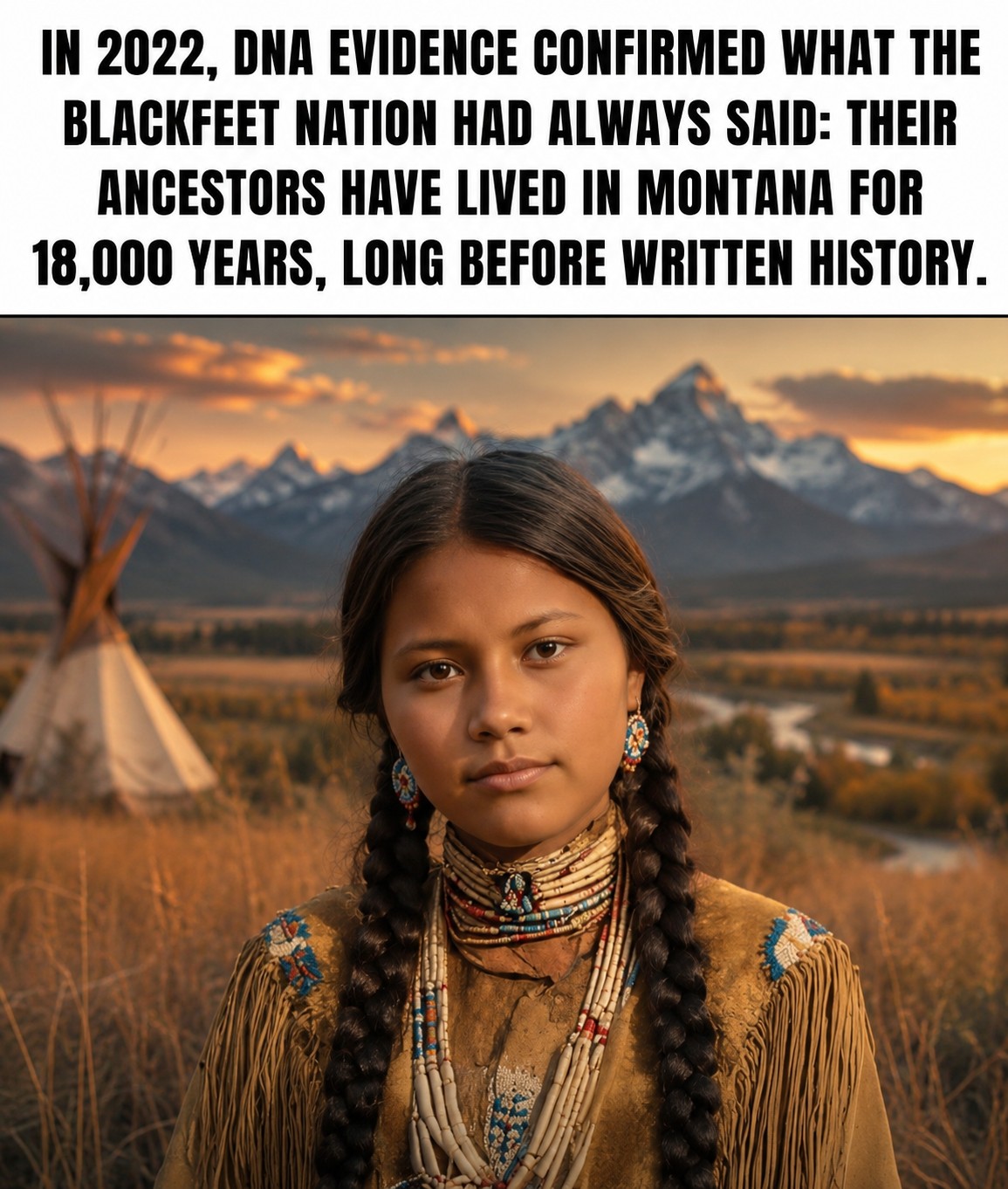
Then, in 2022, science caught up. A groundbreaking DNA study analyzed genetic material from members of the Blackfeet Nation, seeking to understand the ancestry and migration patterns of Indigenous peoples in North America. The results were astonishing: the Blackfeet had lived in Montana for approximately 18,000 years. Their lineage diverged from other Indigenous groups during the late Ice Age, aligning with early migrations across North America. What science confirmed, in precise terms, the Blackfeet had always known. Their oral history was not myth—it was memory encoded in culture, preserved in stories, ceremonies, and community life.

The significance of this discovery extends far beyond academic interest. It validated the authority of oral history as a legitimate record of human experience, challenging centuries of skepticism and privileging of written documentation. For the Blackfeet Nation, the DNA evidence affirmed a profound truth: their stories of ancestral presence and continuity were not merely symbolic but factual. This intersection of science and tradition illustrates a remarkable alignment between two different systems of knowledge—one ancestral and oral, the other modern and analytical—each confirming the other in powerful ways.

The Blackfeet people are part of the wider Blackfoot Confederacy, historically recognized as expert horsemen, hunters, and stewards of the plains. They developed intricate knowledge of the land, its resources, and the ecological patterns of their environment. Their survival and prosperity depended on precise knowledge, careful observation, and cooperation across generations. Oral traditions were central to transmitting these skills, blending practical information with ethical and spiritual teachings. In this way, the land and its history were inseparable from culture and memory, and the stories of ancestral presence were a core component of communal life.

What makes this revelation even more compelling is that the Blackfeet’s oral history was preserved without the benefit of written records or modern technology. Across thousands of years, these stories survived migrations, conflicts, epidemics, and the pressures of colonization. Generations of storytellers—elders, teachers, and cultural leaders—ensured the continuity of knowledge, carefully embedding historical, genealogical, and geographical information into narratives that could be remembered and retold. This oral preservation demonstrates the sophistication, resilience, and reliability of Indigenous methods of knowledge transmission.

The 2022 DNA study did not merely confirm ancestral presence; it elevated the Blackfeet’s cultural memory to broader recognition. For centuries, Indigenous knowledge systems were dismissed or marginalized in academic, political, and social contexts. Now, science provided evidence that oral histories, carefully preserved over millennia, contained precise information about population continuity, migration patterns, and ancestral connections to the land. This breakthrough has significant implications for how societies evaluate different forms of historical knowledge and challenges assumptions that written records are inherently superior to oral traditions.

The validation of Blackfeet oral history also reinforces cultural pride and identity within the community. For young Blackfeet, this confirmation provides tangible evidence of their deep roots in the land, strengthening the sense of belonging and continuity with ancestors. It affirms that their stories, ceremonies, and teachings are not merely symbolic or cultural artifacts but accurate repositories of historical truth. This empowers the community to preserve, celebrate, and transmit these stories with confidence, knowing that the knowledge they carry is both culturally and scientifically recognized.

Moreover, the story of the Blackfeet Nation offers a compelling example of how oral history can intersect with modern technology to enrich understanding. DNA analysis, radiocarbon dating, and other scientific techniques provide new tools for exploring human history, but when combined with Indigenous narratives, they create a more complete and nuanced picture of the past. In Montana, this integration of tradition and science highlights the value of collaboration, respect, and acknowledgment of multiple knowledge systems in uncovering and honoring human history.

The Blackfeet’s story also raises broader questions about respect for oral histories worldwide. Across cultures, Indigenous and marginalized communities have preserved their histories, genealogies, and scientific knowledge through oral traditions. Often, these forms of knowledge have been undervalued in Western academic frameworks, which prioritize written documentation and empirical records. The Blackfeet example demonstrates that oral history is not merely anecdotal but can preserve accurate, testable information across thousands of years, deserving recognition, protection, and integration into scholarly and educational contexts.

For the Blackfeet Nation, ancestral memory is inseparable from land, culture, and identity. The mountains, rivers, and plains of Montana are not only physical landscapes but living records of human experience, linking contemporary communities with ancestors who walked, hunted, and thrived across these territories for millennia. The 2022 DNA confirmation strengthens this connection, providing an additional layer of validation that reinforces cultural continuity and the moral claim to ancestral lands. It is a powerful reminder that belonging is not defined solely by political boundaries or written records but by the persistence of knowledge, memory, and communal life.

Finally, the Blackfeet story invites reflection on the broader implications of integrating oral history and modern science. It demonstrates the potential for collaboration across knowledge systems, highlighting that respect for Indigenous perspectives enriches scientific understanding. It challenges historians, educators, and policymakers to recognize the value of cultural memory, to listen to communities that have preserved knowledge for millennia, and to honor the accuracy and significance of these narratives.

In the case of the Blackfeet Nation, science and culture intersected in a profoundly validating way. The people who had always known their deep connection to Montana finally received recognition from modern science. Yet the story is not merely about confirmation—it is about respect, continuity, and the enduring power of human memory preserved through culture. It shows that oral history is not a supplement to knowledge but a critical form of evidence, capable of surviving thousands of years, shaping identity, and guiding generations.

The revelation in 2022 about the Blackfeet Nation’s ancestry fundamentally reshaped how both Indigenous and non-Indigenous communities understand the deep temporal roots of human settlement in North America. While scholars had long debated migration patterns and settlement timelines, the DNA evidence provided irrefutable proof that the Blackfeet people had lived continuously in Montana for roughly 18,000 years. This timeline situates their ancestors firmly within the context of the late Ice Age, a period marked by vast glaciers, dramatic environmental change, and the first waves of human migration into the continent. The evidence confirmed what the Blackfeet had known for generations: their connection to the land is not merely historical; it is primordial.

For the Blackfeet people, this discovery validated centuries of oral history, storytelling, and cultural transmission. Oral traditions had long been the repository of communal memory, serving as a living archive of ancestry, migration, and environmental adaptation. Through stories, songs, ceremonies, and teachings, elders passed down information about seasonal patterns, migratory routes, spiritual beliefs, and moral codes. These narratives were never treated as mere folklore; they were tools for survival, education, and the reinforcement of cultural identity. The DNA findings underscored the precision and accuracy of these oral histories, demonstrating that cultural memory can persist and encode complex knowledge across thousands of years without written documentation.

The implications of this discovery extend far beyond scientific validation. For the Blackfeet Nation, it strengthens claims to ancestral lands, reinforcing historical sovereignty and cultural continuity. Throughout the past centuries, Indigenous communities in North America have faced displacement, marginalization, and systematic efforts to erase their connection to the land. Legal challenges over land rights, resource access, and environmental stewardship often require evidence of long-standing occupation. DNA evidence, combined with oral history, provides a new dimension of substantiation, offering both legal and moral authority to assert ancestral claims. This interplay between science and tradition exemplifies how modern tools can amplify Indigenous voices and support the protection of heritage and land.

Moreover, the revelation has profound educational significance. By demonstrating the veracity of oral traditions, it challenges the long-standing hierarchy that privileges written history over oral accounts. Educators, historians, and policymakers can now approach Indigenous narratives with increased respect, integrating them into curricula as credible historical sources rather than supplementary or anecdotal accounts. Students learning about the Blackfeet Nation can engage with the continuity of human presence in Montana in a way that bridges scientific evidence and cultural memory, fostering a more holistic understanding of history. This approach helps decolonize education, acknowledging the validity of knowledge systems that have historically been dismissed or undervalued.

The DNA evidence also intersects with broader discussions about Indigenous identity and resilience. The Blackfeet Nation has endured centuries of systemic oppression, including forced relocation during the 19th century, the imposition of boarding schools, and cultural suppression. Yet through these trials, the community preserved its language, rituals, and oral histories, maintaining a robust sense of identity and belonging. The 2022 confirmation of their deep ancestral roots affirms not only historical claims but also the perseverance and adaptability of the culture itself. It highlights how resilience is embedded in knowledge, memory, and community practices, surviving even in the face of severe disruption.

In addition to historical and cultural affirmation, the finding has profound symbolic power. Across generations, the Blackfeet people have maintained a sense of continuity with the land, observing seasonal cycles, conducting ceremonies at sacred sites, and teaching children about their ancestral presence. These practices are now scientifically contextualized, showing that their traditions are not only culturally meaningful but also historically grounded. This alignment of oral knowledge and scientific evidence fosters pride, reinforces cultural legitimacy, and inspires younger generations to continue learning, preserving, and transmitting Indigenous traditions.

The research methodology behind the DNA confirmation was meticulous and respectful of community sovereignty. Researchers collaborated closely with Blackfeet leaders and community members, ensuring that the study respected cultural protocols, ethical standards, and the privacy of participants. This collaborative approach exemplifies how science can engage constructively with Indigenous communities, balancing the pursuit of knowledge with respect for autonomy and cultural values. It also models how future studies can honor the expertise and rights of Indigenous populations while contributing to broader scientific understanding.

The historical context surrounding the Blackfeet Nation further emphasizes the importance of this discovery. Montana and the surrounding Great Plains have been home to diverse Indigenous communities for millennia. The Blackfeet Confederacy, consisting of the Siksika, Kainai, and Piikani, has a rich history of trade, warfare, and diplomacy, as well as deep spiritual and ecological knowledge. Their survival and adaptation through environmental shifts, colonization, and conflicts with other nations underscore the continuity and resilience highlighted by the DNA findings. By situating the Blackfeet presence within an 18,000-year timeline, the study situates the community within broader narratives of human migration, adaptation, and survival in North America.

The discovery also encourages reflection on the relationship between human populations and environmental change. Around 18,000 years ago, Montana and much of North America were emerging from glacial periods, with shifting ecosystems and climates that demanded adaptability and innovation. The ancestors of the Blackfeet developed strategies for hunting, gathering, and navigating complex landscapes, knowledge that was encoded and transmitted through oral traditions. The DNA evidence reinforces the idea that cultural practices, environmental knowledge, and genetic lineage are deeply intertwined, emphasizing the sophistication of early human adaptation strategies in the region.

Furthermore, this revelation challenges conventional perceptions of time, history, and memory. While written records are often considered the primary source of historical truth, the persistence of accurate oral history over tens of thousands of years demonstrates alternative ways of knowing and preserving knowledge. The Blackfeet narrative illustrates that memory, storytelling, and ritual can encode complex historical information that survives over extraordinary spans of time. This recognition has implications not only for Indigenous studies but also for anthropology, archaeology, and history, urging scholars to reevaluate the hierarchy of knowledge systems and the value of intergenerational transmission.

The confirmation of the Blackfeet Nation’s deep ancestral roots also resonates on a spiritual and cultural level. Indigenous cosmologies often emphasize connections between people, ancestors, and the land. Knowing that their ancestors have lived in Montana for 18,000 years validates these spiritual understandings, strengthening cultural identity and reinforcing ethical frameworks grounded in respect for the environment, community, and heritage. It is a reminder that knowledge, identity, and spirituality are inseparable, and that scientific discoveries can complement, rather than contradict, cultural wisdom.

Finally, the 2022 findings encourage broader societal reflection about the importance of Indigenous knowledge, storytelling, and historical presence. For non-Indigenous communities, the confirmation challenges assumptions about settlement, migration, and historical timelines. It invites recognition of Indigenous contributions to cultural knowledge, environmental stewardship, and historical continuity. For Indigenous communities worldwide, it offers a powerful example of how ancestral memory, preserved through oral traditions, can align with scientific inquiry, validating centuries of cultural wisdom and offering pathways for cultural preservation, education, and empowerment.

The 2022 DNA confirmation of the Blackfeet Nation’s presence in Montana for 18,000 years serves as more than a scientific milestone—it is a profound affirmation of identity, continuity, and resilience. While the findings were groundbreaking in scientific terms, their deeper significance lies in the validation of centuries of oral history. For the Blackfeet, these stories have always carried truth: they are not myths or legend, but living memory, encoding ancestral knowledge, migration patterns, and deep connections to the land. Across generations, Blackfeet elders passed down these narratives to youth through storytelling, ceremonies, and communal rituals. The DNA evidence reinforced what the community had always known instinctively: that their history and presence in Montana are inextricably tied to the land itself.

Oral history, as practiced by the Blackfeet and other Indigenous nations, is an intricate and dynamic system of knowledge preservation. Each story conveys not only events but ethical lessons, environmental understanding, and genealogical information. Stories are contextualized within seasons, ceremonies, and land features, creating a multidimensional record of both human activity and ecological awareness. These traditions serve as a cultural ledger, ensuring continuity even when external pressures—colonialism, displacement, and suppression of Indigenous languages—threaten their survival. The 2022 findings demonstrate that such oral knowledge is not only credible but precise, capable of preserving information accurately over tens of thousands of years.

The implications of this validation resonate across legal, cultural, and educational domains. Legally, ancestral presence strengthens Indigenous claims to land and sovereignty. Historically, the Blackfeet Nation faced forced relocation, treaty violations, and encroachment on their traditional territories. Confirmation of a continuous 18,000-year presence provides concrete evidence of their deep-rooted connection to the land, supporting sovereignty claims and reinforcing ethical considerations around land stewardship. Culturally, the findings reinforce identity and pride, providing young Blackfeet with tangible confirmation of their heritage. It underscores the importance of intergenerational transmission of knowledge, demonstrating that stories passed down orally carry enduring truth that modern science can now recognize.

Education is another domain profoundly impacted by the DNA confirmation. Across Montana and the wider United States, curricula often marginalize Indigenous histories or present them in fragmented, inaccurate ways. Incorporating the story of the Blackfeet Nation’s 18,000-year presence into schools can transform understanding of local and continental history. Students can learn that Indigenous peoples have deep, continuous roots on the land, and that oral histories are legitimate, credible records of the past. This integration fosters respect for Indigenous knowledge systems and encourages critical thinking about how history is recorded, interpreted, and taught. By bridging oral tradition and scientific validation, educators can present a richer, more accurate picture of human history, one that honors Indigenous contributions and perspectives.

The 2022 confirmation also emphasizes the resilience of Indigenous culture. The Blackfeet Nation’s stories survived centuries of colonialism, assimilationist policies, and systematic attempts to suppress cultural knowledge. Boarding schools, forced language suppression, and relocation were designed to erase memory, yet the community preserved these narratives through oral traditions. That these stories now align with modern genetic analysis underscores the power and reliability of Indigenous knowledge systems. It is a profound reminder that culture, memory, and identity are resilient forces, capable of preserving truth across millennia even under extreme external pressures.

Moreover, the study highlights the complementary relationship between traditional knowledge and modern science. Historically, Western scholarship often dismissed oral traditions as anecdotal or unreliable. The Blackfeet DNA findings challenge this bias, demonstrating that Indigenous oral histories encode empirical information—about migration, settlement, and lineage—that can be corroborated by scientific techniques. This intersection encourages a broader recognition of diverse knowledge systems, promoting collaboration between scientists and Indigenous communities. It also illustrates how science need not undermine culture; rather, it can affirm, amplify, and contextualize knowledge preserved through human memory and community practice.

The cultural and spiritual dimensions of the Blackfeet’s story are equally significant. Indigenous cosmologies often emphasize deep, intergenerational connections between people, ancestors, and land. The DNA confirmation reinforces these spiritual understandings, affirming that the Blackfeet have long been tied to the landscapes they inhabit. Sacred sites, rivers, and mountains are not merely geographical features but repositories of memory, lineage, and communal identity. The alignment of scientific evidence with spiritual and cultural knowledge strengthens these connections, validating traditions that have shaped ethical, ecological, and social practices for thousands of years.

This confirmation also has profound implications for reconciliation and cross-cultural understanding. By demonstrating the accuracy and continuity of Indigenous oral histories, it challenges stereotypes that have historically minimized Indigenous knowledge. It invites non-Indigenous audiences to recognize the sophistication and validity of these traditions, fostering empathy, respect, and understanding. In Montana and beyond, the Blackfeet DNA confirmation serves as a powerful case study in bridging cultural divides, illustrating that truth can be preserved and communicated in multiple forms—through memory, story, ceremony, and science.

Furthermore, the findings inspire intergenerational reflection within the Blackfeet community. Young people, seeing that their ancestral narratives align with modern science, can experience renewed pride and motivation to learn from elders. They gain tangible evidence that their culture carries enduring truth, encouraging engagement with traditional practices, language, and ceremonial life. This transmission strengthens community cohesion and reinforces the value of Indigenous knowledge as both historical record and guiding framework for contemporary life.

Finally, the 2022 study underscores the importance of acknowledging and respecting Indigenous voices in research. The collaboration between Blackfeet leaders and scientists exemplifies ethical, culturally sensitive research practices. The study respected tribal sovereignty, protected participant privacy, and prioritized community benefit alongside scientific inquiry. This approach models how future research can engage with Indigenous communities responsibly, ensuring that knowledge production empowers rather than exploits, validates rather than diminishes.

In sum, the 2022 DNA confirmation of the Blackfeet Nation’s ancestral presence in Montana for 18,000 years is both a scientific milestone and a profound cultural validation. It affirms the accuracy of oral histories preserved across millennia, strengthens Indigenous claims to land and heritage, and demonstrates the resilience, continuity, and sophistication of Indigenous knowledge systems. It bridges science and culture, validating the power of memory and storytelling while fostering respect, education, and cross-cultural understanding. For the Blackfeet people, it is a recognition of truth, identity, and belonging—a reminder that their stories, teachings, and presence have endured across 18,000 years, and that the land, their culture, and their ancestors are inseparable.

News

Post navigation

Previous Post: Chief Dan Georgen Transforming Indigenous Representation in Cinema through Little Big Man
Next Post: The Blackfeet Nation and the Science of Ancestral Knowledge

Leave a Reply Cancel reply

Your email address will not be published. Required fields are marked *

Recent Posts

  • Family’s Worst Fear Confirmed After Days of Searching — What Investigators Discovered Left the Community Heartbroken
  • Private jet crashes on runway during emergency landing at Dominican Republic airport
  • President Donald Trump Signs New Law Focused on Online Privacy and Digital Safety
  • Why Weight-Gain Transformations Are Changing the Way Women See Beauty and Health
  • Obama Reportedly Furious After Trump’s Latest Decision — Political Tensions Explode as Americans React

Copyright © 2026 Best lifestory.

Powered by PressBook WordPress theme