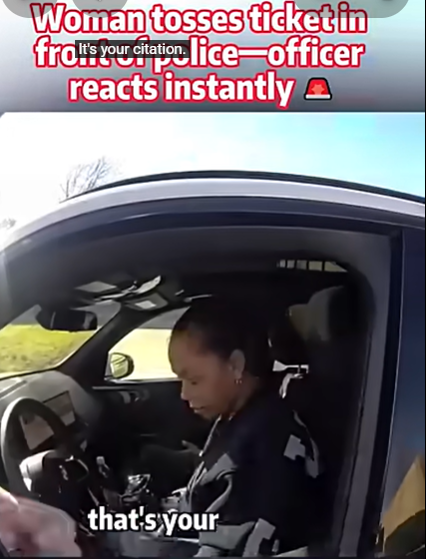
The bodycam video captures a traffic stop that quickly turns from a simple citation into a tense roadside arrest. The incident begins with a police officer standing beside a woman’s vehicle and handing her a citation. At first, the situation appears to be at the final stage of a routine stop. The officer has issued the ticket, the driver has received it, and the encounter could have ended with the woman driving away and dealing with the citation later through the proper process. Instead, the woman reacts angrily, saying she does not want the ticket and tossing it out of the car. That one action changes the direction of the entire encounter. The officer immediately treats the discarded citation as littering and orders her to step out of the vehicle.
The woman refuses to exit, and the stop quickly becomes a standoff. She argues with the officer, denies responsibility, and accuses him of throwing the ticket rather than accepting that she discarded it. Her refusal creates a new problem for the officer. The original traffic citation is no longer the only issue. Now the officer is dealing with a driver who has allegedly littered in front of him and is refusing a direct order to get out of the car. The woman’s tone is confrontational, and she makes it clear that she does not intend to cooperate simply because the officer tells her to. She says she is not afraid of him and demands to speak with a supervisor or a “colonel,” as if a higher authority might overrule the officer’s decision.
The officer tells her that he is the highest-ranking supervisor on-site, meaning there is no immediate higher-ranking person present who can take over the stop. He continues ordering her to step out of the vehicle, but she refuses again and again. This repeated refusal becomes the center of the incident. The woman may believe she is standing up for herself or challenging what she sees as unfair treatment, but from the officer’s perspective, she is refusing a lawful command during a traffic stop. Each time she refuses, the situation becomes more serious and less likely to end with only the original citation.
One of the most emotional parts of the video is the presence of a child inside the vehicle. The child appears to recognize that the situation is getting worse and tries to persuade the woman to cooperate. That detail changes the emotional tone of the scene. The argument is no longer just between an officer and a driver; a child is now witnessing the confrontation from inside the car. The child’s attempt to intervene suggests fear, embarrassment, or concern that the mother’s refusal will lead to something worse. In many police encounters, children inside a vehicle can make the situation more sensitive because officers have to manage the adult’s behavior while also being aware of the child’s safety and emotional state.
The woman continues arguing instead of following the officer’s commands. She appears focused on proving that she should not have to accept the ticket or leave the vehicle. But the roadside is not the place where a citation is usually fought. If a driver believes a ticket is unfair, the normal path is to contest it later through the court or administrative process. Throwing the ticket out of the car and refusing to step out creates an immediate enforcement issue. The officer does not have to debate the original citation endlessly on the side of the road. Once the woman refuses his command, the stop becomes about compliance and control.
As the argument continues, the officer’s verbal commands become ineffective. He gives her multiple chances to exit on her own, but she does not comply. At that point, he attempts to physically remove her from the vehicle. This is the moment when the encounter escalates from a verbal dispute to a physical arrest. The woman resists being removed, and a struggle begins near the vehicle. The officer’s body camera is briefly knocked loose during the struggle, which shows how chaotic the scene becomes. What started with a piece of paper being thrown from a car now involves an officer trying to pull a refusing driver from the vehicle while the situation becomes harder to control.
The physical struggle is one of the clearest examples of how quickly resistance can change the consequences of a police stop. The woman may have believed that refusing to exit would force the officer to wait for another supervisor or abandon the issue. Instead, her refusal gives the officer a reason to take stronger action. Once physical removal begins, the risk increases for everyone present. The woman, the officer, the child, and eventually backup officers are all pulled into a situation that could have ended much earlier if the driver had accepted the ticket or stepped out when ordered.
Backup officers arrive to assist, and the arrest is completed. With more officers present, they are able to gain control, bring the woman to the ground, place her in handcuffs, and detain her. The arrival of backup marks the end of the standoff, but it also shows how far the situation has escalated. A traffic stop that could have ended with paperwork now requires multiple officers and a physical arrest. The woman loses control of the situation completely once backup arrives, and the officers move from repeated commands to final enforcement.
The presence of the child makes the ending feel especially heavy. A child inside the car had already tried to convince the woman to cooperate, but the situation still moved toward arrest. Watching a parent argue with police and then be detained can be frightening and confusing for a child. Even if the child is physically safe, the emotional impact of witnessing the scene can be significant. The child’s attempt to intervene also suggests that, from inside the vehicle, the consequences seemed obvious. The child appeared to understand what the adult was refusing to accept: the longer the argument continued, the worse the outcome would become.
The incident shows how a small act of defiance can create a much larger problem. The woman did not simply disagree with the ticket. She threw it out of the car, argued about who was responsible, refused to exit, demanded a higher authority, ignored repeated commands, and resisted when the officer tried to remove her. Each decision added another layer to the encounter. By the time backup arrived, the original ticket was no longer the main issue. The focus had shifted to littering, refusal to comply, and the physical resistance that followed.
The officer’s position throughout the incident is based on control of the stop. During traffic stops, officers are expected to maintain authority because uncertainty can create safety risks. A driver refusing to exit a vehicle can be a serious problem because the officer cannot fully control what happens inside the car. The driver may reach for objects, attempt to drive away, continue arguing from a protected position, or delay the stop indefinitely. From the officer’s perspective, ordering the woman out of the vehicle is a way to move the interaction into a more controlled position. Her refusal prevents that.
At the same time, the woman’s behavior appears to come from anger and disbelief. She does not accept the ticket, and she seems to believe the officer is abusing his authority. Her demand for a supervisor suggests she thinks someone else might side with her. Her statement that she is not afraid of him shows that she may be trying to assert confidence or resist intimidation. But those reactions do not help her legally. In a police encounter, refusing a direct order can create consequences even if the person believes the order is unfair. The proper place to challenge the officer’s decision is usually after the stop, not through roadside resistance.
The video is also a reminder that a citation is not the same as an admission of guilt. Accepting a ticket does not necessarily mean the driver agrees with it. It simply means the driver has received notice of the alleged violation. The driver can still fight the citation later. Throwing the ticket away in front of the officer, however, creates a separate problem. It turns frustration into an action the officer can respond to immediately. The woman’s refusal to accept that distinction is part of why the encounter spirals.
The demand for a “colonel” or higher-ranking authority also shows a common misunderstanding during tense police encounters. People may believe that if they ask for a supervisor, the officer must stop everything until someone else arrives. In reality, asking for a supervisor does not usually give someone the right to ignore commands. The officer can still continue the stop and take enforcement action if he believes it is necessary. In this case, the officer tells her he is the highest-ranking person on-site, but even if another supervisor were coming, that would not automatically allow her to remain in the vehicle and refuse orders.
The child’s involvement adds a moral dimension to the situation. Adults sometimes become so focused on winning an argument that they forget who is watching. The child in the car seems to understand that cooperation is the safer option. That moment may stand out to viewers because it reverses the expected roles: the child is trying to calm the adult, rather than the adult setting an example for the child. It is a sad detail because the child should not have to manage the emotional temperature of a police stop.
The officer’s body camera being knocked loose during the struggle also shows how quickly physical encounters can become unpredictable. Bodycam footage is meant to document what happens, but during a struggle, even the camera can be displaced. That detail adds to the sense of disorder. Once the interaction becomes physical, the clean record of events can become harder to follow, and the risks increase for everyone involved. This is another reason why officers often give repeated verbal commands before moving to physical action. They are giving the person opportunities to avoid that escalation.
For viewers, the incident may be frustrating because the entire situation appears avoidable. The woman could have kept the citation, driven away, and challenged it later. Even after throwing it out, she could have stepped out of the vehicle when ordered and continued asking for a supervisor from outside the car. Instead, she chose to remain seated, argue, and resist. Those choices turned a minor issue into an arrest. The escalation did not happen all at once; it happened step by step.
The officer’s repeated commands also matter because they show that the woman was given chances to comply before the physical arrest began. This is important in how the encounter is understood. The officer did not immediately remove her from the car after one refusal. He continued telling her to step out. The more she refused, the more the officer could argue that verbal commands had failed. Once that point was reached, the situation moved into physical enforcement.
The final resolution, with backup officers forcing the woman onto the ground and placing her in handcuffs, is the outcome the child seemed to be trying to prevent. It is a stark ending to a stop that began with a citation. The woman’s anger over the ticket may have felt justified to her in the moment, but the result was far worse than simply accepting the paperwork. The arrest becomes a lesson in how important it is to separate disagreement from noncompliance. A person can disagree with an officer, but refusing direct commands during a stop can create immediate legal trouble.
The footage also highlights the emotional cost of pride during police encounters. The woman repeatedly signals that she does not want to appear afraid or controlled. She challenges the officer, demands a higher authority, and refuses to exit. But what may feel like strength in the moment can lead to losing control entirely. By refusing to step out voluntarily, she eventually has no choice when officers remove and detain her. The outcome becomes more humiliating and more serious than the original ticket ever would have been.
In the end, the video presents a clear example of a routine traffic stop that escalates because of refusal and confrontation. The woman is handed a citation, rejects it, throws it out, and is ordered to step out for littering. She refuses, argues, demands a supervisor, and continues to resist even as a child inside the vehicle tries to convince her to cooperate. The officer eventually attempts to remove her, a struggle follows, backup arrives, and she is placed in handcuffs. The strongest takeaway is that a ticket can be challenged later, but resisting commands on the roadside can turn a minor citation into a major arrest. What began as paperwork ended with officers on the ground, a child watching from inside the vehicle, and a woman detained because she refused to let the traffic stop end the easy way.
Another important part of the incident is how quickly the woman’s refusal changes the officer’s options. At the beginning, the officer’s role is limited to issuing a citation and completing the traffic stop. Once the ticket is handed over, the easiest path is for the woman to keep the paperwork, leave the scene, and decide later whether she wants to challenge it. But when she throws the citation out of the vehicle, the officer sees a new violation happening directly in front of him. From that point forward, the encounter is no longer just about the original traffic issue. The woman’s reaction creates a second problem, and her refusal to step out creates a third.
This is what makes the video feel like a chain reaction. Each choice leads to another consequence. The woman does not want the ticket, so she throws it away. The officer treats that as littering and orders her out. She refuses to exit, so the officer repeats the command. She demands a supervisor, but the officer tells her he is the supervisor on-site. She still refuses, so the officer eventually moves from words to physical action. By the time backup arrives, the original citation has almost disappeared from the center of the story. The entire encounter is now about refusal, control, and arrest.
The child inside the car remains one of the most powerful details because the child appears to understand the danger of escalation before the adult does. While the woman argues with the officer, the child tries to persuade her to cooperate. That moment stands out because it shows how stressful the situation has become inside the vehicle. Children often sense when adults are making a situation worse, even if they do not fully understand the legal details. The child likely recognizes the officer’s tone, the repeated commands, and the possibility that something bad could happen if the mother continues refusing. In that moment, the child becomes a voice of reason in a scene driven by anger.
The woman’s demand for a supervisor or “colonel” also shows how people sometimes try to regain control during a police stop. When someone feels powerless, asking for a higher authority can feel like a way to slow things down or challenge the officer’s decision. But asking for a supervisor does not usually pause the officer’s commands. It does not give the person the right to ignore instructions, stay inside the vehicle, or delay the stop indefinitely. The officer’s response that he is the highest-ranking supervisor on-site closes that path, but the woman does not accept it. Instead, she continues arguing, which keeps the conflict moving toward arrest.
Her statement that she is not afraid of the officer is another revealing moment. It suggests that the encounter has become personal in her mind. Rather than treating the situation as a legal process, she appears to view it as a confrontation she needs to win. That mindset can be dangerous during a police stop because the roadside is not a place where arguments are usually resolved in the driver’s favor. Even when an officer is wrong, refusing commands in the moment can create additional charges or justify further action. The safer and smarter option is usually to comply, document what happened, and challenge the officer later through the proper process.
The officer’s repeated orders to exit the vehicle show that he is trying to establish a clear record of noncompliance before using physical force. He does not immediately pull her out after one refusal. He gives commands again and again. This matters because it demonstrates that the woman had multiple chances to avoid the physical struggle. Each refusal makes it harder for the officer to continue relying only on words. At some point, if a driver will not follow a direct order, the officer has to decide whether to allow the refusal to continue or take action to end it. In this video, he chooses to act.
The moment he attempts to remove her from the car is where the situation becomes most dangerous. Vehicles are tight spaces, and physical struggles around car doors can be unpredictable. A person can grab the steering wheel, brace against the seat, kick, pull away, or accidentally cause someone to lose balance. The officer’s body camera being knocked loose shows how quickly the encounter becomes chaotic once physical contact begins. It also shows why verbal compliance matters. A few seconds of physical resistance can turn a controlled scene into a disorderly one.
Backup arriving changes the balance of the encounter. With more officers present, the woman has less ability to continue resisting. The officers are able to bring her to the ground, place her in handcuffs, and fully detain her. That final result is exactly what the earlier commands were meant to avoid. If she had stepped out voluntarily, the encounter may still have been tense, but it likely would not have ended with multiple officers forcing her to the ground while a child watched. The arrival of backup resolves the immediate problem for police, but it also makes the scene more traumatic and more serious than it needed to be.