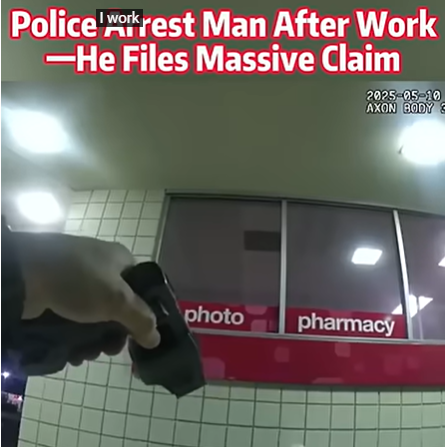
The bodycam video captures a troubling nighttime encounter outside a CVS Pharmacy, where a man wearing a white hoodie is arrested while repeatedly explaining that he works at the store and is simply waiting for a ride home. The scene begins with a police officer approaching the man in the parking lot and quickly taking control of the interaction. The officer points a taser at him, orders him to turn around, and places him in handcuffs. The man appears confused and tries to explain his situation, saying that he works there and is waiting for someone to pick him up. What should have been a simple explanation quickly becomes a tense arrest, with the officer warning him not to move and telling him there is a canine inside the police car.
The presence of the taser immediately raises the tension of the encounter. For the man being detained, the situation changes from a conversation to a threatening moment very quickly. He is outside his workplace at night, apparently expecting a ride, and suddenly finds himself facing a police officer with a taser drawn. The officer’s commands are direct and forceful, leaving very little room for discussion. The man tries to explain that he has a legitimate reason to be there, but the officer’s focus appears to be on compliance first. Once the officer decides the man is being detained, the man’s attempts to explain himself are treated as resistance or an attempt to control the situation.
The man’s explanation is important because it is simple and easy to verify. He says he works at the CVS and is waiting for a ride. That is not a complicated claim. It could potentially be confirmed by checking with store employees, reviewing his work clothes, asking for identification, or speaking with the person arriving to pick him up. Instead, the interaction escalates before that explanation appears to be fully investigated. The officer places him in handcuffs and tells him not to move, creating a situation where the man is no longer free to simply wait for his ride or return to the store.
The arrival of the rideshare driver becomes one of the most important moments in the video because it supports the man’s explanation. The driver arrives to pick him up and confirms that he is there for the man after his shift at work. This detail makes the arrest feel even more questionable. The man had already said he was waiting for a ride, and then the ride actually arrives. The driver’s confirmation gives the officer an opportunity to pause, reassess, and consider whether the man’s story is true. But according to the video summary, the officer tells the driver to leave because the man is going to jail.
That decision becomes the turning point of the encounter. Instead of treating the driver’s arrival as evidence that the man may have been telling the truth, the officer continues with the arrest. From the outside, this can feel frustrating because the situation appears to have a clear explanation. A worker is standing outside his workplace at night, waiting for a rideshare. The rideshare arrives and confirms the pickup. The man’s clothing appears consistent with work. Yet the officer still moves forward, framing the man’s earlier behavior as resisting because he initially tried to leave and allegedly attempted to “dictate” the situation.
The officer’s later explanation to the supervisor adds another layer of concern. When the supervisor arrives, the officer explains his version of events and admits that he believes the man works at the store and is wearing work clothes. That admission matters because it shows the officer understood there was a legitimate reason the man may have been outside the CVS. If the officer already believed the man was likely an employee, then the reason for escalating to arrest becomes harder to understand. The officer’s justification appears to rest not on the man being a suspicious trespasser or a threat, but on the idea that he resisted detention by trying to leave and not letting the officer control the encounter.
This is where the video becomes a larger example of how quickly a police interaction can shift from investigation to enforcement. At first, the officer may have had questions about why the man was outside the store at night. That alone could justify a brief conversation or welfare check. But once the man explained that he worked there and was waiting for a ride, the next step should have been verification. Instead, the officer appears to view the man’s response and movement as noncompliance. From the man’s perspective, he may have felt he had done nothing wrong and had no reason to be detained. From the officer’s perspective, once he gave an instruction, the man was expected to obey immediately.
The tension between those two perspectives is what drives the incident. The man seems to believe he is being stopped for no valid reason. The officer seems to believe the man is refusing to submit to authority. When those interpretations collide, even a simple misunderstanding can become an arrest. The man may have thought he was simply trying to go home after work. The officer may have thought the man was refusing a lawful detention. The problem is that the officer’s own later statements suggest he had reason to believe the man’s explanation was true. That makes the continued arrest feel less like a response to danger and more like a response to perceived disrespect or loss of control.
The warning about the canine in the police car adds to the pressure of the situation. Whether the officer mentioned it as a safety warning or as a way to make the man stay still, it contributes to the fear and intensity of the encounter. The man is already handcuffed, facing arrest, and trying to explain that he belongs there. Hearing that there is a canine nearby can make the situation feel even more intimidating. In moments like this, clear communication becomes especially important. A person who feels threatened may become more anxious, confused, or defensive, which can then be interpreted by officers as more resistance.
The rideshare driver’s role is also important because he functions as an outside witness who confirms the man’s story in real time. He is not part of the earlier interaction and has no obvious reason to create a false explanation. He arrives for the pickup and tells the officer that the man is the person he came to collect after work. That should have been a strong signal that the man was not loitering without purpose. Yet the officer dismisses the driver and tells him to leave. That moment may leave viewers wondering why confirmation from a neutral third party did not change the officer’s approach.
The supervisor’s arrival creates another chance for reassessment. Supervisors are often expected to review situations, listen to the officer’s explanation, and determine whether the response is appropriate. When the officer tells the supervisor that he believes the man works at the store, it becomes clear that the situation is not based on a complete mystery about who the man is. The disagreement is now focused on whether the man’s conduct during the stop justified arrest. The officer’s use of the word “resisting” becomes central because resisting can turn a minor encounter into a criminal matter. But the video summary suggests the alleged resistance was tied to the man initially trying to leave and “dictate” the interaction, not necessarily to violence or a serious threat.
This distinction matters. There is a difference between someone physically attacking an officer and someone trying to leave because they do not understand why they are being detained. There is also a difference between active danger and verbal disagreement. If the man believed he was free to go because he worked there and had a ride coming, his attempt to leave may have been based on confusion rather than criminal intent. The officer, however, appears to interpret that attempt as resisting. That interpretation becomes the reason the encounter escalates into an arrest.
The video also shows how important it is for officers to explain detentions clearly. If a person is not free to leave, officers should make that clear and explain why. When people understand the reason for a stop, they may be more likely to comply, even if they disagree. If they do not understand the reason, they may continue moving, asking questions, or trying to end the encounter. In this case, the man’s repeated explanation that he works at CVS suggests he does not understand why the officer is treating him as suspicious. A calm explanation and quick verification could have changed the tone of the scene.
The fact that the man was outside a CVS at night may have influenced the officer’s suspicion. Businesses at night can be places where officers watch for trespassing, theft, suspicious activity, or safety concerns. A person standing outside after hours may draw attention. But suspicion is not proof, and once the person gives a reasonable explanation, that explanation should be tested fairly. The driver’s arrival and the officer’s own belief that the man worked there appear to support the man’s side of the story. That is why the arrest feels difficult to justify based only on the facts described.
For the man, the emotional impact of the encounter is easy to understand. He may have finished a shift, stepped outside, and waited for transportation. Instead of going home, he is handcuffed and told he is going to jail. That kind of reversal can feel humiliating and frightening. It can also create a sense of helplessness, because even when evidence appears to support his explanation, the officer continues with the arrest. The man is no longer dealing with a misunderstanding he can explain away; he is facing the power of an officer who has already decided the situation is criminal.
The officer’s use of the phrase about the man trying to “dictate” the situation is also revealing. It suggests that the officer may have viewed the man’s behavior as a challenge to authority. In police encounters, officers often expect people to comply first and ask questions later. Civilians, however, often expect to be told why they are being stopped before they submit to commands. When those expectations clash, the officer may see questioning as defiance, while the civilian sees the officer’s commands as unfair. This video appears to sit directly in that conflict.
The arrest also raises concerns about how minor encounters can produce serious consequences. If the man was simply waiting for a ride after work, the situation could have ended with a brief check and confirmation. Instead, he is taken into custody, which can affect his job, his record, his finances, and his trust in law enforcement. Even if charges are later dismissed, the arrest itself can create real harm. Being booked into jail is not a small inconvenience. It can mean missed work, legal costs, embarrassment, and lasting stress.
The bodycam footage is powerful because it captures the moment when an ordinary explanation is not enough to stop an escalation. The man says he works there. The driver confirms he is picking him up. The officer admits he believes the man works there. Yet the arrest continues. That sequence is what makes the video stand out. Viewers are left asking whether the arrest was truly about public safety or whether it became about the man failing to obey the officer’s instructions exactly as expected.
The situation also highlights the importance of proportionality. Officers have authority to detain people under certain circumstances, but the response should match the actual risk. A taser, handcuffs, a canine warning, and jail are serious measures. If the underlying situation is a worker waiting outside his workplace for a ride, then the level of force and consequence may appear excessive. Even if the officer felt the man was not complying at first, the later confirmation from the driver and the officer’s own belief about the man’s employment should have encouraged a calmer reassessment.
The supervisor’s role becomes especially important in this kind of case. When a supervisor arrives, they have the opportunity to question whether the arrest is necessary or whether the situation can be resolved another way. The officer’s explanation gives the supervisor the key facts: the man likely works at CVS, he is wearing work clothes, but the officer believes he resisted because he tried to leave and control the interaction. A careful supervisor would need to weigh whether that behavior truly justified jail, especially after the man’s reason for being there was confirmed.
In the end, the video presents a troubling example of how a person can go from waiting for a ride to being arrested because an officer interprets confusion or disagreement as resistance. The man’s story appears to be supported by the rideshare driver and even partly accepted by the officer himself. Yet the officer continues to justify the arrest based on the man’s initial reaction to being detained. The footage leaves viewers with a clear question: once the officer believed the man worked there and had confirmation that he was being picked up after his shift, was jail still necessary?
The strongest takeaway from the encounter is that police authority must be paired with careful judgment. Officers may need to investigate suspicious situations, especially at night near businesses. But investigation should include listening, verifying, and reassessing when new information appears. In this case, the man’s explanation was not only plausible; it was confirmed by the arriving driver. The officer’s decision to continue with the arrest despite that confirmation makes the incident feel like an avoidable escalation. What began as a man waiting outside CVS for a ride home became a night of handcuffs, a taser warning, a dismissed rideshare driver, and an arrest that raises serious questions about communication, discretion, and the difference between genuine resistance and a person simply trying to explain why he had every right to be there.
Another important part of the encounter is the way the man’s ordinary routine is suddenly transformed into a criminal situation. He appears to be doing something many workers do every night: finishing a shift, stepping outside, and waiting for a ride home. For someone working late hours, especially at a store like CVS, waiting outside for transportation may be normal. Employees may not always have a car, may rely on rideshare services, or may wait near the entrance where the driver can easily find them. From the man’s point of view, he likely believed his presence there was completely reasonable. He was not hiding, running, or breaking into the business. He was standing near the place where he says he works, waiting for the ride that eventually arrived.
That ordinary explanation is what makes the escalation so troubling. If a person can clearly explain why they are at a location, and that explanation is quickly supported by a third party, then the situation should become less tense, not more serious. The rideshare driver’s arrival is a key moment because it confirms the man’s claim in real time. The driver did not appear later after the arrest was already complete; he arrived during the encounter, exactly as the man said he would. That should have given the officer a reason to pause and reassess. Instead, the driver is told to leave because the man is going to jail. To viewers, that moment can feel like the officer is no longer interested in whether the man’s explanation is true. The arrest has already become the main focus.
The officer’s later admission to the supervisor makes the situation even more difficult to understand. He admits that he believes the man works at the store and that he is wearing work clothes. That means the officer is not claiming he arrested a stranger with no connection to the location. He recognizes that the man likely belongs there. The problem, according to the officer, is that the man tried to leave and was attempting to “dictate” the situation after being told he was detained. This explanation changes the heart of the incident. It suggests the arrest may not be about the man being suspicious outside CVS, but about how the man responded when the officer tried to control the encounter.
This is where the difference between suspicion and authority becomes important. An officer may begin an encounter because something looks unusual. But once the person provides a reasonable explanation, the officer should be willing to test that explanation fairly. If the explanation checks out, the encounter should usually move toward resolution. In this case, however, the man’s attempt to explain himself appears to be interpreted as defiance. Instead of seeing the man as a worker confused about why he is being detained, the officer sees him as someone refusing to obey. That interpretation leads to handcuffs, a taser threat, and jail.
The use of a taser at the beginning of the arrest also shapes the entire tone of the video. A taser is not just a communication tool; it is a weapon that signals the officer is prepared to use force if the person does not comply. For the man, seeing the taser pointed at him likely made the situation feel dangerous and frightening. It also may have made it harder for him to think clearly or calmly explain himself. People do not always respond perfectly when they are suddenly threatened with force, especially if they believe they have done nothing wrong. Fear can make a person talk faster, ask more questions, hesitate, or move in ways the officer may not like. Those reactions can then be misread as resistance, creating a cycle where fear leads to more pressure, and more pressure creates more fear.
The warning about the canine in the police car adds another layer of intimidation. Even if the officer intended it as a warning to keep the man still, it makes the scene feel more severe. The man is already handcuffed and being controlled. Mentioning a canine suggests that any movement could lead to an even more frightening consequence. In a situation where the man is claiming to be an employee waiting for a ride, this level of pressure may appear excessive. It raises the question of whether the officer’s response matched the actual risk presented by the man.