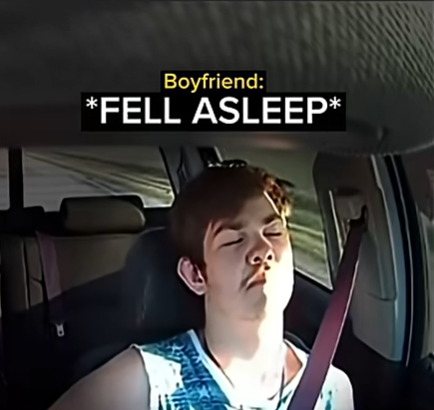
A long highway drive can feel calm and ordinary until one frightening second changes everything. This dashcam footage captures a terrifying moment when a couple narrowly avoids a serious crash after both of them fall asleep inside a moving truck. What begins as a quiet drive quickly turns into a scene of panic, danger, and sudden realization. The video is unsettling because it shows how fast drowsy driving can become life-threatening, even when the road seems open and nothing unusual appears to be happening.
At the start of the footage, the boyfriend is behind the wheel of the truck, traveling down the highway. The vehicle continues moving forward, but the driver is no longer fully aware of what is happening. His eyes are closed, his body appears relaxed, and he has completely fallen asleep while still in control of the vehicle. For a few moments, the truck keeps going, but the danger is already present. A sleeping driver cannot react to traffic, curves, road edges, or sudden obstacles. The vehicle is moving, but the person responsible for guiding it is no longer awake.
The camera then reveals that his girlfriend, sitting in the passenger seat, is also fast asleep. This detail makes the situation even more frightening. There is no one awake to notice the danger, no one to warn the driver, and no one to grab his attention before the truck begins drifting. Both people inside the vehicle are unaware that they are seconds away from a possible disaster. The silence of the moment makes it more disturbing. Nothing loud or dramatic happens at first. The danger builds quietly, hidden behind the ordinary image of two tired people sleeping during a road trip.
Then the situation suddenly changes. The boyfriend snaps awake and immediately realizes something is wrong. The truck is no longer safely centered on the road. It has started veering off course, moving toward the shoulder instead of staying in the lane. In that instant, his body reacts before he has fully processed what is happening. The calmness of sleep is replaced by shock. The vehicle hits the rough shoulder, and the sound becomes loud and violent. The rattling noise jolts through the truck, turning the sleepy silence into chaos.
The rough shoulder acts like an emergency alarm. The sudden vibration and noise make it clear that the vehicle is dangerously close to leaving the roadway completely. The truck begins swerving, and the boyfriend grips the steering wheel in panic. He is now fully awake, but he has woken up inside a moving emergency. There is no time to think slowly or calmly. He has to regain control immediately. His hands move quickly, and he fights to bring the truck back under control before it slides farther off the road or overturns.
The most intense part of the video is the struggle for control. The boyfriend yells “No! No!” as he tries to steady the steering wheel. His voice is filled with fear because he understands how close they are to a serious accident. The truck shakes and swerves as he works to slow it down. Every movement matters. Overcorrecting could make the situation worse, but failing to react could send the vehicle completely off the road. The moment is filled with panic because the outcome is uncertain. For a few seconds, it is unclear whether he will be able to stop safely.
The girlfriend wakes up in the middle of the commotion, confused and terrified. One second she is asleep, and the next she is jolted awake by the sound of the truck hitting the shoulder and the boyfriend shouting. Her reaction is immediate. She screams, disoriented and frightened, trying to understand what has just happened. Her question, “What the f*** just happened?” captures the shock of waking up inside a near-crash. She has no memory of the moments leading up to it, only the sudden fear of being thrown into danger without warning.
As the truck finally slows down and comes to a stop on the side of the road, the fear begins to shift into realization. They are safe, but only barely. The boyfriend has managed to stop the vehicle before the situation becomes much worse. The danger has passed, but the emotional impact remains. The girlfriend begins to panic as she understands that they could have been seriously hurt. The boyfriend, still processing what happened, sighs with relief and smiles nervously at the camera. His words, “I think we’re good,” sound calm, but the nervousness behind them is clear. He knows how close they came to disaster.
What makes this footage so powerful is that the danger was not caused by reckless speeding, aggressive driving, or a dramatic road event. It was caused by exhaustion. Falling asleep at the wheel can happen quietly. A driver may feel tired, blink slowly, drift mentally, and then lose awareness for a few seconds. But at highway speeds, a few seconds can be enough for a vehicle to travel a long distance without control. The driver may wake up only after the car drifts, hits the shoulder, crosses lanes, or approaches an obstacle. By then, the situation can already be critical.
This video shows the frightening truth about drowsy driving: it can feel harmless until it is not. Many people believe they can push through tiredness, especially during long trips. They may tell themselves they are almost home, that they only need to stay awake a little longer, or that opening a window or playing music will help. But fatigue can overpower intention. The body eventually demands rest, and when sleep takes over, the driver loses the ability to make decisions. The road does not pause because the driver is tired.
The presence of the sleeping passenger also adds an important lesson. Passengers can sometimes help keep a driver alert by talking, watching the road, or noticing signs of fatigue. But when everyone in the vehicle is tired, the risk increases. In this footage, there is no second set of eyes watching the road. Both people are asleep, leaving the truck moving without an alert person inside. That is why planning rest during long drives is so important. A safe trip is not only about the driver’s skill. It is also about the driver’s condition.
The boyfriend’s quick reaction likely prevented a much worse outcome. Waking up suddenly, recognizing the danger, and bringing the truck to a stop required fast instinct. Even though he panicked, he reacted with enough control to avoid a crash. But the fact that they survived should not make the situation seem less serious. They were lucky. A different road, a sharper drop-off, nearby traffic, a guardrail, or a slower reaction could have changed the ending completely. The footage is a relief because they are safe, but it is also a warning.
The girlfriend’s panic after waking up is completely understandable. She goes from sleep to terror in a matter of seconds. Her mind has to catch up with what her body is experiencing: the shaking vehicle, the loud noise, the boyfriend shouting, and the sudden stop. That kind of shock can leave a person shaken even after the physical danger is over. The emotional fear often arrives after the vehicle has stopped, when the person finally realizes what almost happened. In the moment, the body reacts. Afterward, the mind understands.
The boyfriend’s nervous smile at the end is also telling. People sometimes smile or laugh after a frightening situation, not because it was funny, but because their body is releasing stress. Relief can look strange after fear. His smile does not erase the seriousness of the moment. Instead, it shows how overwhelmed he is. He is trying to reassure himself and his girlfriend that they survived, that the truck stopped, and that the worst did not happen. His words are simple, but the video makes it clear that they came very close to danger.
This incident is a reminder that tiredness should be treated as a real driving hazard. Many drivers understand the dangers of alcohol, distraction, and speeding, but they may underestimate sleepiness. Fatigue can slow reaction time, reduce attention, blur judgment, and lead to brief moments of sleep without warning. A tired driver may not always realize how impaired they are. They may feel in control right up until the moment their eyes close.
The safest decision during a long drive is to stop before exhaustion becomes overwhelming. Pulling into a safe rest area, switching drivers, taking a proper break, drinking water, stretching, or sleeping before continuing can prevent a dangerous situation. It may feel inconvenient to delay a trip, but no destination is worth risking lives. The road will still be there after rest. The important thing is arriving safely.
The video also shows how quickly ordinary people can become part of a life-threatening moment. The couple is not doing anything unusual. They are simply traveling in a truck, tired enough to fall asleep. That normality is what makes the footage so relatable and frightening. Many people have experienced heavy eyelids during a drive or told themselves they could make it just a little farther. This video shows why that thought can be dangerous. Sleep can arrive faster than expected, and once it does, control is gone.
By the end of the footage, the couple is safe, the truck is stopped, and the immediate danger is over. But the message remains strong. They were given a second chance, and the dashcam captured a moment that could easily have ended differently. Their experience serves as a warning to anyone who drives while tired. Fatigue is not something to ignore, and sleep is not something that can be negotiated with while driving. When the body is exhausted, the safest choice is to stop.
The most haunting part of the video is how close the couple came to disaster without realizing it. The girlfriend was asleep. The boyfriend was asleep. The truck was drifting. For a brief moment, nobody was truly in control. Then a sudden jolt, a loud rattle, and a desperate reaction brought them back from the edge. Their survival feels like a relief, but the footage leaves behind a clear lesson: staying awake behind the wheel is not optional. It is the difference between a normal drive and a near tragedy.
In the end, the dashcam footage is not only a record of a close call. It is a reminder of how fragile safety can be when exhaustion takes over. A highway can seem smooth, a vehicle can feel steady, and a driver can believe everything is fine, but sleep can turn that confidence into danger in seconds. The couple was fortunate to stop safely and walk away shaken but unharmed. Their experience should encourage every driver to listen to their body, respect fatigue, and choose rest before the road forces a wake-up call far more dangerous than expected.
What makes the footage even more unsettling is the way the danger arrives without warning. There is no dramatic build-up, no obvious mistake that everyone can see coming, and no loud argument or distraction before the truck begins to drift. The couple simply appears tired, quiet, and unaware. That silence is part of what makes the video so powerful. It shows that some of the most dangerous moments on the road can begin in the most ordinary way. A person’s eyes close for a little too long. Their head relaxes. Their attention disappears. The vehicle keeps moving, but the driver is no longer mentally present.
For a few seconds, the truck is essentially traveling without an active driver. That is the frightening reality of falling asleep at the wheel. The road does not become safer because the driver is exhausted. The truck does not slow down on its own just because the people inside are unaware. Everything continues at highway speed. Lanes, shoulders, traffic signs, curves, and roadside barriers all remain in place, but the person who should be responding to them is asleep. In that short space of time, the difference between safety and disaster can come down to luck.
The boyfriend’s sudden awakening likely happens because the truck reaches the rough shoulder and the vibration becomes impossible to ignore. That rough edge of the road becomes the only warning system that wakes him before it is too late. The loud rattling, the shaking, and the unstable movement of the truck all crash into his senses at once. He wakes not gently, but violently, thrown from sleep into panic. His body has to switch instantly from rest to emergency response. That kind of sudden shock is terrifying because there is no time to slowly understand the situation. He has to react before his mind is fully clear.
In that moment, his fear is completely visible. His shouted words are simple, but they carry the weight of everything happening at once. He is not only trying to control the truck; he is trying to stop the worst possible outcome from unfolding. The road shoulder, the sound of the tires, and the swerving movement all tell him that the situation is serious. He has seconds to correct the path of the vehicle. If he turns too sharply, the truck could become unstable. If he does not turn enough, it could leave the road completely. It is a narrow and terrifying balance.
The girlfriend’s experience is different but just as frightening. She does not witness the beginning of the danger. She wakes up inside the middle of it. To her, there is no gradual understanding. She hears shouting, feels the vehicle shaking, and sees panic before she knows why. Her fear comes from confusion as much as from danger. One moment she is asleep, and the next she is inside a truck that feels out of control. That sudden jump from rest to terror can make the mind feel completely disoriented. Her scream and shock are natural responses to waking up in a crisis she did not see coming.
After the vehicle stops, the silence that follows feels almost unreal. The truck is no longer shaking. The violent noise is gone. The couple is no longer moving toward danger. But the emotional force of the moment remains inside the vehicle. Both of them have to process the fact that they were asleep while traveling at high speed. They have to realize that they might have gone off the road, hit something, rolled, or caused a crash involving others. Even though the danger is over, the fear does not disappear immediately. Sometimes the mind understands the seriousness of a situation only after the body is safe.
That is why near-miss moments can be so powerful. Nothing terrible happens in the end, but the possibility becomes painfully clear. The couple does not need to see a wreck to understand the risk. The swerving truck, the rough shoulder, and the panic are enough. The video gives viewers the same feeling. It creates relief because they survive, but it also leaves behind a heavy thought: this could have ended very differently. The fact that it did not become a tragedy does not make the warning any less serious.
Drowsy driving is especially dangerous because many people underestimate it. A tired driver may still feel responsible, careful, and experienced. They may believe they can manage the road because they have driven many times before. But fatigue affects the body in ways that confidence cannot overcome. Tiredness slows the brain, weakens focus, and makes reaction time worse. More importantly, sleep can arrive in brief, uncontrollable moments. A driver may not remember closing their eyes. They may only remember waking up when something has already gone wrong.
This is one of the reasons the video feels so important. It captures the exact moment when tiredness turns into a real emergency. It is not a warning based on imagination. It is a visible example of what can happen when exhaustion is ignored. The boyfriend does wake up in time, but only barely. The fact that he manages to recover should not be seen as proof that drowsy driving can be controlled. It should be seen as proof that they were extremely fortunate.
The passenger being asleep also shows how road trips can create shared fatigue. Long drives often happen late at night, early in the morning, or after busy days. People may push themselves because they want to reach home, meet a deadline, avoid stopping, or save time. Passengers may fall asleep first, leaving the driver alone with the road, the darkness, and the steady hum of the vehicle. That combination can make tiredness stronger. A quiet cabin, a straight highway, and repetitive scenery can make it even harder to stay alert.
The emotional danger is that tired drivers often bargain with themselves. They may think they only need to drive a few more minutes. They may tell themselves they are not that tired. They may believe that turning up the music, opening a window, or sitting up straighter will be enough. But those tricks do not replace real rest. They may create a short feeling of alertness, but they do not solve exhaustion. When the body needs sleep, it can overpower the driver’s plans without asking permission.
The boyfriend’s nervous smile at the end of the video may seem surprising after such a frightening moment, but it is a very human reaction. After intense fear, people sometimes smile, laugh, or speak casually because they are overwhelmed. It can be the body’s way of releasing pressure. His words, “I think we’re good,” sound simple, but they also show that he is trying to calm the situation down. He wants to believe the danger has passed. He wants to reassure his girlfriend, the camera, and maybe himself. But beneath that nervous calm is the understanding that they came far too close to something terrible.
The girlfriend’s panic shows the other side of the aftermath. For her, relief does not arrive immediately. Her body is still filled with fear. She is trying to make sense of what happened, and the answer is terrifying: both of them had fallen asleep while the truck was moving. That realization can create a wave of panic even after the vehicle is stopped. Sometimes being safe is not enough to stop the emotional reaction right away. The mind still replays what could have happened.
This footage can also make viewers think about responsibility on the road. Driving is not only about controlling a machine. It is about protecting everyone inside the vehicle and everyone nearby. When a driver becomes too tired to stay awake, the risk does not affect only them. It affects passengers, other drivers, pedestrians, emergency responders, and families who may be impacted by a crash. That is why fatigue must be taken seriously before it reaches a dangerous point.