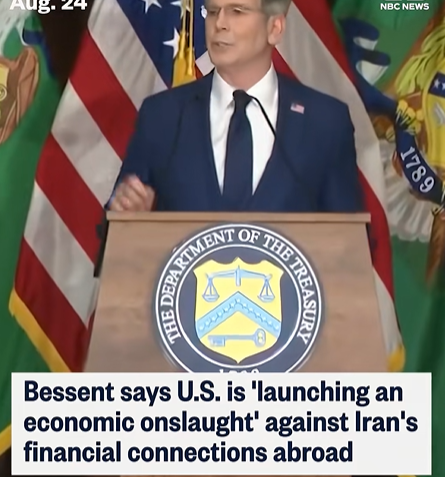
The United States has launched a sweeping new economic pressure campaign against Iran, with Treasury Secretary Scott Bessent announcing what the administration has named “Operation Economic Outcast,” an aggressive effort designed to isolate Tehran from the global financial system and cut off the sources of revenue that Washington says are helping sustain the Iranian regime. The announcement immediately drew international attention because it represents a significant escalation in the economic battle between the United States and Iran, extending the pressure beyond Iranian institutions themselves and putting foreign companies, financial networks and countries that continue doing business with Tehran on notice.
The announcement was made by Bessent on August 24, 2026, as the Trump administration sought to intensify economic pressure on Iran. According to the U.S. Treasury Department, the operation is intended to sever the economic connections that allow Iran to generate revenue and maintain access to international trade. Bessent described the campaign as an unprecedented effort and compared its significance to the opening of a major military campaign during World War II, calling it an “economic D-Day.”
The dramatic language has helped turn the announcement into one of the most closely watched developments in the ongoing confrontation between Washington and Tehran. A video circulating from NBC News captures the announcement and the administration’s message that the United States is preparing to make economic engagement with Iran increasingly costly for governments, companies and individuals around the world.
@nbcnews Treasury Secretary Bessent says the Treasury Department is launching “Operation Economic Outcast,” which he calls “an unprecedented campaign against the Islamic Republic of Iran and its enablers.”
At the center of the operation is a simple objective: Washington wants to make it increasingly difficult for Iran to earn money, move money, transport its goods and maintain the international relationships that allow its economy to function. Rather than relying exclusively on traditional sanctions against Iranian government agencies, the new campaign is designed to target the broader international network that allows Iranian trade to continue.
Bessent said the Treasury Department had mapped the networks Iran uses to move oil, transfer money, evade sanctions and maintain commercial relationships abroad. The administration’s position is that previous sanctions have created pressure but have not completely eliminated the channels through which Iran continues to generate revenue.
“Operation Economic Outcast” is intended to close those gaps.
The campaign focuses on several sectors that Washington considers essential to Iran’s ability to survive economically. Treasury specifically identified digital assets, technology, gold, aviation and shipping as five critical economic lifelines that Iran has used through foreign networks. New sanctions and enforcement measures are designed to increase the risks for companies and individuals participating in those activities.
The scale of the announcement is significant. Treasury said its Office of Foreign Assets Control was sanctioning more than 60 entities, individuals and vessels around the world that the administration says have helped Iran procure technology connected to its nuclear and missile programs, conduct cyber operations or generate oil revenue.
The United States is also warning that the consequences will not necessarily stop with Iranian companies.
That is one of the most important aspects of the new strategy.
Washington is increasingly using what are known as secondary sanctions, which can penalize foreign companies or individuals for conducting certain types of business with sanctioned Iranian entities. This gives the United States enormous leverage because access to the American financial system and U.S. dollar transactions is extremely important to businesses around the world.
The message from the Treasury Department is therefore aimed not only at Tehran but also at the governments and companies that continue to trade with Iran.
Bessent said countries would have to make choices about whether they wanted to continue supporting Iran economically or maintain close economic relationships with the United States. He warned that entities facilitating Iranian transactions could eventually face consequences under U.S. sanctions authorities. NBC News reported that the administration’s measures are aimed at international entities involved in Iranian trade related to shipping, oil, cryptocurrency, gold and aviation.
That approach creates a much broader economic battlefield.
Iran has spent years developing methods to keep trade moving despite sanctions. Oil remains particularly important because energy exports are one of the country’s most valuable sources of foreign currency. Tehran has relied on complex networks of intermediaries, shipping companies, exchange houses and other mechanisms to move petroleum and receive payment.
The Trump administration wants to disrupt those networks.
The Treasury Department’s announcement makes clear that Washington is attempting to track not only the Iranian entities at the center of these operations but also the intermediaries that make the transactions possible. According to Bessent, the campaign will focus on the people and organizations that purchase, transport and facilitate Iranian oil, as well as those helping move Iranian money through financial networks and free-trade zones.
That means companies that previously believed they could conduct business with Iran without becoming a major target may now face a very different calculation.
The United States is essentially warning that the cost of doing business with Tehran could rise dramatically.
For Iran, the timing is particularly significant. The new economic campaign comes after months of military confrontation and continued tension surrounding Iran’s nuclear program, regional influence and control over energy routes.
The economic pressure is therefore not happening in isolation.
It is part of a broader strategy by the Trump administration to force Iran into a position where maintaining its current policies becomes increasingly difficult. U.S. officials have argued that economic pressure could ultimately force Tehran back toward negotiations and potentially produce concessions over its nuclear ambitions.
Defense Secretary Pete Hegseth has also emphasized the role of economic pressure in the administration’s strategy, while leaving open the possibility of further military action if Washington believes it is necessary. Al Jazeera reported that Hegseth said economic pressure currently hurts Iran the most, while also declining to rule out future military strikes.
That combination of military pressure and economic pressure has created a highly uncertain situation.
The United States is attempting to make clear that the economic campaign should not be interpreted as a retreat from its broader objectives. Instead, officials are presenting sanctions as another instrument of national power.
The Treasury Department has described the operation in unusually forceful terms. Bessent said the campaign would continue until the Iranian regime is isolated economically and emphasized that the United States intends to eliminate what it considers the financial channels sustaining the regime.
The administration is also trying to convince other countries that cooperating with Washington will bring economic benefits while continuing to support Iran will bring increasing risks.
That creates a difficult choice for governments that have important economic relationships with Tehran.
China is perhaps the most important example.
China is Iran’s largest oil customer and one of Tehran’s most important economic partners. Any serious attempt to completely isolate Iran from global markets therefore faces a major obstacle if China continues purchasing Iranian oil.
This is where the new campaign becomes considerably more complicated.
Washington has warned that countries facilitating Iranian economic activity could face sanctions, but the administration has also shown caution about directly targeting major Chinese financial institutions. The reason is straightforward: imposing sanctions on major Chinese banks could trigger a much larger confrontation between Washington and Beijing and potentially destabilize international financial markets.
The Associated Press reported that the administration’s campaign faces a major challenge in China, which remains Iran’s main trading partner and top oil buyer. While U.S. sanctions have targeted some Iran-linked companies based in China and Hong Kong, the administration has so far avoided imposing the most disruptive possible measures against major Chinese financial institutions.
That decision illustrates the difficult balance facing the Trump administration.
Washington wants to maximize pressure on Iran without triggering a completely separate economic confrontation with China.
Those two objectives can conflict.
If the United States aggressively sanctions Chinese banks for processing Iranian transactions, Beijing could retaliate. That could affect trade, financial markets and diplomatic negotiations between the world’s two largest economies.
If Washington avoids targeting China’s most important financial institutions, however, Iran could continue to have access to one of its most important economic lifelines.
That is why the effectiveness of Operation Economic Outcast may ultimately depend not only on what the United States does but also on what other countries decide to do.
The campaign is built around the idea that Iran cannot sustain its economy indefinitely if enough international partners stop facilitating its trade.
But convincing those partners to comply is a separate challenge.
Some governments may cooperate with Washington because they depend heavily on the United States economically or politically. Others may calculate that maintaining trade with Iran is worth the risk of U.S. sanctions.
That creates a complicated international chessboard.
The United Arab Emirates, for example, has already taken steps to reduce or suspend trade with Iran, according to recent reporting. Other countries have not necessarily made the same commitment. China has strongly objected to U.S. threats involving secondary sanctions and has warned Washington against using its financial power to dictate how other countries conduct legitimate trade.
Iran, meanwhile, has rejected the idea that sanctions will force it to surrender.
Iranian officials have repeatedly argued that their country has lived under U.S. sanctions for decades and has developed ways to survive them. Iranian Foreign Minister Abbas Araghchi dismissed the latest campaign as another version of a strategy Tehran has seen many times before. Al Jazeera reported that Araghchi argued that Washington was repeatedly returning to the same approach rather than finding a new solution.
That response highlights the fundamental disagreement between Washington and Tehran.
The United States believes economic pressure can eventually force Iran to change its behavior.
Iran believes it can withstand the pressure and continue operating.
The outcome will depend on how much economic pain the Iranian government can absorb and how much cooperation Washington can obtain from the rest of the world.
For ordinary Iranians, the consequences could be significant.
Iran’s economy has already been under tremendous pressure. Sanctions can weaken a country’s currency, make imports more expensive, restrict access to international banking and make it harder for businesses to obtain technology and investment.
When sanctions intensify, ordinary citizens can feel the effects through higher prices, reduced purchasing power and shortages of certain goods.
Supporters of the U.S. strategy argue that the goal is to pressure the Iranian government rather than the Iranian population. But economic sanctions rarely operate in a completely isolated manner. When a country’s ability to participate in international commerce becomes more restricted, the consequences can spread through the broader economy.
That creates one of the central dilemmas of the strategy.
Washington wants to weaken the Iranian government without creating additional suffering for ordinary people.
Whether that distinction can realistically be maintained is a matter of intense debate.
The administration argues that the campaign is necessary because Iran’s government continues to pursue policies that Washington considers dangerous. Treasury Secretary Bessent has specifically connected the operation to Iran’s nuclear and missile capabilities, as well as its regional activities and financial networks.
Critics, however, question whether additional sanctions will actually produce the political changes the United States wants.
Sanctions have been imposed on Iran for years, and while they have caused serious economic damage, they have not consistently produced a change in Tehran’s strategic behavior.
This is why the new campaign is being watched so closely.
If Operation Economic Outcast succeeds, the administration could argue that maximum economic pressure has finally forced Iran to make major concessions.
If it fails, Washington could face the difficult question of what comes next.
That question becomes even more important because the administration is presenting the campaign as part of a larger effort to bring the conflict toward an end.
The Washington Post reported that Bessent described the initiative as a campaign intended to sever Iran’s remaining connections to the global economy and push the conflict toward an “endgame.”
That language suggests that the administration sees economic isolation as a potential pathway toward negotiations or capitulation.
But there is a major difference between hurting an economy and changing a government’s political decisions.
Governments can sometimes survive severe economic hardship, especially when leaders believe the alternative to resistance would threaten their political survival.
Iran’s leadership has decades of experience dealing with sanctions. It has developed informal financial networks, alternative trade relationships and mechanisms for moving goods and money outside traditional Western systems.
The United States is now attempting to dismantle those mechanisms.
The Treasury Department’s emphasis on mapping every network is therefore central to the campaign. Instead of simply adding another list of sanctioned Iranian organizations, Washington wants to attack the infrastructure that makes sanctions evasion possible.
That includes shipping.
Iran has used fleets of tankers and complex ownership structures to transport oil despite restrictions. Vessels can change names, flags and ownership arrangements, while cargo can move through intermediaries before reaching its final destination.
Washington wants to make those transactions increasingly difficult.
The same applies to aviation.
Iran’s aviation sector has long faced restrictions that limit its ability to obtain aircraft, parts and technology. The new campaign seeks to increase pressure on foreign entities involved in facilitating aviation-related activity connected to Iran.
Technology is another critical area.
Modern economies depend on access to advanced equipment, software and technical expertise. Restricting Iran’s ability to acquire certain technologies could affect sectors ranging from industrial production to communications and military development.
Gold and digital assets provide another challenge.
Gold can function as a store of value and a mechanism for moving wealth when access to traditional banking systems is restricted. Digital assets can also provide alternative methods of transferring funds across borders, although those networks are not completely outside the reach of regulators.
The Treasury Department is therefore attempting to attack several different financial escape routes simultaneously.
That is what makes Operation Economic Outcast different from a single sanctions announcement.
It is being presented as a continuing campaign.
Bessent said the operation would build momentum over time and that the United States would continue identifying and targeting networks that allow Iran to generate revenue.
The message is designed to create uncertainty for companies that might otherwise consider doing business with Iran.
Even if a company is not sanctioned today, executives may now have to consider whether a transaction could expose them to sanctions later.
That uncertainty itself can have economic consequences.
Banks may become more reluctant to process payments involving Iranian businesses. Shipping companies may become more cautious about transporting Iranian cargo. Insurance companies may refuse to cover certain transactions. Foreign investors may decide that the political risk is too high.
In this way, sanctions can create a chilling effect far beyond the organizations directly named on a sanctions list.
That is precisely what Washington wants.
The goal is not merely to punish specific companies.
The goal is to make the entire global business community think twice before facilitating Iranian economic activity.
But that strategy also raises questions about the reach of American financial power.
The U.S. dollar remains central to international commerce, and access to American financial institutions is extraordinarily valuable. That gives Washington an advantage that few other governments possess.
Yet the more aggressively that power is used, the greater the incentive for other countries to develop alternatives.
China, Russia and other governments have already explored mechanisms designed to reduce dependence on the dollar and Western financial institutions.
If secondary sanctions become increasingly common, those efforts could accelerate.
That means Operation Economic Outcast could have consequences extending beyond Iran.
It could influence how governments around the world think about international trade, banking and financial sovereignty.
The immediate goal is Iran.
The long-term implications could be much broader.
There is also a question of global energy markets.
Iran is a major oil-producing country, and any disruption to its exports can affect global supply. The Strait of Hormuz is particularly important because a large portion of the world’s energy shipments traditionally passes through the narrow waterway.
The current conflict has already created significant uncertainty surrounding the route.
Oil prices have responded to developments in the region, and markets have been closely watching whether the economic campaign could escalate tensions or instead create an incentive for de-escalation.
Interestingly, markets initially reacted to the new sanctions with some relief. MarketWatch reported that oil prices fell after Bessent’s announcement as investors interpreted the move as potentially increasing the possibility of a negotiated resolution rather than immediate military escalation.
That reaction illustrates the uncertainty surrounding the strategy.
Investors are not necessarily assuming that more sanctions automatically mean more conflict.
Some are interpreting the economic campaign as an alternative to military escalation.
If the United States can achieve its objectives through financial pressure rather than additional military action, global markets could view that as a positive development.
But if Iran responds aggressively, the situation could change quickly.
Iranian officials have warned that continued pressure could provoke retaliation, particularly involving energy routes and the Strait of Hormuz.
That possibility makes the economic campaign a high-stakes geopolitical experiment.
Washington is attempting to use its economic power to force Tehran into a new calculation without triggering a larger conflict.
Iran, meanwhile, has to decide whether resistance or negotiation offers the better chance of preserving the regime’s interests.
Neither side has an easy path.
For President Donald Trump, the operation also represents an opportunity to demonstrate that his administration’s strategy toward Iran is different from previous attempts.
Trump has repeatedly promised maximum pressure against governments he considers threats to American interests. His administration now has an opportunity to show whether that philosophy can produce a result.
But the success of Operation Economic Outcast will not be measured by the number of sanctions announced.
It will be measured by whether Iran’s revenue actually declines, whether sanctions evasion networks are disrupted, whether international partners comply and, ultimately, whether Tehran changes its behavior.
That is a much higher standard.
The Treasury Department’s announcement is powerful in its rhetoric, but the real test will occur in the months ahead.
Can Washington persuade China to significantly reduce Iranian oil purchases?
Can it convince international banks to stop processing Iranian transactions?
Can it disrupt shipping networks?
Can it prevent Iran from replacing lost revenue through alternative markets?
Can it maintain international support without triggering a broader confrontation?
And can it achieve those objectives without creating major economic consequences for American consumers or global markets?
Those questions remain unanswered.
For now, Operation Economic Outcast represents a major escalation in the financial pressure campaign.
The administration is telling Iran that the era of finding loopholes and relying on foreign intermediaries is coming to an end.
It is telling other countries that neutrality may become increasingly difficult.
And it is telling companies that doing business with Tehran could carry consequences even if those companies are not directly connected to the Iranian government.
The language used by Bessent reflects the seriousness with which Washington views the campaign.
He framed the choice as one between economic isolation and returning to normal participation in the international economy.
That framing leaves little room for ambiguity.