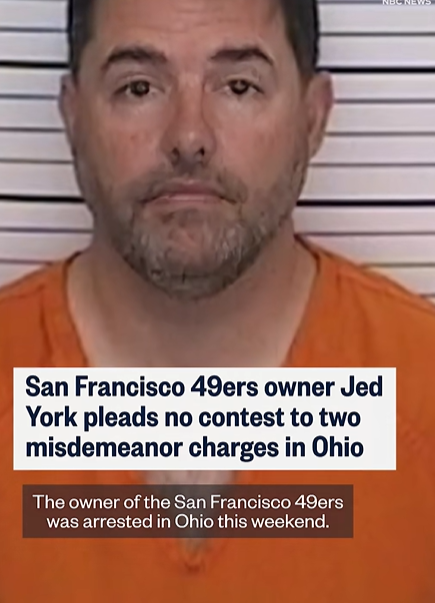
Breaking news surrounding San Francisco 49ers owner Jed York has sent shock waves through the NFL after the longtime team executive was arrested in Ohio in connection with an undercover prostitution investigation. What initially emerged as a startling report that one of the most powerful owners in professional football had been arrested quickly developed into a much more complicated legal story, with court records revealing that York later pleaded no contest to two misdemeanor charges after the original prostitution allegation was amended.
The news has attracted enormous attention because York is not simply a businessman associated with the 49ers. He is the franchise’s principal owner and CEO, a figure who has been deeply involved with the organization for years and whose decisions have shaped the team’s direction on and off the field. The timing is also significant, coming as the 49ers prepare for another NFL season and face expectations surrounding a roster that has remained one of the league’s most closely watched teams.
An NBC News video circulating on social media brought the story to a national audience, with the headline initially focusing on York’s arrest on suspicion of prostitution. But as additional information emerged from police reports and court records, the legal picture became clearer.
York was arrested on Sunday, August 23, in East Palestine, Ohio, a community near Youngstown, where he was born and raised. According to NBC Bay Area and other reports, the arrest was carried out by East Palestine police with assistance from the Mahoning Valley Human Trafficking Task Force.
The investigation involved an undercover online advertisement. Authorities allege that York responded to an advertisement on a website known for prostitution activity and arranged to meet someone he believed was offering sexual services. Court documents said he arranged to pay money in exchange for sexual activity and traveled to the location provided by the person he believed he was contacting.
When York arrived, however, he was not meeting a prostitute.
@nbcnews San Francisco 49ers owner Jed York was arrested over the weekend in Ohio and pleaded no contest to misdemeanor charges of disorderly conduct and possessing criminal tools.
He was meeting an undercover police operation.
That distinction is at the heart of the case and helps explain how a prominent NFL owner suddenly found himself being taken into custody in a small Ohio community.
According to law-enforcement records reported by multiple outlets, York allegedly used an alias while communicating with the undercover account. An incident report obtained by reporters said he identified himself as “Joe” and contacted the advertisement multiple times while attempting to arrange a meeting.
The details that have emerged describe a process that unfolded over more than one day.
The police advertisement was designed as part of an operation targeting people attempting to purchase sex. According to reports, York initially contacted the account and did not immediately receive a response. He later followed up, and communication eventually developed into an agreement to meet.
The amount of money discussed in reports has varied slightly depending on the source and stage of the reporting. NBC Bay Area cited court documents describing an agreement involving $140, while other reports based on the incident report described an amount of $160.
The precise financial details, however, are less important to the larger story than what happened after York arrived.
Police arrested him.
He was booked into the Columbiana County Jail and initially faced allegations including engaging in prostitution and possessing criminal tools. He later posted a $5,000 bond and was released.
The case then moved quickly through the local court system.
On Monday, York pleaded no contest to misdemeanor disorderly conduct and possessing criminal tools. The original prostitution-related charge was amended to disorderly conduct as part of the resolution of the case. According to NBC Bay Area, the court ordered York to pay fines and costs and imposed a jail sentence that included credit for time already served.
CBS News Bay Area reported that York was ordered to spend two days in the Columbiana County Jail, with one day credited for time served, and was ordered to pay a $1,150 fine.
The resolution means that headlines describing York simply as having been “arrested for prostitution” do not tell the complete legal story.
He was arrested on suspicion of engaging in prostitution.
But the charge was later amended.
And he ultimately pleaded no contest to the lesser misdemeanor charges.
That distinction is important when discussing an ongoing legal story because an arrest is not the same as a conviction on the original allegation. The final charges in the case were disorderly conduct and possession of criminal tools.
The “criminal tool” allegation itself stems from York’s use of his cellphone to communicate with the undercover account, according to prosecutors and court records.
The case might have remained a relatively obscure local story if not for the identity of the person arrested.
Jed York is one of the most recognizable owners in the NFL.
He became CEO of the San Francisco 49ers in 2008 and took over as principal owner of the franchise in 2024. He is also the nephew of former 49ers owner Eddie DeBartolo Jr., linking him to one of the most prominent ownership families in the history of the franchise.
Under York’s leadership, the 49ers have experienced some of the most successful football seasons in the organization’s modern history.
The team has reached the Super Bowl multiple times during his tenure, and the organization has become one of the NFL’s most valuable franchises.
York’s public profile has therefore been closely tied to the team’s success.
That makes the arrest particularly damaging from a public-relations standpoint.
The 49ers are not an ordinary sports organization. They are one of the NFL’s flagship franchises, with a national and international fan base. The team’s games, players, coaches and executives are followed by millions of people, and the owner’s behavior can quickly become a major story far beyond the football field.
The incident is also happening at an awkward moment for the organization.
The NFL season is approaching, and the team is preparing for another campaign under head coach Kyle Shanahan and general manager John Lynch. The football operation itself is expected to continue functioning despite the controversy surrounding the owner.
Shanahan has acknowledged the situation publicly, describing it as personal and emphasizing that it would not interfere with the team’s football operations. Reuters reported that Shanahan said the situation was personal while indicating that the team’s football activities would continue.
That distinction is important.
NFL franchises are enormous businesses with hundreds of employees, coaches, players and support staff. A legal controversy involving the owner does not automatically stop the football operation.
The players still have to practice.
Coaches still have to prepare for games.
The front office still has to make personnel decisions.
And the season still has to begin.
But the story creates a difficult environment around the team because every public appearance involving York is likely to attract questions.
The organization itself has chosen to say very little.
The 49ers released a statement indicating that the matter had been resolved legally and that the team would not provide further comment. CBS News Bay Area quoted the organization as saying it would not comment further because the matter was a legal issue that had been resolved.
That approach is understandable.
The franchise has little incentive to become part of the legal discussion, particularly after the case has already been resolved through a plea.
At the same time, silence can create a vacuum that is quickly filled by speculation.
That has already happened online.
Social media users have reacted with disbelief, anger, humor and questions about whether York could face consequences from the NFL itself.
The league has confirmed that it is aware of the incident.
The NFL is reviewing the case under its personal conduct policy, which applies not only to players and coaches but also to owners and executives.
That raises another important question: could Jed York face discipline from the league?
The answer is that it is possible, although the nature and severity of any potential punishment remain uncertain.
The NFL’s personal conduct policy gives the league authority to discipline individuals associated with the league for conduct that undermines its standards. Owners are not automatically exempt simply because they control franchises.
The league has historically faced difficult questions when team owners become involved in legal controversies.
One of the most frequently cited comparisons is the 2019 case involving New England Patriots owner Robert Kraft, who was charged in Florida as part of an investigation into prostitution. Kraft ultimately had the charges against him dropped after prosecutors faced legal issues involving evidence. The circumstances were not identical to York’s case, but the comparison is likely to arise because both involved high-profile NFL owners and allegations connected to prostitution.
The NFL’s response to York could therefore attract considerable attention.
A fine would be one possibility.
A suspension or other restrictions could also be considered.
The league could ultimately determine that the legal resolution and circumstances do not justify a major disciplinary penalty.
At this stage, however, there is no confirmed announcement of what punishment, if any, York will receive.
That uncertainty is likely to continue while the league reviews the matter.
The NFL has enormous financial and reputational interests in how it handles situations involving owners.
The league presents itself as an organization with strict standards for conduct, but owners occupy a unique position because they are also the people who control the franchises.
Removing an owner from control is extraordinarily difficult and would require a much more serious set of circumstances and league action than a simple suspension.
For now, the most immediate consequence for York is the reputational damage.
The arrest has become national news.
His name is now associated with an incident that would have been extremely embarrassing for almost anyone, and the fact that he is the owner of one of America’s most recognizable sports teams has amplified the story.
The circumstances are also attracting additional attention because of York’s personal life.
In May 2026, York filed for divorce from his wife, Danielle Belluomini York, citing irreconcilable differences. The couple has two children and has agreed to joint custody, according to reporting about the divorce.
The arrest therefore comes during a period of significant personal upheaval.
That does not establish any connection between the divorce and the arrest, and it would be inappropriate to speculate about one. But the timing has inevitably drawn public attention because both developments occurred within a relatively short period.
For York, the next challenge will be managing the fallout while continuing to lead a major NFL organization.
The football team cannot simply pause because of the controversy.
The 49ers are expected to compete for the postseason, and the organization’s football leadership has emphasized maintaining focus.
That places additional responsibility on Shanahan, Lynch and other executives.
The coach has already suggested that the incident will not disrupt the team’s football operations.
That may be the best approach for the franchise.
Players generally want to focus on football.
Coaches want to focus on preparation.
Fans want to know whether the team can win.
But the owner controversy is unlikely to disappear immediately.
Every press conference could bring questions.
Every team event could attract cameras.
Every major decision involving York could be scrutinized.
And every development from the NFL’s review could generate another wave of headlines.
The incident also raises broader questions about the responsibilities of sports owners.
Professional sports owners occupy a position unlike ordinary private citizens because their actions can influence organizations that represent entire cities and communities.
Fans often develop emotional connections with their teams that go far beyond the business itself.
The 49ers are deeply connected to the history of San Francisco and Northern California.
The team’s identity is built on generations of players, coaches and supporters.
When an owner becomes involved in controversy, fans may feel that the reputation of the organization itself has been affected.
That is particularly true when the controversy involves allegations of illegal or inappropriate conduct.
At the same time, there is a difference between holding an individual accountable and assigning responsibility to an entire organization.
The players did not cause the incident.
The coaching staff did not cause the incident.
The team’s fans did not cause it.
The football operation itself is separate from the legal case.
That is why the 49ers have emphasized that the matter is personal and resolved.
Still, ownership carries responsibility.
York’s position means the public will judge the franchise partly through his actions.
The question now is how the organization handles the aftermath.
Will York remain highly visible?
Will he step back temporarily?
Will the NFL impose a penalty?
Will the story continue to dominate coverage once the season begins?
Those questions remain unanswered.
The legal case itself moved unusually quickly.
York was arrested Sunday.
He posted bail.
He appeared in court Monday.
He entered a no-contest plea.
And the case was resolved with misdemeanor charges, fines and time served.
That speed means that much of the future controversy may shift away from the criminal court and toward the NFL and the court of public opinion.
The public often reacts differently to legal outcomes than courts do.
A person can resolve a criminal case through a plea agreement and still face significant reputational consequences.
That is especially true for someone with a highly visible position.
York’s case also illustrates how undercover operations can produce unexpected arrests.
The Mahoning Valley Human Trafficking Task Force has conducted prostitution-related investigations in the area, and East Palestine has been the site of similar operations.
According to reports, police used an online advertisement to identify potential buyers and then arranged meetings with undercover officers.
York allegedly responded to the advertisement and traveled to the arranged location.
The operation did not require police to identify him in advance.
They were waiting for the person who responded to the advertisement.
That person turned out to be one of the most powerful figures in the NFL.
The incident therefore quickly transformed from a local law-enforcement operation into a national sports story.
The details that have emerged are likely to continue receiving attention because the police report contains additional information about the communication between York and the undercover account.
The Associated Press reported that York used an alias while sending messages over a period of two days and that parts of the incident report remain redacted.
That means there may still be information that has not become public.
At the same time, legal analysts have cautioned that the public may never know every detail of the investigation.
Some records could remain unavailable or restricted depending on the legal process.
York has also reportedly sought to have records related to the case sealed or expunged, although the status of those efforts could change as the process continues. NBC Bay Area reported that an effort to restrict access to records was discussed by a legal analyst following the case.
For the 49ers, the best-case scenario is probably that the story fades as football takes over the national conversation.
NFL seasons move quickly.
A few weeks into the regular season, injuries, wins, losses, trades and player performances can dominate the news cycle.
But that outcome will depend partly on whether the NFL takes disciplinary action.
If the league announces a significant penalty, the controversy will return to the headlines.
If the league closes its review without major punishment, the organization may have a better chance of moving forward.
There is also the question of whether York’s ownership role itself could become a subject of debate.
There is currently no indication that the 49ers are being sold or that York is being forced out.
Such an outcome would be extremely unlikely based solely on the current legal resolution.
The NFL has mechanisms for dealing with ownership issues, but forced ownership changes are extraordinary.
The more realistic possibility is that York remains in control while facing whatever disciplinary or reputational consequences the league determines are appropriate.
For fans, reactions will likely depend on their personal views of the incident.
Some may believe that the legal resolution should end the matter.
Others may argue that an NFL owner should be held to a higher standard regardless of the criminal charge ultimately entered.
Still others may separate York entirely from the football operation and focus only on the players and coaches.
There is no universal reaction.
But the story has already become part of the 49ers’ history.
And that history is complicated.
York has been both criticized and praised throughout his time as team CEO and owner.
The organization experienced difficult periods early in his tenure, including controversies surrounding coaching decisions and front-office management.
But the franchise eventually developed into one of the NFL’s strongest football organizations under the leadership of Shanahan and Lynch.
The 49ers reached multiple Super Bowls during the current era and became a consistent contender in the NFC.
That success has helped shape York’s reputation as an owner.
The arrest now creates a sharp contrast between the team’s football success and the personal controversy surrounding its owner.
The organization wants to talk about football.
The public wants to talk about the arrest.
That tension will likely continue.
For Kyle Shanahan, the challenge is to keep his players focused.
Shanahan has already dealt with his own recent headlines after being involved in a car accident, adding another unusual element to the team’s offseason. But the coach has emphasized moving forward and preparing the team.
Players will likely follow that lead.
The NFL season is unforgiving.
Teams do not get extra time because of off-field controversy.
Games still have to be played.
The 49ers still have to prepare.
And the expectations surrounding the team remain extremely high.
That is why the next few weeks could be particularly important.
If the team performs well, football could begin to dominate the narrative.
If the team struggles, however, the ownership controversy could remain a constant part of the conversation.
Every decision involving York could be interpreted through the lens of the arrest.
This is the reality of modern sports media.
A controversy involving a prominent owner does not remain confined to a courtroom.
It becomes a social-media story, a television story, a business story and a sports story simultaneously.
The NBC News TikTok is an example of how quickly the information reached a national audience.
The initial headline was short and dramatic: the 49ers’ owner had been arrested on suspicion of prostitution.
That headline alone was enough to generate enormous attention.
But the subsequent court developments changed the picture.
The original allegation was amended.
York pleaded no contest to misdemeanor charges.
He received a relatively limited criminal penalty.
And the NFL began its own review.
That sequence demonstrates why breaking-news stories should always be updated as new information becomes available.
An arrest is the beginning of a legal process, not necessarily its conclusion.
In York’s case, the legal process moved rapidly from an initial prostitution allegation to a plea involving lesser charges.
The final court outcome is therefore different from the original arrest headline.
That does not make the arrest irrelevant.
It remains a significant event, particularly because of York’s position.
But it does mean that responsible reporting should distinguish the allegation from the final legal disposition.
For now, Jed York remains the owner and CEO of the San Francisco 49ers.