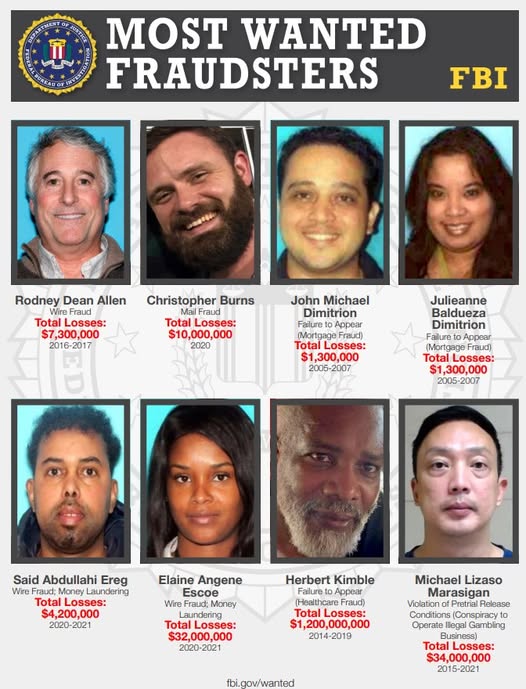
The Federal Bureau of Investigation has taken a significant new step in its ongoing effort to combat financial crime with the launch of a dedicated “Most Wanted Fraudsters” list, marking a notable shift in how authorities approach and communicate the threat of large-scale fraud. While the FBI has long maintained lists targeting violent criminals and national security threats, this new initiative places financial criminals in a similar spotlight, reflecting the growing impact of fraud on individuals, businesses, and the broader economy.
For many years, fraud was often viewed as a less visible form of crime compared to acts of violence. However, recent trends have demonstrated that financial crimes can be just as damaging, affecting millions of people and resulting in billions of dollars in losses annually. From sophisticated online scams to complex investment schemes, fraud has evolved alongside technology, making it more difficult to detect and more widespread than ever before. In response to this growing challenge, the FBI’s decision to publicly identify and track suspected fraudsters represents an effort to bring greater awareness and accountability to these crimes.
The creation of the “Most Wanted Fraudsters” list also reflects a broader recognition that financial crime is no longer confined to isolated incidents or small-scale operations. Many modern fraud schemes involve organized networks that operate across borders, using advanced techniques to target victims and avoid detection. These networks often rely on digital platforms, making it possible to reach large numbers of people quickly and efficiently. As a result, the scale of these operations can be vast, with a single scheme potentially affecting thousands of victims.
By highlighting individuals who are charged with defrauding the public, the FBI aims to disrupt these networks and encourage public participation in identifying suspects. The agency has emphasized the importance of tips from the public, providing multiple channels through which information can be submitted. Whether through an online portal, a phone call, or direct contact with a local field office, individuals who have information about these fugitives are encouraged to come forward. This collaborative approach recognizes that members of the public can play a crucial role in locating individuals who may otherwise remain difficult to track.
The decision to launch a dedicated fraud-focused list also signals a shift in priorities within law enforcement. As digital technology continues to transform the way people live and work, it has also created new opportunities for criminal activity. Cyber-enabled fraud, in particular, has become increasingly prevalent, with criminals exploiting vulnerabilities in online systems and human behavior. From phishing emails to fake investment opportunities, these schemes often rely on deception rather than force, making them harder to identify and prevent.
One of the key challenges in combating fraud is the fact that it often involves a level of trust. Victims may believe they are engaging in legitimate transactions, only to discover later that they have been deceived. This element of trust can make fraud especially damaging, as it not only results in financial loss but also undermines confidence in systems and institutions. By publicly identifying those responsible for such schemes, the FBI aims to reinforce the message that fraud is a serious crime with real consequences.
Another important aspect of the initiative is its potential to raise awareness among the public. Many people are not fully aware of the range of fraud schemes that exist or the tactics used by criminals. By drawing attention to specific cases and individuals, the FBI can help educate the public about the risks and warning signs associated with fraud. This increased awareness can, in turn, help prevent future incidents by enabling individuals to recognize and avoid potential scams.
The impact of fraud extends beyond individual victims, affecting businesses, communities, and the economy as a whole. Companies that fall victim to fraud may experience financial losses, reputational damage, and operational disruptions. At a broader level, widespread fraud can erode trust in financial systems and institutions, creating challenges for economic stability. Addressing these issues requires a coordinated effort that involves not only law enforcement but also the private sector and the public.
The global nature of many fraud schemes adds another layer of complexity to enforcement efforts. Criminals may operate from one country while targeting victims in another, making it difficult to track and apprehend them. This often requires cooperation between international agencies and governments, as well as the use of advanced investigative techniques. The FBI’s initiative can be seen as part of this broader effort to strengthen collaboration and improve the effectiveness of enforcement actions.
In addition to targeting individuals, efforts to combat fraud also involve addressing the systems and processes that enable it. This includes improving cybersecurity measures, enhancing regulatory frameworks, and promoting best practices among businesses and individuals. While these efforts may not eliminate fraud entirely, they can reduce vulnerabilities and make it more difficult for criminals to succeed.
Public perception of fraud is also evolving, as more people become aware of its prevalence and impact. Stories of individuals losing savings or businesses being compromised have brought attention to the seriousness of these crimes. The FBI’s initiative builds on this awareness, providing a structured way to focus attention on specific cases and individuals.
At the same time, it is important to approach these efforts with a clear understanding of the legal process. Being placed on a wanted list indicates that an individual is sought by law enforcement, but it does not replace the need for due process. Investigations, charges, and court proceedings all play a role in determining outcomes, and the rights of individuals must be respected throughout this process.
Looking ahead, the success of the “Most Wanted Fraudsters” list will depend on a variety of factors, including public engagement, investigative resources, and the ability to adapt to changing trends in criminal activity. As fraud continues to evolve, so too must the strategies used to combat it. This initiative represents one step in that ongoing effort, reflecting a commitment to addressing financial crime in a more visible and proactive way.
Ultimately, the launch of this list underscores the importance of awareness, collaboration, and accountability in the fight against fraud. By bringing greater attention to these crimes and those responsible for them, the FBI aims to protect the public and reinforce the message that financial crime is taken seriously. As technology continues to shape the landscape of both opportunity and risk, initiatives like this play a crucial role in ensuring that efforts to combat fraud remain effective and relevant.