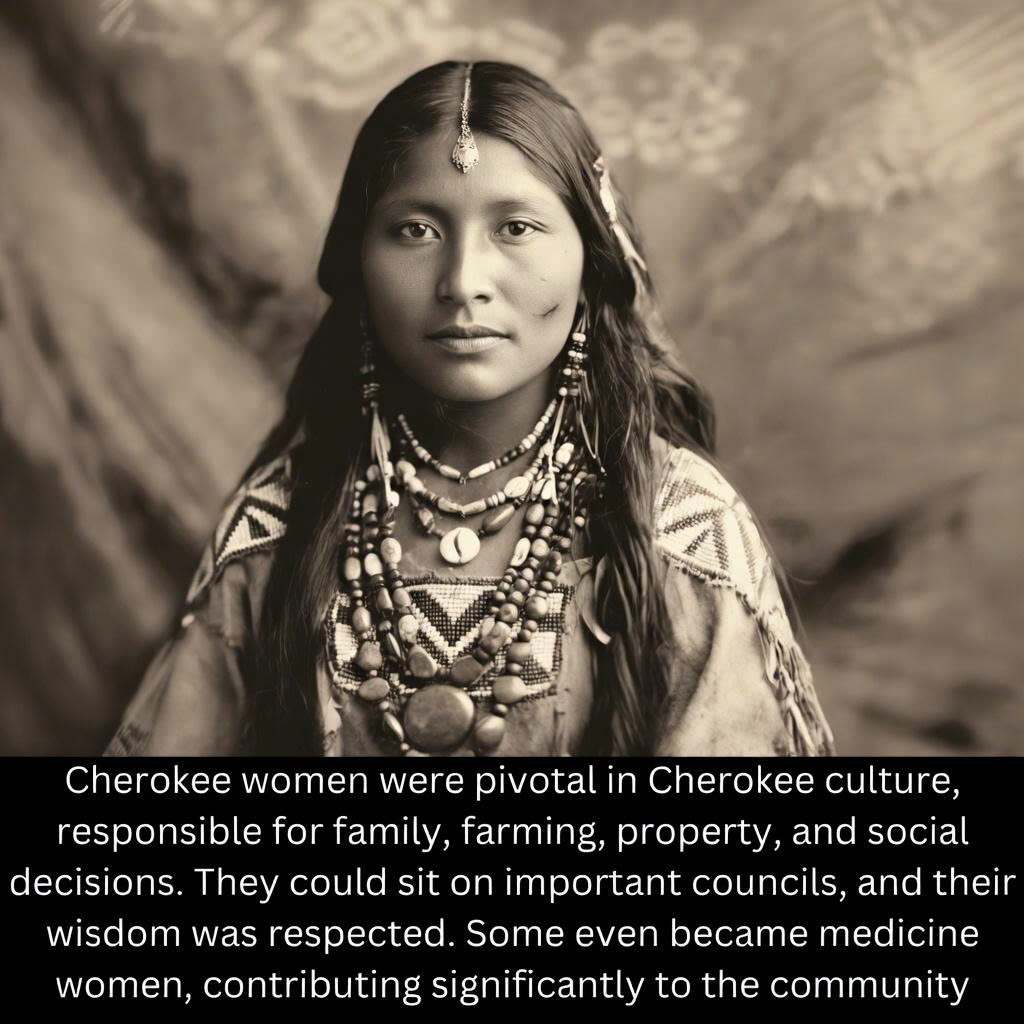
Long before European colonizers tried to reshape Native societies into their own image, Cherokee women lived within a culture where their voices carried weight, their labor sustained communities, and their authority was recognized as essential to the balance of daily life. In Cherokee society, women were not simply helpers in the background of history. They were mothers, farmers, property owners, decision-makers, clan leaders, healers, cultural keepers, and sometimes powerful political figures whose words could influence the direction of an entire nation. Their position challenges many common assumptions about gender roles in the past, especially the idea that patriarchy has always been the natural order of society. Among the Cherokee, power was not understood only through male leadership, military strength, or public authority. Power was also found in the home, in the fields, in the clan, in the control of food, in the raising of children, in spiritual knowledge, and in the ability to preserve community life across generations. Cherokee women held authority in all of these areas, and because of that, they were central to the survival and identity of their people.
One of the most striking examples of Cherokee women’s independence was the way marriage and divorce worked. In many European societies of the same period, marriage placed women under the legal and social authority of their husbands. A woman’s property, choices, and sometimes even her children could be controlled by the man she married. Divorce was difficult, often shameful, and usually required male permission, religious approval, or legal intervention. In Cherokee society, the situation was very different. Because homes and much of the household property belonged to women, a woman who no longer wished to remain married had the authority to end the marriage herself. The commonly repeated image is simple but powerful: if a Cherokee woman wanted a divorce, she placed her husband’s belongings outside the home. That act made the decision clear. The marriage was over, and the man was expected to leave. There was no need for lawyers, judges, or permission from male relatives. The home was hers, the household belonged to her, and her choice mattered.
This practice was not a small cultural curiosity. It reflected a much deeper structure in Cherokee life. Cherokee society was matrilineal, meaning that identity, clan membership, and family belonging passed through the mother’s line. Children belonged to the mother’s clan, not the father’s. A person’s place in society was connected to the mother’s family, and inheritance often followed female lines. This gave women a stable and respected position within the social order. A woman was not absorbed into her husband’s family in the way many European women were. Instead, the husband entered her world. When a Cherokee couple married, the man often came to live with his wife and her family. Her relatives, especially her brothers, had important responsibilities in the lives of her children. In many cases, maternal uncles played a major role in discipline, teaching, and guidance. This created a family system in which women were not isolated or dependent on husbands for security. They were surrounded by their own clan network, and that network gave them strength.
European colonizers who entered Cherokee territory often struggled to understand this system. They came from societies where men were expected to own property, lead families, and represent households in political matters. When they encountered Cherokee women who owned homes, controlled crops, participated in councils, and had the right to end marriages, many colonizers reacted with confusion or disapproval. Some described Cherokee society through mocking or dismissive language because they could not imagine a world where women were not legally or socially beneath men. To them, a society in which women had real authority seemed disorderly or improper. But their discomfort said more about European assumptions than about Cherokee life. The Cherokee system was not chaotic. It was organized according to a different logic, one that recognized the importance of both women’s and men’s roles.
Cherokee women were especially powerful because they controlled agriculture, and agriculture was the foundation of community survival. They cultivated corn, beans, and squash, often called the “Three Sisters,” which provided essential food for the nation. These crops were not only practical sources of nutrition but also deeply connected to culture, ceremony, and community life. Women planted, tended, harvested, stored, and distributed much of the food. That meant they were responsible for the daily nourishment of families and villages. In a society where food security determined survival, the people who controlled food held enormous influence. Men hunted, fished, fought, traded, and conducted diplomacy, but women’s agricultural labor made settled life possible. Their work fed children, elders, warriors, visitors, and leaders. Without women’s knowledge of land, seasons, seeds, storage, and preparation, Cherokee society could not have functioned.
The control of food also gave women social and political power. Food was not just a private household matter. It shaped relationships between families, clans, and communities. Women decided how food was shared, preserved, and used. They prepared meals for gatherings and ceremonies. They supported travelers and guests. They helped maintain balance in times of shortage or conflict. In many Native societies, generosity and distribution were signs of leadership, and Cherokee women played a central role in that system. Their authority came not from domination, but from responsibility. They sustained life, and that made their judgment valuable.
Cherokee women also contributed through skilled crafts and domestic production. They wove baskets, made pottery, processed hides, created clothing, prepared medicines, and maintained homes. These tasks required knowledge, patience, artistry, and practical intelligence. A basket that could hold water, a piece of leather softened for use, a house built for family life, or a field planted at the right time all represented skill passed down through generations. Women preserved not only objects but methods, stories, and teachings. Through everyday labor, they carried cultural memory. A child learning from a mother, grandmother, aunt, or elder was not simply learning chores. The child was learning how to belong to the Cherokee world.
Women’s influence extended beyond the home and field into public decision-making. Cherokee women could sit in councils and speak on important matters. They were involved in discussions about war, peace, diplomacy, and community policy. While men often held visible roles in warfare and negotiations, women’s voices were respected because they represented clans, families, and the continuation of the people. Decisions about war were not only military decisions. They affected homes, crops, children, captives, mourning families, and the future of the nation. Because women bore and raised children, maintained households, and preserved food supplies, their perspectives were essential. A society that ignored women’s wisdom would be ignoring the very people most responsible for its continuity.
Some Cherokee women rose to especially respected positions, such as “Beloved Women” or “War Women.” These titles were not symbolic compliments. They represented real authority. A Beloved Woman could speak in councils, influence diplomacy, and in some cases decide the fate of prisoners. Her words could carry moral and political force. Nancy Ward, also known as Nanyehi, is one of the most famous examples. She became known for her courage, wisdom, and influence during a period of intense conflict between the Cherokee and European settlers. She participated in diplomacy, warned settlers of attacks in some accounts, and advocated at times for peace while still defending Cherokee interests. Her life shows the complexity of Cherokee women’s power. She was not simply a peaceful figure or a romantic symbol. She lived in a violent and changing world, and she used the authority available to her to protect her people as best she could.
The existence of women like Nancy Ward reveals how different Cherokee gender roles were from the rigid European model. In Cherokee culture, women and men had different responsibilities, but difference did not automatically mean inferiority. Men and women operated in complementary spheres, each with respected forms of power. Men were often associated with hunting, warfare, and certain forms of diplomacy. Women were associated with agriculture, property, clan identity, family life, and certain forms of political and spiritual authority. These roles were not identical, and Cherokee society was not a modern equality movement in the way people might understand the term today. There were hierarchies, conflicts, expectations, and limits. Still, women’s authority was real. They were not legally invisible. They were not merely property. They were not dependent on men for social identity. They stood at the center of the clan system and the household economy.
This balance deeply disturbed many European observers. Colonizers often believed that “civilization” meant private property controlled by men, Christian marriage, male-headed households, and women confined to submissive domestic roles. When they saw Cherokee women farming while men hunted, some Europeans wrongly interpreted this as proof that Cherokee men were lazy or that Cherokee women were oppressed by labor. They failed to understand that women’s agricultural work was a source of authority, not simply burden. In Europe, plowing and land ownership were often associated with male power. Among the Cherokee, women’s connection to crops and homes gave them influence and independence. Colonizers judged Cherokee life through their own gender expectations and then tried to “correct” it.
Missionaries, government officials, and settlers gradually pushed Cherokee society toward European patriarchal norms. They encouraged men to become individual farmers and property owners, even though agriculture had traditionally been women’s work. They promoted the idea that men should head households and women should become obedient wives in the European Christian model. They introduced legal systems that favored male authority and reduced women’s control over property and marriage. They also tended to recognize male leaders in political negotiations, even when women had important traditional authority. Over time, colonial pressure weakened the public power of Cherokee women and shifted social structures toward patriarchy.
This transformation was not natural or inevitable. It was imposed through pressure, law, religion, education, and violence. The U.S. government and European-American settlers wanted Native nations to become more like them, not because Cherokee systems were failing, but because Indigenous independence stood in the way of expansion. Gender roles became part of colonization. To control Native land, colonizers also tried to control Native families. To weaken Cherokee sovereignty, they undermined Cherokee women’s authority. If property could be transferred through male ownership, if political negotiations could be conducted only with men, if children could be educated away from clan traditions, then the structure of Cherokee life could be reshaped from within.
Forced removal devastated Cherokee communities and placed enormous strain on women’s roles. The Trail of Tears and related removal policies tore families from ancestral homelands, disrupted agriculture, destroyed homes, and caused immense suffering. Women who had inherited land, maintained households, and cultivated fields were forced away from the places where their authority had been rooted. Removal was not only a political tragedy or a territorial theft. It was also an attack on a way of life in which women’s relationship to home, land, food, and clan was central. When the land was taken, women lost more than property in a Western legal sense. They lost gardens, burial places, community networks, sacred geography, and the physical foundation of inherited responsibility.
Boarding schools later continued the assault on Cherokee culture and other Indigenous cultures. Native children were taken from families and placed in institutions designed to erase language, traditions, and identity. Girls were often trained in domestic service according to Euro-American ideals of womanhood, while boys were trained in labor or trades. These schools did not respect Indigenous family systems, clan structures, or women’s traditional authority. They tried to replace them. By separating children from mothers, grandmothers, aunties, and clan relatives, boarding schools interrupted the transmission of knowledge that had sustained Cherokee identity for generations. Language, stories, ceremonies, and everyday teachings were all targeted.
Yet Cherokee women resisted. Resistance did not always look like battle or public protest, though it could include political action. Often it looked like teaching a child a word in the Cherokee language, remembering a story, preserving a recipe, maintaining a ceremony, protecting kinship ties, or refusing to accept that colonial values were superior. Women carried memory through times when official policies tried to erase it. They held families together through removal, poverty, legal pressure, and cultural attack. They adapted when necessary but continued to preserve what they could. The survival of Cherokee identity today owes much to the quiet and public labor of women who refused to let their culture disappear.
The story of Cherokee women matters because it offers a powerful correction to the way history is often told. Too often, women appear in historical narratives only as wives, mothers, victims, or background figures. Indigenous women are especially often misrepresented, romanticized, or erased. But Cherokee women were historical actors. They shaped economies, families, diplomacy, law, and culture. They made decisions. They owned property. They ended marriages. They spoke in councils. They raised children within a clan system that gave those children identity and belonging. They preserved language and tradition under extreme pressure. Their lives show that women’s power has taken many forms across different societies and that Western patriarchy was never the only possible model.
Their story also challenges the idea that progress always moves in a straight line from the past to the present. Many people assume that women in earlier centuries everywhere had fewer rights than women today. But in some areas, Cherokee women in the 1700s held powers that European and American women would not gain for a very long time. They could own homes and property, initiate divorce, and influence government at a time when many European-descended women were legally restricted by marriage and denied political participation. This does not mean Cherokee society should be idealized as perfect. No society is without conflict, inequality, or pain. But it does mean that history is more complex than the simple idea that all women everywhere were powerless until modern reforms.
Cherokee women’s authority was rooted in a worldview that valued relationship and responsibility. A woman’s power was connected to her clan, her home, her fields, her children, her community, and her knowledge. It was not only individual freedom, although individual choice mattered, especially in marriage and divorce. It was also collective responsibility. Women held power because they sustained the people. They were trusted because their work, wisdom, and kinship roles were essential to survival. This kind of authority can be difficult for modern readers to recognize if they think power only means holding an official title, commanding armies, or controlling money. Cherokee women remind us that power can also mean deciding who belongs, who eats, how property passes, how children are raised, and how a culture remembers itself.
The image of a woman placing her husband’s belongings outside the door remains powerful because it reverses so many expectations. In many patriarchal societies, the home belongs to the husband, and the woman is the one expected to leave or endure. In the Cherokee example, the home belongs to the woman. The decision is hers. The doorstep becomes a boundary. It says that marriage is not ownership. It says that a woman’s consent matters not only at the beginning of a relationship but throughout it. It says that a household can be organized around female authority without collapsing. For colonizers, this was shocking. For Cherokee society, it made sense within the larger structure of matrilineal life.
Today, remembering Cherokee women’s power is not about using the past as a simple political slogan. It is about honoring a real history that colonial narratives often tried to distort. It is about understanding that Indigenous societies had complex systems of governance, gender, family, economy, and law before European intervention. It is about recognizing that colonization did not merely take land; it also attacked relationships, identities, and gender systems. And it is about seeing that the survival of Cherokee culture is not accidental. It survived because people, especially women, carried it forward through extraordinary pressure.
Cherokee women were farmers, but they were not merely laborers. They were property owners, but they were not merely household managers. They were mothers, but they were not confined to motherhood alone. They were cultural keepers, but they were also political voices. Their wisdom was respected because their responsibilities touched every part of life. They helped decide the future because they were already sustaining the present. Their authority shows that societies can be organized in ways that do not place men above women as a universal rule. It shows that gender balance has existed in real communities, not just in dreams or theories. It shows that patriarchy is not fate.
The legacy of Cherokee women continues to matter because the questions their history raises are still alive. Who owns the home? Who controls the food? Whose family line defines belonging? Whose voice is heard in public decisions? Who teaches the children? Who preserves memory when institutions try to erase it? Who decides when a relationship is over? These are not small questions. They shape the structure of everyday life. Cherokee women answered them in ways that gave women dignity, responsibility, and recognized power. That history deserves to be remembered not as an exception or a curiosity, but as proof that human societies have always had multiple possibilities.
When people say that gender inequality is simply “how things have always been,” the history of Cherokee women stands as a direct challenge. There were women who owned the houses. There were women whose clans gave children their identities. There were women who farmed the fields that fed the nation and controlled the distribution of food. There were women who sat in councils, spoke on matters of war and peace, and carried enough authority to influence life-or-death decisions. There were women who could end a marriage by placing a man’s belongings outside a door that belonged to them. These women were not imaginary. They lived, worked, governed, resisted, and remembered. Their world was changed by colonization, but it was not erased. The memory of their power remains, and with it comes a lesson that is both historical and deeply human: different worlds are possible, because different worlds have already existed.