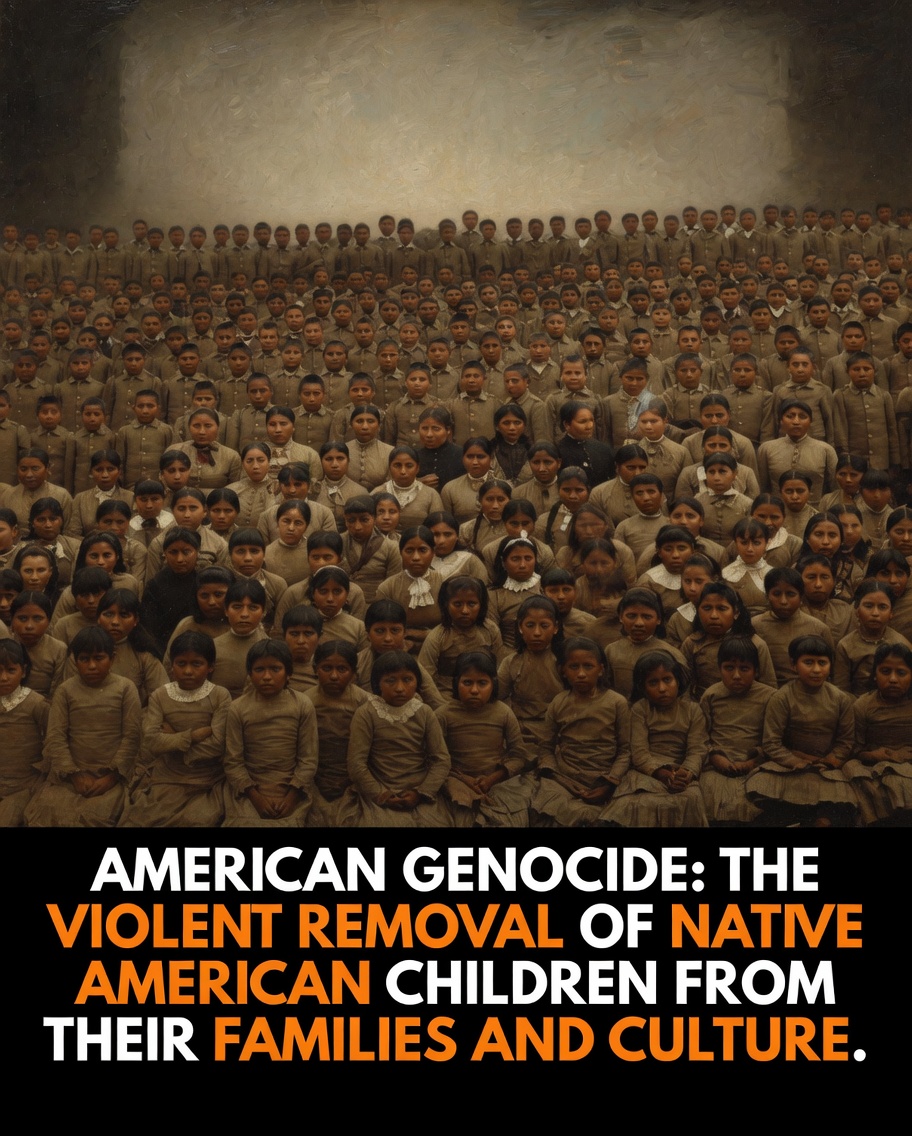
For over a century, Native American children were forcibly removed from their families and communities under government and church policies aimed at assimilation. These children were placed in boarding schools spread across the United States, with the ostensible goal of educating and civilizing them. In reality, these institutions systematically stripped children of their languages, cultural practices, and identities, replacing them with Euro-American customs and values. Hair was cut, traditional clothing forbidden, and speaking native languages often met with harsh punishment. These acts were designed to sever the connection between children and their heritage, creating generations of youth disconnected from the knowledge, traditions, and histories of their families. The boarding schools, such as the Carlisle Indian Industrial School, became symbols of cultural erasure. Children were trained for domestic labor or menial work instead of higher education, reinforcing the social and economic hierarchy imposed by colonial systems. This structured deprivation went beyond education; it was an orchestrated effort to assimilate Indigenous populations by destroying the cultural, familial, and social bonds that had sustained them for centuries.
Abuse, neglect, and high mortality rates were rampant in these institutions. Investigations and historical documentation reveal that children suffered physical and psychological abuse, malnutrition, and exposure to disease. Many never returned home, and their deaths were often unrecorded or buried in unmarked graves. For decades, these children were considered property of the state or church, and families had little recourse. Parents who resisted faced threats, removal of rations, or coercive legal pressure. For those who survived, the trauma of separation, mistreatment, and forced conformity left indelible scars. Many struggled to reintegrate into their communities, unable to fully reconnect with their families, speak their languages, or participate in traditional ceremonies. The systematic suppression of culture in these schools constitutes a clear form of cultural genocide, as recognized by scholars and Indigenous historians.
The impact of this era extends far beyond the children directly involved. The loss of language, spiritual knowledge, and cultural practices created intergenerational trauma that continues to affect Native communities today. Elders who survived boarding schools often carried feelings of shame, dislocation, and grief, which affected their ability to teach subsequent generations. Many Native languages and ceremonies were severely endangered, with communities losing critical cultural continuity. Families were fractured, and the sense of belonging to a community, a clan, or a tribe was undermined. The psychological impact manifested in increased rates of mental health struggles, addiction, and social instability in the decades following the closures of these schools. The boarding school era stands as a stark reminder of how policies intended to “educate” or “civilize” can, in fact, devastate cultures and generations.
In contemporary times, Native communities have worked tirelessly to reclaim their heritage. Language revitalization programs, cultural workshops, and storytelling initiatives have emerged as critical tools to restore what was lost. Tribal nations have advocated for the identification and memorialization of burial sites, giving children and families a measure of dignity long denied. Efforts to document the full extent of the boarding school system, including the names of children who perished, are ongoing and have received federal attention. The U.S. Department of the Interior and other agencies have begun investigating unmarked graves and ensuring that future generations can access a truthful account of these schools. Tribal communities have emphasized the importance of returning agency, giving voice to survivors, and ensuring that their histories are recognized in the broader narrative of American history.
The boarding school era also informs the wider discussion about Indigenous rights and recognition in the United States. It highlights the need for systemic change, acknowledgment of historical injustices, and a commitment to preserving Native languages, traditions, and governance. By centering Indigenous voices, policy makers and educators can begin to address the lingering effects of this cultural genocide. Today, public awareness of these schools has grown, with documentaries, books, and academic research bringing their stories to light. A growing movement seeks to ensure that all Americans understand the depth of suffering caused by forced assimilation and the resilience of Native communities in reclaiming their culture.
These schools were not isolated incidents but part of a broader pattern of colonial oppression that included land theft, displacement, and suppression of Indigenous governance. Taken together, these policies sought to replace Native ways of life with Euro-American norms, often violently. Boarding schools represented a particularly insidious form of control, targeting the youngest members of Indigenous communities and eroding the very foundation of cultural continuity. Yet, despite these efforts, Native peoples persisted. Through oral histories, ceremonies, and daily life, communities maintained traditions, passing them to future generations in defiance of assimilationist policies. The survival and revival of these traditions underscore the resilience of Indigenous peoples and their enduring connection to their cultural identity.
Recognizing the trauma of the boarding school era is crucial for reconciliation. Public acknowledgment, formal apologies, and memorials serve to validate the experiences of survivors and honor the memory of those who never returned. Education plays a vital role in this process, ensuring that future generations understand the full scope of what occurred. By teaching students about the boarding school era alongside Indigenous history and perspectives, society can foster a deeper respect for Native cultures and a commitment to justice. These efforts are not only about remembrance but also about preventing the recurrence of cultural erasure and ensuring that Indigenous communities thrive on their own terms.
Today, many Native American tribes are actively engaged in cultural revitalization. Language immersion schools, traditional arts programs, and community gatherings help restore what was suppressed for generations. Survivors of boarding schools share their stories, helping younger generations reclaim their histories and rebuild family and community connections. This ongoing work is a testament to the resilience and determination of Native peoples to maintain their identity, heal from historical trauma, and educate the broader public about the consequences of assimilationist policies. Each story shared, each language reclaimed, and each tradition revived represents a triumph over the oppressive systems that sought to erase them.
The legacy of these boarding schools is not just historical—it continues to shape the social, cultural, and political realities of Native communities today. Understanding this legacy is essential for anyone seeking to engage with Indigenous peoples in meaningful and respectful ways. By recognizing the depth of historical trauma, acknowledging ongoing challenges, and supporting initiatives aimed at cultural preservation and restoration, society can contribute to the healing and empowerment of Native communities. This era, though marked by suffering and loss, also highlights the extraordinary resilience, resourcefulness, and enduring strength of Native American peoples who continue to fight for the survival and flourishing of their cultures.
The legacy of Native American boarding schools continues to reverberate across generations, shaping not only the personal lives of survivors but also the broader social and cultural dynamics within Indigenous communities. The trauma inflicted by the systematic removal of children from their homes created fractures in family structures that were often difficult to mend. Many survivors recount the profound sense of loss and displacement they experienced, as the familiar comforts of home, family, and community were stripped away in favor of foreign rules, languages, and customs. The boarding schools’ curriculum was designed to alienate children from their cultural roots, emphasizing labor and obedience over intellectual development or the preservation of identity. As a result, generations of Native Americans grew up with a dual consciousness: the memory of a culture they were taught to abandon and the external pressures of a society that often devalued their heritage.
The physical and emotional abuse suffered at these institutions was widespread and often devastating. Historical records reveal that children were frequently subjected to harsh punishments for speaking their native languages or practicing traditional rituals. Physical discipline, including beatings and confinement, was common, creating an environment of fear and suppression. Beyond the immediate trauma, these experiences instilled long-lasting psychological effects, including anxiety, depression, and a sense of disconnection from one’s identity. Many survivors reported struggling with the inability to communicate with their parents or community members in the language of their ancestors, creating a cultural chasm that lasted for decades. The schools’ pervasive attempts to erase Indigenous identity did not merely aim to educate—they sought to fundamentally reshape the children, replacing the cultural knowledge, spiritual practices, and familial bonds that had defined their lives for generations.
Despite these challenges, Native communities have shown remarkable resilience in reclaiming their cultural heritage. Language revitalization programs, led by tribal elders and educators, have emerged as essential tools for cultural restoration. Immersion schools and community classes provide opportunities for younger generations to learn their ancestral languages, reconnecting with the linguistic roots that were almost extinguished. Storytelling, music, dance, and traditional crafts are also being revived, not merely as cultural exercises but as vital mechanisms for healing and intergenerational transmission. By reclaiming these elements of culture, Indigenous communities assert their identity, affirm the value of their traditions, and foster a renewed sense of community cohesion. These efforts underscore the enduring strength of Native peoples, who continue to resist the legacies of oppression and nurture their cultural legacy despite centuries of systemic attempts to erase it.
The discovery of unmarked burial sites at former boarding schools has intensified the urgency of these reclamation efforts. Investigations have revealed the remains of children who died while in the care of these institutions, often due to preventable illnesses, malnutrition, or mistreatment. These findings have ignited calls for accountability, reparations, and formal acknowledgment of the suffering endured by Indigenous children. For many families, the identification and proper memorialization of these burial sites are crucial steps toward closure and recognition. Tribes are working tirelessly to document the names of children who perished, reconstruct their histories, and ensure that their memory is honored. These initiatives serve not only as acts of remembrance but as powerful statements of cultural resilience, asserting that even in death, the children remain part of the living community and its enduring narrative.
The boarding school experience also had profound effects on community governance and social structures. Matrilineal and patrilineal systems, clan structures, and community rituals were disrupted as children were removed from their homes for extended periods. Elders, who traditionally served as custodians of knowledge, lost opportunities to pass down wisdom and cultural practices, weakening the transmission of heritage. This disruption extended beyond individual families, affecting social cohesion and community leadership. Yet, communities have adapted, finding new ways to restore these bonds and rebuild social frameworks. Tribal councils, cultural committees, and intergenerational mentorship programs have emerged to ensure that the teachings, values, and governance structures continue to be transmitted to future generations. These efforts are vital not only for cultural preservation but for reinforcing community resilience and self-determination in the face of historical and ongoing challenges.
Healing from the boarding school era requires confronting both the past and its continuing effects. Mental health services tailored to Indigenous populations have become essential, addressing the complex trauma experienced by survivors and their descendants. Culturally informed therapy, traditional healing practices, and community support networks provide mechanisms for coping with the intergenerational impact of forced assimilation. Education and awareness campaigns help broader society understand the depth of harm caused by these institutions, fostering empathy and support for restorative initiatives. The process of reconciliation is ongoing, requiring acknowledgment of the truth, formal apologies, and systemic changes that prevent the repetition of such injustices. It also requires celebrating and elevating Indigenous culture, ensuring that it thrives in contemporary society rather than remaining a relic of the past.
The importance of accurate historical representation cannot be overstated. For too long, mainstream narratives minimized or ignored the suffering endured by Native children in boarding schools. Textbooks often presented sanitized accounts of American history, omitting the coercive nature of these institutions and their lasting consequences. By documenting survivor testimonies, investigating burial sites, and including Indigenous perspectives in educational curricula, society can begin to correct these omissions. Accurate historical representation is not merely an academic exercise—it is a moral imperative that validates the experiences of survivors and ensures that the lessons of the past inform a more just future.
Efforts to restore language and culture also extend to the arts and media. Indigenous writers, filmmakers, and artists are creating works that reflect their lived experiences and challenge historical erasure. Literature, film, and visual arts provide platforms for storytelling, allowing communities to share their narratives with both internal and external audiences. These cultural productions not only preserve heritage but also engage younger generations, inspiring pride in identity and fostering understanding among non-Indigenous audiences. By integrating contemporary creativity with traditional knowledge, Native communities are reclaiming their voices and asserting the ongoing relevance of their culture.
The legacy of boarding schools has also influenced policy and advocacy. Tribal leaders and Indigenous organizations are actively lobbying for reparations, educational reforms, and legal recognition of historical harms. Federal and state governments have begun to acknowledge the injustices inflicted, though efforts vary widely in scope and effectiveness. Legislation aimed at supporting cultural revitalization, protecting Indigenous lands, and promoting language preservation reflects a growing recognition of the need to address historical wrongs. Advocacy work continues to emphasize that true justice involves more than symbolic gestures; it requires structural changes that empower Indigenous communities to reclaim authority over their education, heritage, and cultural practices.
The boarding school era also provides a broader lesson about the dangers of cultural assimilation as a policy goal. It demonstrates how government and institutional power can be wielded to suppress identity, inflict trauma, and destabilize communities. The resilience of Native peoples, however, underscores that culture cannot be eradicated entirely; it adapts, survives, and persists through human ingenuity and commitment. Oral traditions, rituals, and community knowledge proved more durable than the coercive power of boarding schools. This resilience serves as a testament to the strength of human communities and the importance of respecting cultural diversity in policy and governance.
In conclusion, the story of Native American boarding schools is one of profound loss, resilience, and cultural survival. The removal of children from their families and communities was a deliberate attempt at assimilation, resulting in widespread trauma and the erosion of cultural knowledge. Yet, through language revitalization, storytelling, cultural education, and advocacy, Indigenous communities continue to reclaim their heritage and transmit it to future generations. Recognition of this history is essential not only for the healing of survivors and descendants but for the moral and cultural integrity of society as a whole. By honoring the experiences of those who endured these institutions and supporting ongoing cultural restoration, we affirm the enduring strength, wisdom, and resilience of Native American peoples, ensuring that their legacy will not only survive but thrive.
The impact of Native American boarding schools is deeply interwoven with the broader narrative of colonization and systemic oppression in the United States. These schools were not isolated incidents but part of a coordinated strategy to dismantle Indigenous cultures and assert control over the lives, lands, and identities of Native peoples. By forcibly removing children from their homes, the government and associated institutions disrupted the natural processes of cultural transmission that had sustained Indigenous communities for centuries. Elders, who traditionally played a central role in teaching language, history, and spirituality, were denied the opportunity to pass on knowledge directly to the next generation. This interruption created gaps that would echo across multiple generations, affecting social cohesion, spiritual continuity, and collective identity.
Language loss remains one of the most profound consequences of the boarding school system. As children were punished for speaking their native tongues, many grew up unable to communicate fluently with their parents or grandparents. Over time, entire languages faced the threat of extinction. Today, language revitalization programs across Native communities serve as critical tools in restoring these lost connections. These programs are not simply educational; they are acts of cultural reclamation, affirming identity and ensuring that ancestral wisdom, storytelling, and oral traditions continue to thrive. Elders often lead these initiatives, teaching pronunciation, grammar, and stories, bridging the past with the present. This intergenerational exchange is pivotal in healing the fractures caused by the boarding school experience.
In addition to cultural and linguistic impacts, the boarding school era left lasting emotional and psychological scars. Survivors frequently recount feelings of isolation, shame, and internalized stigma resulting from years of institutional control. Many experienced physical and emotional abuse, including labor exploitation, punitive measures, and neglect. The separation from family members compounded the trauma, as children were thrust into environments that were both alien and often hostile. These experiences contributed to cycles of trauma that extended into adulthood, affecting parenting, community relationships, and mental health. Healing from such widespread trauma requires culturally sensitive approaches that integrate traditional healing practices with modern therapeutic strategies, fostering resilience and communal support.
The discovery of unmarked burial sites and the documentation of deaths in boarding schools has prompted renewed efforts to confront this history. Communities are actively engaged in identifying these sites, preserving records, and honoring the memories of children who died far from home. Memorials and ceremonies serve not only as acts of remembrance but also as powerful statements about the enduring presence and dignity of Indigenous peoples. By acknowledging the full scope of loss, communities are reclaiming narratives that were once silenced, fostering intergenerational healing and resilience. These efforts also serve as educational tools, informing broader society about the consequences of assimilation policies and the need for continued advocacy and accountability.
Legal and policy reforms have begun to recognize the harms caused by the boarding school system. Federal initiatives, such as the establishment of the Federal Indian Boarding School Initiative, aim to investigate historical abuses and provide resources for healing and reparations. While the path toward full acknowledgment and restoration is ongoing, these measures represent important steps in addressing historical injustices. Tribal sovereignty and self-determination remain central to these efforts, as Native nations work to regain authority over education, cultural preservation, and community governance. Ensuring that Indigenous voices guide policy decisions is essential to creating solutions that honor both historical truth and contemporary needs.
The boarding school experience also underscores the resilience and ingenuity of Native communities. Despite systematic attempts to erase cultural identity, Indigenous peoples have preserved traditions, oral histories, and social structures in ways that defy external pressures. Music, dance, ceremonial practices, and storytelling have persisted as living cultural expressions, reinforcing connections to heritage and community. Contemporary artists, educators, and cultural leaders continue to adapt these traditions to modern contexts, blending historical knowledge with creative innovation. These practices serve not only as cultural preservation but also as forms of activism, demonstrating the ongoing strength and relevance of Native identities in contemporary society.
Education today plays a crucial role in confronting the legacy of boarding schools. Incorporating Indigenous perspectives into curricula ensures that history is represented more accurately and that the voices of Native peoples are heard. Lessons on boarding schools, treaty rights, and cultural traditions provide students with a holistic understanding of the experiences and contributions of Indigenous communities. By educating both Indigenous and non-Indigenous students, schools foster awareness, empathy, and respect, laying the foundation for stronger relationships between communities. Beyond formal education, community programs, cultural workshops, and mentorship initiatives create spaces for knowledge transmission and skill-building, empowering younger generations to embrace their heritage proudly.
Ultimately, the story of Native American boarding schools is not solely one of suffering; it is also a story of enduring strength, resilience, and reclamation. The generations of children who survived these institutions, along with their descendants, continue to rebuild cultural continuity, reclaim languages, honor ancestral knowledge, and advocate for recognition and justice. While the trauma of the past cannot be erased, it can be acknowledged, confronted, and used as a foundation for healing. Through ongoing efforts in cultural preservation, education, legal reform, and community engagement, Indigenous peoples ensure that the lessons of history inform a future defined by respect, dignity, and resilience. The legacy of boarding schools serves as a powerful reminder of the importance of cultural survival, the strength of communities in the face of adversity, and the enduring spirit of Native peoples who continue to shape their own destinies while preserving the knowledge and traditions of their ancestors.