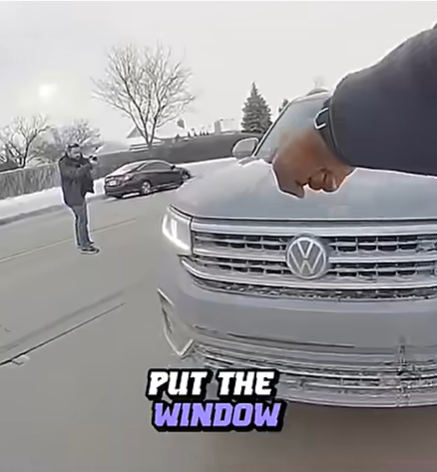
The video begins with the kind of tension that immediately makes the viewer uncomfortable. A vehicle has been pulled over, officers have their weapons drawn, and the driver is being ordered to follow commands exactly. The situation appears dangerous from the first seconds. The officers are shouting, the driver is under extreme pressure, and every movement seems loaded with risk. One command after another is given with urgency: put your hands out, open the door, step out slowly, walk backward, do not make any sudden moves. For the person inside the vehicle, the moment must have felt terrifying. He was not simply being stopped for a traffic violation. He was being treated as a serious threat before he had any real chance to understand why.
What makes the video so disturbing is not only the intensity of the stop, but the fact that the driver later turns out to be the wrong person. The officers believed they were stopping a suspect vehicle, but after the driver was ordered out and the situation began to settle, they realized the license plate did not match the vehicle they were actually looking for. That single detail changes the entire meaning of the encounter. What first looked like a high-risk police stop becomes a case of mistaken identity, and the fear placed on the driver becomes much harder to justify emotionally. From his point of view, he was suddenly surrounded by armed officers, shouted at, threatened, and forced to comply with terrifying commands, only for the police to realize afterward that they had stopped the wrong car.
The driver’s anger is completely understandable. Anyone in his position would likely feel shaken, humiliated, furious, and deeply unsafe. A police stop at gunpoint is not a small mistake. It is not like being asked for the wrong document or being briefly delayed at a checkpoint. It is a moment where a person may genuinely believe their life is at risk. When officers shout commands with weapons drawn, the driver has to process fear, confusion, and obedience all at once. One misunderstood movement, one delayed reaction, one nervous mistake, and the situation could become much worse. That is why the driver’s frustration after the officers admit the mistake carries so much weight. He is not simply upset that he was inconvenienced. He is upset because he was placed in a situation where the consequences of someone else’s error could have been devastating.
The officer named Harvey admitting responsibility is one of the most important parts of the video. Once the mistake becomes clear, he does not appear to hide behind excuses or pretend that the driver is overreacting. Instead, he acknowledges the error, gives the driver his business card, and says that the driver has every right to be furious. That matters. In many tense encounters, people feel even more disrespected when officials refuse to admit fault. A mistake is already bad, but a mistake followed by denial can feel even worse. Harvey’s admission does not erase what happened, but it does create a moment of accountability. He recognizes that the driver was wronged, and he says so directly.
Still, an apology or business card cannot undo the fear of the stop. That is the difficult part. Police officers are human, and humans can make mistakes. But when police mistakes involve weapons, commands, and the possibility of force, the stakes are much higher than in most professions. A typo in an office document can be corrected. A wrong food order can be replaced. A mistaken police stop at gunpoint can leave lasting emotional damage. The driver may replay the moment in his mind long after the video ends. He may remember the officers shouting, the feeling of stepping out slowly, the fear of doing something wrong, and the shock of learning that none of it should have happened to him in the first place.
This is why accuracy matters so much in policing. Before officers conduct a high-risk stop, they must be as certain as possible that the vehicle and person match the threat they believe they are responding to. A license plate mismatch is not a small detail. It is one of the clearest identifiers available. If the plate does not match, officers need to slow down and reassess before escalating the situation to such a dangerous level. Of course, police work can move quickly. Officers may receive incomplete information, make split-second judgments, and face situations where hesitation could put them in danger. But that reality does not remove the responsibility to verify. In fact, because the consequences are so serious, verification becomes even more important.
The video also highlights the emotional gap between how officers may experience a stop and how the person being stopped experiences it. For officers, a high-risk stop may be a trained procedure. They may see it as following protocol: control the hands, control movement, maintain distance, reduce uncertainty, and secure the scene. For the driver, however, it is not routine at all. It may be one of the most frightening moments of his life. He is not thinking in terms of procedure. He is thinking about survival. He may not know why he has been stopped. He may not understand what the officers believe. He may be scared that even if he obeys, something could still go wrong. That difference in perspective matters. A procedure can be technically familiar to police while still being traumatic for an innocent person on the receiving end.
The driver’s reaction after the mistake is revealed is not only anger; it is a demand to be treated as a human being. He forcefully expresses that what happened was unacceptable and ridiculous. His words may be emotional, but the emotion fits the situation. People sometimes expect those wronged by authority to remain calm, polite, and measured, even immediately after being frightened. But that expectation can be unfair. When a person has just been put through a terrifying experience, anger is a natural response. His frustration is part of the evidence of how serious the mistake was. If he had simply shrugged and driven away, it might be easier for viewers to underestimate the harm. His anger forces the seriousness of the moment into the open.
At the same time, the video is powerful because the encounter does not appear to end with the officers doubling down. Harvey’s decision to take responsibility prevents the situation from becoming even more disrespectful. He does not tell the driver to calm down in a dismissive way. He does not insist that the driver should be grateful it was only a mistake. He does not pretend the fear was imaginary. By saying, in effect, that the driver has every right to be angry, he validates the driver’s experience. That is not enough by itself, but it is better than defensiveness. Accountability starts with admitting reality.
The incident also raises larger questions about trust between the public and law enforcement. Trust is not built only by solving crimes or making arrests. It is also built by how officers handle mistakes. Communities know that officers will not be perfect. What people need to see is that when officers make errors, those errors are taken seriously. If a department treats a wrong stop as no big deal, trust breaks down. If officers act as though fear caused by police mistakes does not matter, people become less willing to cooperate, report crimes, or believe that the system respects them. But when an officer admits fault, documents the incident, and gives the person a way to follow up, it at least opens the door to repair.
Repair, however, should not stop at a personal apology. A serious wrong stop should lead to review. How was the wrong vehicle identified? Was the license plate checked before the stop escalated? Was the vehicle color, model, or location confused with the suspect vehicle? Did communication between officers contribute to the mistake? Was there a chance to verify before drawing weapons? Were commands given in a way that increased risk unnecessarily? These questions matter not because every officer involved must be attacked personally, but because systems improve only when mistakes are studied honestly. If the same error can happen again tomorrow, then the lesson has not been learned.
The threat made during the stop is also a major part of why the video feels so intense. The officer’s language, as described, was not calm or neutral. It was an explicit warning that if the driver did anything other than follow commands, the consequences would be severe. In high-risk police situations, officers often use strong language to gain compliance, especially when they believe someone may be dangerous. But when the person is innocent and the stop is wrong, that language becomes especially painful. It means the driver was not only stopped by mistake; he was verbally placed under extreme fear by mistake. Even if the officer believed he was acting for safety, the impact on the driver remains real.
This is one of the hardest realities in police encounters: intent and impact are not always the same. The officers may not have intended to traumatize an innocent person. They may have believed they were stopping someone connected to a serious situation. They may have been trying to protect themselves and the public. But the impact was that an innocent driver was treated like a dangerous suspect. Good intentions cannot fully erase harmful impact. A responsible response must hold both truths at once: officers may have been acting under pressure, and the driver still suffered a serious wrong.
The video also shows how important communication becomes after a mistake. Once officers realized they had the wrong vehicle, they had a choice. They could minimize the mistake, rush the driver away, or treat him like an inconvenience. Instead, Harvey’s admission creates a different tone. By handing over his card and taking responsibility, he gives the driver a point of contact and a name attached to the mistake. That matters because one of the most frustrating feelings after being wronged by an institution is the feeling that no one can be held accountable. A business card is not justice by itself, but it is a symbol that the officer is not disappearing anonymously behind the badge.
The driver’s anger also represents a larger public fear: that anyone can suddenly become the wrong person in the wrong place. Most people watching the video can imagine themselves in his position. Maybe they drive a similar car. Maybe they happen to be in the same area as a suspect. Maybe an officer misreads a plate or receives bad information. The frightening part is how quickly ordinary life can turn into a high-risk stop. One moment a person is driving normally; the next, they are facing shouted commands and weapons. That possibility is why people demand accuracy, restraint, and accountability. When police power is used, it must be used carefully because ordinary people have very little control once that power is directed at them.
This incident also reminds viewers that compliance during a frightening encounter is not always easy. People often say, “Just follow orders,” but in real life, fear can make even simple instructions difficult. When several officers are shouting, when adrenaline is high, when a person is confused about why they are being stopped, and when they know that any movement may be judged harshly, the body can freeze or shake. A person may move too slowly, too quickly, or misunderstand a command. That is why officers must give clear, consistent instructions and avoid creating unnecessary confusion. The safer the communication, the lower the risk for everyone.
From the officers’ perspective, high-risk stops are dangerous because they do not know what they are facing. That is true. Officers may have only partial information, and some stops do involve armed or violent suspects. But the power imbalance means the burden of precision must remain high. The driver cannot verify the police information for them while sitting in the vehicle under threat. He cannot correct their database, compare suspect details, or calmly debate the plate number in that moment. The officers control the scene. Therefore, officers also carry responsibility for making sure the scene should have been created in the first place.
The emotional force of the driver’s response comes from the fact that he knows he did nothing to deserve that level of fear. Being stopped by police can already be stressful. Being stopped at gunpoint is something else entirely. When he learns it was because of a mistake, his outrage becomes not only personal but moral. He is saying, in effect, “You cannot do this to people and then treat it like a small error.” That message is important. It pushes back against the idea that authority can frighten innocent people and then simply move on.
The incident also speaks to the need for humility in positions of power. Police officers are given authority that ordinary citizens do not have. They can stop vehicles, detain people, issue commands, and in serious situations, use force. Because of that authority, humility is not optional. Officers must be willing to admit when they are wrong. Harvey’s admission matters because it shows a moment of humility. But humility should also exist before escalation, not only after error. It should encourage officers to ask: Are we sure? Did we verify? Is this the right car? Is there another way to reduce risk before turning this into a high-risk stop?
For the public, the video can create mixed feelings. Some viewers may focus on the mistake and see it as proof of serious police failure. Others may focus on the officer’s apology and see it as an example of taking responsibility. Both interpretations can exist together. The stop was wrong, and the admission of fault was important. The driver was right to be angry, and the officer was right to acknowledge that anger. The incident should not be reduced to only one simple conclusion. Its value is in showing both the danger of police error and the importance of accountability afterward.
The larger lesson is that authority must always be matched with responsibility. The more power an institution has, the more carefully it must use that power. A wrong stop involving shouted commands and drawn weapons is not just a procedural mistake; it is a human event with emotional consequences. The driver in this video became the center of a frightening situation because someone got something wrong. That should matter to everyone, regardless of their general views about police. A system that can make such a mistake must also be serious about preventing the next one.
In the end, the video is not only about one driver, one officer, or one mistaken license plate. It is about the fragile line between public safety and personal harm. Police must sometimes act quickly to protect people, but speed without accuracy can endanger the innocent. Officers must sometimes give firm commands, but commands based on mistaken identity can deeply damage trust. Apologies matter, but prevention matters more. The driver’s anger should not be dismissed as overreaction. It is the natural response of a person who was forced into fear because of an error he did not create.
What stays with the viewer is the moment of realization: the officers suddenly understand that the vehicle does not match, and the entire stop shifts from certainty to mistake. That shift is heavy. It shows how dangerous certainty can be when it arrives too early. It shows why every detail matters. It shows why verification is not a technical formality but a safeguard for human life and dignity. And it shows that when authority gets it wrong, the person harmed has every right to demand answers.
The driver drove away from the encounter alive, but that does not mean nothing happened. Fear happened. Humiliation happened. Anger happened. A trust wound happened. The officer’s apology may have been sincere, and his accountability may have been meaningful, but the moment still deserves scrutiny. The best outcome is not simply that the driver received a business card. The best outcome would be that the department learns from the mistake, improves its procedures, and prevents another innocent person from experiencing the same fear.
This video matters because it forces a difficult but necessary truth into view: public safety cannot come at the cost of careless identification, and accountability cannot begin only after someone has been terrified. The driver had every right to be furious because he was treated as a threat when he was not the suspect. The officer was right to admit the mistake because honesty is the first step toward repair. But the deeper responsibility belongs to the system itself. A mistake this serious should become more than a viral clip. It should become a reason to train better, verify more carefully, communicate more clearly, and remember that behind every vehicle stopped is a human being whose life can be changed in seconds.
Another important part of this story is how easily a mistake can become dangerous when everyone involved is operating under fear. Police officers may have believed they were dealing with a serious suspect, so they approached the vehicle with maximum caution. The driver, meanwhile, had no way of knowing what information the officers had or why they were treating him as a threat. That creates a dangerous imbalance. Officers are acting from suspicion, while the driver is acting from confusion. In that gap, even small movements can be misread. A person reaching for a seatbelt, lowering a window, moving a hand, or turning their head could be interpreted as noncompliance. That is why mistaken high-risk stops are so serious. They do not only create emotional harm after the fact; they create immediate physical risk in the moment.
This kind of incident also shows why public trust depends on more than individual officer behavior. Harvey admitting the mistake was important, but the public also needs to know that there are systems in place to prevent similar errors. A department should not rely only on one officer’s honesty after something goes wrong. It should have strong procedures before the stop happens. License plates should be confirmed carefully. Vehicle descriptions should be repeated clearly. Dispatch information should be checked. Officers should communicate uncertainty when they are not fully sure. If one detail does not match, especially something as important as the plate, that should immediately slow the escalation unless there is a clear and urgent threat.
The driver’s anger may also come from the feeling of being powerless. During the stop, he had to obey. He could not argue, explain, or defend himself in a normal way. He could not say, “You have the wrong car,” and expect a calm discussion. In that moment, the only safe option was compliance. That loss of control is frightening. Afterward, when the officers realized the mistake, his anger became the only power he had left. His voice was the only way to reclaim some dignity after being treated like a suspect. That is why his reaction should not be dismissed as disrespectful. It was a human response to being placed in a terrifying situation without cause.