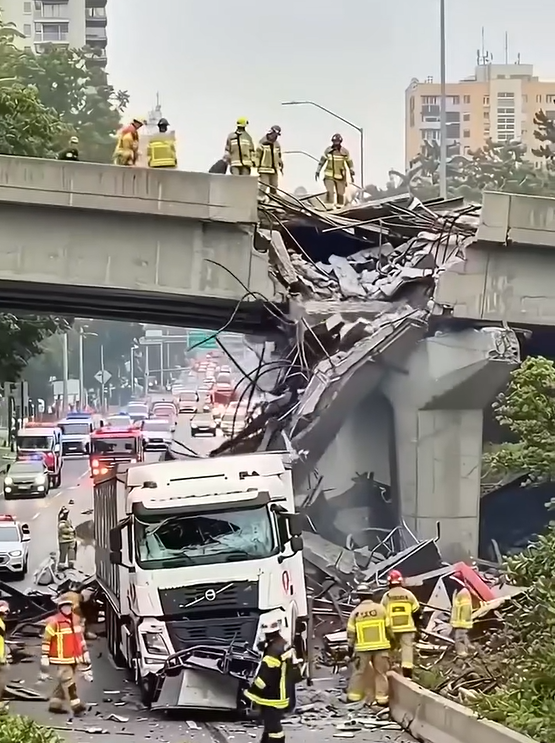
A serious commercial vehicle collision caused major traffic disruption in Richmond, British Columbia, after a dump trailer struck the Cambie Road overpass along Knight Street, forcing authorities to shut down the busy southbound route while engineers examined the structure for possible damage.
The collision occurred Friday morning on Knight Street, just south of the Knight Street Bridge, according to Richmond RCMP. Police said emergency crews were called to the area at approximately 7:15 a.m. Pacific Time after receiving reports that a large commercial vehicle had collided with the Cambie Road overpass.
Images from the scene showed the aftermath of the dramatic crash, with the commercial trailer pressed against the overpass and highway signage along the northern side of the structure. The impact immediately raised concerns about whether the bridge and surrounding infrastructure had suffered damage that could make the area unsafe for motorists.
Southbound lanes of Knight Street were closed as police, transportation officials and city crews worked around the crash site. Drivers heading through Richmond were advised to avoid the area and find alternative routes because authorities could not immediately estimate when the highway would reopen.
Richmond RCMP said the closure would remain in place while officials assessed the condition of the overpass and confirmed whether the structure could safely support normal traffic.
Police acknowledged that the closure would create significant inconvenience for commuters and other travellers but stressed that public safety had to come first.
Knight Street is an important transportation corridor connecting Richmond with Vancouver and surrounding areas. A major closure during busy daytime hours can quickly cause traffic congestion on nearby streets as thousands of drivers search for alternative routes.
Authorities therefore urged motorists to plan ahead, allow additional travel time and avoid the affected section of Knight Street whenever possible.
The City of Richmond said that although the highway itself falls under provincial jurisdiction, municipal staff were assisting with the emergency response and structural examination.
Engineers and other specialists were brought to the scene to determine whether the collision had compromised the Cambie Road overpass or any nearby portions of the Knight Street transportation system.
Officials said a detailed structural examination would be necessary before traffic could safely return to normal.
The inspection process was expected to continue throughout the day.
Photographs taken following the collision showed the trailer resting against the overpass, creating a striking scene for drivers and residents in the area.
The position of the trailer suggested that the upper portion of the commercial vehicle had failed to clear the bridge while travelling beneath it.
As investigators examined the scene, questions emerged about exactly how the collision happened and what occurred immediately afterward.
Early information from police indicated that the driver had been speaking with investigators.
However, Richmond RCMP later provided additional details about the incident and the investigation.
According to police, investigators determined that the commercial vehicle had been towing a dump trailer while the trailer was in a raised position.
Because the trailer remained elevated, it was unable to pass safely beneath the Cambie Road overpass.
The raised trailer struck the structure with enough force that it became separated from the commercial vehicle.
Police said the vehicle itself was eventually located some distance away from the trailer.
That discovery became an important part of the investigation because the truck and trailer were no longer together when authorities examined the crash scene.
RCMP Cpl. Dennis Hwang said investigators determined that the dump trailer had been travelling in its raised position before failing to clear the overpass.
Police later said the driver of the commercial vehicle was not co-operating with investigators.
The Richmond Road Safety Unit subsequently took responsibility for the investigation.
No injuries were reported in connection with the crash, according to police.
That was one of the few pieces of good news to emerge from an incident that created substantial transportation problems and raised concerns about possible damage to critical infrastructure.
Although the collision looked severe, emergency officials did not report any motorists, pedestrians or workers being injured.
The lack of injuries allowed crews to focus their attention on securing the scene, investigating the cause of the collision and determining whether the overpass could remain in service.
Structural assessments following an overpass collision can be complicated because damage is not always immediately visible.
Even when a bridge appears intact from the outside, engineers may need to inspect concrete, steel, support components, joints and other parts of the structure to determine whether the impact affected its ability to safely carry traffic.
An over-height commercial vehicle can deliver significant force when it strikes an overhead structure, especially when travelling at normal highway speeds.
For that reason, roads are sometimes kept closed even after the vehicle involved in the collision has been removed.
Authorities need to be confident that the structure above the road remains secure before allowing thousands of vehicles to pass beneath or across it.
In Richmond, officials said the examination involved not only the Cambie Road overpass but also nearby infrastructure associated with Knight Street.
The Richmond Road Safety Unit was expected to work alongside British Columbia’s Ministry of Transportation and Infrastructure as engineers carried out their assessments.
Officials were looking at the Knight Street bridge deck, the Cambie Road overpass and surrounding areas that could potentially have been affected by the collision.
Until those inspections were completed, authorities were unwilling to give motorists a firm reopening time.
For commuters, the timing of the collision created immediate difficulties.
The incident happened shortly after 7 a.m., when many residents were beginning their morning journeys to work, school and other destinations.
Once southbound Knight Street was closed, traffic pressure shifted to other routes through Richmond.
Police encouraged travellers to reroute instead of approaching the closure and hoping to pass through.
The crash also renewed attention on a recurring transportation safety issue in British Columbia: commercial trucks and oversized loads striking highway overpasses.
The Lower Mainland and Fraser Valley have experienced a number of similar incidents in recent years, leading to repeated discussions about driver responsibility, commercial vehicle safety and the design of transportation infrastructure.
Overpass strikes can cause far more than traffic delays.
Depending on the severity of the impact, a collision can lead to expensive repairs, lengthy closures, inspections, restrictions on bridge use and significant disruption for nearby communities.
Major transportation corridors often carry thousands of vehicles every day, meaning even a short closure can have widespread consequences.
Commercial transport routes are particularly important because they are used not only by everyday motorists but also by trucks carrying goods between ports, warehouses, distribution centres and businesses.
When one of these routes becomes unavailable, the effects can extend beyond commuters and potentially disrupt freight movement as well.
The Richmond collision therefore became part of a larger debate about how over-height commercial vehicles are managed on British Columbia roads.
Last summer, a series of incidents involving trucks striking overhead structures prompted concerns from transportation officials and trucking industry representatives.
One widely discussed incident occurred at a Highway 1 overpass in Langley.
At the time, provincial transportation authorities said it was among several cases involving trucks or vehicles carrying loads that were too high to safely pass beneath bridges.
Repeated collisions have led members of the trucking industry and government officials to discuss possible solutions.
These include stronger enforcement, improved driver training, better route planning, warning systems, clearer signage and technology that can alert drivers when their vehicles exceed safe height limits.
Industry representatives have acknowledged that driver error can contribute to these crashes.
A driver operating a commercial vehicle is expected to understand the height of the truck and its load and to ensure that the planned route can accommodate the vehicle.
The situation becomes particularly dangerous when equipment such as a dump trailer is left in a raised position while the vehicle is moving.
A raised dump trailer dramatically increases the total height of a commercial vehicle and can create an immediate risk when travelling beneath bridges, power lines, signs or other overhead structures.
The Richmond incident appeared to demonstrate exactly why such situations can have serious consequences.
According to police, the dump trailer was still raised when it encountered the Cambie Road overpass.
The collision was powerful enough to separate the trailer from the commercial vehicle, leaving the trailer at the overpass while the truck was found farther away.
Investigators were expected to examine the sequence of events carefully.
That process could include reviewing the truck and trailer, speaking with witnesses, studying nearby cameras and determining the vehicle’s movements before and after the collision.
Police could also examine whether any mechanical issues contributed to the incident.
Commercial vehicles often contain equipment and systems designed to help drivers monitor the position and condition of trailers.
Investigators may therefore consider whether the raised trailer resulted from human error, a mechanical problem or another factor.
Authorities had not publicly announced a final cause beyond the initial finding that the raised dump trailer failed to clear the structure.
The incident also highlighted the importance of reporting commercial vehicle collisions immediately.
When a truck strikes public infrastructure, authorities need to respond quickly even if the driver believes the damage is minor.
Structural damage can create risks for other motorists, and leaving the area without proper inspection can make those risks more difficult to manage.
Police said the commercial vehicle involved in the Richmond incident was found some distance from the trailer after the two became separated.
Authorities did not initially provide complete details explaining the driver’s actions following the collision.
Later information from RCMP indicated that the driver was not co-operating with investigators.
The investigation remained active as police attempted to establish a complete picture of what occurred.
For transportation officials, meanwhile, the immediate priority was the overpass itself.
Engineers typically look for cracking, displacement, deformation or other signs that a collision has weakened a structure.
They may also inspect barriers, signs, support beams and adjoining sections of roadway.
If damage is discovered, authorities must determine whether temporary repairs can allow traffic to resume or whether more substantial construction is required.
Even when an overpass is eventually declared safe, crews may still need to repair cosmetic or secondary damage caused by the collision.
Highway signs and other roadside equipment can also be damaged when a large commercial trailer strikes an overpass.
Photos from the Richmond scene showed the trailer positioned close to signs attached to the structure.
Officials therefore had several components to examine before giving the all-clear.
The crash drew considerable attention partly because incidents involving commercial vehicles and overpasses have become a familiar concern for drivers in the region.
Each new collision raises questions about whether enough is being done to prevent similar events.
Some trucking industry representatives have argued that infrastructure improvements should form part of the solution.
They say better warnings and modernized highway systems could help drivers identify dangerous routes before a vehicle reaches a low-clearance structure.
Others point to enforcement and driver accountability.
Commercial vehicle operators are responsible for understanding the dimensions of their equipment and following appropriate transportation routes.
When loads exceed standard dimensions, additional permits and planning may be required.
Technology may also play a growing role in preventing overpass strikes.
Height-detection systems can use sensors to recognize vehicles that are too tall for an approaching bridge.
Those systems can trigger warning signs or flashing lights, giving drivers an opportunity to stop or change direction before reaching the structure.
Navigation systems designed specifically for commercial vehicles can also account for height, weight and other restrictions when recommending routes.
Unlike ordinary passenger vehicle navigation applications, commercial routing technology can help truck drivers avoid roads where their vehicles do not meet clearance requirements.
However, technology alone cannot prevent every incident.
Drivers must also correctly use their equipment and respond to warnings.
For vehicles such as dump trucks, operators must ensure that trailers or boxes have fully returned to their normal travelling position before entering public roads.
A raised trailer can be difficult to miss from outside the vehicle, but a driver inside the cab may not always have a clear direct view of the equipment behind them.
That makes proper procedures, warning devices and pre-travel checks particularly important.
The Richmond collision serves as another reminder of how quickly one commercial vehicle incident can affect an entire transportation network.
What began as a single truck striking an overpass resulted in lane closures, emergency response activity, police investigation, engineering inspections and widespread traffic disruption.
Even without injuries, the consequences can be significant.
Emergency crews and transportation officials must redirect resources to the scene.
Commuters lose time.
Commercial traffic may need to take longer routes.
Government agencies may face repair and inspection costs.
Businesses can also feel the effects when employees, customers or deliveries are delayed.
The broader economic impact of repeated overpass strikes is one reason transportation agencies continue looking for ways to reduce them.
British Columbia has already faced public discussion about penalties and safety measures related to commercial vehicles damaging infrastructure.
Severe incidents can result in substantial costs for taxpayers and transportation agencies, particularly when major bridges or highways require repairs.
Infrastructure damage also creates safety concerns extending well beyond the vehicle responsible for the original collision.
A bridge serves thousands or even millions of people during its lifetime.
Any collision that could compromise its structural integrity must therefore be treated seriously.
In Richmond, authorities approached the Cambie Road overpass crash with that level of caution.
Police closed the southbound lanes of Knight Street and kept them closed while engineers examined the area.
Officials made clear that reopening the roadway would depend on safety findings rather than convenience.
Motorists were asked to remain patient while inspections continued.
The City of Richmond expressed hope that the overpass could reopen as quickly as possible but said the structural examination had to be completed first.
For people travelling in the area, that meant uncertainty throughout much of the day.
Drivers checking traffic conditions were advised to use alternative routes and remain alert for updates from police and transportation officials.
The incident also generated considerable public interest because of the dramatic photographs circulating from the scene.
A large trailer pressed against an overpass creates an unusual and visually striking image, particularly on a heavily travelled urban roadway.
However, officials emphasized that the situation was more than simply an unusual traffic accident.
The collision potentially affected major public infrastructure and required careful investigation.
As crews worked at the scene, investigators were also considering the conduct of the commercial vehicle operator.
Police had initially indicated that the driver was co-operating.
Later in the day, Richmond RCMP issued updated information saying the driver was not co-operating with investigators.
Authorities did not immediately provide a detailed explanation for that change in description.
The Road Safety Unit continued its work alongside provincial transportation authorities.
No criminal or regulatory conclusions had been publicly announced in the information available about the incident, and determining responsibility would depend on the results of the investigation.
Commercial vehicle collisions can fall under several different areas of law and regulation depending on the circumstances.
Investigators may look at driver behaviour, vehicle maintenance, company procedures, load requirements and other factors.
If violations are identified, penalties can vary depending on their seriousness.
For now, the Richmond crash stands as another example of the potential dangers created when a commercial vehicle exceeds the available clearance beneath an overpass.
The most fortunate aspect of the incident was that nobody was reported injured.
A collision involving a large truck, heavy trailer and major highway structure has the potential to be much more serious.
Had another vehicle been travelling directly beside or behind the trailer at the moment of impact, the outcome could have been very different.
Falling debris is also a concern during bridge strikes.
Concrete, metal, signs or vehicle components can become hazards for surrounding traffic.
The early-morning timing may have helped limit the number of vehicles immediately around the truck compared with busier periods, although Knight Street is commonly used by commuters and commercial traffic throughout the day.
Emergency response crews were able to secure the area while officials assessed the damage.
As the investigation continues, transportation safety specialists are likely to examine the Richmond incident alongside other recent bridge strikes.
Patterns in these collisions can help authorities identify which preventive measures are most effective.
Possible approaches include tougher penalties, mandatory warning technology, additional driver education, improved road signage and infrastructure upgrades.
The trucking industry has previously argued that responsibility should not fall entirely on individual drivers.
Representatives have said governments should also examine the design and condition of transportation networks and provide better information to commercial operators.
At the same time, commercial vehicle operators are expected to follow strict safety standards because of the size and weight of the equipment they control.
The debate reflects the complexity of the problem.
Preventing overpass collisions may require action from drivers, trucking companies, regulators, engineers and transportation planners.
No single measure is likely to eliminate every incident.
However, every major collision provides investigators with information that can be used to improve safety.
For Richmond residents, the immediate concern remained when the busy route would return to normal.
Knight Street provides an important link for people travelling between Richmond and Vancouver, and prolonged disruptions can create congestion across a wide area.
Police therefore continued urging motorists to avoid the southbound closure and select another route.
Drivers approaching the area were encouraged to monitor official traffic updates rather than rely on normal travel times.
As crews examined the Cambie Road overpass, the damaged trailer remained one of the clearest signs of the force involved in the crash.
The trailer’s separation from the truck illustrated how severe the impact had been.
Despite that force, no injuries were reported.
Officials continued working through the day to ensure the overpass and nearby infrastructure had not sustained damage that could endanger the public.
The final findings of the engineering assessment and police investigation will determine what happens next, including whether repairs, enforcement measures or additional safety actions are required.
Until those assessments are complete, the Richmond collision remains another significant example of the risks posed by over-height commercial vehicles on busy highways.
The incident disrupted one of the region’s important transportation routes, triggered a major safety response and once again brought the issue of truck-overpass collisions into public discussion.
For authorities, the immediate mission is straightforward: determine exactly what happened, confirm that the infrastructure is safe and prevent another dangerous collision from occurring.
For motorists, the incident is also a reminder that a single mistake involving heavy commercial equipment can have consequences reaching far beyond the vehicle itself.
One raised trailer was enough to close a major roadway, bring police and engineering teams to the scene and disrupt travel for countless people throughout the region.
Fortunately, this time, the collision ended without reported injuries.
The investigation will now focus on why the dump trailer was travelling in the raised position, what happened after it struck the Cambie Road overpass, whether the infrastructure suffered lasting damage and whether additional action will be taken as a result.
As Richmond and provincial transportation officials work to restore normal traffic conditions, the collision is likely to add momentum to ongoing discussions about commercial vehicle safety, overpass protection and the measures needed to prevent another major strike on British Columbia’s roads.