Vice President JD Vance returned to his home state of Ohio for a major announcement centered on American manufacturing, jobs and the future of one of the industrial facilities most closely connected to his own family history. The visit brought Vance back to Middletown, the southwestern Ohio city where he grew up and where his grandfather worked for decades, for the announcement of a $1 billion investment in the Cleveland-Cliffs Middletown Works steel plant.
The event immediately attracted attention because of the size of the investment and the political symbolism surrounding the location. Vance chose to speak at the same steel complex where his grandfather, James Vance, had worked for nearly 40 years when the facility was known as Armco Steel. Standing before steelworkers and political supporters, the vice president used the setting to connect his personal story with the Trump administration’s economic message about rebuilding domestic industry.
The announcement involved Cleveland-Cliffs committing to a major modernization of Middletown Works, with the company saying the project would represent approximately $1 billion in total investment. The plan is supported by a rescoped $500 million award from the U.S. Department of Energy, with Cleveland-Cliffs providing substantial investment of its own. The company said the project was intended to improve the plant’s efficiency, reliability and long-term competitiveness.
For Middletown, the announcement carried significance far beyond a single political speech. Cleveland-Cliffs said Middletown Works currently supports about 2,300 jobs and produces approximately three million tons of raw steel annually. The modernization project is expected to employ more than 1,500 workers at the peak of construction, including workers from local union building trades.
Vance presented the investment as evidence that American manufacturing could remain viable in communities that had endured decades of industrial decline. He spoke about growing up in Middletown and remembered watching members of his family depend on the manufacturing economy for stable employment. His grandfather’s history at the plant became one of the central themes of the speech.
The vice president told the audience that returning to the facility carried special personal meaning because it allowed him to stand in the same place where his grandfather had spent much of his working life. Vance described his grandfather as a man who was not wealthy or highly educated but whose version of the American dream centered on having a stable job, supporting his family and providing his children and grandchildren with opportunities.
That personal framing was also closely tied to the administration’s political argument. Vance portrayed towns like Middletown as communities that had paid a heavy price when manufacturing jobs moved overseas and local industries declined. He argued that trade policies, immigration policies and decisions made by previous administrations had contributed to economic difficulties across industrial areas of the Midwest.
Those claims remain politically contested. Supporters of the administration credit tariffs and industrial policy with encouraging companies to invest in domestic facilities, while critics argue that tariffs can also increase costs for manufacturers and consumers and that the causes of manufacturing decline include automation, global competition and long-term economic restructuring. Vance used the Ohio event to present the administration’s side of that broader economic debate.
Cleveland-Cliffs itself credited federal policy with helping make the investment possible. Company leadership said cooperation with the Trump administration and the Department of Energy had helped produce a project designed to improve competitiveness while maintaining the blast-furnace steelmaking route at Middletown.
The plan represents a change from an earlier proposal for the facility. A previous federal award had been connected to a project that would have shifted parts of Middletown Works toward hydrogen-based production. The revised plan instead focuses heavily on rebuilding and optimizing the existing blast furnace and introducing other technological improvements to the plant.
Vance portrayed that change as a practical approach to protecting American steelmaking jobs. During his remarks, he said the modernization would upgrade the iron-making furnace and introduce technology intended to improve plant operations while also addressing environmental performance.
The company has said that the project should improve energy efficiency, operational reliability and productivity. Construction work is expected to continue over several years, with the blast furnace rebuild targeted for completion around the first quarter of 2030.
For workers in Middletown, the promise that thousands of existing jobs could be preserved may be just as important as the new construction employment generated by the project. Large steel facilities support not only people working directly inside the plants but also contractors, transportation companies, suppliers, restaurants and other businesses throughout the surrounding area.
That economic connection helps explain why steel plants often carry an importance in industrial communities that extends beyond their direct employment numbers. When a major plant expands, local governments can benefit from additional economic activity. When one closes, the consequences can ripple through housing markets, businesses, schools and municipal finances.
Middletown has experienced many of the economic and social changes associated with the transformation of American manufacturing over the past several decades. Vance made those changes a central subject of his bestselling memoir “Hillbilly Elegy,” although his portrayal of the community and the broader Appalachian experience has also generated criticism and debate.
His return as vice president created a striking political contrast. Vance left Middletown, served in the Marine Corps, attended Ohio State University and Yale Law School, entered business and eventually became a U.S. senator from Ohio before becoming Donald Trump’s running mate in 2024. He is now vice president of the United States. The White House continues to identify Middletown as a central part of his personal story.
His August visit was his first return to his hometown in that role for an event of this scale. Pool reports described a crowd greeting him with chants of “USA” as he entered the steel facility wearing a dark suit and red tie.
Vance also used the appearance to support Republican candidates ahead of the 2026 midterm elections. He acknowledged several Ohio Republicans during the speech, including gubernatorial candidate Vivek Ramaswamy and other state political figures. The event therefore combined an official economic announcement with an unmistakable campaign-season political message.
That distinction matters because Ohio is one of the states receiving significant national attention ahead of the November elections. Republicans have performed strongly in recent statewide federal contests, but several races remain competitive, including the contest for the Senate seat connected to Vance’s move into the vice presidency.
Ohio’s Senate election is attracting extraordinary levels of spending. Reuters reported in September that the contest involving Republican Jon Husted and Democrat Sherrod Brown had already drawn hundreds of millions of dollars in advertising commitments, with outside political groups increasing their involvement as Election Day approached.
Vance’s appearance in Middletown therefore served several purposes at once. It allowed the administration to promote a major manufacturing investment, gave Republican candidates an opportunity to appear alongside the vice president and placed Vance in a politically useful setting that reinforced his working-class Ohio background.
The location was especially effective for the economic message he wanted to deliver. Instead of appearing in a Washington conference room, Vance stood inside a functioning industrial complex surrounded by steelworkers. His grandfather’s history at the facility allowed him to present the economic discussion as something personal rather than purely theoretical.
Vance argued that American political leaders had spent too many years accepting the idea that industrial decline was unavoidable. He said the administration was trying to reverse that pattern by encouraging companies to manufacture goods in the United States and discouraging reliance on imported products and foreign labor.
Tariffs were an important part of that argument. The Trump administration has repeatedly used import duties as a way of attempting to protect American producers from foreign competition. Cleveland-Cliffs CEO Lourenco Goncalves has also credited steel tariffs with helping support the economics behind continued investment in domestic steelmaking.
Tariffs, however, remain one of the administration’s most debated economic policies. Supporters say they can protect strategic industries and give domestic producers room to expand. Critics argue that companies importing materials often pass some of the additional costs to consumers and businesses. The ultimate economic impact depends on the product, the structure of the market, currency movements and how domestic and foreign producers respond.
Vance also connected the manufacturing discussion to immigration. During the Middletown speech, he argued that reducing illegal immigration would increase incentives for companies to train and hire American workers. He said the administration wanted employers to look first to the domestic labor force rather than relying on workers brought into the country from abroad.
That argument is also politically disputed. Employers in industries including agriculture, construction, hospitality and manufacturing have said immigrant workers can fill persistent labor shortages, while the administration and its supporters argue that a tighter labor supply can improve opportunities and wages for American workers.
The Middletown event showed how the Trump administration increasingly combines trade, immigration, energy and manufacturing into a single economic message. Instead of treating each issue separately, Vance argued that tariffs, border enforcement, domestic energy production and industrial investment were all parts of the same effort to strengthen American workers.
The Cleveland-Cliffs project gave him a concrete example to point toward.
According to the company, the modernization is intended to keep Middletown Works producing automotive-grade steel and other products for decades. The facility is part of Cleveland-Cliffs’ broader network of steelmaking operations across the United States and Canada.
The company said the investment would preserve the plant’s steelmaking capacity while improving its ability to compete. Because steel is used in automobiles, construction, machinery, infrastructure and defense applications, domestic steel production is frequently discussed by both parties as an economic and national-security issue.
The administration emphasized that point during the Ohio announcement. Republican Sen. Jon Husted said every additional ton of steel produced domestically reduces the amount the United States needs to obtain from foreign producers. He presented the Middletown investment as a way of strengthening both Ohio manufacturing and American industrial independence.
Cleveland-Cliffs described the project in similarly strategic terms, arguing that the investment would keep advanced steel production in Middletown for decades.
The environmental elements of the project also received attention. Vance argued that preserving heavy industry and improving environmental performance did not have to be conflicting goals. According to Cleveland-Cliffs, the modernization is expected to improve energy efficiency and operational performance, although the revised project differs substantially from the hydrogen-centered plan previously envisioned.
That change is likely to remain part of the broader debate surrounding federal industrial policy. Environmental groups and clean-energy advocates have pushed for steel production methods that reduce reliance on coal and traditional blast furnaces. Supporters of the revised Middletown plan argue that protecting domestic steel production and existing jobs requires technologies that can operate economically at industrial scale today.
The announcement therefore sits at the intersection of several major debates: climate policy, industrial employment, federal subsidies, tariffs and the future of American manufacturing.
Vance focused most heavily on employment and local identity.
After completing his formal remarks at Middletown Works, he made another Ohio stop at Price Hill Chili in Cincinnati. Pool reports described the vice president greeting customers, serving beer and Cincinnati-style chili dogs and interacting with a crowd before his public schedule in the state concluded.
The more casual appearance reinforced the political dimension of the visit. Vance is one of the administration’s most visible campaign surrogates ahead of the midterm elections and has increasingly traveled across the country to support Republican candidates.
His national political profile has also generated early discussion about the 2028 presidential election. Vance has not been elected as a presidential nominee for 2028, and no election result or formal party nomination has made him the Republican candidate. Speculation about a future presidential campaign should therefore be distinguished from anything that has actually been “confirmed.”
That distinction is particularly important because social-media posts about Vance have repeatedly used deliberately incomplete headlines such as “JD Vance was confirmed as…” without explaining what supposedly occurred.
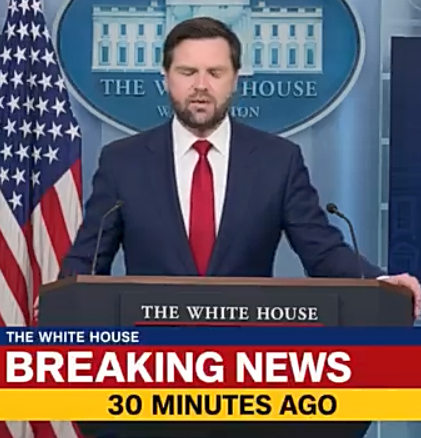
The video attached to the current claim illustrates the problem.
It contains only a very short shot of Vance speaking behind a White House podium while a graphic across the bottom says “BREAKING NEWS” and “30 MINUTES AGO.” The clip itself provides no visible evidence establishing that Vance suffered an accident, died, resigned, received a medical diagnosis or experienced another personal emergency.
Reliable reporting contradicts any implication that he has suddenly disappeared from public life.
On September 21, Vance appeared publicly in Greensboro, North Carolina, campaigning in the state’s Senate race. Reports published September 22 also show him publicly addressing questions involving the Trump administration and White House media access. C-SPAN listed a Vance news conference on administration anti-fraud efforts as taking place on September 22.
That means a headline claiming that something tragic was “confirmed 30 minutes ago in Ohio” should not be treated as established news simply because it appears alongside a dramatic video or crying-heart emojis.
The words after “confirmed as” matter.
Without them, the headline encourages readers to imagine the most serious possible outcome while avoiding making a specific statement that can easily be checked.
That style has become common on social platforms. A headline creates fear or curiosity, the important information is deliberately withheld, and readers are pushed toward a link promising the rest of the story.
In the case of Vance, several sites have circulated nearly identical versions of the “30 Minutes Ago in Ohio” headline while attaching entirely different stories to it. Some versions discuss old political controversies, others discuss unrelated security incidents, and others acknowledge that no sudden tragedy involving the vice president has actually been confirmed.
That inconsistency is itself a reason for caution.
A genuine breaking development involving the vice president would ordinarily be reported quickly by major wire services, national broadcasters, local Ohio outlets and official government sources. The basic details would not depend on an incomplete sentence posted by a collection of unrelated websites.
The confirmed major Ohio development involving Vance in recent weeks is much clearer: he returned to Middletown on August 21, appeared at the steel plant where his grandfather had worked and helped announce a $1 billion Cleveland-Cliffs modernization project supported in part by a $500 million federal award.
The announcement also provides a much more meaningful story than the viral wording suggests.
It concerns the future of thousands of workers, a major American industrial company, federal energy policy, the midterm elections and the economic strategy that Vance and Trump are asking voters to support.
For Vance personally, Middletown remains one of the most important locations in his political identity. He regularly describes the city as the place that shaped his understanding of economic decline, addiction, family instability and the disappearance of stable industrial jobs.
His critics dispute parts of that interpretation and argue that his political narrative oversimplifies the economic and social history of communities like Middletown. His supporters view his background as evidence that he understands the problems facing industrial towns.
The steel-plant appearance gave voters another example of that contrast.
Vance presented the $1 billion investment as evidence that government policy could encourage major corporations to commit capital to American communities. The company itself argued that federal support and trade policy helped make the project possible.
How successful the project ultimately becomes will depend on what happens over the coming years.
Construction must be completed, the technological upgrades must perform as expected, steel demand must remain strong enough to sustain production, and the plant must remain competitive against domestic and international suppliers.
Political announcements often focus on investment totals and projected jobs. The longer-term test is whether those promised benefits materialize.
For workers at Middletown Works, however, the commitment represents a major statement about the plant’s future.
A billion-dollar modernization project signals that Cleveland-Cliffs expects the facility to remain an important part of its operations rather than treating it as an industrial asset nearing the end of its useful life.
That may be the most significant part of the announcement for the community.
Vance’s political message was that towns such as Middletown should not have to accept the disappearance of manufacturing as inevitable.
Democrats and Republicans will continue debating which policies offer the best route toward achieving that objective. They disagree over tariffs, environmental rules, taxation, labor policy and federal spending, even while politicians in both parties increasingly talk about the importance of rebuilding domestic manufacturing.
The Ohio steel project will provide a real-world case through which those policies can eventually be judged.
For now, what has actually been confirmed is considerably different from what the dramatic viral headline may lead viewers to believe.
There is no reliable evidence in the uploaded clip establishing sudden tragic news involving JD Vance.
Instead, Vance remains the sitting vice president and has continued making public appearances.
His recent major Ohio story was a return to Middletown built around manufacturing, steel and a $1 billion investment in the community where he grew up.
That announcement may not contain the shocking twist suggested by “30 minutes ago” social-media posts, but it has real consequences for workers, the Ohio economy and the administration’s broader economic agenda.
And as the 2026 midterm elections approach, it also offers a preview of the message Vance is likely to continue delivering around the country: that Republicans want voters to judge the administration by whether it can bring investment, industrial production and jobs back to communities that have experienced decades of economic disruption.
Whether voters accept that argument will be determined at the ballot box.
Whether the Middletown investment succeeds will take considerably longer to determine.
But those are the issues supported by the available evidence — not the unexplained tragedy implied by a viral headline ending with the words “confirmed as.”
The attention surrounding Vance’s return to Ohio also demonstrates how closely his political identity remains connected to the state where his career began. Even after moving into the vice presidency, Ohio continues to provide an important backdrop for his arguments about manufacturing, wages and the future of working-class communities.
For residents of Middletown, however, the most important question is likely to be what happens after the speeches and cameras disappear. Large investment announcements can generate excitement, but communities ultimately judge them by the jobs that remain, the construction that actually takes place and whether local businesses see lasting benefits.
The Cleveland-Cliffs project will therefore continue to receive attention long after Vance’s visit. Workers will be watching the modernization effort closely, while political leaders are likely to point to its progress as part of the continuing national debate over American manufacturing and industrial policy.
At the same time, viral posts surrounding Vance show why dramatic “breaking news” headlines should be treated carefully. A few words, emotional emojis and a short video can create the impression that something far more serious has happened than the evidence supports.
The confirmed Ohio story is already significant without exaggeration: a sitting vice president returned to his hometown, stood inside the steel plant connected to his family history and promoted a major investment intended to shape the facility’s future for years to come.