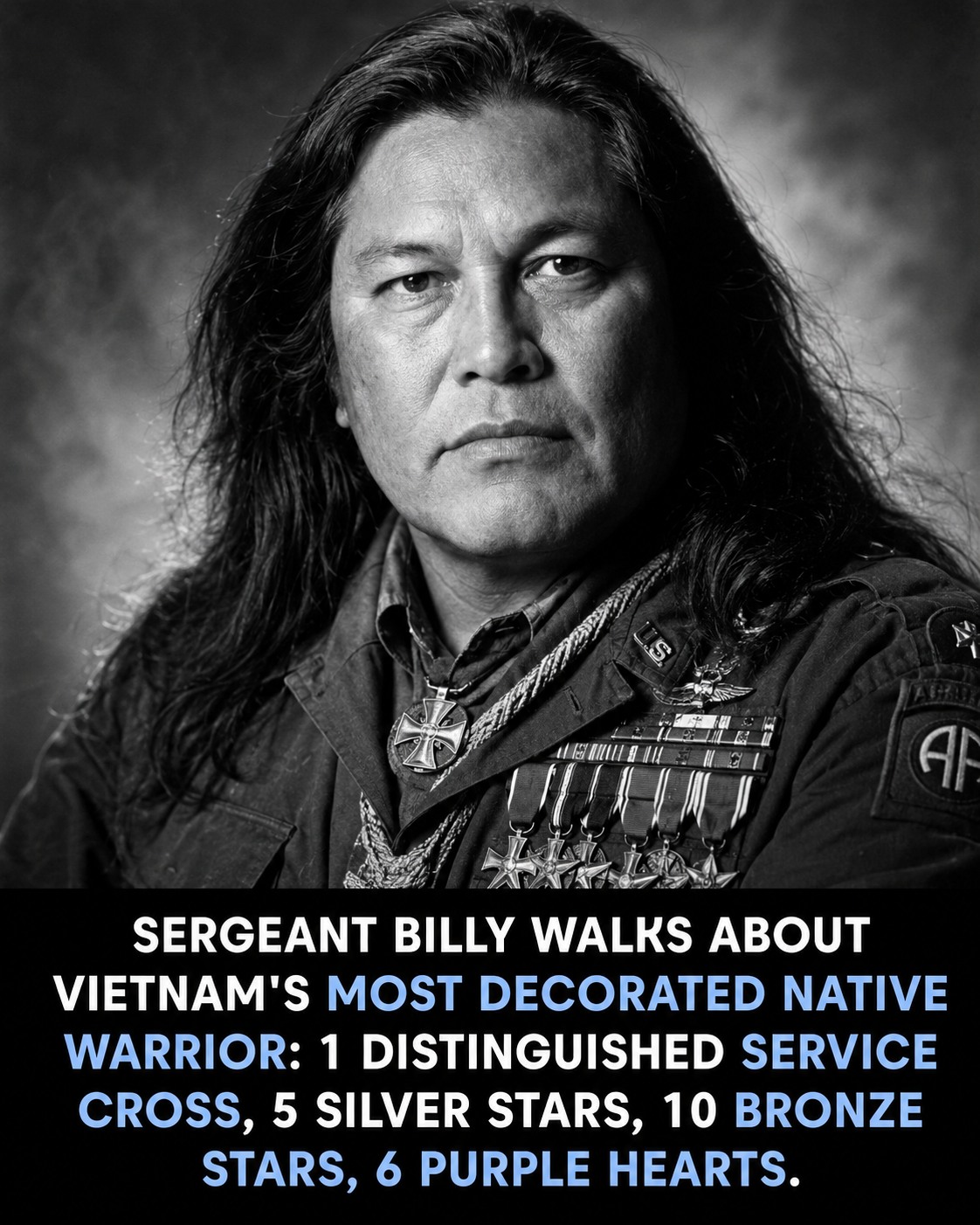
Sergeant Billy Walks About stands as a towering figure in the history of military service, a symbol not only of extraordinary courage but also of the enduring contributions of Native American warriors to the United States armed forces. Born into the Oglala Lakota Sioux tribe, Walks About carried with him a legacy of resilience, spiritual strength, and a warrior ethos deeply embedded in his cultural heritage. The Oglala Lakota, part of the larger Sioux nation, have long been recognized for their martial prowess and strong sense of community. This background, infused with values of honor, bravery, and responsibility to one’s people, shaped Walks About’s approach to service and underpinned his extraordinary performance on the battlefield during the Vietnam War.
Walks About’s military career is distinguished by an unprecedented series of decorations, including the Distinguished Service Cross, five Silver Stars, ten Bronze Stars, and six Purple Hearts. Each award represents a chapter of heroism, sacrifice, and endurance. The Distinguished Service Cross, the second-highest military honor in the United States, was awarded to Walks About for acts of extreme gallantry in combat. Such recognition is reserved for soldiers who demonstrate extraordinary courage under direct enemy fire, often at great personal risk. Walks About’s actions exemplified this standard in every sense: he repeatedly placed himself in harm’s way to protect his fellow soldiers, often engaging the enemy in close quarters while sustaining serious injuries.
The Silver Stars further attest to his repeated acts of valor. Receiving five Silver Stars is itself a rare and remarkable achievement, signaling multiple instances of gallantry and tactical brilliance. Accounts of Walks About’s engagement in combat describe a soldier who was unflinching in the face of danger, capable of making split-second decisions under extreme duress. Whether leading assaults, providing cover fire, or rescuing wounded comrades under fire, Walks About’s heroism was both proactive and protective. The ten Bronze Stars and six Purple Hearts similarly chronicle the depth and frequency of his sacrifices. Each Bronze Star recognizes meritorious achievement or heroism in combat operations, while the Purple Hearts document the wounds he sustained in the line of duty, injuries that would have deterred less resolute soldiers.
Walks About’s service cannot be fully understood without acknowledging the broader context of Native American military contributions. Native Americans have served in disproportionate numbers throughout U.S. military history, from the Revolutionary War to modern conflicts. Their roles have often extended beyond combat to include scouting, intelligence, and specialized tactical functions. For the Oglala Lakota in particular, service in the military has historically been intertwined with cultural notions of warriorhood. The values instilled from a young age—a combination of courage, honor, spiritual connection, and responsibility to one’s community—prepared individuals like Walks About to excel in situations demanding both moral and physical bravery.
During the Vietnam War, Walks About’s service was marked not only by personal heroism but also by leadership and tactical acumen. The Vietnam conflict presented unique challenges: guerrilla warfare, unpredictable terrain, and intense psychological pressure. Soldiers faced constant threats from ambushes, booby traps, and relentless enemy fire. Walks About distinguished himself in such conditions by demonstrating calmness under pressure, an ability to assess complex combat scenarios quickly, and a commitment to the welfare of his comrades. Eyewitness accounts from his units describe a soldier who not only engaged with the enemy with fierce determination but also maintained cohesion among his fellow troops, ensuring their safety whenever possible.
One of the defining aspects of Walks About’s heroism was his willingness to act decisively, even when the odds were overwhelmingly against him. In multiple documented engagements, he entered active combat zones to retrieve wounded soldiers, carrying them to safety under enemy fire. His actions were characterized by selflessness and a profound sense of duty. Such acts are emblematic of the warrior ethos taught within his tribal traditions, where the protection of one’s people is paramount. The battlefield became a modern arena in which Walks About applied these timeless values, demonstrating that courage and honor transcend time and circumstance.
The psychological and emotional resilience Walks About exhibited during his service is another remarkable aspect of his story. Sustaining six combat injuries—evidenced by his Purple Hearts—would have ended the service of many soldiers. Yet Walks About returned to duty after each wound, embodying an exceptional level of physical and mental fortitude. The capacity to recover from physical trauma while continuing to perform effectively under life-threatening conditions speaks to his extraordinary resilience and discipline. Beyond physical bravery, his presence provided a stabilizing force to his unit, inspiring fellow soldiers to act with courage and determination.
Walks About’s legacy extends beyond battlefield heroism. His life serves as a bridge between Native American traditions and contemporary military service, illustrating the ongoing contributions of Indigenous peoples to the United States armed forces. The values of community, bravery, and responsibility he embodied continue to inspire Native and non-Native soldiers alike. By achieving one of the highest concentrations of military honors in U.S. history, he brought visibility and recognition to Native American service members, highlighting the historical and contemporary significance of their contributions.
In addition to his military accolades, Walks About’s life exemplifies the cultural integration of traditional Native American values with modern concepts of leadership and service. His actions demonstrate how ancient principles of courage, protection, and loyalty can manifest in contemporary contexts, such as complex military operations in foreign territories. Walks About’s approach to combat—strategic, calculated, and simultaneously infused with compassion—reflects an understanding that true warriorhood involves both tactical excellence and ethical responsibility.
Post-war, Walks About became a symbol of Native American achievement and valor. His story has been chronicled in military histories, oral accounts, and photographs, each depicting not just a decorated soldier but a man whose life embodies principles of courage, resilience, and selflessness. For young Native Americans, he stands as a role model, illustrating that cultural heritage and contemporary service can coexist, producing achievements that resonate far beyond the battlefield.
Walks About’s recognition also sheds light on broader military history, providing insight into the individual narratives that compose the collective experience of soldiers in Vietnam. The conflict itself was characterized by political complexity, harsh environmental conditions, and extreme combat challenges. Within this context, individuals like Walks About illustrate how personal bravery, leadership, and cultural grounding can shape outcomes, save lives, and leave enduring legacies.
Finally, Walks About’s life and service remind us of the often-overlooked narratives within military history. While statistics and strategic accounts provide one perspective, personal stories like his offer profound insight into the human dimensions of warfare—courage under fire, resilience in the face of injury, and the capacity for leadership rooted in ethical and cultural principles. His Distinguished Service Cross, Silver Stars, Bronze Stars, and Purple Hearts are tangible acknowledgments of acts that are as much moral and spiritual as they are physical.
Sergeant Billy Walks About’s story, therefore, transcends simple biography. It is an account of heroism, cultural pride, resilience, and the enduring values of the Oglala Lakota Sioux. It reminds us of the extraordinary contributions of Native American soldiers, the complexity of human courage, and the ways in which individual actions can inspire generations. Every decoration he received tells a story of sacrifice, bravery, and unyielding commitment—not only to his country but also to his fellow soldiers and the enduring legacy of his people. In celebrating Sergeant Walks About, we honor not just a remarkable soldier but a living embodiment of a timeless warrior spirit.
Sergeant Billy Walks About’s journey to becoming one of the most decorated Native American warriors in Vietnam was shaped long before he ever set foot on foreign soil. Born into the Oglala Lakota Sioux tribe, he grew up in a community where storytelling, tradition, and resilience were central to daily life. The Lakota, like many Indigenous peoples, have a long history of warrior culture, emphasizing courage, responsibility, and protection of one’s community. From a young age, Walks About would have been immersed in stories of valor, survival, and the moral imperatives of being a warrior—lessons that would later inform his actions on the battlefield. These early experiences provided a foundation for discipline, fortitude, and ethical judgment, qualities that would define his military service.
When Walks About enlisted, he entered a military system that often overlooked the contributions of Native Americans despite their long history of service. For centuries, Indigenous men had served in U.S. conflicts, from the Revolutionary War through World Wars I and II, often in disproportionate numbers relative to their population. Native American soldiers brought unique skills, particularly in tracking, navigation, and survival, shaped by generations of cultural practices. Walks About’s heritage provided him with a perspective and skill set that proved invaluable in the complex and challenging conditions of the Vietnam War, where terrain, guerrilla tactics, and environmental hazards demanded more than conventional military training.
Vietnam presented one of the most demanding theaters of war in modern military history. Dense jungles, unpredictable weather, and an enemy adept in ambush and tunnel warfare created an environment of constant threat. Soldiers faced the dual challenges of physical endurance and mental resilience, as each patrol could quickly become a matter of life or death. Within this context, Walks About distinguished himself repeatedly, demonstrating not only courage but also leadership and strategic acumen. Multiple accounts describe him as a soldier who could maintain composure under extreme pressure, a critical trait in a conflict where hesitation could have fatal consequences.
One notable instance of Walks About’s heroism involved a firefight in a heavily ambushed village, where his unit was pinned down by enemy forces. Under withering fire, Walks About moved decisively, positioning himself to provide covering fire and protect fellow soldiers attempting to evacuate the wounded. His actions were characterized by calculated risk-taking; he entered zones of intense danger repeatedly, drawing enemy attention and fire away from his comrades. During this engagement, he sustained injuries that would earn him one of his six Purple Hearts, yet he refused evacuation until every member of his squad was safely removed from the immediate threat. Such decisions highlight the moral dimension of his bravery—his valor was inseparable from his concern for others, embodying the principle of placing the welfare of the group above personal safety.
Walks About’s capacity to lead extended beyond immediate combat scenarios. His cultural grounding as an Oglala Lakota Sioux informed his approach to teamwork, loyalty, and the moral responsibilities of leadership. Indigenous warrior traditions often emphasize collective success over individual glory, and Walks About applied these principles in Vietnam, fostering cohesion, trust, and mutual support among soldiers. Peers frequently cited his ability to motivate and calm others under extreme stress, using both verbal guidance and personal example to maintain morale. Leadership in combat is often measured not only by strategic success but by the psychological stability of the unit, and Walks About’s reputation suggests he excelled in both arenas.
The decorations he received reflect the extraordinary frequency and intensity of his valor. Five Silver Stars indicate repeated acts of gallantry in direct combat, each representing moments where he went beyond duty to protect his unit or achieve critical objectives. Ten Bronze Stars further illustrate his consistent commitment to courageous action, often involving tactical skill and quick decision-making in high-pressure scenarios. Collectively, these awards provide a record of sustained bravery and repeated exposure to life-threatening situations, each medal a tangible acknowledgment of acts that few could have accomplished with such effectiveness and composure.
Walks About’s achievements also underscore the complex realities of combat in Vietnam. Soldiers faced not only enemy engagement but also the psychological burden of constant uncertainty. The dense jungles, with limited visibility and unpredictable terrain, created conditions where every step could conceal ambushes or booby traps. Under these circumstances, decision-making had to be both rapid and precise. Walks About’s ability to navigate these challenges while maintaining effectiveness reflects a combination of experience, instinct, and mental resilience. His repeated exposure to danger and his survival through numerous injuries attest to an extraordinary capacity for both tactical thinking and physical endurance.
Beyond his battlefield exploits, Walks About’s story illuminates the broader contributions of Native Americans to military service. Despite their historically marginalized status, Indigenous peoples have consistently volunteered for military duty in numbers exceeding their proportion of the general population. This pattern reflects cultural values that honor bravery, communal responsibility, and service to the collective good. Walks About’s life exemplifies how these cultural principles translated into practical effectiveness in modern warfare, combining traditional warrior ethics with contemporary combat requirements.
Walks About’s personal resilience is further evident in his repeated returns to active duty after sustaining injuries. The six Purple Hearts he received not only document the physical toll of battle but also highlight his psychological fortitude. Pain, fatigue, and trauma were constant companions, yet he continued to engage in operations, providing leadership, skill, and protection to those around him. This capacity to continue performing at a high level under extreme physical and mental stress is rare, and it underscores the exceptional nature of his character and dedication.
Post-war, Walks About became an enduring symbol of Native American service and heroism. His story has been documented in photographs, oral histories, and military records, offering inspiration to both Indigenous and non-Indigenous communities. The cultural significance of his achievements extends beyond individual valor; it serves as a reminder of the centuries-long tradition of Native American contributions to U.S. military history. Through his service, Walks About demonstrated that cultural heritage and contemporary military excellence are not mutually exclusive but can complement and reinforce one another.
Walks About’s legacy continues to influence contemporary discussions about diversity, representation, and recognition in the armed forces. By achieving a record of decorations unprecedented among Native American soldiers in Vietnam, he brought attention to the often-overlooked service of Indigenous peoples. His accomplishments challenge narratives that marginalize or overlook minority contributions and provide a model for how cultural identity and military service can coexist with distinction and honor.
In addition to his military achievements, Walks About’s life provides lessons on leadership under pressure. His ability to make rapid, ethically sound decisions in combat demonstrates the integration of moral reasoning, tactical acumen, and human empathy. These qualities allowed him not only to survive but to thrive in extreme circumstances, protecting others and achieving objectives that required both courage and judgment. His example underscores the importance of character, training, and cultural grounding in effective military leadership.
Sergeant Billy Walks About’s story is therefore more than a record of medals and commendations; it is a testament to human courage, cultural heritage, and the capacity for extraordinary action in extraordinary circumstances. His life embodies the resilience, intelligence, and ethical strength of a warrior committed to his people, his unit, and his country. Each decoration—the Distinguished Service Cross, the Silver Stars, the Bronze Stars, and the Purple Hearts—tells a story of sacrifice, bravery, and unwavering commitment to duty.
The legacy of Walks About serves as both historical record and inspirational narrative. His contributions highlight the enduring presence and influence of Native American soldiers in American military history and demonstrate the universal principles of courage, loyalty, and selflessness. In remembering Sergeant Billy Walks About, we honor not only an exceptional individual but also the broader tradition of Native American service that has enriched and strengthened the United States armed forces for generations.
Sergeant Billy Walks About’s influence extends far beyond the battlefield. His courage and unwavering dedication serve as an enduring example for both Native and non-Native soldiers, illustrating how heritage and personal integrity can shape leadership under the most extreme conditions. In the years following his service, Walks About became a respected voice in military communities, offering guidance and mentorship to younger soldiers navigating the complexities of combat and service. His experiences in Vietnam provided a profound understanding of not only strategy and tactics but also the psychological and emotional dimensions of warfare—lessons he shared generously, ensuring that future generations could benefit from his knowledge and insight.
The impact of Walks About’s service on the perception of Native American contributions cannot be overstated. Throughout history, Indigenous soldiers have often served with distinction, yet their stories have frequently been overlooked in mainstream accounts of military history. Walks About’s remarkable record—1 Distinguished Service Cross, 5 Silver Stars, 10 Bronze Stars, and 6 Purple Hearts—brought attention to the sacrifices and valor of Native warriors, inspiring a renewed recognition of the critical role they have played in shaping the United States military’s successes. His story highlighted the intersection of cultural heritage and national service, showing how traditional values of bravery, honor, and community responsibility can enhance effectiveness in modern warfare.
Walks About’s reputation for resilience and bravery also contributed to a broader understanding of the psychological endurance required in combat. His repeated injuries, documented through his Purple Hearts, demonstrate an extraordinary capacity for recovery, focus, and sustained engagement under relentless stress. Soldiers witnessing his actions often reported feeling motivated and protected by his presence, knowing that a leader of his caliber was committed to their safety and success. This psychological reinforcement—the assurance of competence and courage in leadership—played a crucial role in unit cohesion and morale, proving that heroism in war extends beyond individual acts of valor to encompass influence over others’ performance and confidence.
Equally important was Walks About’s ability to bridge cultural and social gaps within the military. As a Lakota Sioux, he brought a perspective rooted in centuries of Indigenous warrior traditions, emphasizing collective responsibility, ethical action, and spiritual resilience. His approach to leadership integrated these cultural principles with military doctrine, creating a model of service that was both effective and morally grounded. Soldiers under his command benefited from his emphasis on respect, accountability, and shared responsibility, learning to value collaboration, trust, and the human dimension of warfare alongside tactical excellence.
The legacy of Walks About’s service has continued to resonate in educational and cultural contexts as well. Military historians, Indigenous organizations, and veteran advocacy groups frequently reference his achievements to highlight the broader contributions of Native Americans to the United States military. Through lectures, public talks, and historical accounts, his story serves as a reminder of the enduring link between cultural identity and military service. It encourages reflection on the diverse backgrounds and perspectives that strengthen armed forces and enrich collective understanding of courage and leadership.
Moreover, Walks About’s experiences offer valuable lessons in resilience, adaptation, and the ethical dimensions of combat. The battlefield demands not only physical prowess but also moral judgment and emotional intelligence. His consistent prioritization of his comrades’ safety, even in situations that posed extreme personal risk, exemplifies the highest standards of military ethics. This balance between courage and responsibility underscores the principle that true heroism involves both action and conscience, and that leadership in life-threatening scenarios requires a holistic approach that accounts for human vulnerability as well as strategic objectives.
In recounting Sergeant Billy Walks About’s story, one sees a narrative that transcends mere military accomplishment. It is a testament to the integration of heritage, moral strength, tactical expertise, and human empathy. Every medal and citation represents a moment where courage intersected with principle, where bravery was measured not only by acts of valor but by the protection and inspiration provided to others. His life and service continue to serve as a touchstone for discussions about leadership, cultural contribution, and the enduring role of Native Americans in shaping the history and values of the United States military.