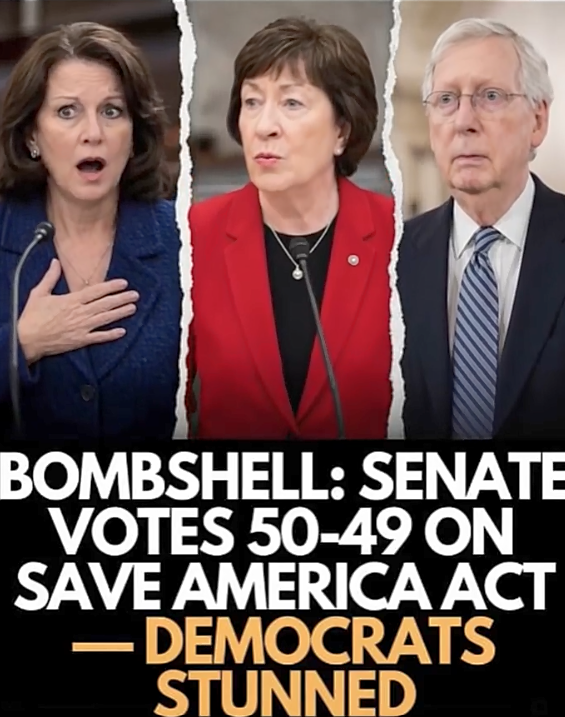
What looked at first glance like a stunning late-night victory for the SAVE America Act was actually something more complicated—and politically revealing. On June 5, 2026, the United States Senate recorded a 50-49 vote connected to one of the most fiercely debated election bills in Washington. The narrow tally immediately became a major talking point because, for the first time in this particular fight, supporters could point to an official Senate roll call showing 50 senators backing the core proposal. Yet the most important detail is also the easiest to lose in a dramatic headline: the SAVE America Act did not pass the Senate in that vote. The Senate was voting on a motion to waive budget rules for Senator Mike Lee’s Amendment 5804, which sought to ensure that only citizens were registered for federal elections and to require voters to provide photo identification. Fifty senators voted yes, 49 voted no and one senator did not vote. Because the motion required three-fifths of the Senate rather than a simple majority, it was officially rejected.
That procedural distinction dramatically changes what the 50-49 result means. The vote was not final passage of the SAVE America Act, nor was it a conventional up-or-down vote in which 50 votes would necessarily have been enough. Lee’s amendment was being considered during debate over S. 2, a budget reconciliation measure. A budget point of order had been raised against the election provisions, meaning supporters needed to waive the applicable budget rules before the amendment could survive. Under the Congressional Budget Act, that waiver required a three-fifths vote. The official Senate record therefore lists the result plainly: “Motion Rejected.” In other words, supporters won a numerical majority among senators voting, but lost the procedural contest that actually determined whether the amendment could advance. That is why both statements can be true at the same time: the proposal received 50 votes to 49, and the proposal still failed.
Even so, supporters had an obvious reason to celebrate the number 50. For months, one of the central questions surrounding the SAVE America Act had been whether Republicans could even assemble a simple Senate majority for its central provisions. The June vote provided a concrete answer, at least for Lee’s version of the proposal. It demonstrated that 50 senators were willing to go on record in favor of a measure described by the Senate as ensuring that only citizens are registered to vote in federal elections and requiring photo identification from voters. That did not erase the 60-vote procedural obstacle, but it changed the political conversation. Instead of arguing only about whether the policy had enough Senate support, proponents could now argue that Senate procedures—not the lack of a basic majority—were stopping it. That distinction quickly fed a much larger Republican debate over the legislative filibuster, budget reconciliation and whether Senate rules should be changed or circumvented to move election legislation before the 2026 midterms.
The significance became even clearer when the 50-49 vote was compared with another SAVE-related vote only hours earlier. A motion involving Senator Lindsey Graham’s Amendment 5779 had failed 48-50. According to the Senate Daily Press account, Republican Senators Susan Collins, Mitch McConnell, Lisa Murkowski and Thom Tillis voted against that effort, while Senators Michael Bennet and Joni Ernst did not vote. Later, when Lee’s Amendment 5804 came up, the final count became 50-49. The Senate Daily Press listed McConnell, Murkowski and Tillis as the Republicans voting no, while Bennet did not vote. Collins therefore supported the Lee motion, while Ernst also participated in the later vote. The movement from 48 supporters to 50 may have looked small on paper, but in a chamber where a single vote can reshape the political narrative, it was enough to give election-law advocates something they had been seeking: a recorded majority supporting the central citizenship and identification requirements.
The fight began well before that late-night Senate showdown. Republican Representative Chip Roy of Texas and Senator Mike Lee of Utah launched the SAVE America Act in January 2026 as an expanded version of the earlier Safeguard American Voter Eligibility proposal. The legislation paired documentary proof-of-citizenship requirements for federal voter registration with a new national photo-identification requirement for casting federal ballots. In February, the House used S. 1383 as the legislative vehicle for the proposal and approved the SAVE America Act language by a 218-213 vote. The measure then moved into a Senate where Republicans held the majority but not the 60 seats generally needed to overcome a legislative filibuster. That gap between having a majority and having 60 votes has shaped nearly every stage of the legislation’s journey.
At its core, the proposal attempts to create stricter national rules governing participation in federal elections. The House text would require documentary proof of United States citizenship when a person registers to vote in a federal election. It would also impose an eligible photo-ID requirement for voting and create additional responsibilities for states to verify voter eligibility and maintain their registration lists. The legislation contains provisions addressing people whose documents do not neatly match their current information and calls for processes for citizens who face documentation problems, but the exact operation of those processes has become one of the major subjects of disagreement. The basic Republican argument is straightforward: if federal elections are legally limited to American citizens, election systems should require affirmative documentary evidence of citizenship instead of relying primarily on attestations and existing verification procedures.
Supporters describe the legislation as an election-integrity measure rather than a restriction on voting. They argue that citizenship is the fundamental qualification distinguishing who may participate in federal elections and that requiring proof of that qualification is no more unreasonable than verifying eligibility in other areas of government. Photo identification, in their view, provides a second safeguard by confirming that the person casting a ballot is the person associated with the voter registration. Supporters also contend that election laws should not merely punish unlawful voting after it occurs; they should make unlawful registration and voting difficult in the first place. For lawmakers such as Roy and Lee, the principle is that every lawful vote is potentially diluted if an ineligible ballot enters the system, even if such cases are uncommon. The legislation therefore focuses not simply on prosecuting violations but on establishing verification requirements before registration and voting occur.
One fact at the center of the debate, however, is that noncitizens are already prohibited from voting in federal elections. Federal law, specifically 18 U.S.C. §611, makes it unlawful for an alien to vote in an election for federal offices except under narrow circumstances involving elections that also contain separate local contests for which noncitizen voting may legally be permitted. Violations can carry criminal penalties. USAGov likewise states that noncitizens, including lawful permanent residents, cannot vote in federal elections. Supporters of the SAVE America Act do not dispute that prohibition; instead, they argue that existing rules do not provide sufficient mechanisms for verifying citizenship before someone enters the voter-registration system. Opponents respond that creating major new documentation requirements to address conduct that is already illegal—and that independent analyses have generally found to be rare—risks imposing a much larger burden on eligible citizens than the problem warrants.
That disagreement is where the debate becomes far more complicated than a simple argument over whether identification should be required. Documentary proof of citizenship is different from ordinary voter ID. A driver’s license, for example, may establish a person’s identity without necessarily establishing citizenship unless it contains the necessary citizenship information. A citizen relying on a birth certificate can face another complication when the name on the certificate differs from a current legal name after marriage or divorce. A passport can resolve many of those issues but not every American has one. Research cited by the Bipartisan Policy Center estimated that roughly 12 percent of registered voters did not have ready access to common combinations of documents likely to satisfy documentary-proof requirements. The organization also found that access to qualifying documents varied according to income and education, suggesting that implementation could create practical hurdles even when every affected person is unquestionably an American citizen.
Women who changed their names after marriage became one of the most visible examples in the political argument. Opponents claimed that birth certificates showing a maiden name could leave voters scrambling for marriage certificates, court records or other supporting documents. Supporters countered that the legislation specifically requires states to create mechanisms for addressing name discrepancies and does not simply prohibit citizens with changed names from registering. FactCheck.org found that the House-passed language does contain a process for those situations: voters may be able to provide additional documentation or use an affidavit attesting that the name on the citizenship document is a previous name. At the same time, the legislation does not spell out every administrative detail, leaving states with significant implementation work. The dispute is therefore not accurately described as either “married women automatically cannot vote” or “name changes present no additional burden.” The real question is how easy, consistent and accessible the required state processes would be in practice.
Similar concerns have been raised for elderly voters, people with disabilities, rural residents, naturalized citizens and Americans who do not have easy access to original documents. For supporters, those difficulties are administrative problems that can be solved through alternative verification procedures without abandoning the principle of documentary citizenship checks. For opponents, they demonstrate why seemingly simple election requirements can have unequal consequences. A rule that takes one person five minutes to satisfy could require another person to obtain a replacement birth certificate from another state, locate a marriage record, travel to an election office or navigate an unfamiliar government process. Those practical consequences are particularly important because voter registration in the United States is administered through thousands of state and local offices rather than through a single national registration system. Turning a federal requirement into functioning procedures nationwide would therefore require training, guidance, databases, documentation rules and methods for resolving disputed cases.
The 50-49 Senate result did nothing to settle those policy questions. What it settled, at least momentarily, was the arithmetic. There was an identifiable group of 50 senators willing to support Lee’s citizenship-and-ID amendment, but there were not 60 senators willing to waive the budget rules. This is crucial because some coverage of the vote can create the impression that the Senate passed the SAVE America Act by a single vote. It did not. The official roll call says the required majority was three-fifths and the result was rejected. The Congressional Record likewise states that because three-fifths of senators did not vote in favor, the waiver failed and the amendment fell. The difference between a political majority and a procedurally sufficient majority is the entire story of that night.
The 60-vote problem has also followed the legislation outside the reconciliation process. Earlier in March, the Senate spent days debating the SAVE America Act through the House message accompanying S. 1383. On March 26, a cloture attempt involving a voter-ID amendment failed 53-47 because it did not reach 60 votes. That episode demonstrated the obstacle Republicans would face under ordinary Senate procedures: having 53 Republican senators did not automatically mean the majority could end debate and move legislation toward passage. Democrats remained overwhelmingly opposed to the package, and Republican leaders had no expectation that enough Democrats would cross party lines to reach 60.
That reality produced increasing demands from President Donald Trump and some Republican senators to change the Senate’s approach. Trump repeatedly pressed Majority Leader John Thune to find a way to pass the SAVE America Act and later called for eliminating the legislative filibuster. Some supporters proposed returning to a “talking filibuster,” arguing that senators opposing legislation should be required to physically hold the floor rather than allowing the 60-vote requirement to function as a routine procedural barrier. Thune resisted those demands, saying Republicans lacked the votes both to pass the SAVE America Act under existing rules and to eliminate the filibuster. By late July, after Trump called for the Senate to remain in Washington until the measure passed, Thune publicly argued that keeping senators in session would accomplish little without a viable path to the necessary votes.
The June 5 tally nevertheless strengthened the argument of Republicans seeking more aggressive procedural action. Their case became: if 50 senators support these provisions, then the obstacle is no longer majority opinion inside the chamber but Senate rules requiring more than a majority in particular circumstances. Critics of that argument respond that supermajority requirements are not accidental glitches; they are established parts of Senate procedure that affect legislation from both parties. In the June vote specifically, the 60-vote requirement resulted from an attempt to waive congressional budget rules, not simply from Democrats launching an ordinary legislative filibuster. Eliminating the filibuster would therefore not automatically make every procedural obstacle surrounding reconciliation disappear. Election provisions still have to survive the rules governing which policies can be included in budget legislation.
That point helps explain why repeated attempts to move the SAVE America Act through different legislative vehicles have mattered. Republicans have pursued the proposal through stand-alone legislation, the House message to S. 1383, amendments to reconciliation legislation and, later, efforts to attach SAVE America Act language to other major bills. The House subsequently incorporated the legislation’s text into its fiscal 2027 defense authorization package. Meanwhile, a Senate bill designated S. 3752 and titled the SAVE America Act was introduced in August and referred to the Senate Committee on Rules and Administration. The existence of those additional paths shows that the June defeat did not end the fight, but it also underscores that the dramatic 50-49 vote did not send the measure to the president’s desk. The legislation remained unresolved.
The approaching 2026 midterm elections have intensified every part of the argument. Supporters want the new requirements in place as quickly as possible, framing the issue as a question of public confidence before millions of Americans vote for control of Congress. Opponents argue that dramatically changing registration and identification requirements close to a national election could create confusion for voters and election administrators. That timing dispute is especially significant because the House considered language making major requirements effective upon enactment rather than postponing them for several years. If legislation of this scale were enacted shortly before an election, state officials could face intense pressure to issue guidance, change forms, train workers and establish alternative verification procedures on a compressed schedule.
The politics surrounding voter eligibility have also moved beyond Congress. The Trump administration has pursued separate efforts involving citizenship data and voter-roll verification, some of which have faced court challenges. Just days before September 8, a federal appeals court declined to lift restrictions on the administration’s attempt to use the Department of Homeland Security’s SAVE database for broad citizenship checks of voter records. The dispute illustrates how the same fundamental conflict driving the SAVE America Act—how aggressively government should verify citizenship without wrongly affecting eligible voters—is playing out simultaneously in Congress, federal agencies and the courts.
For Democrats, the central argument remains that election security should not come at the cost of making registration substantially more difficult for eligible Americans. Democratic lawmakers and civil-rights organizations have characterized the legislation as unnecessary and potentially disenfranchising, pointing to existing laws against noncitizen voting and to the number of citizens who may not have qualifying documents readily available. For Republicans, the argument is almost the reverse: the right to vote is important enough that government should demand clear proof that everyone participating is legally eligible, and administrative inconveniences can be addressed without weakening the basic verification requirement. Those positions arise from fundamentally different assessments of risk. Republicans emphasize the potential damage of an ineligible vote and the public distrust created by uncertainty. Democrats emphasize the potential damage of an eligible voter being prevented or discouraged from participating.
Neither side disappeared after the 50-49 vote. If anything, the result gave both sides new material. Republicans could say that a Senate majority had now supported the core citizenship and identification requirements. Democrats could say that the amendment had still been rejected under Senate rules and that supporters were attempting to push sweeping election policy through a budget process. Those two interpretations are not mutually exclusive. The vote genuinely demonstrated majority support for Lee’s amendment among senators voting, and the amendment genuinely failed. Understanding that dual reality is essential to understanding why the number 50 became politically powerful without becoming legislatively decisive.
The vote also highlights how misleading political headlines can become when they compress complicated Senate procedure into a few dramatic words. “Senate Votes 50-49 on SAVE America Act” immediately sounds like a bill passed by one vote. A reader seeing only that headline might reasonably assume that the legislation cleared the chamber. The official record tells a different story. Fifty senators supported the motion, but 60 were required. The amendment therefore died at that stage. What happened was still important, but its importance was strategic rather than statutory: supporters had demonstrated a majority for the core policy, while also demonstrating that the existing pathway could not carry it into law.
That leaves the SAVE America Act at the center of a larger battle over election administration and Senate power. One path would be to persuade enough senators to reach the normal 60-vote threshold. Given the depth of Democratic opposition, that remains extraordinarily difficult. Another would involve changing Senate filibuster rules, but Thune and other Republicans have repeatedly indicated that there are not enough votes in their conference for that option. A third is to continue searching for legislative vehicles that can move by simple majority, although the June budget ruling demonstrates how difficult it can be to fit election regulation into procedures designed primarily for taxes and spending. A fourth is attaching some or all of the legislation to broader must-pass packages, a strategy House Republicans have already explored.
For voters watching the controversy, the most important question is therefore not whether the Senate “passed” the SAVE America Act 50-49. It did not. The more important question is what that 50-49 tally revealed about the next phase of the fight. It showed that supporters had reached a symbolic threshold they had struggled to demonstrate earlier: 50 Senate votes for an amendment carrying the legislation’s central citizenship and voter-ID principles. It also showed the limits of that accomplishment. Three-fifths were required, only 50 senators voted yes, and the Senate officially rejected the motion. The political breakthrough and the legislative defeat happened simultaneously.
That is why the late-night vote continues to resonate. For advocates of the SAVE America Act, it is evidence that a majority exists and that Senate procedure stands between their election agenda and enactment. For opponents, it is evidence that the safeguards built into Senate procedure prevented a major national election-policy change from being pushed through an unsuitable budget mechanism. For Republican leaders, it creates pressure to explain what happens next. For Democrats, it reinforces the urgency of defending existing registration rules. And for Americans trying to understand a dramatic 50-49 headline, it offers a reminder that in the Senate, the number on the scoreboard does not always tell the entire story. The SAVE America Act won 50 votes that night, but it did not become law. The real significance of the vote was that a proposal once described as unable to command a Senate majority suddenly had one on the official record—while the procedural wall blocking it remained firmly in place.