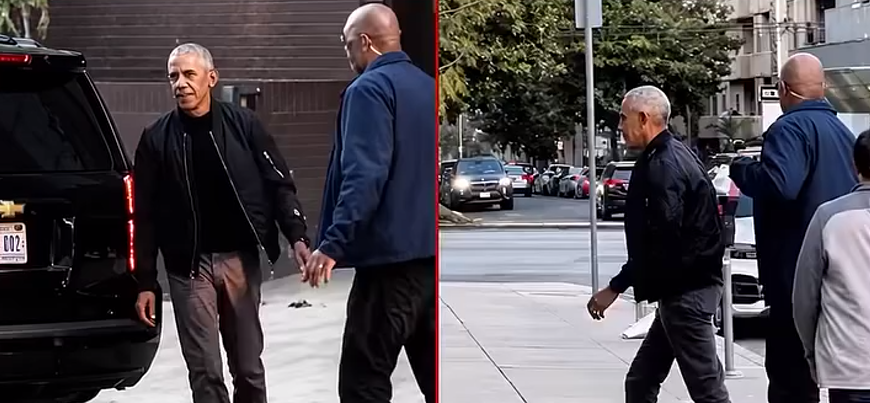
A bizarre late-night confrontation outside former President Barack Obama’s Washington, D.C., residence turned what should have been a routine Secret Service security assignment into an embarrassing internal controversy after two officers assigned near the property became involved in a physical altercation, prompting an urgent radio call for assistance and ultimately leading to both officers being suspended.
The incident unfolded at approximately 2:30 a.m. on May 21, 2025, outside the Washington residence of the former president. Instead of responding to an outside security threat, Secret Service personnel suddenly found themselves dealing with a conflict involving members of their own agency.
Video and audio associated with the confrontation subsequently emerged publicly, transforming an internal personnel matter into a widely discussed episode and raising questions about discipline, professionalism and readiness inside the agency responsible for protecting current and former presidents.
According to reporting on the incident, one of the officers radioed for a supervisor as tensions escalated.
“Get out here immediately before I do something,” she could be heard saying in audio associated with the incident, before using much more confrontational language about the other officer. Video subsequently showed a physical confrontation involving the two officers.
The episode was extraordinary partly because of where it occurred.
This was not an argument in an ordinary workplace or a disagreement between employees away from duty.
The officers were stationed near the home of a former president of the United States.
Barack Obama continues to receive Secret Service protection after leaving office, as former presidents are entitled to lifetime protection. That means the security surrounding his residence forms part of a protective operation designed around one overriding principle: agents and officers must remain prepared for potential threats.
Instead, personnel responsible for that mission became the center of the disturbance themselves.
The Secret Service responded by suspending both officers and launching an internal investigation.
The agency emphasized that it maintains strict standards of employee conduct and considers behavior violating those standards unacceptable. Officials did not publicly release every detail surrounding what started the dispute, leaving an important part of the story unresolved.
There was also no indication in the reporting that Barack Obama himself was harmed or confronted during the incident.
That distinction is important because dramatic descriptions such as “chaos at Obama’s house” can create the impression that someone attempted to attack or breach the former president’s residence.
The available reporting supports a different story: two Secret Service officers assigned near the residence became involved in a confrontation with each other.
That is still serious.
But it is serious for very different reasons.
The controversy concerns whether officers entrusted with one of the most sensitive law-enforcement assignments in the country maintained the professionalism and situational awareness expected of them.
Secret Service protection is fundamentally built around preparation.
Agents cannot know exactly when a threat will appear.
Most shifts around a protected residence may pass without anything extraordinary happening.
Hours of apparent inactivity can be followed by seconds requiring immediate judgment.
That reality means personnel must remain attentive even when nothing appears wrong.
A suspicious vehicle may approach.
Someone may attempt to cross a security perimeter.
A package may appear unexpectedly.
An alarm may activate.
An individual could behave erratically near the property.
An emergency involving the protectee could occur inside.
In any of those circumstances, officers need to react quickly.
That is why a fight between officers during a protective assignment creates questions extending beyond ordinary workplace misconduct.
If personnel are focused on confronting one another, critics naturally ask whether their attention has been diverted from the person or property they are supposed to protect.
There is no evidence that an outside attacker exploited the May 2025 confrontation or that Obama was endangered by a simultaneous intrusion.
Nevertheless, protective agencies are expected to evaluate vulnerabilities before someone exploits them rather than afterward.
That is what makes discipline part of security.
An officer does not need to deliberately abandon a post to create a vulnerability.
Distraction can be enough.
The incident therefore became another uncomfortable moment for an agency whose performance has been subjected to extraordinary scrutiny in recent years.
The Secret Service has one of the most unforgiving missions in the federal government.
When it succeeds, very little happens.
A president attends an event and returns safely.
A former president travels and returns safely.
A family goes about its daily routine without incident.
Success often looks completely ordinary.
Failure can become historic.
That is why the agency is sometimes described as operating under a “zero-fail” expectation.
A government review released in September 2026 again highlighted the extraordinary demands placed on the Secret Service while also identifying shortcomings in how the agency has responded to security incidents and updated protective policies. The Government Accountability Office examined 83 security incidents between 2015 and 2025 and found that policy changes followed only 25 of them. Investigators also identified delayed policy updates and concerns about how emerging threats such as civilian drones had been addressed.
Those broader institutional questions make seemingly isolated disciplinary incidents more significant.
A fight between two officers does not prove that the entire Secret Service is dysfunctional.
Thousands of personnel perform demanding assignments without becoming involved in such incidents.
But when misconduct occurs inside an organization with a zero-fail protective mission, management must determine whether the episode was genuinely isolated or reflects problems involving supervision, training, staffing, morale or organizational culture.
The location outside Obama’s residence makes those questions unavoidable.
Former presidents remain high-profile individuals long after leaving the White House.
Their movements can attract crowds.
Their homes can attract protesters, curious visitors and potentially dangerous individuals.
They can receive threats because of actions taken while in office or because they remain politically influential afterward.
Obama is particularly recognizable worldwide.
Consequently, the protective operation around him cannot be treated as ceremonial.
It remains a genuine security assignment.
Protection of a former president also differs from guarding a fixed government building.
The protectee lives a private life.
Family members come and go.
Guests may visit.
Deliveries arrive.
Neighbors live nearby.
Traffic continues through surrounding streets.
Agents and officers must distinguish normal activity from suspicious behavior without transforming an entire neighborhood into an inaccessible fortress.
That requires concentration and judgment.
Secret Service personnel also have to perform that work continuously.
Protection does not end because it is 2:30 in the morning.
Indeed, overnight shifts create their own challenges.
The streets may be quieter.
Fatigue becomes relevant.
Long stretches of inactivity can make vigilance difficult.
But threats do not follow office hours.
The agency therefore needs officers on overnight assignments to maintain exactly the same professional standards expected during highly visible daytime events.
That helps explain why audio of an officer urgently requesting a supervisor attracted so much attention.
The call suggested that an interpersonal dispute had reached a level where immediate intervention was needed.
Once video of the physical confrontation became public, the agency could no longer treat the matter merely as a private disagreement between employees.
It became a public test of accountability.
The Secret Service’s decision to suspend both officers pending investigation represented the first major disciplinary response.
Suspension does not itself establish every disputed fact surrounding an incident.
An internal investigation can examine video, radio communications, witness accounts, supervisory decisions and the actions of each participant before determining what additional consequences are appropriate.
Federal employees also possess procedural rights during disciplinary investigations.
The public therefore should not assume that suspension automatically determines the final outcome.
But removing the officers from duty while investigators examine what happened is understandable given the sensitivity of their assignment.
The unanswered question is what caused the confrontation.
Initial reporting did not establish a complete explanation.
That uncertainty should be preserved rather than filled with speculation.
Social media often does the opposite.
Once dramatic footage emerges, people attempt to reconstruct motives from a few seconds of video.
Rumors become explanations.
Political interpretations become facts.
Personal accusations can spread without evidence.
In this case, the verified central facts are already unusual enough: two Secret Service officers assigned near a former president’s residence became involved in a physical altercation, one radioed for supervisory assistance, both were suspended and the agency investigated.
Nothing more sensational needs to be invented.
The incident also illustrates an important distinction between Secret Service agents and the agency’s Uniformed Division.
The public frequently uses the word “agent” for virtually anyone associated with presidential security.
The Secret Service actually has different components with different responsibilities.
Uniformed Division officers play a major role in securing facilities and protected locations, including the White House complex and other sensitive sites.
Special agents frequently work more directly on protective details and investigations.
Both are part of the broader protective system.
The officers involved in the Obama-residence confrontation were reported to be Uniformed Division personnel.
Their work may not receive the same public attention as the suited agents seen walking beside presidents, but perimeter security is essential.
A protective detail functions through layers.
One layer remains close to the protectee.
Another secures entrances.
Another watches surrounding areas.
Others examine intelligence, coordinate transportation, screen visitors or prepare locations before a protectee arrives.
If one layer fails, the remaining layers may have to compensate.
The objective is redundancy.
That system exists because history has repeatedly demonstrated that presidents and former presidents can face unpredictable threats.
Obama himself experienced serious security incidents while president.
In November 2011, gunshots were fired at the White House while Sasha Obama was inside the residence and Malia was expected to return. Investigators did not discover until days later that bullets had struck the White House, an episode later cited in congressional scrutiny of Secret Service performance.
Then, in September 2014, another major breach occurred when a man jumped the White House fence and managed to enter the executive mansion shortly after Obama and his daughters had departed for Camp David.
The incident triggered evacuations and intense criticism of the Secret Service.
Those episodes demonstrated how quickly a seemingly secure environment can become vulnerable.
They also damaged confidence in an agency historically associated with almost invisible professionalism.
A Secret Service officer standing at a perimeter may appear to have a straightforward assignment.
But the job exists precisely because the unexpected sometimes happens.
Obama’s relationship with Secret Service protection began long before he entered the White House.
He received protection during the 2008 presidential campaign as his national profile and crowds grew.
After his election, he and his family had to adapt to a reality shared by presidential families across generations: virtually every movement outside private secured spaces required coordination with protective personnel.
Former officials have described the unusual relationship that develops between protectees and the people assigned to guard them.
Agents can become physically present during intensely private moments while simultaneously maintaining professional distance.
They know schedules.
They know family routines.
They see moments never intended for public consumption.
Yet they are expected to remain discreet.
During Obama’s presidency, reports described both the family’s dependence on the Secret Service and the frustrations inherent in living under constant protection. Obama once recalled with nostalgia one of his last opportunities to walk relatively freely during the 2008 campaign, while Michelle Obama famously compared the restrictions of White House life to living in an extremely comfortable prison.
Protection does not disappear when a presidency ends.
The environment changes.
A former president no longer lives behind the permanent security infrastructure of the White House.
Instead, the Secret Service has to adapt protective measures to private residences, offices, travel and public events.
Obama’s Washington home consequently became one of the locations around which the agency maintains security.
For the officers assigned there, professionalism is therefore more than an employment expectation.
It is an operational requirement.
That makes the May 2025 fight particularly damaging from an optics perspective.
Imagine the situation from the agency’s point of view.
Its personnel are stationed outside a former president’s residence partly to ensure that disturbances are detected and controlled.
Then its own officers become the disturbance.
The irony was impossible to miss.
Video gave the story additional momentum.
Without footage, the confrontation might have remained a relatively obscure personnel matter described through a short agency statement.
Once people could see portions of the encounter and hear associated radio communications, the story became much more tangible.
Video changes public reaction.
Written descriptions create distance.
Images make an event immediate.
Social media then accelerates distribution.
Clips are reposted without context.
Commentators add dramatic headlines.
Within hours, an incident involving two employees can become a referendum on an entire federal agency.
That can be unfair to thousands of employees who had nothing to do with the confrontation.
But it also demonstrates why public servants working in highly sensitive positions are held to unusually high standards.
Uniforms represent institutions.
When someone wearing one behaves badly, audiences rarely separate the individual completely from the organization.
The Secret Service therefore had an institutional interest in responding quickly.
Its statement emphasized its strict code of conduct and made clear that behavior violating that code was unacceptable.
The deeper challenge is determining whether disciplinary action alone is enough.
If investigators concluded that two individuals simply had a personal conflict that escalated, individual discipline could address much of the problem.
If the confrontation revealed poor supervision or longstanding workplace tensions that had not been addressed, management questions would become more important.
If staffing pressure or exhaustion contributed, leadership would need to examine scheduling and workforce conditions.
Those possibilities are questions rather than established conclusions.
They demonstrate what an effective internal investigation should attempt to determine.
Secret Service leadership also has to consider public confidence.
Presidential protection depends partly on secrecy.
The agency cannot reveal every security procedure to prove that it is doing its job.
Detailed disclosure could create vulnerabilities.
That means the public is frequently asked to trust an institution whose most important operations remain hidden.
Maintaining that trust requires visible professionalism in the areas the public can see.
When officers fight while assigned outside a former president’s home, the agency loses some of that benefit of the doubt.
Rebuilding it requires accountability.
The incident should nevertheless be kept in proportion.
There was no reported assassination attempt connected with the confrontation.
There was no reported attack on Obama.
There was no established breach of his residence caused by the fight.
There was no evidence presented publicly that an outsider exploited the distraction.
Describing the episode as though Obama narrowly escaped an attacker would therefore distort what happened.
The legitimate controversy is serious enough.
Two officers entrusted with protecting a former president apparently became so consumed by their dispute that a supervisor had to be summoned and the conflict became physical.
For an ordinary employer, that would be a significant workplace disciplinary matter.
For the Secret Service, it becomes a security concern as well.
The difference comes from the agency’s mission.
A restaurant can temporarily replace employees after a fight.
A retail store can close a department.
A presidential protective operation cannot simply pause.
Someone must remain responsible for security every minute.
That is why personnel reliability matters so much.
The broader scrutiny facing the Secret Service makes the timing especially uncomfortable.
The agency underwent enormous criticism following the July 2024 assassination attempt against Donald Trump in Butler, Pennsylvania, where a gunman managed to fire from a nearby rooftop and wound Trump.
That attack triggered investigations, leadership changes and renewed scrutiny of protective planning.
A subsequent armed incident near Trump’s Florida golf course added to concerns about the difficulty of protecting political figures in open environments.
The Government Accountability Office’s 2026 examination of Secret Service policies concluded that the agency had not always documented why incidents failed to produce policy changes and had allowed some policies to become outdated. The report specifically emphasized emerging threats such as drones.
Against that institutional background, any fresh episode suggesting poor discipline receives more attention than it might have a decade earlier.
This does not mean the Obama-house confrontation is equivalent to a protective failure involving an armed attacker.
It clearly is not.
But organizational reputation is cumulative.
Every incident becomes part of a larger conversation about whether the agency has sufficient leadership, staffing, training and accountability to meet its demanding mission.
That conversation also has to recognize the enormous difficulty of the work.
Secret Service employees routinely work long and unpredictable hours.
Presidential travel can require extensive advance planning.
Campaign seasons create exhausting schedules.
International trips demand coordination with foreign governments.
Former presidents continue traveling.
Current presidents require constant coverage.
Families require protection.
Major political candidates can receive details.
National Special Security Events consume resources.
Threats must be investigated.
Meanwhile, the agency must recruit, train and retain enough qualified personnel to sustain these operations.
The solution to misconduct cannot simply be telling everyone to work harder.
Leadership has to create conditions in which employees can meet standards consistently.
Training matters.
Supervision matters.
Morale matters.
Rest matters.
Clear disciplinary expectations matter.
So does a workplace culture in which conflicts are resolved before they become physical.
For the Obama family, the public significance of the incident may ultimately be limited.
There is no indication from the verified reporting that Barack or Michelle Obama participated in the confrontation or were responsible for it.
Their home was the location of the protective assignment, not the cause of the officers’ disagreement.
Yet their presence explains why the story became national news.
If two federal employees fought in an ordinary government parking lot, the episode might never become a headline.
When the same behavior occurs outside the residence of a former president, it raises the stakes immediately.
Obama’s continued Secret Service protection also serves as a reminder that leaving office does not return a former president to ordinary private life.
Presidents accumulate enemies.
Their decisions affect wars, intelligence operations, criminal prosecutions and international relationships.
Their symbolic importance continues long after their formal authority ends.
Protection therefore follows them for life.
For Secret Service personnel, that means the mission extends across decades and administrations.
The agents protecting Obama today operate under an administration led by a political rival.
That does not matter operationally.
Professional protection is supposed to be politically neutral.
The agency protects the office and the individuals legally entitled to protection, not a political party.
That neutrality is another reason professional conduct is essential.
Americans must be able to trust that the people assigned to protect political leaders will perform their duties regardless of personal politics or workplace disagreements.
The confrontation outside Obama’s residence violated that expectation of professionalism, even though no reported external threat materialized at the same time.
The long-term significance will depend partly on what the Secret Service learned from its investigation.
Public disciplinary details may remain limited because federal personnel matters involve privacy protections.
That can frustrate people demanding complete transparency.
But accountability does not always require every employment record to become public.
The agency can review procedures internally.
Supervisors can receive guidance.
Employees can face appropriate discipline.
Training can be changed.
Staffing practices can be examined.
The critical question is whether lessons are actually absorbed.
The 2026 GAO findings make that point especially relevant.
Reviewing security incidents is useful only if the organization identifies necessary changes and follows through.
Documentation matters because institutional memory matters.
Leadership changes.
Employees retire.
Details fade.
Written procedures allow lessons from one incident to protect against repetition years later.
The Obama-residence confrontation may ultimately be remembered less as a security crisis than as an extraordinary example of why protective professionalism cannot be taken for granted.
Two officers.
One overnight assignment.
One escalating disagreement.
One urgent radio call.
One physical confrontation.
And suddenly an agency responsible for protecting America’s political leaders found itself answering questions about whether its own personnel had become a distraction from the mission.
The episode was dramatic, but the most important part came afterward.
Were the officers held accountable?
Did supervisors determine what allowed the conflict to reach that point?
Were any weaknesses in management identified?
Could similar behavior happen again during another sensitive assignment?
Those are more meaningful questions than the viral footage itself.
For the public, the story also offers a useful lesson about dramatic headlines.
“Chaos at Obama’s house” sounds like an attack.
The verified facts tell a stranger story.
The chaos came not from an intruder trying to reach the former president, but from two people assigned to help keep him safe.
That distinction does not make the episode insignificant.
In some ways, it makes it more remarkable.
The Secret Service exists to remain calm when everyone else is panicking.
Its personnel are trained to control dangerous situations, not create them.
When officers lose that discipline outside the home of someone they are assigned to protect, scrutiny is inevitable.
Barack Obama spent eight years occupying perhaps the most heavily protected residence in America.
He experienced threats, a shooting directed at the White House and a major fence-jumping breach during his presidency. He has lived with Secret Service protection since before becoming president.
Years after leaving office, protection remains part of his daily reality.
That protection depends on people.
Technology can detect threats.
Cameras can monitor streets.
Barriers can slow intruders.
Radios can summon help.
But ultimately, trained human beings must make decisions.
Their judgment is the system’s most important component.
That is why discipline matters even when no attacker appears.
The night of May 21, 2025, did not become a story because the Secret Service failed to stop someone from attacking Obama.
It became a story because officers assigned to prevent chaos became involved in chaos themselves.
Both were suspended.
The agency investigated.
No reported outside threat took advantage of the situation.
And yet the footage left behind an uncomfortable question for an organization whose mission allows virtually no margin for error:
What if there had been one?
That question explains why an apparently isolated workplace fight became more than an embarrassing viral video.
For the Secret Service, every second spent distracted from protection carries potential consequences that ordinary workplaces never face.
And outside the home of a former president of the United States, even a fight between colleagues can become a reminder of just how much depends on the people standing guard.