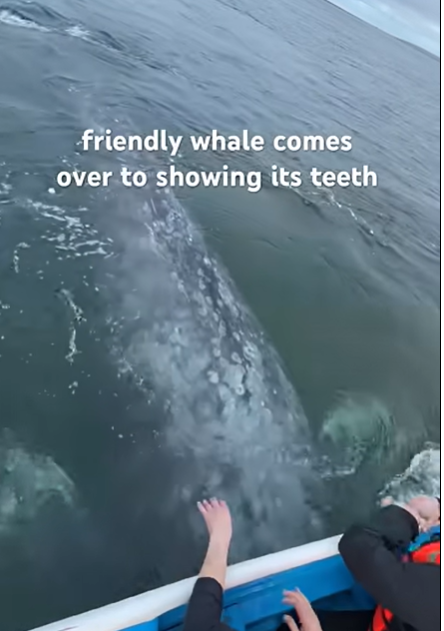
There is something instantly unforgettable about a moment when a massive wild animal chooses, on its own, to come close to humans without fear. In the video, a gray whale glides beside a small boat, close enough for the passengers to reach down and touch its skin. The whale does not appear frantic, aggressive, or frightened. Instead, it moves with a kind of calm curiosity, rolling gently onto its side and even onto its back as if it is presenting itself for attention. The people on the boat react with amazement, and it is easy to understand why. A whale is one of the largest creatures on Earth, and yet in this moment, it seems to behave with the softness and playfulness of an animal seeking connection. The contrast is what makes the scene so powerful. Something so huge, so wild, and so completely at home in the open sea approaches a tiny human boat not with force, but with gentleness.
What makes encounters like this so emotionally moving is that they seem to break the usual distance between people and nature. Most humans experience wildlife through screens, documentaries, zoos, or brief glimpses from far away. Even when people go out on the water to watch whales, the whales are often seen surfacing at a distance, sending up a misty blow, showing a tail, or briefly arching their backs before disappearing beneath the waves. Those experiences are already special. But this kind of close interaction feels different. It creates the sense that the barrier between species has thinned for a moment. The whale is not merely being observed. It appears to be participating in the encounter. That participation is what makes the scene so memorable. It is not just a case of humans discovering an animal. It feels, at least emotionally, as if the animal is discovering the humans too.
Gray whales are especially fascinating in this regard because they are known for long migrations and for occasionally displaying curious behavior around boats. These whales travel extraordinary distances, moving between feeding and breeding grounds across vast stretches of ocean. They are creatures of endurance, instinct, and deep memory, navigating coastlines and currents with a rhythm shaped by generations. To think that an animal capable of such immense journeys would pause beside a small vessel and seemingly invite human touch creates a powerful emotional effect. It reminds people that intelligence, sensitivity, and personality exist throughout the animal world in ways humans are still trying to fully understand. A whale does not have to be human-like to be emotionally compelling, but moments like this naturally encourage people to see qualities such as curiosity, playfulness, or trust in the animal’s behavior.
The scene also reveals something about how quickly humans respond to gentleness. If a giant whale approached aggressively, the reaction would be terror, and rightly so. Even a small movement from such a large body could overturn a boat or send people into panic. But when the whale rolls slowly beside the vessel, exposing part of its body and lingering near the surface, the atmosphere changes entirely. Fear gives way to awe. The passengers stretch out their hands. Their gestures become soft and careful. Their voices, if heard, would likely carry excitement mixed with disbelief. There is a universal human response to tenderness, especially when it comes from an unexpected place. The whale’s size does not disappear, but its calmness transforms the way that size is understood. It stops seeming threatening and starts seeming majestic.
Part of the beauty of the video lies in the comparison people instinctively make between the whale and a domesticated animal. The description says the whale rolls onto its side and back in a way that resembles a dog looking for affection. That comparison is powerful because it translates an unfamiliar marine behavior into something emotionally recognizable. Most people know what it looks like when a dog flops over for belly rubs or leans into human contact with trust. To see a whale display a motion that feels similar is both charming and surprising. Of course, a gray whale is not a dog, and its behavior should not be reduced entirely to human interpretation. Still, humans understand the world through analogy, and the dog-like comparison helps explain why the moment feels so endearing. It makes the whale seem not less wild, but more relatable.
At the same time, the encounter also invites reflection on how humans interpret animal behavior. People often want to believe that a wild animal is “friendly” in the same way a pet is friendly. Sometimes that interpretation may reflect reality to some degree, especially when an animal repeatedly seeks out interaction. But it is also important to remember that wild animals operate within their own instincts, needs, and patterns. A whale may approach for many reasons: curiosity, play, social behavior, comfort with boats, environmental conditions, or a learned association with human presence. The fact that the whale appears calm and receptive does not mean it has become domesticated or that it understands the encounter in exactly the way humans do. That does not make the moment less beautiful. If anything, it makes it more meaningful. Humans are not simply seeing a mirror of themselves. They are witnessing the mystery of another being acting in a way that overlaps, for a moment, with human ideas of affection and connection.
The passengers’ ability to pet the whale adds another layer of wonder. Touch is one of the most intimate forms of contact. Looking at an animal from a distance is one thing. Touching it creates a completely different memory. The skin of a whale is not like the fur of a dog or the feathers of a bird. It is smooth in some places, textured in others, shaped by the sea, by life, by constant movement through saltwater. To place a hand on the body of a whale is to feel, even briefly, the reality of a creature that otherwise seems almost mythical in scale. For the people on that boat, the encounter was probably one of those rare experiences that remain vivid for years, maybe for life. They may forget countless ordinary days, but they will remember the feeling of reaching over the side of the boat and touching a whale that chose to swim beside them.
Moments like this are also powerful because they tap into an ancient part of human imagination. For centuries, whales occupied a place somewhere between fear, myth, and fascination. In older stories, the sea was often imagined as a realm of mystery, and whales were among its greatest symbols. They were seen as monsters, omens, or almost supernatural presences because of their size and the difficulty of truly knowing them. Modern science has transformed much of that mystery into knowledge, but the emotional force remains. A whale surfacing beside a boat still feels larger than ordinary life. It still feels like a brush with something ancient and immense. That is why people often describe such encounters in almost spiritual language. They feel humbled, emotional, quiet, or overwhelmed. The whale is not only an animal in that moment; it becomes a reminder of scale, life, and the depth of the natural world.
There is also a tenderness in the way the whale seems to trust the people nearby. Trust may be too strong or too human a word, but the impression of trust is certainly there. The whale does not rush in and out. It lingers. It stays near enough for physical contact. It rolls and reveals itself in a relaxed manner. To human eyes, this looks like vulnerability. Large animals are often most impressive when they display strength, but they are often most moving when they display calmness. The whale is not proving power. It is sharing presence. That kind of presence affects people deeply because it feels like a gift. The humans on the boat did not force the whale to come near. They did not create the moment. They received it.
This sense of receiving rather than controlling is important. In many parts of human life, people try to dominate nature, organize it, contain it, or consume it. Wild animals are often treated as attractions, resources, or threats. But a moment like this reverses that pattern. The humans are small, passive, and lucky. The whale decides the terms of closeness. It comes near because it wants to, and it could leave at any time. The people are not masters of the encounter. They are witnesses to it. This reversal can be deeply healthy for the human imagination because it reminds people that the natural world is not here merely to serve human desires. It exists on its own terms, and when it allows moments of proximity, those moments should be treated with gratitude and respect.
The ocean setting intensifies everything. On land, humans often feel secure. At sea, even on a boat, there is a mild underlying awareness of vulnerability. The water is vast, moving, and unfamiliar to most people in the way it is familiar to marine life. A boat is a small floating edge between two worlds. To stand on that edge while a whale rises beside you is to feel both exposed and privileged. The boat becomes a meeting point between species, a fragile platform from which humans glimpse a life lived beneath the surface. Unlike an aquarium, where water is contained and viewed through glass, the open ocean has no visible boundary. The whale can vanish into that depth at any moment. That possibility gives the interaction a dreamlike quality. It is here, close enough to touch, and yet it remains fundamentally beyond human possession.
What makes the description especially engaging is the phrase about the whale “showing its teeth.” That detail adds personality, even humor, to the video. Humans naturally read facial expressions and mouth movements as communicative, even when they belong to animals whose expressions do not map neatly onto human emotion. The idea of a whale swimming over to “show its teeth” sounds almost playful, like someone smiling for attention. Whether that is scientifically accurate as an interpretation matters less in the emotional context of the video than the effect it creates. It turns the whale from a distant marine creature into a character in a shared moment. It makes the encounter feel like an introduction. The whale is not only present; it is presenting itself.
Scenes like this often go viral because they offer a rare combination of scale and sweetness. The internet is full of dramatic wildlife content—predators hunting, animals fighting, rescues, storms, survival. This video offers something gentler. There is no chase, no panic, no violence. The emotional energy comes from wonder. That matters because people are deeply hungry for images that restore a sense of beauty and connection. In a world where many videos are built around shock or outrage, a moment of peaceful cross-species interaction stands out. It gives viewers a reason to pause and feel something other than tension. It invites amazement rather than conflict.
Still, the video also opens an important conversation about how humans should behave around marine life. Encounters like this can inspire love for animals, but they can also encourage people to seek out similar moments without understanding the risks or ethical boundaries. Wild whales are not pets, no matter how friendly they may seem in individual cases. They are powerful, sentient animals living in complex ecological systems. Human interaction must always prioritize their welfare, not human entertainment. If a whale chooses to approach, that is different from humans trying to crowd, chase, or harass one. Respecting distance, following guidelines, and allowing animals control over the interaction is essential. Otherwise, the very admiration that draws people toward wildlife can become harmful.
This balance between wonder and respect is a recurring challenge in modern nature tourism. People want meaningful experiences with wildlife, and such experiences can indeed deepen empathy and conservation awareness. A person who has looked into the eye of a whale or felt the splash of its movement beside a boat may leave with a stronger commitment to protecting oceans. But responsible tourism depends on humility. Humans must remember that the goal is not to turn wild creatures into performers. The goal is to witness them without causing stress or altering their behavior in damaging ways. The beauty of this video lies partly in the sense that the whale itself was leading the interaction. That is what keeps the moment feeling magical rather than exploitative.
There is also something emotionally symbolic about a gray whale choosing closeness. Whales are often associated with wisdom, age, and memory in human imagination. They move through deep water, communicate across distances, and live lives mostly hidden from human view. When such an animal approaches with apparent ease, people often experience it as a kind of reassurance. It feels as though the ocean itself has offered a peaceful sign, a moment of contact that says the wild world is not only distant or hostile. Of course, nature is not sending human messages in a literal sense. But human beings are storytelling creatures, and moments like this naturally become symbols. They symbolize trust, curiosity, mutual presence, and the possibility of coexistence.
The passengers’ reactions are also part of the story, even when the whale is clearly the star. Human emotion is often what helps other viewers feel the importance of a wildlife encounter. A whale beside a boat is visually impressive on its own, but seeing people reach out in amazement, hesitate, laugh, or gasp allows viewers to imagine themselves there. The passengers become stand-ins for everyone who has ever dreamed of being close to a whale. Their hands reaching over the edge of the boat become symbols of human longing—not the longing to control nature, but the longing to feel close to something vast and beautiful. In that sense, the video is not only about a whale. It is also about what humans seek when they go into the natural world: not just sightseeing, but connection.
Connection, however, does not have to mean sameness. One of the most meaningful aspects of the encounter is that the whale remains entirely itself. It is not trained. It is not performing on command. It does not belong to the people on the boat. It is free. That freedom gives the encounter dignity. The joy of the moment comes precisely from the fact that the whale could have stayed away and did not. It chose proximity. It chose, for whatever reason exists in its own animal experience, to glide alongside humans and allow touch. That freedom distinguishes true wildlife encounters from staged interactions. It means the beauty of the moment was not manufactured. It arose from shared presence in a living environment.
When people watch videos like this, many of them likely feel a mixture of happiness and sadness. Happiness because the moment is so beautiful. Sadness because it is rare, fleeting, and a reminder of how disconnected many humans are from the natural world. Most people do not spend their days in environments where wild animals approach peacefully. Much of modern life happens indoors, online, or in heavily managed spaces. The whale’s appearance beside the boat cuts through that artificiality. It reminds people that there are still immense, breathing, intelligent creatures moving through the oceans right now, beyond the routines of cities and screens. That reminder can feel both comforting and aching. It reveals how much wonder still exists and how little of it most people regularly experience.
The video may also inspire viewers to think more seriously about conservation. Whales have a long and painful history with humans. For centuries, many whale species were hunted on a massive scale, their bodies turned into oil, meat, and industrial products. Some populations were driven to the edge of collapse. The fact that people can now celebrate a living whale approaching a boat rather than viewing a whale primarily as a resource reflects a major shift in human values. But that shift remains incomplete. Marine ecosystems still face threats from pollution, ship strikes, fishing gear entanglement, climate change, underwater noise, and habitat disruption. A video of a “friendly whale” is heartwarming, but it should also remind viewers that creatures capable of inspiring such wonder deserve protection at a systemic level, not just admiration in isolated moments.
There is a particular emotional power in gentleness coming from strength. This is true in human life, and it is true here. A whale is immensely powerful. It does not need human approval. It does not need to prove anything. Yet in the video, its power is expressed through softness, not force. It stays near the boat, rolls slowly, and allows the encounter to remain peaceful. That kind of gentleness feels noble. It shifts the meaning of greatness away from dominance and toward calm presence. Perhaps that is part of why people are so drawn to whales in general. They embody a kind of majesty that does not need display. Their scale is overwhelming, but their movement can be graceful. Their presence is immense, but their interaction can be quiet.
Another reason the moment resonates is that it touches something childlike in people. Many adults, when confronted with a whale up close, likely feel the same wonder they would have felt as children reading about sea creatures or seeing them in picture books and documentaries. The world becomes larger again. Imagination becomes real. A whale is no longer an image or an idea. It is beside you, breathing, moving, glistening in the water. That return to wonder is precious. It reminds people that not all amazement needs to be ironic or distant. Some things are simply extraordinary, and the right response is honest awe.
The image of the whale beside the boat may linger because it captures a rare kind of peace. Nothing in the scene appears rushed. The water moves, the boat floats, the whale glides, and the passengers reach out. The encounter unfolds in a rhythm that feels natural and unforced. In a world where so much content is fast, loud, and aggressive, this slowness is part of the magic. The whale does not need to perform tricks. Its mere presence, close and calm, is enough. The ocean does not need to become dramatic. Its quiet surface is enough. The people do not need complicated words. Their astonishment is enough.