A deadly shooting at a downtown Minneapolis apartment building left two residents dead, several civilians wounded and police officers injured after what investigators say began during a child-custody exchange and escalated into violence throughout the residential tower.
The September 2 incident unfolded at Shoreline Plaza, a high-rise apartment complex at 15 East Grant Street near Minneapolis’ Loring Park neighborhood. Authorities said emergency calls began coming in shortly after 4:30 p.m., prompting a rapid response from Minneapolis police and numerous other law-enforcement agencies.
Initial reports described an extraordinarily chaotic scene. Officers arrived to find wounded people and continued hearing gunfire from inside the building. Police moved through the property searching for victims and attempting to locate the shooter while residents sought shelter or tried to escape.
Minneapolis officials ultimately confirmed that two civilians were killed. The suspected shooter also died, bringing the total number of deaths connected with the incident to three. Several other civilians were wounded, while three Minneapolis police officers suffered injuries during the response, two of them from gunfire.
The Minnesota Bureau of Criminal Apprehension later identified the two residents who died as 63-year-old Dale Henry Spry and 61-year-old Muse A. Afrah. Both were believed to live in the apartment complex where the violence occurred.
Investigators identified the suspected shooter as 35-year-old Carlton Neal Johnson II.
Authorities said the shooting did not begin as a random encounter inside the tower.
According to investigators, the first violence occurred outside the building during what was supposed to be a custody exchange involving Johnson, a woman with whom he shared a child and their young daughter.
The Minnesota Bureau of Criminal Apprehension said Johnson shot the woman in the leg. The child was able to get away safely and was not physically injured.
That was only the beginning of the attack.
Investigators said Johnson then entered Shoreline Plaza and shot two employees on the first floor. Both survived, although authorities initially described one of the employees as being in critical condition.
Johnson then went to the ninth floor, where he lived.
Authorities said he encountered Spry and Afrah, both fellow residents of the building, and fatally shot them.
The sequence transformed what had begun as an apparent domestic-violence incident outside the tower into a much larger active-shooter emergency involving residents, staff members and responding police officers.
Police arrived within minutes of the first emergency calls.
As officers entered the building, they encountered victims in the lobby and continued hearing gunshots coming from above.
Rather than waiting outside, responding officers moved toward the gunfire.
They eventually traced the activity to an upper floor of the building, where officials said visibility became severely limited by a haze inside the hallway.
The circumstances surrounding that haze later became clearer when body-camera footage was released.
Video from officers’ cameras showed a cloud developing during the confrontation. Reporting on the footage indicated that the haze appeared to have been caused when gunfire struck or disturbed a fire extinguisher or related equipment in the hallway.
Two officers were shot during the confrontation.
The Bureau of Criminal Apprehension identified them as Officer Joseph Michnowski, who had served with the Minneapolis Police Department since 2021, and Officer Yahye Ahmed, who joined the department in November 2024.
Michnowski was struck twice in the abdomen and required surgery.
Ahmed was shot in the leg.
A third officer suffered a non-gunshot injury involving broken glass and was treated and released. Officials said the injured officers were expected to recover.
The body-camera recordings released later in September provided the public with a far clearer picture of what responding officers encountered.
The footage showed officers moving through the building and reaching the ninth floor while attempting to locate both victims and the gunman.
At one point, officers encountered a wounded person in the hallway.
Moments later, the shooter appeared from around a corner and opened fire at extremely close range, according to accounts of the released video.
Michnowski was hit but remained able to communicate with other officers.
Additional gunfire followed as police and Johnson exchanged shots.
Ahmed was also wounded during the confrontation.
The newly released footage confirmed how confined and dangerous the situation had become inside the apartment hallway, where officers had limited visibility and very little distance separating them from the armed suspect.
Authorities said Johnson died during the exchange of gunfire with police.
A preliminary autopsy determined that he died from multiple gunshot wounds, and his death was classified as a homicide, according to information released by the Minnesota Bureau of Criminal Apprehension.
Investigators continued working afterward to determine which officers discharged their weapons.
The BCA initially identified Officer Liban Mohamed Ibrahim as one officer who fired during the confrontation and said investigators were determining whether additional officers had also discharged firearms.
The rapid progression of the attack created significant confusion during the first hours following the shooting.
Early reports indicated that three officers had been injured, but officials later clarified that two had suffered gunshot wounds while a third was hurt by glass.
Additional officers also experienced medical problems after encountering an unknown airborne substance, according to the City of Minneapolis. Two officers were separately injured in a squad-car crash while responding to the emergency.
Law-enforcement agencies from across the Minneapolis area converged on the neighborhood.
The Minnesota State Patrol, Hennepin County Sheriff’s Office, Minneapolis Park Police, St. Paul Police Department, University of Minnesota Police Department and several suburban agencies assisted.
The FBI also responded to support local authorities.
The scale of the response reflected how uncertain the situation remained while officers were searching the high-rise.
Residents inside the building did not initially know where the shooter was located or whether additional gunmen might be involved.
Police established a large perimeter around the property while emergency medical personnel prepared to treat the wounded.
Some residents described hiding inside apartments as gunfire echoed through the building.
One resident told MPR News that she was in an elevator approaching the first floor when she heard shots. She quickly closed the elevator doors, returned upstairs and took shelter inside her apartment while the shooting continued.
The City of Minneapolis arranged a reunification location for residents and families at Central Lutheran Church.
The American Red Cross prepared shelter assistance for people displaced by the shooting, while the Salvation Army provided food as authorities continued processing the massive crime scene.
As investigators reconstructed the sequence of events, attention quickly turned to Johnson’s history at Shoreline Plaza.
Court records showed that building management had been attempting to evict him before the shooting.
The eviction complaint described multiple allegations involving threatening or violent behavior at the property.
According to those records, management accused Johnson of assaulting another resident earlier in the year, displaying a firearm in the presence of staff and residents and threatening another resident with a gun.
One resident had also sought a restraining order, writing that he feared entering and leaving his own apartment because of Johnson’s alleged conduct.
Johnson disputed allegations contained in the eviction proceedings.
The eviction case had not been completed at the time of the shooting, and a trial was scheduled for September 11, just over a week after the attack.
Those details raised questions about whether there were warning signs before the violence.
However, an eviction proceeding or previous allegation does not by itself establish that authorities could have legally predicted or prevented the September 2 attack.
Investigators and journalists continued examining Johnson’s previous interactions with residents, building managers and law enforcement in an effort to understand the events that preceded the shooting.
Authorities characterized the beginning of the incident as domestic violence because the first person Johnson allegedly shot was the mother of his child during the custody exchange.
The subsequent shootings of building employees and residents substantially expanded the scope of the violence.
The child’s presence during the initial encounter added another disturbing element.
Investigators said she was not physically harmed and was moved away from the shooting as the emergency unfolded.
The survival of the wounded civilians and officers became another major focus following the attack.
In the days afterward, authorities said Ahmed had been released from the hospital, while Michnowski remained hospitalized after undergoing surgery.
By September 16, Minneapolis police confirmed that Michnowski had also returned home from the hospital.
The two slain residents, meanwhile, became the focus of mourning among neighbors and people connected with the building.
Afrah and Spry had apparently been caught in an attack that escalated through the apartment complex after beginning outside.
Authorities said both men lived in the building and were on the same upper floor where Johnson lived.
Later reporting also identified the wounded civilians more fully.
Among them were the woman shot during the custody exchange and two employees of the apartment building.
The violence therefore affected several groups of people almost simultaneously: a former partner, building staff, residents and police officers who responded to the emergency.
Minneapolis Mayor Jacob Frey publicly praised the officers who entered the building.
Frey said officers moved through the property looking for wounded residents, helped bring victims to safety and continued their response despite being fired upon themselves.
Interim Minneapolis Police Chief Bill Peterson similarly described the event as extraordinarily dangerous and thanked the large number of local and state agencies that helped manage the response.
Peterson also praised the Bureau of Criminal Apprehension for taking responsibility for the investigation into the police use of force.
Because officers exchanged gunfire with the suspect, the BCA became responsible for investigating that portion of the incident.
Such outside investigations are intended to establish the sequence of police gunfire, identify which officers fired weapons and document evidence independently of the department whose officers were involved.
Body-camera footage, surveillance recordings, physical evidence and witness statements all became part of that investigative process.
The footage released roughly two weeks later gave the public a rare view into the seconds when officers encountered the shooter.
It also showed how rapidly the situation changed.
Officers who had entered the floor trying to locate victims suddenly found themselves taking gunfire in a narrow residential hallway.
One officer was shot in the abdomen, another in the leg, yet police continued responding until the threat ended.
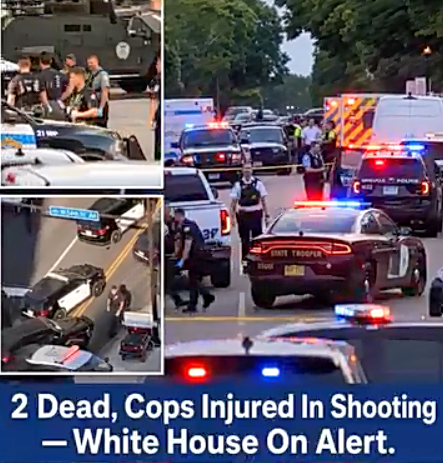
The images included in the uploaded video appear consistent with the large emergency response surrounding this Minneapolis incident.
Rows of police vehicles, tactical officers, ambulances and heavily equipped law-enforcement personnel filled the area around Shoreline Plaza as authorities secured the scene.
However, the text placed over the video creates a potentially misleading impression.
It states that two people were dead and officers were injured, which reflects part of what happened, but it adds that the “White House” was “on alert.”
Reliable reporting on the Minneapolis shooting describes assistance from local agencies, the Minnesota Bureau of Criminal Apprehension and the FBI, but I found no reliable source establishing that the incident triggered a specific White House security alert.
The distinction matters because the shooting occurred hundreds of miles away from Washington, D.C., and authorities treated it as a Minneapolis crime and public-safety emergency.
Federal involvement came through investigative assistance from the FBI, not because the shooting took place near the White House.
Short social-media videos frequently combine genuine footage with dramatic captions designed to attract attention.
That can make an otherwise real event appear connected to another location or political development that has not been established by reporting.
In this case, the verified story is already extremely serious without adding an unsupported White House connection.
Two residents lost their lives.
Three civilians were wounded.
Two police officers were shot, another officer suffered a separate injury, and additional emergency responders experienced medical or traffic-related problems while responding.
The suspected gunman also died.
The shooting had repercussions throughout the Loring Park neighborhood.
A major downtown residential building became a crime scene, residents were evacuated or temporarily displaced, streets were filled with emergency vehicles and community organizations mobilized to provide food, shelter and reunification assistance.
The event also came at a time when Minneapolis residents were already dealing with broader concerns about public safety and violence.
Yet investigators emphasized the specific circumstances of this shooting rather than immediately treating it as an indiscriminate attack without a known starting point.
The evidence gathered by the BCA indicated that the violence began during the custody exchange and then expanded after Johnson entered the apartment building.
That distinction helps explain the sequence.
The first victim was connected personally to Johnson.
The building employees were then attacked downstairs.
Two residents were killed upstairs.
Responding officers were shot when they reached the ninth floor.
What began as violence involving a personal relationship had, within minutes, become an active-shooter situation affecting an entire high-rise building.
Court documents concerning the pending eviction added still more context.
Property managers had alleged repeated incidents involving weapons and threats during the months preceding the shooting.
Johnson had denied aspects of those accusations through the legal process.
Because the eviction case was still pending, there had been no final court resolution of those disputes before September 2.
Questions also emerged about earlier contacts between Johnson and the criminal-justice system.
Reporting after the shooting examined whether previous incidents involving alleged threats or weapons had resulted in criminal charges.
Such questions are likely to remain part of the public discussion surrounding the case, but they involve complicated legal standards regarding evidence, probable cause and prosecutors’ ability to prove individual allegations beyond a reasonable doubt.
The immediate factual record is clearer regarding what occurred on September 2.
At approximately 4:36 p.m., emergency calls began reporting a shooting at the downtown apartment complex.
Officers arrived within minutes.
They encountered wounded civilians and continued gunfire.
They followed the shots toward the ninth floor.
Two responding officers were hit.
Police exchanged fire with Johnson.
Two residents were killed, three other civilians were wounded and Johnson died.
By later that evening, authorities said the scene had been secured and there was no continuing threat to the public.
The days that followed were devoted to identifying victims, examining physical evidence, reviewing officer body cameras and surveillance recordings and interviewing witnesses.
Investigators also examined the gunman’s apartment and the broader history of disputes within the building.
Later media reports said investigators recovered ammunition, magazines and other firearm-related items from Johnson’s residence, although the BCA investigation remained responsible for determining the complete evidentiary picture.
The eventual release of police video on September 16 and 17 brought renewed attention to the case.
The footage showed the confrontation from officers’ perspectives and illustrated the limited amount of time they had to react.
Police were searching the hallway when gunfire erupted at close range.
Michnowski continued communicating over his radio even after being struck.
Ahmed was subsequently wounded as additional shots were exchanged.
The images were dramatic, but they also served an investigative and transparency purpose.
Body-camera releases can allow the public to compare early official accounts with visual evidence from the scene.
In this case, later reporting said the videos were broadly consistent with investigators’ earlier description of officers reaching the ninth floor and exchanging gunfire with Johnson.
The investigation does not erase the human impact on those who lived at Shoreline Plaza.
Residents who were not physically injured still experienced a violent event inside their home.
Some hid while gunfire continued.
Others were evacuated and unable to immediately return.
Building employees who ordinarily handled maintenance or management suddenly became shooting victims.
A child witnessed the beginning of an incident involving her parents but escaped without physical injury.
Two families lost relatives who had simply been living in the building when the violence reached their floor.
The consequences therefore extend far beyond crime-scene statistics.
For first responders, the incident demonstrated the risks involved when police enter a large residential property without knowing precisely where an armed person is located.
A high-rise introduces additional difficulties because officers must navigate stairwells, elevators, hallways, locked doors and multiple floors occupied by residents who may themselves be trying to escape.
The haze officers encountered on the ninth floor made an already difficult situation even more dangerous.
Communication between officers became essential as some were wounded and others continued searching for the suspect.
The large response visible in images from outside the building also reflected the need for agencies to divide responsibilities.
Some officers entered the tower.
Others secured the perimeter.
Emergency medical teams treated victims.
Additional departments responded to other calls elsewhere in the city because so many Minneapolis resources had been concentrated around Shoreline Plaza.
The episode also illustrates how information changes during major breaking-news events.
Early reports said the suspect’s cause of death was unknown.
Some initial news accounts cited unnamed sources suggesting a self-inflicted wound.
The BCA subsequently said Johnson died during an exchange of gunfire with officers, while the medical examiner determined that he had suffered multiple gunshot wounds and classified the death as a homicide.
That evolution is why later investigative findings are generally more reliable than the first information circulating while a scene is still active.
The same principle applies to victim totals and descriptions of officer injuries.
Initial figures often change as hospitals, police departments and investigators reconcile information.
By the time authorities provided fuller details, the central picture was that two civilians had been killed, three additional civilians had been shot and survived, two officers had been shot, another officer had suffered a non-gunshot injury and the shooter had died.
That is the verified event behind the dramatic video.
The story is not one of an attack at the White House.
It is the story of a domestic-violence incident that escalated into a deadly shooting inside a Minneapolis apartment tower, killing two residents and drawing responding police officers into a gun battle on the ninth floor.
Authorities continue to examine the circumstances that preceded the attack, including Johnson’s disputes with building management and other residents.
The BCA investigation into the officer-involved shooting has also remained an important part of the case.
Meanwhile, the release of body-camera footage has provided the public with a clearer understanding of the final confrontation.
For the families of Dale Henry Spry and Muse A. Afrah, however, the central fact remains the loss of two men whose lives ended during violence inside their own residential building.
For the surviving victims, including the woman wounded during the custody exchange and the two building employees, recovery has extended beyond the afternoon of the shooting.
And for the officers involved, the incident became another example of how quickly a routine emergency dispatch can become a life-threatening confrontation.
Michnowski’s eventual release from the hospital offered one positive development following the shooting, as did Ahmed’s earlier discharge and the expectation that both officers would recover.
The young child who was present when the violence began was also physically unharmed, another important detail in an incident with the potential to produce even greater loss.
As investigators continue reviewing the case, the September 2 shooting remains one of the most serious recent acts of violence in downtown Minneapolis.
Its sequence illustrates how rapidly domestic violence can expand into danger for unrelated people nearby.
It also underscores the challenges facing building managers, law enforcement and courts when allegations of threats and firearms emerge before a violent incident but remain part of unresolved legal proceedings.
There may be further findings as the BCA completes its review and additional investigative records become public.
But the fundamental timeline is already well established.
A custody exchange outside Shoreline Plaza turned violent.
The gunman entered the tower and shot building employees.
He proceeded to the ninth floor and killed two residents.
Police rushed toward the gunfire.
Two officers were shot during the confrontation.
The gunman died after exchanging fire with police.
That sequence, rather than an unsupported connection to the White House, is the story supported by official statements, investigative reporting and the subsequently released body-camera footage.
The video’s dramatic presentation may draw attention, but the verified facts tell an already devastating story: two residents killed, multiple people wounded, police officers shot while responding and an apartment community left dealing with the consequences of violence that unfolded within minutes.