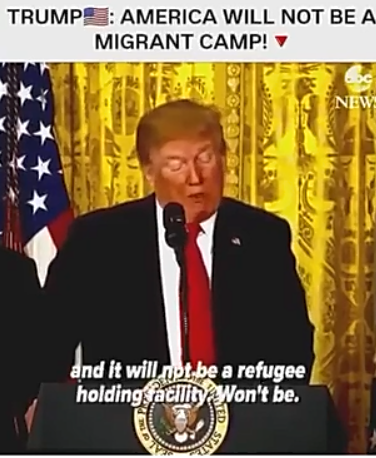
The short video shows Donald Trump delivering one of the most widely circulated immigration statements of his first presidency, declaring that the United States would not become a “migrant camp” as his administration faced intense controversy over immigration enforcement at the southern border.
Although the clip can easily appear current when shared without context, the remarks are historical. Trump delivered them on June 18, 2018, during a White House meeting of the National Space Council. The official White House transcript confirms that he temporarily shifted away from the space-policy discussion to speak about immigration and border security.
In the clip, Trump says that the United States “will not be a migrant camp” and then points to migration pressures in Europe and elsewhere as examples of what he said he did not want to see happen in the United States. His remarks were brief, but they immediately became part of a much larger national argument over immigration enforcement, border security and the treatment of families arriving at the U.S.-Mexico border.
The timing of the statement was especially important. During the spring of 2018, the Trump administration had adopted a substantially tougher approach toward people accused of crossing the southern border illegally.
On April 6, 2018, Attorney General Jeff Sessions announced what the Justice Department described as a “zero-tolerance policy” for criminal improper-entry offenses along the Southwest border. Federal prosecutors were instructed, to the extent practicable, to accept referrals for prosecution under the federal law covering improper entry into the United States.
That enforcement decision had significant consequences for families arriving with children.
When parents were referred for criminal prosecution, they could be placed in federal criminal detention. Their children could not simply remain with them in adult criminal detention facilities and were instead transferred into the custody of the Department of Health and Human Services’ Office of Refugee Resettlement. The Government Accountability Office later concluded that the April 2018 prosecution policy produced a considerable increase in family separations.
That situation had become a major national controversy by the time Trump made the remarks contained in the video.
Images and reports involving separated families were generating criticism from Democrats, immigration advocates, religious organizations and some Republicans. The administration defended tougher enforcement by emphasizing immigration law, deterrence and border security, while critics argued that separating parents and children created an unacceptable humanitarian cost.
Trump used his June 18 remarks to emphasize the security side of that debate.
He argued that the country needed effective borders and immigration enforcement and portrayed congressional Democrats as obstructing legislative solutions. In his official remarks, Trump repeatedly blamed Democrats for the broader immigration impasse and called for them to negotiate with Republicans.
That political framing became one of the most disputed aspects of the 2018 controversy.
Trump argued publicly that existing laws and congressional inaction were responsible for the situation at the border. However, the specific zero-tolerance prosecution initiative operating at the time had been announced by his own Justice Department in April 2018. GAO later reported that the policy increased the number of parents referred for criminal prosecution and consequently increased the number of children separated from them.
Understanding that distinction is important when viewing the short viral clip today.
The video captures Trump’s rhetoric about what he believed the United States should not become, but it does not contain the broader policy debate occurring around the statement.
The phrase itself was memorable precisely because it reduced a complicated immigration dispute to a simple political message.
Trump’s approach to immigration had already been a defining element of his political identity. From his 2016 presidential campaign onward, he repeatedly emphasized border enforcement, restrictions on illegal immigration and changes to the legal immigration system.
For supporters of his immigration agenda, the June 2018 statement reinforced a broader argument that governments have a responsibility to control borders and determine who is permitted to enter and remain in the country.
For opponents, the statement became associated with an immigration enforcement approach they considered unnecessarily harsh, particularly because it came during the family-separation controversy.
Those competing interpretations help explain why the clip continues to circulate years later.
The footage is short, direct and easily detached from its original historical setting. Without the date or surrounding context, a viewer encountering it on social media might reasonably assume that Trump had delivered the remarks recently.
In reality, the statement came from an entirely different political moment.
Trump was in the second year of his first presidential term. Republicans controlled both chambers of Congress, and lawmakers were discussing several possible immigration proposals while facing disagreements within their own party over border enforcement, legal immigration, protections for undocumented immigrants brought to the United States as children and other issues.
The family-separation controversy was developing particularly quickly.
Government figures provided at the time indicated that thousands of children had been separated from parents during the implementation of the zero-tolerance initiative. FactCheck.org, citing DHS information, reported that 2,342 children were separated from parents between May 5 and June 9, 2018.
Later government reviews examined an even broader group of children affected by separation.
The Government Accountability Office reported that, in response to a federal court order, the government identified 2,654 children who potentially qualified for reunification. As of September 10, 2018, 2,217 had been released while 437 remained in custody, according to GAO.
The controversy therefore went far beyond ordinary disagreements over immigration statistics.
It involved difficult questions about prosecution, detention, parental rights, child welfare and how the federal government should respond when adults entered the country with children outside authorized ports of entry.
Trump’s administration maintained that the government needed to enforce immigration law consistently.
Critics argued that the government had chosen an enforcement strategy that predictably produced family separation.
The GAO review later found that DHS and HHS officials said their agencies had not adequately planned for the increase in separated children resulting from the zero-tolerance policy. Officials told GAO that they had not received advance notice of the Attorney General’s April memo and had not prepared for the reunification challenges that later followed.
That lack of preparation became another major part of the controversy.
The government had to determine where separated parents and children were located, establish whether they were eligible for reunification and create systems capable of matching family members who sometimes had been transferred to different parts of the country.
GAO reported that agencies did not initially have a single consistent system for identifying children who had been separated from parents. The government eventually had to review thousands of case files as part of the effort to identify affected children.
Just two days after the remarks shown in the uploaded video, Trump changed part of the administration’s approach.
On June 20, 2018, he signed an executive order directing federal agencies to maintain family unity where possible while continuing enforcement against illegal entry. The order called for families to be detained together during immigration or criminal proceedings, subject to legal and resource constraints.
At the signing ceremony, Trump said he wanted strong border enforcement while also keeping families together.
The executive action did not abandon the administration’s broader zero-tolerance position. Instead, it sought to change how families were handled while prosecutions and immigration proceedings continued.
Legal questions quickly followed.
The government also faced requirements arising from the long-running Flores settlement, which established protections affecting the detention of immigrant children.
Trump’s June 20 executive order directed the attorney general to seek modification of the Flores agreement so that families could potentially remain detained together for longer periods while their cases were resolved.
Several days later, a federal judge issued an order requiring the government to reunify many separated families.
GAO’s timeline states that the June 26 court order generally prohibited separating covered parents and minor children in DHS custody unless specific circumstances applied, such as a finding that the parent posed a danger to the child or voluntarily declined reunification.
Those developments transformed the controversy from primarily a political battle into a major administrative and legal challenge.
Federal agencies had to track thousands of people while dealing with court deadlines, immigration proceedings and questions surrounding the eligibility of individual parents for reunification.
The intense controversy surrounding family separation is essential context for understanding why Trump’s words in the video received so much attention.
When he referred to the United States not becoming a migrant camp, he was presenting immigration as a question of national sovereignty and border control.
His critics viewed the language differently.
They argued that political rhetoric about migrants risked obscuring the humanitarian circumstances of families seeking entry, including people who intended to request asylum.
Supporters of stricter enforcement countered that asylum systems and humanitarian protections could not function effectively without mechanisms for preventing unauthorized entry and addressing fraudulent or unsupported claims.
Those arguments remain familiar in American immigration politics because many of the underlying policy questions were never permanently resolved.
Presidents of both parties have faced pressure at the southern border, particularly during periods when large numbers of migrants arrived over relatively short periods.
The political emphasis, enforcement strategies and proposed solutions have varied significantly from administration to administration, but questions involving detention capacity, asylum processing, deportation, border infrastructure and congressional immigration reform have remained persistent.
That continuing relevance helps explain why older political clips frequently return to social media.
A statement made in 2018 can suddenly appear contemporary when immigration once again becomes a major national issue.
Trump’s speaking style also contributes to the durability of such clips.
Rather than describing immigration primarily through technical legal language, he frequently uses short phrases designed to communicate a broader political argument quickly.
The “migrant camp” statement is an example.
Within only a few seconds, it communicates his view that large-scale uncontrolled migration could fundamentally change the country and that stronger enforcement was necessary to prevent that outcome.
Whether viewers agree with that argument depends heavily on their own views of immigration, enforcement, humanitarian obligations and presidential authority.
But the historical context can be established independently of those political judgments.
The clip was recorded at the White House on June 18, 2018.
It occurred during a National Space Council event, despite the fact that Trump’s remarks temporarily shifted toward immigration.
The administration was in the middle of implementing the Justice Department’s zero-tolerance approach toward improper-entry prosecutions.
Family separations had become a national controversy.
And two days later Trump signed an executive order intended to keep families together while maintaining stricter border enforcement.
The official transcript also shows that Trump connected the immigration issue directly to Europe.
He told his audience to consider what was happening in European countries and said the United States could not allow the same situation to develop domestically.
Those comments reflected a broader political debate that had followed Europe’s large migration influx beginning several years earlier.
European governments were struggling with questions involving refugee admissions, asylum systems, integration, border controls and the sharing of responsibilities among European Union members.
Trump frequently cited Europe during immigration discussions as a warning about what he considered the consequences of insufficient border controls.
His opponents disputed those comparisons and argued that the United States’ geographic, legal and migration circumstances differed substantially from those of European countries.
That disagreement illustrates why the same brief statement could produce dramatically different responses depending on the audience.
To supporters, it sounded like a straightforward declaration of national border sovereignty.
To critics, it sounded like an overly broad characterization of migrants during a humanitarian controversy.
The video itself does not resolve that political argument.
What it does provide is a particularly concise example of the way Trump communicated immigration policy to the public.
Instead of beginning with statutes, court decisions or administrative procedures, he began with an easily understood outcome: what he said America would not become.
That communication strategy had already proven politically effective for him during the 2016 campaign.
Simple phrases involving borders, walls, security and national sovereignty allowed Trump to turn complicated immigration questions into messages that could circulate easily through television coverage and, increasingly, social media.
The video continues to demonstrate that effect.
A speech lasting only seconds can continue reaching audiences many years after the event because it contains a clear statement and a recognizable political message.
However, the age of the footage matters.
Presenting the clip as though it were a new presidential announcement would create an inaccurate impression of when the remarks were made.
It is better understood as resurfaced footage from Trump’s first presidency and from one of the most contentious immigration debates of 2018.
The broader historical record also shows that the family-separation controversy did not end immediately after the June 20 executive order.
Federal officials continued working to reunite families, courts continued supervising aspects of the process, and government oversight organizations later examined how the policy had been implemented.
GAO concluded that federal agencies had not adequately planned for the consequences of the increased separations and documented significant difficulties associated with identifying and reunifying parents and children.
Those findings added another dimension to the political debate.
Supporters of the administration could point to the government’s responsibility to enforce federal immigration law.
Critics could point to documented administrative problems and argue that the government had implemented a major enforcement change without sufficient preparation for its effects on families.
Both questions became intertwined: how strongly should immigration laws be enforced, and what obligations does the government have when enforcement separates families?
Congress was also deeply involved in the debate.
Trump repeatedly argued that lawmakers needed to change immigration laws, while members of Congress offered competing proposals addressing border security, legal immigration and the treatment of children and families.
But comprehensive immigration reform remained difficult because lawmakers disagreed not only between parties but also within them.
Republicans differed over issues such as protections for some undocumented immigrants, legal immigration levels and how aggressively enforcement should operate.
Democrats generally demanded protections for immigrant families and criticized many of Trump’s enforcement measures while also facing internal differences over broader immigration policy.
The result was a political environment in which presidential action often became more prominent because major immigration legislation remained difficult to pass.
That pattern has appeared repeatedly in modern U.S. politics.
Presidents have relied on executive actions and administrative enforcement decisions, only for those measures to face lawsuits, reversal by later administrations or renewed congressional debate.
The 2018 controversy surrounding the video fits directly into that larger pattern.
Trump’s statement was therefore not simply an isolated remark.
It was part of an ongoing political struggle over who should control immigration policy, how far presidential enforcement authority extends and whether Congress could agree on legislative changes capable of surviving changes in administration.
The phrase shown in the clip became memorable because it distilled Trump’s side of that argument into a few words.
But the surrounding events were considerably more complicated.
They involved federal prosecutors, immigration officers, health and human services officials, detention facilities, congressional lawmakers, federal judges, advocacy organizations and thousands of families navigating the immigration system.
For viewers encountering the video today, that context makes the footage more meaningful.
It shows a president speaking during a moment of intense political pressure rather than issuing a standalone declaration without surrounding events.
It also provides an example of how political videos can lose important information when reduced to short social-media excerpts.
A viewer might see only Trump declaring that America would not become a migrant camp.
The original speech also contained accusations against Democrats, appeals for immigration legislation and calls for border security.
The national debate surrounding it included family separation, congressional negotiations and legal disputes.
Two days afterward, Trump signed an executive order changing how his administration intended to handle families.
Within another week, a federal court had ordered large-scale reunifications.
That sequence of events places the video within one of the most consequential immigration episodes of Trump’s first term.
It also explains why the footage continues to attract attention.
Immigration remains one of the most politically divisive subjects in the United States, and Trump remains closely associated with calls for stronger border enforcement.
Older statements therefore frequently regain relevance whenever border policy returns to the center of political debate.
But historical accuracy matters even when the underlying political questions remain current.
The clip should not be mistaken for a newly delivered speech.
It is a record of what Trump said on June 18, 2018, at a White House event during the zero-tolerance and family-separation controversy.
More than eight years later, the words continue to illustrate the central conflict that defined much of Trump’s immigration message: his argument that strict control of the border is necessary to preserve national security and sovereignty, set against criticism that aggressive enforcement policies can create serious humanitarian and legal consequences.
The debate over where that balance should be drawn belongs to voters, lawmakers and the courts.
The historical record, however, makes the circumstances behind this particular clip clear.
Trump delivered the statement during his first presidential term, as his administration defended a tougher prosecution policy at the southern border.
His remarks immediately became connected to the national debate over separated families.
His administration then changed part of its approach through an executive order two days later.
And subsequent government reviews documented both the scale of the separations and the difficulties agencies faced in reunifying affected families.
That broader history is what sits behind the few seconds captured in the viral video.
A short declaration about America not becoming a “migrant camp” may be the portion that fits most easily into a social-media post, but the full story involves border enforcement, family separation, court intervention, congressional conflict and a national argument over immigration policy that extended far beyond a single speech.
For that reason, the resurfaced footage remains politically recognizable today while belonging unmistakably to the events of 2018.
The lasting significance of the episode also comes from the way it changed the national conversation about immigration enforcement. The 2018 zero-tolerance policy increased family separations, and the federal government later faced the difficult task of identifying and reunifying affected children with their parents. A Government Accountability Office review found that federal agencies had not adequately planned for the increase in separated children before the policy was implemented.
Those developments ensured that the controversy would remain part of the broader debate surrounding Trump’s first-term immigration record. Supporters of stricter enforcement continued to emphasize border control, enforcement of existing law and the government’s responsibility to regulate entry into the country. Critics focused heavily on the humanitarian consequences of separating families and the administrative difficulties that followed.
Years later, the resurfacing of the video demonstrates how easily older political footage can return to public attention when similar issues dominate national debate. The words may sound familiar because immigration and border security continue to be central subjects in American politics, but understanding exactly when the statement was made remains essential.
The clip therefore serves not only as a record of Trump’s immigration rhetoric, but also as a reminder that short viral videos often represent only a small portion of a much larger political and historical story. The few seconds shown on screen were connected to policies, court battles, agency decisions and family experiences that continued long after the cameras stopped recording.