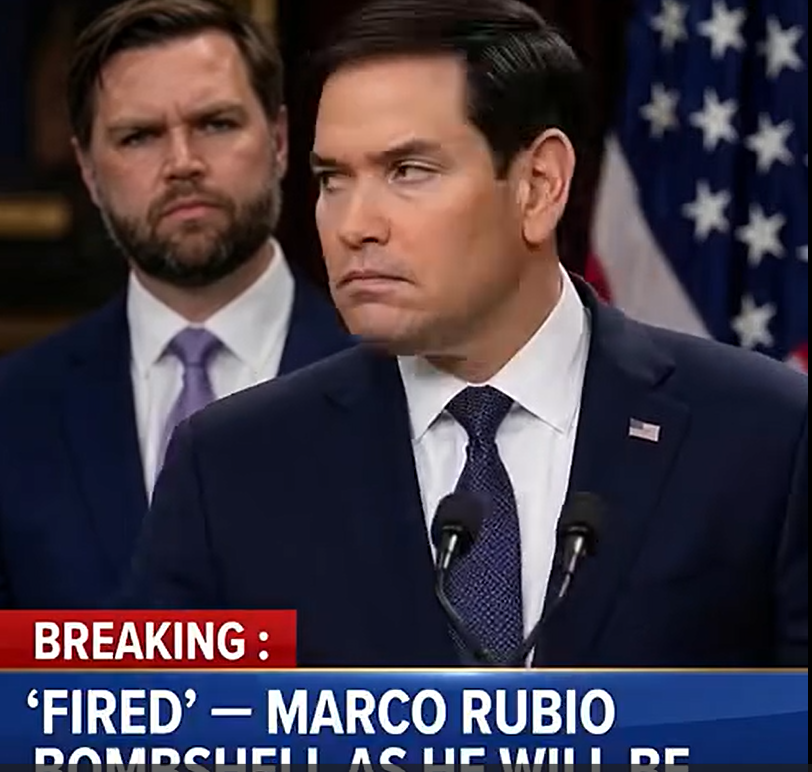
A dramatic video circulating online places the word “FIRED” alongside Secretary of State Marco Rubio and suggests that a major political bombshell has shaken President Donald Trump’s administration.
The short clip shows Rubio speaking at a podium while Vice President JD Vance stands behind him. The presentation is designed to create the impression that Rubio has either been dismissed or is facing an imminent removal from the Trump administration.
But the current facts tell a very different story.
Marco Rubio has not been fired as secretary of state. As recently as September 23, 2026, Rubio was publicly representing the United States in New York during the United Nations General Assembly, delivering an extended press briefing on Iran, international diplomacy, Cuba and other foreign-policy issues.
Reuters also identified Rubio as secretary of state in reporting from September 22, when he discussed the possibility of talks with Iranian representatives during the U.N. gathering. That makes clear that the dramatic “FIRED” language appearing in the viral clip does not describe Rubio’s current employment status.
In fact, the headline attached to the uploaded clip appears to have circulated previously. A video titled “‘Fired’ – Marco Rubio Bombshell Rocks White House” was published online in October 2025, meaning footage or headlines using similar language can resurface long after their original publication and appear new when shared without a date.
That distinction is especially important with political videos.
A short clip combined with a dramatic caption can create an impression that something happened minutes or hours ago, even when the underlying footage or speculation originated months earlier.
Rubio’s actual position inside the Trump administration has moved in almost the opposite direction from the suggestion that he was pushed out.
Trump nominated the former Florida senator to become secretary of state following the 2024 election. On January 20, 2025, the Senate confirmed Rubio by a vote of 99-0, an unusually broad bipartisan confirmation for a major Cabinet position.
Rubio subsequently became one of the administration’s most prominent foreign-policy figures.
His responsibilities expanded further after changes inside Trump’s national-security team. By 2026, Reuters was identifying Rubio not only as secretary of state but also as national security adviser, giving him substantial influence across both the State Department and White House national-security structure.
That combination of positions placed Rubio at the center of decisions involving Europe, Russia, China, Latin America, Iran and other major foreign-policy questions.
Reuters reported in June 2026 that personnel changes at the National Security Council appeared likely to strengthen Rubio’s influence, with several people associated with him moving into important NSC positions.
That does not mean Rubio has avoided political controversy.
Like nearly every senior figure in Trump’s administration, he has faced criticism from multiple directions, including disputes involving foreign policy, government restructuring and his relationship with different factions of the Republican Party.
He has also been the subject of recurring speculation about how long he would remain in Trump’s Cabinet.
Some of that speculation stretches back to the unusual history between Trump and Rubio.
The two were bitter rivals during the 2016 Republican presidential primary.
Trump repeatedly attacked Rubio during that campaign, while Rubio sharply criticized Trump in return. Their relationship years later became dramatically different as Rubio emerged as one of Trump’s senior administration officials.
That transformation attracted considerable attention after Trump returned to the White House.
By January 2026, reporting about Rubio described how a politician once viewed as a potential ideological mismatch for Trump’s movement had become an increasingly influential defender of the administration’s foreign-policy agenda. The Guardian noted that predictions that Rubio might quickly disappear from the administration had not materialized; instead, his authority had expanded.
There has, however, been one position Rubio actually left.
In February 2026, Rubio stopped serving as acting archivist of the United States.
That development could easily produce confusion if reduced to a misleading headline.
Reuters reported that Rubio stepped away from the temporary National Archives position because federal law limits how long an individual can serve in an acting role without Senate confirmation. His responsibilities there were transferred to senior adviser James Byron.
Rubio did not lose his primary Cabinet position.
He remained secretary of state and continued serving in the administration’s national-security structure.
Reuters specifically described him at the time as both secretary of state and national security adviser.
The difference between leaving one temporary assignment and being fired from the administration is significant.
Rubio accumulated an unusual number of responsibilities during Trump’s second term, which sometimes resulted in headlines describing him as wearing several different government “hats.”
Giving up one acting position therefore did not mean he had been removed from government.
Current events provide even stronger evidence.
On September 17, 2026, Rubio spoke with Chinese Foreign Minister Wang Yi about diplomatic relations and possible future high-level interactions between Washington and Beijing. Reuters reported the conversation as part of ongoing preparations surrounding U.S.-China diplomacy.
One day later, he met South Korean Foreign Minister Cho Hyun as the two governments discussed investment, security and Seoul’s role in regional and Middle Eastern affairs.
On September 22, Rubio appeared publicly during the United Nations General Assembly and discussed the possibility of diplomatic engagement with Iran.
The following day, September 23, he delivered remarks to reporters in New York in an official appearance distributed by the U.S. Department of State.
Those activities are inconsistent with the idea that Rubio has just been fired.
Instead, they show him continuing to operate in one of the most senior positions in the administration.
The viral wording may also draw attention because Rubio and Vice President JD Vance have increasingly been discussed together in connection with the Republican Party’s future after Trump.
Neither man has formally declared a 2028 presidential candidacy, but both have received significant attention as possible future Republican contenders.
That discussion intensified in 2026 after both men made prominent appearances at the White House briefing-room podium.
The Associated Press reported in May that appearances by Rubio and Vance generated increased speculation about the party’s post-Trump leadership, even though both publicly emphasized their current administration responsibilities rather than declaring campaigns.
Reuters similarly reported that their highly visible White House appearances increased attention on both men and their possible future political ambitions.
Rubio attracted particular attention after one White House briefing in which he presented a broader message about America’s future.
Coverage of the appearance noted that clips of Rubio circulated widely online afterward.
That visibility contributed to discussion about whether Rubio’s profile inside the administration was becoming larger rather than smaller.
Vance has nevertheless remained another central figure in discussions about the Republican Party’s future.
The two men occupy very different formal positions.
Vance is vice president and therefore cannot simply be dismissed from office by the president in the way a Cabinet secretary can be removed.
Rubio, by contrast, serves in an appointed Cabinet position and therefore remains subject to presidential authority over executive-branch personnel.
The fact that Vance and Rubio sometimes appear together has encouraged political commentators to examine their different speaking styles, policy roles and relationships with Trump.
But those discussions should not be confused with evidence that one is about to replace the other or that Rubio has been dismissed.
Trump himself has contributed to the attention surrounding both men by publicly discussing them in connection with the future of the Republican Party.
Reports have described Trump asking advisers and allies for their opinions regarding Vance and Rubio, adding to speculation about what the Republican field could eventually look like after Trump.
More recent reporting has indicated that Trump has privately spoken favorably about Vance’s political future, although advisers have cautioned against treating those conversations as a final decision about the 2028 race.
None of that amounts to a current presidential contest between Vance and Rubio.
The next presidential election is still more than two years away, neither has formally entered a race, and political circumstances can change substantially before candidates officially begin campaigning.
For now, both remain senior members of the Trump administration.
Rubio’s current responsibilities are particularly significant because the United States is dealing with several major international disputes simultaneously.
His September 2026 appearances at the United Nations have included discussions involving Iran, international institutions and U.S. relationships with governments around the world.
Rubio told reporters on September 23 that the Trump administration viewed national interest as the central responsibility of government and argued that existing international institutions had struggled to resolve major global conflicts.
Those comments reflect Rubio’s continuing role in explaining and implementing the administration’s foreign-policy strategy.
They also demonstrate the difference between verified government activity and a sensational social-media caption.
A viewer seeing only the six-second clip might reasonably believe Rubio had just received some kind of dismissal notice.
Nothing visible in the footage itself establishes that.
The clip shows Rubio speaking publicly with Vance nearby and overlays a dramatic headline.
The text is an editorial addition, not evidence of an official personnel announcement.
No recent White House statement or credible current reporting supports the claim that Trump has fired Rubio from his position as secretary of state.
Instead, official and independent sources published within the last several days continue to identify him in that role.
That does not prevent future personnel changes.
Cabinet members serve at the pleasure of the president, and Trump has changed senior officials at various points throughout his presidencies.
But reporting a possible future event as though it has already happened would be inaccurate.
The available evidence establishes Rubio’s current status, not what Trump might decide at some unknown point in the future.
The history of the administration also illustrates why rumors about firings attract attention.
Trump has made significant personnel changes within his national-security operation.
Mike Waltz, who previously held the national security adviser position, left that role after controversy surrounding a Signal group chat in which journalist Jeffrey Goldberg was accidentally included in discussions among senior administration officials about military action involving Yemen.
Rubio subsequently took on additional national-security responsibilities.
That personnel change actually strengthened Rubio’s position within the administration rather than weakening it.
By mid-2026, Reuters reported that restructuring at the National Security Council could further increase Rubio’s influence there.
His expanded authority has also created criticism.
Opponents of administration policy have challenged Rubio over decisions involving foreign aid, international institutions, military affairs and diplomatic relationships.
Some figures on the political right have criticized him as well.
One dispute developed in 2025 after Peter Marocco, a senior figure involved in efforts to dismantle or significantly reduce USAID operations, left the administration.
Reporting at the time described complaints from some hard-line Trump supporters who believed Rubio had not been sufficiently aggressive in pursuing Marocco’s approach.
Other administration officials disputed the suggestion that the disagreement was primarily ideological and described broader concerns about Marocco’s management style.
That episode demonstrated that Rubio’s relationship with different Republican factions has not always been uncomplicated.
But political criticism should not be converted into a claim of dismissal unless a dismissal actually occurs.
Rubio’s longevity in the administration has itself become noteworthy because earlier speculation suggested his relationship with Trump could eventually become difficult.
Instead, he accumulated additional assignments.
That pattern became evident enough that Rubio’s multiple government roles generated online jokes about how many jobs he was performing simultaneously.
When he relinquished the acting archivist role in February, Reuters noted that his collection of positions reflected the level of trust Trump had placed in him despite their bitter rivalry during the 2016 campaign.
The same pattern remains visible in September.
Rubio has participated in some of the administration’s most sensitive diplomatic discussions.
He remains involved with China policy.
He has been discussing Iran.
He continues to represent the United States at major international meetings.
And he continues to operate within the administration’s national-security decision-making structure.
There is also a broader lesson in how videos such as this one circulate.
Modern political content frequently removes speeches from their original context and adds text designed to encourage viewers to click, share or continue watching.
Words such as “BREAKING,” “FIRED,” “BOMBSHELL,” and “JUST IN” can make old footage appear like a newly developing event.
Sometimes the underlying event is real but exaggerated.
Sometimes the headline refers to speculation rather than an actual decision.
And sometimes the footage itself has little direct relationship to the claim placed over it.
The Rubio clip is a useful example because the visual material appears authentic while the implication created by the headline does not match his current status.
Rubio really is shown speaking.
JD Vance really does appear behind him.
But neither of those facts establishes that Rubio was fired.
The current official record shows the opposite.
He continues serving as secretary of state, a position to which the Senate confirmed him unanimously in January 2025.
He has also remained involved in the national-security apparatus, with Reuters identifying him as both secretary of state and national security adviser during 2026.
And on September 23, 2026 — immediately before the date of this article — Rubio appeared publicly in New York to answer reporters’ questions as secretary of state.
That is the clearest current evidence available.
The political discussion surrounding Rubio is nevertheless worth following because his role has evolved significantly since Trump returned to office.
A former presidential rival became the administration’s chief diplomat.
He then accumulated additional national-security responsibilities.
His public visibility increased.
And discussion began about whether he could eventually play an even larger role in Republican politics.
Those developments provide legitimate material for political analysis.
An actual firing would be a major change.
But there is no verified current firing to report.
The closest personnel event involving Rubio himself was his departure from the temporary acting archivist position in February 2026, and Reuters reported that this occurred because of statutory limits governing acting appointments rather than because Trump removed Rubio from his major administration posts.
Rubio’s activities since then reinforce that interpretation.
Months after leaving the Archives role, he continued conducting diplomacy, directing the State Department and participating in national-security policy.
During the current U.N. General Assembly gathering, he has remained one of the administration’s most visible representatives.
On September 22, he publicly discussed possible engagement with Iran.
On September 23, he held a lengthy press session in New York.
Recent Reuters reporting also continues to identify him as a central administration official in discussions involving Europe, NATO and other national-security questions.
The relationship between Rubio and Vance will likely continue attracting attention because both are prominent Republicans with national profiles.
Their appearances together naturally encourage speculation about alliances, competition and the future direction of the party.
But those questions remain separate from Rubio’s present employment status.
There is no verified evidence that Vance has replaced Rubio, that Rubio has been dismissed, or that Trump has announced plans to remove him.
What can be established is more straightforward.
Marco Rubio remains U.S. secretary of state.
He continues to carry out official diplomatic duties.
He remains involved in national-security policymaking.
And the dramatic “FIRED” wording attached to the viral clip should therefore be understood as a sensational headline rather than confirmation of an actual dismissal.
The episode is another reminder of why dates matter when political videos reappear online.
A headline published in 2025 can resurface in 2026.
A prediction can be reposted as though it were a confirmed event.
A temporary change in one government assignment can be presented as the loss of an entirely different job.
And a few seconds of authentic footage can be combined with text that gives viewers a misleading impression of what actually happened.
In Rubio’s case, the most recent evidence is unusually clear.
He was confirmed as secretary of state in January 2025 by a 99-0 Senate vote.
He later took on substantial national-security responsibilities.
He left a separate temporary Archives role in February 2026 because of limits applying to acting appointments.
His influence within the National Security Council remained substantial enough that Reuters was reporting on an internal reshuffle involving Rubio allies several months later.
And in September 2026, he continues appearing publicly and officially as secretary of state.
The viral clip therefore tells only a small part of the story.
The dramatic word on the screen may attract attention, but the verified political reality is that Marco Rubio has not been fired from the Trump administration.
For now, the more consequential story is how much responsibility he continues to hold, how his relationship with Trump evolved from bitter presidential rivalry to senior administration service, and how his increasingly visible role intersects with broader discussions about the future leadership of the Republican Party.
Those questions remain politically significant.
But they are questions about influence, responsibility and future ambitions — not evidence of a current firing.
Rubio’s continued activity at the highest levels of American diplomacy makes the contrast with the viral “FIRED” claim particularly clear. On September 23, he met Russian Foreign Minister Sergey Lavrov in New York while attending events surrounding the United Nations General Assembly. Reuters described Rubio in its coverage as the U.S. secretary of state, once again confirming that he continued carrying out official responsibilities rather than departing the administration.
Rubio was also involved in diplomatic discussions with India. U.S. and Indian officials said he and Indian Foreign Minister S. Jaishankar discussed bilateral relations and the Trump administration’s Russia sanctions legislation. The conversation formed part of a busy week in which Rubio was simultaneously dealing with several major international relationships.
Those meetings followed Rubio’s recent engagement with Japan and South Korea. On September 21, he met the foreign ministers of both countries ahead of President Trump’s summit with Chinese President Xi Jinping. The discussions included security commitments, economic cooperation, North Korea and stability surrounding Taiwan, placing Rubio directly within preparations for one of the administration’s most consequential diplomatic meetings.
His current responsibilities therefore offer little support for the suggestion that he has suddenly been removed from Trump’s team. Instead, the available reporting shows a Cabinet official continuing to handle sensitive negotiations involving Russia, China, India, Iran and major U.S. allies.
Rubio’s role has also expanded beyond the traditional responsibilities of a secretary of state. Recent reporting continues to identify him as both secretary of state and national security adviser, giving him an unusually broad position within the administration’s foreign-policy operation.
That does not mean his position is immune from political disagreement or future change. Senior administration officials frequently become the subject of speculation, particularly when they hold several important responsibilities or have their own national political profiles. But speculation about what could happen is different from evidence that a dismissal has actually taken place.
This distinction becomes especially important as attention increasingly turns toward the political future of senior Republicans. Rubio’s name regularly appears in discussions surrounding the party’s possible post-Trump leadership, as does Vice President JD Vance’s. Those conversations can generate dramatic headlines, but they should not automatically be interpreted as evidence of conflict, dismissal or an active campaign for a future office.
For now, Rubio’s public schedule remains focused on his existing government responsibilities. His September appearances show him participating in high-level international negotiations at a time when the administration is dealing with disputes involving Iran, Russia, China, Europe and the Middle East.
The continuing diplomatic activity provides a straightforward reality check for viewers encountering the viral clip. A politician who had actually just been fired from the position of secretary of state would not simultaneously be representing the United States in meetings with major foreign governments under that title.
That is why the timing of political content matters so much. Authentic footage can be paired with an exaggerated headline, an older rumor can suddenly begin circulating again, and viewers can easily be left with the impression that a dramatic personnel decision has just occurred.
In Rubio’s case, current reporting points in the opposite direction. Rather than disappearing from the administration, he remains highly visible in its foreign-policy operations. Reuters was still identifying him as secretary of state on September 24 while reporting on his diplomatic discussions with India.
The larger story, therefore, is not that Rubio has been fired. It is that a dramatic online claim has resurfaced while Rubio continues carrying out some of the administration’s most prominent diplomatic assignments.
As long as he remains in those roles, new appearances alongside Trump, Vance and other senior officials are likely to continue generating political speculation. But any claim that his status has changed should be measured against current official activity and credible reporting rather than the dramatic wording attached to a short viral video.