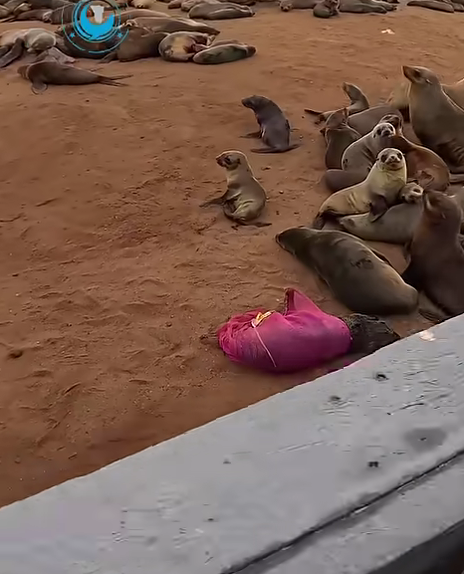
This video from Ocean Conservation Namibia documents a wildlife rescue operation involving a young Cape fur seal that has become entangled in marine plastic debris. The footage presents a clear sequence of events that begins with the discovery of the animal, continues through the careful rescue process, and concludes with the seal’s release back into its natural environment. It also briefly highlights the broader environmental issue of ocean pollution through the examination of the debris after the rescue is completed.
The video opens with the discovery of a young Cape fur seal in a distressed and immobilized state on a sandy beach. The animal is visibly trapped within a bright pink plastic mesh bag or netting material that is tightly wrapped around its body. The plastic extends from the seal’s neck region down across its torso and continues toward its hind flippers, effectively restricting its ability to move freely. This type of entanglement is particularly dangerous for marine mammals because it can severely limit mobility, interfere with feeding, and cause long-term injury if not addressed.
At the beginning of the footage, the seal appears both vocal and defensive, which is a natural reaction for a wild animal experiencing stress and physical restraint. Its movements are limited by the tightness of the plastic, and any attempts to struggle only further emphasize how restricted it is. Situations like this are unfortunately common in marine environments where discarded fishing gear, plastic packaging, and synthetic materials can persist in the ecosystem for long periods of time.
The rescue worker approaches the animal carefully, understanding both the risk to the seal and the need to avoid causing additional harm. Working with wild animals in distress requires a balance between urgency and caution, as sudden movements or improper handling can worsen injuries. In this case, the rescuer stabilizes the seal to prevent it from thrashing or injuring itself further while the removal process begins.
Once the animal is safely controlled, the rescuer begins the delicate task of cutting away the plastic mesh. A pair of heavy-duty specialized scissors is used for this process, designed to cut through tough synthetic materials without requiring excessive force. The rescuer works methodically, carefully snipping through the tight layers of plastic along the seal’s back. The choice of cutting position is important, as it helps reduce the risk of accidentally cutting or damaging the animal’s skin underneath the mesh.
The process requires patience and precision, as the plastic is tightly embedded around the seal’s body. Each cut must be made with careful attention to the seal’s movements and breathing. Throughout the rescue, the animal remains vocal and visibly stressed, but the rescuer maintains steady control to ensure that the situation does not escalate into further injury. The interaction reflects a common challenge in wildlife rescue: the need to act quickly to prevent prolonged suffering while also ensuring that every action is performed safely and accurately.
As the cutting continues, the plastic begins to loosen around the seal’s body. Gradually, the mesh structure that had been restricting its movement starts to open. This stage of the rescue is critical because it marks the transition from immobilization to partial freedom. Even small openings in the plastic allow the animal to move slightly more freely, reducing pressure on its body and lowering immediate distress.
Eventually, the mesh is cut wide enough to allow for removal. The rescuer carefully pulls the remaining plastic away from the seal’s body, ensuring that no sections are left behind and that no additional entanglement remains around the limbs or neck area. This step is particularly important because leftover strands of plastic can continue to pose a risk even after the main entanglement has been removed.
Once the final pieces of plastic are taken off, the seal is fully freed. The transformation in its behavior is immediate and noticeable. The animal quickly regains mobility and, after a brief moment of orientation, turns toward the open beach. Without hesitation, it scampers away from the rescuer and moves toward the rest of its colony. This rapid departure is a natural response, as wild seals typically seek to return to safety and social groups after stressful encounters.
The release portion of the video provides a powerful contrast to the earlier scenes of restriction and distress. Where the seal was once immobilized and struggling, it is now able to move freely and independently. This moment serves as the emotional resolution of the rescue, showing the direct positive outcome of the intervention.
After the seal has left the immediate area, the rescuer examines the discarded plastic debris. The pink mesh bag is held up and inspected more closely, revealing additional details about its composition. Among the material, a small yellow tag or label is visible, suggesting that the item may have originated from commercial or industrial use before entering the marine environment. This detail highlights a broader issue within ocean ecosystems: the persistence of human-generated waste and its impact on wildlife.
Plastic pollution in marine environments poses a significant threat to a wide range of species, particularly those that inhabit coastal waters. Materials such as nets, bags, and packaging can drift for long distances before washing ashore or becoming submerged. Once in the water, these items can entangle animals, obstruct movement, or be mistakenly ingested. Seals, in particular, are vulnerable because of their active swimming behavior and tendency to explore coastal zones where debris often accumulates.
The presence of brightly colored plastic, such as the pink mesh seen in the video, can also increase the likelihood of entanglement. In many cases, animals may not immediately recognize these materials as hazards, especially when they resemble natural objects or drift unpredictably in the water. Over time, even small pieces of debris can accumulate and create serious entanglement risks for marine life.
The rescue operation documented in the video reflects the ongoing efforts of conservation organizations working to mitigate the impact of pollution on wildlife. Teams involved in such rescues often operate in challenging conditions, responding to reports of entangled animals along remote stretches of coastline. Their work requires not only technical skill but also a deep understanding of animal behavior and environmental conditions.
Each successful rescue, such as the one shown in the video, contributes to both the survival of individual animals and the broader awareness of environmental issues. While one seal’s release may seem like a small event in the context of global pollution, it represents a tangible example of how direct intervention can make a difference. At the same time, it underscores the scale of the problem, as similar incidents continue to occur in many parts of the world.
The emotional impact of the footage is largely driven by the clear before-and-after contrast. The seal is first shown in a state of distress and restriction, and later in a state of freedom and movement. This transformation reinforces the importance of timely intervention and highlights the vulnerability of marine life to human-generated waste. It also emphasizes the effectiveness of trained rescue efforts when properly executed.
In conclusion, the video provides both a detailed look at a specific rescue event and a broader reflection on the issue of marine plastic pollution. The careful removal of the entangling debris, the immediate recovery of the seal, and the final inspection of the discarded material all contribute to a narrative that is both informative and impactful. The footage serves as a reminder of the ongoing challenges faced by marine ecosystems and the importance of continued conservation efforts to protect vulnerable species from preventable harm.
Beyond the immediate rescue itself, the situation shown in the video reflects a much larger and ongoing environmental challenge faced by coastal conservation teams around the world. Cape fur seals, like many marine mammals, inhabit regions where human activity and natural ecosystems overlap. This overlap increases the likelihood of encounters with discarded fishing equipment, packaging materials, and other forms of plastic pollution that accumulate in ocean currents and eventually wash up along shorelines.
One of the most significant issues highlighted by incidents like this is the durability of synthetic materials in marine environments. Unlike organic waste, plastic does not decompose quickly. Instead, it can persist for years or even decades, gradually breaking down into smaller fragments while still maintaining its structural integrity. This means that even after being discarded or lost, items such as nets or mesh bags continue to pose risks long after their initial use.
In coastal regions like Namibia’s shoreline, ocean currents and wind patterns can carry debris from both local and distant sources. As a result, wildlife is not only affected by nearby human activity but also by pollution that originates far away. This interconnectedness of marine systems means that conservation efforts must often address global patterns of waste distribution rather than isolated local incidents.
The rescue operation itself demonstrates the importance of specialized training in wildlife response. Rescuers working with marine mammals must be prepared to handle unpredictable behavior, especially when dealing with animals in distress. A trapped seal may react defensively, vocalize loudly, or attempt sudden movements that could complicate the rescue process. Proper restraint techniques are therefore essential to ensure both human safety and animal welfare.
In this particular case, the rescuer’s approach shows a clear understanding of these principles. By stabilizing the seal before beginning the cutting process, the risk of injury is minimized. The use of appropriate tools, such as heavy-duty scissors designed for tough synthetic materials, also plays a crucial role in ensuring that the plastic can be removed efficiently without excessive force.
Another important aspect of this type of rescue is time sensitivity. Prolonged entanglement can lead to a range of serious health issues for marine animals, including restricted blood flow, skin damage, infections, and long-term mobility problems. In severe cases, entanglement can even result in suffocation or starvation if the animal is unable to feed properly. This urgency is why rescue teams often prioritize quick but careful intervention when responding to such cases.
The behavior of the seal during the rescue also provides insight into how wild animals perceive and respond to human assistance. While the seal appears distressed and defensive at first, its reaction changes noticeably once the entangling material begins to loosen. This shift suggests that as physical constraints are reduced, the animal is better able to assess its surroundings and begin transitioning from a state of panic to one of recovery.
Once fully freed, the seal’s immediate movement toward the ocean or its colony reflects a natural instinct for safety and social reintegration. Seals are highly social animals, and being separated from their group can increase vulnerability to predators and environmental stress. Returning quickly to familiar surroundings is therefore an important part of post-rescue recovery behavior.
The moment the seal re-enters its environment also serves as a powerful visual representation of successful intervention. Unlike many environmental issues that lack immediate feedback, wildlife rescues often provide a clear and observable outcome. This direct cause-and-effect relationship—where human action results in immediate animal survival—can be particularly impactful for viewers and conservation awareness efforts.
The examination of the discarded plastic after the rescue adds another layer of meaning to the video. The visible tag or label attached to the mesh suggests that the material likely originated from a manufactured source, possibly linked to packaging, fishing operations, or industrial use. This detail emphasizes that marine debris is not random; it is often directly traceable to human activity and production systems.
Understanding the origin of such materials is a key part of addressing the broader issue of ocean pollution. Conservation efforts increasingly focus not only on removing debris from the environment but also on preventing it from entering ecosystems in the first place. This includes improving waste management systems, developing biodegradable alternatives, and promoting responsible disposal practices across industries.
Public awareness also plays a significant role in reducing marine pollution. Videos like this contribute to education by providing a clear and emotional example of how human waste directly affects wildlife. Seeing a tangible consequence—such as a seal entangled in plastic—can be more impactful than abstract statistics alone, as it creates a visual connection between behavior and environmental outcome.
In addition to awareness, long-term solutions require collaboration between governments, environmental organizations, industries, and local communities. Coastal cleanup programs, stricter regulations on plastic use, and international agreements on waste reduction are all part of the broader strategy to reduce the amount of debris entering oceans. However, despite these efforts, incidents like the one shown in the video continue to occur, demonstrating that the issue remains ongoing and complex.
From a conservation perspective, each successful rescue also contributes to research and data collection. Organizations often document entanglement cases to track patterns in debris types, locations, and affected species. This information helps identify high-risk areas and informs future prevention strategies. Over time, such data can lead to more targeted and effective environmental policies.
The emotional impact of the video is also worth noting. Unlike abstract discussions about pollution, the visual narrative of a single animal in distress followed by successful rescue creates a strong emotional arc. This type of storytelling can be particularly effective in encouraging public engagement, as it connects environmental issues to individual lives and outcomes.
Ultimately, the video serves as both a documentation of a specific rescue event and a reflection of a much larger environmental challenge. While the immediate outcome is positive—the seal is freed and returns to its environment—the underlying issue of plastic pollution remains unresolved. This duality is a central theme in many conservation efforts: celebrating individual successes while continuing to address systemic problems.
The work of organizations like Ocean Conservation Namibia illustrates the ongoing commitment required to protect marine life in environments heavily influenced by human activity. Each rescue represents not only the saving of a single animal but also a broader effort to mitigate the impact of pollution on fragile ecosystems. Through continued intervention, education, and prevention, conservation groups aim to reduce the frequency of such incidents and improve the overall health of marine environments.
To further expand on the significance of the rescue, it is important to consider the long-term effects that entanglement can have on marine mammals even after they are freed. While the seal in the video is shown successfully returning to its colony, not all animals experience such immediate or complete recovery. In many cases, entanglement injuries can leave lasting scars, reduced mobility, or internal damage that may affect feeding efficiency and survival over time. Even shallow cuts caused by plastic mesh can become infected in harsh marine environments, making early intervention critical for improving long-term outcomes.
Another important dimension of this event is the role of observation and rapid response in conservation work. Many rescues depend on the ability of trained teams or local observers to identify distressed animals quickly and report their location. Coastal monitoring systems, volunteer networks, and public awareness all contribute to reducing response times. In remote areas, however, delays in reporting can significantly reduce the chances of survival for entangled wildlife, especially when animals are tightly restricted or unable to reach food sources.
The emotional reaction of viewers to footage like this also plays a subtle but meaningful role in conservation outcomes. Visual documentation of rescues tends to generate empathy and concern, which can translate into increased support for environmental organizations. This support may come in the form of donations, volunteer participation, or advocacy for stronger environmental protections. While the rescue itself is a physical intervention, the video also functions as a communication tool that extends its impact far beyond the immediate event.
Additionally, the presence of clearly identifiable plastic materials in the footage reinforces the traceability of pollution sources. When items such as labeled mesh bags are recovered, they provide valuable clues about how and where the debris entered the marine environment. This information can help researchers identify patterns related to fishing activity, waste disposal practices, or industrial leakage. Over time, these data points contribute to a larger understanding of how human systems interact with ocean ecosystems.
The rescue also highlights the balance between urgency and precision that defines much of wildlife conservation work. Every movement during the intervention must be carefully controlled to avoid worsening the animal’s condition. At the same time, delays can increase stress and prolong suffering. This dual pressure requires both technical skill and emotional composure from rescuers, particularly when dealing with animals that are actively resisting restraint.
Finally, the broader ecological message of the video extends beyond a single species. Cape fur seals are part of a complex marine ecosystem that includes fish, birds, and other marine mammals, all of which can be affected by plastic pollution in different ways. The same debris that entangles a seal could later fragment into smaller pieces, be ingested by fish, or accumulate in food chains, ultimately affecting a wide range of species. In this way, the rescue not only represents the saving of one animal but also symbolizes a much larger effort to protect the interconnected web of marine life.