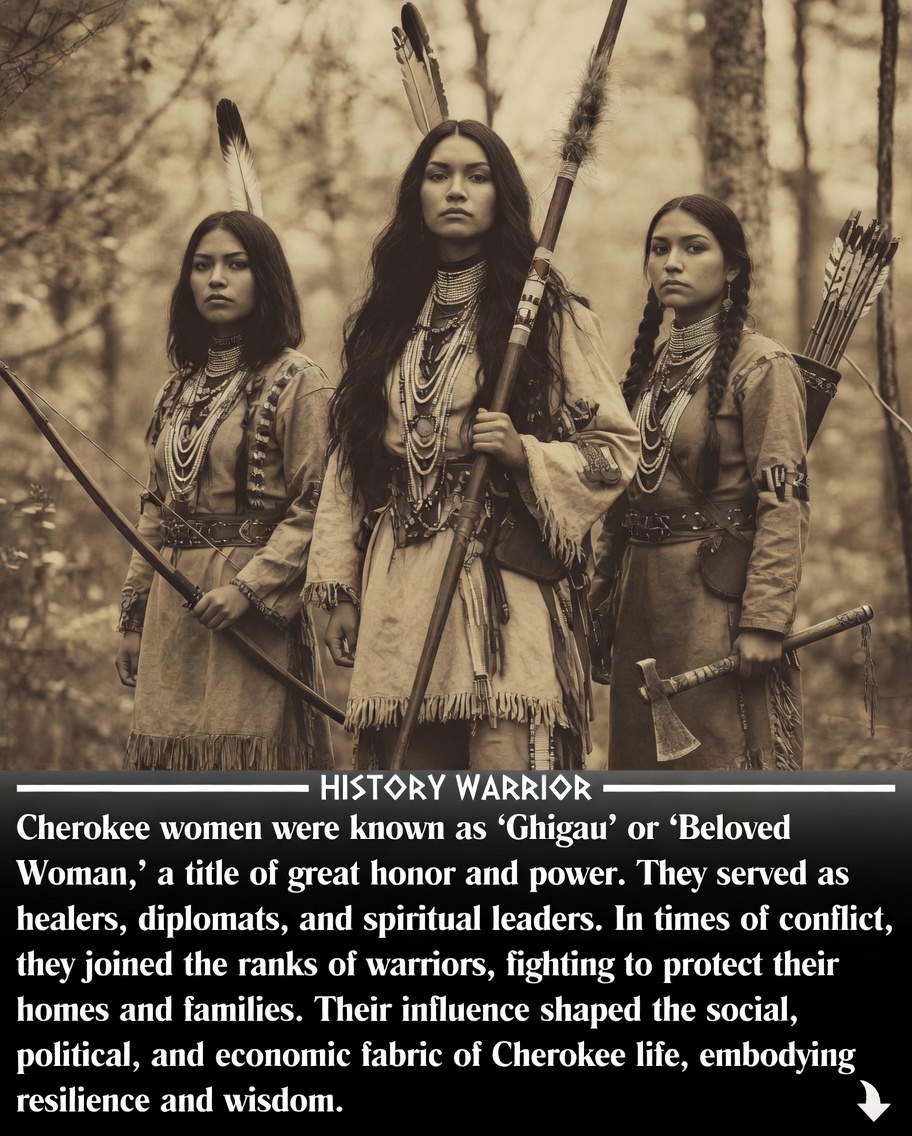
In Cherokee society, women were not merely participants in daily life—they were central figures whose influence touched every aspect of tribal organization, governance, and culture. Their societal roles reflected a deeply rooted understanding of balance, responsibility, and resilience. Known as “Ghigau” or “Beloved Women,” Cherokee women who earned this honor embodied wisdom, diplomacy, and spiritual guidance. These women were recognized as leaders capable of making decisions that affected the tribe as a whole. Their counsel was sought in matters ranging from dispute resolution to strategic planning, and their judgment was highly respected. In times of peace, these women worked as healers, mediators, and cultural custodians, preserving and transmitting the knowledge and traditions that defined Cherokee identity. In times of conflict, they did not retreat to the background but actively participated in defending their communities, sometimes taking up arms to protect their homes and families. This duality of nurturing and protecting highlighted a unique societal structure that allowed Cherokee women to exercise authority in a way that was both equitable and culturally celebrated.
The matrilineal system of the Cherokee reinforced the importance of women in all spheres of life. Unlike patriarchal societies where inheritance and lineage followed the father’s line, Cherokee families traced their lineage through the mother. This arrangement had profound implications for identity, inheritance, and social organization. Children were considered members of their mother’s clan, and their place within the community was secured through maternal lineage. Men, while still central to hunting and warfare, were guided by maternal uncles rather than fathers in matters of mentorship and social responsibilities. Boys learned essential survival skills and cultural knowledge from their maternal uncles, embedding the idea that lineage and guidance were shared across generations of women and their male relatives. The emphasis on matrilineal inheritance ensured that land, property, and familial authority remained closely tied to women, reinforcing their central role in sustaining Cherokee society.
Cherokee women’s authority extended beyond family and kinship structures into governance and community leadership. Beloved Women often had a seat in tribal councils, where they could influence decisions on land use, alliances, and diplomacy with other tribes or colonial powers. This participation offered a counter-narrative to European misconceptions of gender roles, which often marginalized women from public decision-making. Indeed, European observers frequently mischaracterized Cherokee governance, sometimes referring to it dismissively as a “petticoat government,” failing to understand the legitimacy of women’s influence. Cherokee women’s involvement was not symbolic but operational—they held real power, shaped policies, and ensured the continuity of social structures that prioritized both community welfare and individual responsibility.
Daily life for Cherokee women was an intricate blend of domestic, agricultural, and economic responsibilities. They were responsible for the preparation of meals, the cultivation of crops such as corn, beans, and squash, and the management of food stores. Basket weaving, pottery, and crafting clothing from animal hides were vital tasks, both for everyday use and for ceremonial purposes. Women’s work ensured that the community could sustain itself, particularly during harsh winters or periods of scarcity. Their labor was not merely functional; it was deeply connected to cultural expression and continuity. Traditional skills were passed down through observation, apprenticeship, and storytelling, creating a living education system where each generation of girls learned both practical and spiritual knowledge. These skills enabled Cherokee women to maintain economic independence, as property—including homes, tools, and belongings—was often under their control. In instances of divorce, the woman’s ownership and authority were respected, further demonstrating the strength and autonomy that Cherokee women exercised.
The spiritual and cultural dimensions of Cherokee women’s lives were equally significant. They were custodians of ritual knowledge, ceremonies, and oral histories. Storytelling was not just entertainment—it was a critical vehicle for teaching lessons, preserving history, and maintaining communal identity. Girls learned about the origins of their people, the cycles of nature, and the moral frameworks that guided behavior. Ceremonial dances, songs, and prayers were taught by women to ensure the survival of spiritual practices. Through these roles, women were pivotal in maintaining the balance between human life and the natural and spiritual worlds, reinforcing the Cherokee worldview that all elements of existence were interconnected.
War and conflict also revealed the versatility and bravery of Cherokee women. When external threats emerged, women could be called upon to defend their villages. Some were trained in the use of weapons, while others provided critical support by creating fortifications, tending to the wounded, or strategizing for the safety of families and communities. Their participation in defense was a natural extension of their societal role, blending courage with care, strategy with compassion. This dual responsibility underscores a fundamental principle in Cherokee culture: strength is measured not solely in physical prowess but in the ability to protect, nurture, and sustain the community. Women were revered not only for their capacity to perform these duties but also for embodying the values of resilience, intelligence, and foresight.
Education and mentorship were central to the transfer of knowledge among Cherokee women. Girls learned their roles and responsibilities through immersion in daily life, observation of elders, and participation in communal tasks. They were taught how to cultivate the land, prepare foods, weave, craft tools, and engage in spiritual practices. Equally important, they learned the moral and ethical frameworks that guided social interactions and governance. These lessons were interwoven with stories of legendary figures, heroic ancestors, and the lessons of past struggles. Such a holistic education emphasized the integration of practical skills, ethical reasoning, and cultural continuity, preparing young women to take on leadership roles within their clans and the broader Cherokee society.
The Cherokee system of governance and social organization ensured that women’s voices were valued not only in domestic and cultural contexts but also in decision-making forums. Beloved Women often served as advisors, diplomats, and mediators. They negotiated with other tribes and European settlers, navigated complex social and political landscapes, and ensured that the community’s interests were represented. These women demonstrated that power and influence were exercised through wisdom, negotiation, and ethical guidance, rather than through coercion alone. Their contributions to governance helped maintain social cohesion and protect Cherokee sovereignty, illustrating the essential role of women in shaping both internal policy and external relationships.
Throughout history, the strength and influence of Cherokee women have been evident in their resilience in the face of external pressures. Colonization, forced removals, and policies aimed at eroding Indigenous culture challenged traditional ways of life. Yet Cherokee women continued to uphold cultural practices, maintain social structures, and educate new generations. Their leadership ensured that the community’s heritage survived, despite the profound disruptions and hardships they endured. By safeguarding traditions, women preserved not only practical knowledge but also the intangible values, spiritual practices, and social norms that define Cherokee identity.
Cherokee women’s legacy is a testament to the enduring power of matrilineal societies and the centrality of women in Indigenous governance, culture, and community life. Their contributions reflect a sophisticated understanding of social organization, resource management, and cultural continuity. They were warriors, healers, teachers, and leaders—roles that were respected and essential for the survival and flourishing of the Cherokee Nation. The lessons from Cherokee women’s historical roles continue to resonate today, offering insights into leadership, resilience, and the integration of cultural values into daily life and governance.
By examining the lives of Cherokee women, historians and cultural observers gain a deeper appreciation for the complexity and richness of Indigenous societies. These women were not passive participants in history—they were active agents whose decisions, skills, and leadership shaped the trajectory of their people. From domestic management to political influence, from spiritual guidance to battlefield courage, Cherokee women exemplified a holistic form of leadership that balanced strength with wisdom, authority with compassion, and tradition with adaptability.
The historical record of Cherokee women also provides important lessons for contemporary society. Recognizing the role of women in governance, decision-making, and cultural preservation can inform modern approaches to leadership and community organization. The Cherokee example demonstrates that societies benefit when women’s voices are included in shaping policies, guiding moral frameworks, and managing communal resources. It underscores the importance of valuing diverse forms of knowledge, including oral traditions, mentorship, and lived experience, in building resilient and cohesive communities.
In conclusion, the Cherokee women known as Ghigau or Beloved Women were central to the social, cultural, and political life of their communities. Their roles encompassed healing, diplomacy, spiritual guidance, education, and defense, reflecting a profound integration of responsibility and authority. Through matrilineal lineage, control of property, and participation in governance, they ensured the continuity and resilience of Cherokee society across generations. Their legacy continues to inspire and inform contemporary understanding of Indigenous leadership, gender equity, and cultural preservation. By honoring the contributions of Cherokee women, we gain insight into a model of society where women’s voices and skills are essential to the survival, prosperity, and ethical governance of the community.
The influence of Cherokee women extended far beyond their immediate families and communities, permeating every aspect of tribal life and interacting with the broader world. Their presence in diplomacy, for instance, was vital in times when the Cherokee faced encroachment and negotiation with European settlers. Women often acted as intermediaries, conveying messages, negotiating terms, and ensuring that agreements reflected the welfare of the tribe. In many cases, their insights and counsel prevented conflicts from escalating into violence, demonstrating a form of leadership that combined empathy, intelligence, and foresight. Their participation in these diplomatic efforts was a critical factor in the survival and adaptation of Cherokee society as it navigated the pressures of colonization, territorial disputes, and forced migration.
The educational role of Cherokee women cannot be overstated. Through oral tradition, they imparted knowledge, morals, and history to their children, ensuring the continuity of cultural identity. Girls learned essential skills in agriculture, crafting, and household management, while boys gained instruction in hunting, defense, and leadership from maternal uncles. This system reinforced matrilineal values, creating an environment where children recognized the importance of women as pillars of authority and knowledge. Storytelling was central to this education, blending practical instruction with spiritual and moral guidance. Tales of heroism, community values, and the natural world shaped young minds, equipping them with the tools needed for survival and leadership in both mundane and extraordinary circumstances.
Cherokee women’s role in religion and spirituality was profound. They were keepers of ceremonial knowledge, responsible for guiding community rituals, maintaining sacred spaces, and preserving the spiritual integrity of the tribe. Many ceremonies centered on seasonal changes, agricultural cycles, and the life and death of community members, and women ensured these practices were observed correctly and passed on accurately. Their authority in spiritual matters often intersected with political influence, as many decisions about land, resources, and alliances had spiritual considerations. This integration of the sacred and secular illustrated the Cherokee understanding that effective governance and community welfare were inseparable from spiritual observance.
One of the most striking aspects of Cherokee women’s cultural authority was their ability to serve as leaders during crises. During periods of conflict with other tribes or with European settlers, Cherokee women were not passive bystanders. Some took up arms to defend their villages, while others coordinated essential supplies, protected children, and maintained morale. Their strategic thinking and management skills often ensured that communities remained functional under pressure. Even when not directly involved in combat, the decision-making capacity of women influenced outcomes significantly, demonstrating that leadership in Cherokee culture was distributed and recognized across gender lines, a system that contrasted sharply with the patriarchal norms of European societies at the time.
Women also played a crucial role in Cherokee economic life. Their management of crops, storage of food, and production of textiles and goods created a foundation for community sustenance. The crops they cultivated—corn, beans, and squash—were central to the tribe’s nutrition and trade. In addition, women’s weaving, pottery, and craftsmanship produced goods for domestic use, ceremonial purposes, and exchange with neighboring tribes and European settlers. Their economic contributions gave them tangible authority, as control over resources translated into influence over social and political matters. The matrilineal system ensured that this authority was inherited, reinforcing the idea that women were central to the survival and prosperity of the Cherokee.
Cherokee women’s influence extended to family and community governance. Decisions regarding marriage, inheritance, and property often involved women, who held the final authority in many cases. Marriages were sometimes arranged to strengthen alliances or maintain harmony between clans, and women could exercise autonomy in these negotiations. Property rights reinforced this autonomy, with women owning homes, household goods, and land in some instances. Divorce did not diminish a woman’s social standing; rather, she maintained control over her household and possessions, a stark contrast to many European customs of the period. This independence allowed Cherokee women to act as stable centers within their families, ensuring that children, elders, and community members were cared for and protected.
The cultural knowledge imparted by Cherokee women extended into arts and crafts, with young girls learning intricate techniques in weaving, beadwork, and pottery. These skills were not merely utilitarian—they also carried cultural symbolism and preserved traditions. Patterns, motifs, and colors conveyed stories, clan affiliations, and spiritual beliefs. Women’s artistry was a medium through which culture was maintained, communicated, and celebrated. Through teaching these skills, Cherokee women ensured that each generation understood its heritage, identity, and connection to both the physical and spiritual world.
Cherokee women also served as healers, using knowledge of medicinal plants, traditional remedies, and holistic practices to maintain community health. This expertise was crucial, particularly during periods of disease outbreaks or injury from conflict. Their role as healers encompassed physical, emotional, and spiritual well-being, reflecting a holistic understanding of health that integrated the body, mind, and community. The authority of women in these areas reinforced their broader societal influence, as their guidance was sought and respected in critical matters affecting the tribe.
The Cherokee approach to gender roles, particularly in leadership and governance, highlights a sophisticated social system that balanced authority between men and women. While men traditionally engaged in hunting, warfare, and external relations, women’s influence in internal governance, diplomacy, and cultural preservation ensured a comprehensive and stable societal structure. Beloved Women, or Ghigau, exemplified the highest level of female authority, serving as advisors, mediators, and spiritual guides. Their recognition as leaders was formal and respected, illustrating the Cherokee commitment to equity and shared responsibility. This system fostered social cohesion and resilience, enabling the community to navigate external pressures and internal challenges effectively.
Cherokee women’s impact on education, governance, and cultural continuity cannot be separated from their broader influence on community cohesion and identity. Their leadership, wisdom, and resilience reinforced social norms and values, ensuring that traditions were maintained even in the face of adversity. They provided continuity across generations, bridging the past and future while instilling a sense of pride, responsibility, and belonging in young members of the community. By preserving and transmitting knowledge, women ensured that Cherokee identity remained strong, adaptive, and culturally rich, even during periods of colonization and forced displacement.
Even in modern times, the legacy of Cherokee women continues to inspire and inform contemporary Indigenous leadership and gender dynamics. Scholars, cultural practitioners, and community members recognize the historical importance of women in governance, cultural preservation, and education. Contemporary programs that emphasize Indigenous knowledge, language preservation, and community leadership often draw upon the models established by Cherokee women, highlighting their enduring influence. Their historical roles provide a framework for understanding the integration of social, spiritual, and political authority in Indigenous societies, offering lessons that remain relevant today.
In reflecting on the lives and contributions of Cherokee women, it becomes clear that their roles were multifaceted, influential, and essential to the survival and prosperity of the Cherokee Nation. Their involvement in domestic life, governance, education, spiritual guidance, and conflict resolution exemplifies a comprehensive understanding of leadership and responsibility. By examining these roles, we gain insight into the complexity of Cherokee society and the ways in which gender, culture, and authority intersected to create resilient, adaptable communities capable of sustaining their heritage across centuries. The legacy of Cherokee women serves as a powerful reminder that cultural knowledge, leadership, and resilience are preserved and passed down through generations, shaping the social, political, and spiritual fabric of the community in enduring ways.
Cherokee women’s influence also extended to community ceremonies, where they played central roles in preserving and performing cultural rituals. Their participation in dances, festivals, and spiritual ceremonies reinforced social cohesion and cultural identity. Women often guided younger generations, teaching them the symbolic meaning behind each movement, song, and artifact. Through these practices, they ensured that cultural knowledge remained dynamic and accessible, embedding values of respect, cooperation, and communal responsibility into daily life. These ceremonial responsibilities also served to strengthen intergenerational bonds, fostering a sense of belonging and continuity among the Cherokee people.
The adaptability of Cherokee women is another noteworthy aspect of their historical legacy. As European colonization intensified, Cherokee communities faced tremendous pressures, including displacement, forced assimilation, and changes in trade and governance. Women often acted as stabilizing forces, managing households under increasingly challenging conditions while simultaneously maintaining cultural traditions. They ensured the survival of language, rituals, and social norms, providing a bridge between the old ways and emerging realities. Their resilience and adaptability were crucial in sustaining Cherokee society during periods of social upheaval, highlighting their indispensable role in community continuity.
In addition, Cherokee women played a critical role in agriculture, which was central to the tribe’s economy and food security. Women were responsible for planting, tending, and harvesting crops, and their expertise ensured the sustainability of food sources. Beyond food production, they were adept at preserving, storing, and preparing provisions for families and communities, ensuring that nutritional and cultural needs were met. These economic roles underscored the intersection of practical skill and societal influence, demonstrating that Cherokee women’s contributions were both material and symbolic, reinforcing their central place within the social hierarchy.
Cherokee women also influenced conflict resolution and the enforcement of social norms. In matters of disputes or transgressions within the community, women often acted as mediators, using diplomacy, negotiation, and moral authority to restore harmony. Their perspectives were valued, particularly in disputes involving family matters, land use, and community obligations. By employing empathy and insight, women helped maintain societal balance, illustrating the Cherokee understanding that effective governance and social order required collaboration across genders. Their leadership in this domain further reinforced their status as respected figures whose wisdom shaped the functioning and stability of Cherokee life.
The educational influence of Cherokee women extended to mentorship and apprenticeship. Young girls learned not only practical skills but also ethical, spiritual, and leadership principles. They observed women’s decision-making processes, witnessed their participation in councils, and absorbed lessons in negotiation and strategy. Boys, in turn, were guided by maternal uncles, but they also observed the authority and influence of women, gaining an understanding of gender dynamics and the value of women’s insight. This comprehensive system ensured that knowledge, skills, and values were transmitted effectively across generations, creating a society that valued both male and female contributions equally.
Finally, the legacy of Cherokee women continues to resonate in contemporary Indigenous life. Many programs focusing on language preservation, cultural education, and community leadership draw inspiration from historical female figures and the principles they embodied. Modern Cherokee women continue to lead initiatives in education, governance, health, and arts, carrying forward the heritage of resilience, wisdom, and cultural stewardship. Their historical roles provide a model of leadership that combines practicality, spirituality, and social responsibility, offering lessons relevant not only to Indigenous communities but to broader discussions of gender, authority, and cultural preservation.