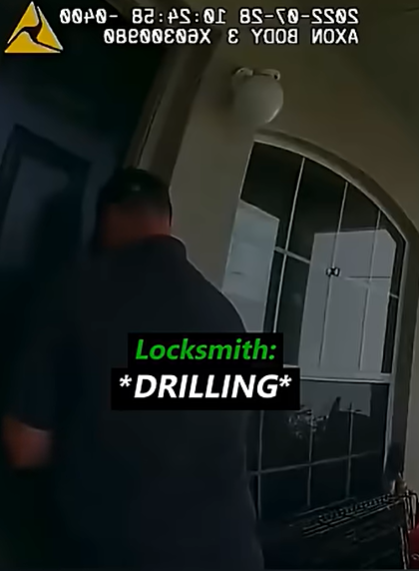
A routine eviction attempt turned into a deeply upsetting mistake when a law enforcement officer and a locksmith arrived at the wrong home and began drilling into the front door lock while the homeowner was still inside. What should have been a legal process carried out at a specific address quickly became a frightening and frustrating situation for an innocent resident who had no reason to expect anyone at her door, let alone someone trying to remove her lock.
The incident began when the officer and locksmith arrived at a property to execute an eviction notice. From their perspective, they were there to carry out an official duty. The locksmith approached the front door and began working on the lock, using a drill to remove it so entry could be made. In eviction situations, this kind of action may be part of the process when the property has to be secured or turned over. But in this case, there was one major problem: they were at the wrong house.
Inside the home, the homeowner became aware that something was happening at her front door. The sound of drilling and the presence of people outside would be alarming for anyone, especially when no warning had been given and no explanation was immediately clear. Instead of opening the door right away, she spoke through her home security system to ask what was going on. Her confusion was understandable. From her side, it looked like strangers had come to her door and were actively damaging her lock.
The homeowner explained that she was fully paid up on her bills. That detail matters because she seemed to believe the action at her door might somehow be connected to a financial or housing issue. She wanted to make it clear that there was no reason for anyone to be removing her lock or trying to enter her home. She also told them that her dogs were inside the house, which added another layer of urgency and fear. If someone forced entry into the wrong home, the dogs could panic, run out, or be put in a stressful situation.
At first, the officer appeared to believe they were at the correct address. But once the homeowner challenged what was happening and the address was checked more carefully, the mistake became clear. They were at house number 43 instead of house number 47. That small difference in numbers created a major problem. The eviction notice was not for this homeowner’s house at all. The officer realized that they had gone to the wrong property and immediately stopped the process.
To his credit, the officer admitted the mistake. He acknowledged that they were at the wrong address and apologized to the homeowner. That was the necessary first step. Once the error was discovered, the drilling had to stop, and the homeowner had to be told clearly that the eviction action was not meant for her property. Still, an apology did not erase what had already happened. Her lock had already been damaged, her sense of safety had been shaken, and she had just experienced a frightening moment at her own front door.
When the homeowner came outside, she was visibly upset. Her reaction was not surprising. A person’s home is supposed to be the place where they feel secure. Having an officer and locksmith mistakenly begin the process of forcing entry can feel like a serious violation, even if it was accidental. She demanded to know who was responsible for the error. That question was reasonable. From her perspective, this was not a small clerical issue. Someone had arrived at her home, acted on the wrong address, and damaged her property.
She also asked for multiple copies of the new keys for her family. This was another practical concern. Once a lock has been drilled out or replaced, the people who live in the home need access. It is not enough to simply say the lock will be repaired. The homeowner needed assurance that she and her family would be able to use their own front door without more inconvenience. If family members depended on that key, then replacing the lock meant providing enough keys for the household.
The officer acknowledged that the mistake was a joint error and promised that the lock would be replaced. That response addressed part of the problem. Replacing the lock was necessary because the locksmith had already begun damaging or removing it. But the emotional side of the situation remained unresolved. The homeowner was not only worried about the cost of the lock. She was upset because someone had come to the wrong house and started an eviction process against her by mistake.
The tension rose when the officer tried to downplay the situation by telling her it was “not a big deal.” That phrase made the homeowner even more angry. From the officer’s point of view, he may have meant that the mistake could be corrected, that no one had been hurt, and that the lock would be replaced. But to the homeowner, hearing that it was “not a big deal” likely felt dismissive. It sounded as though the fear, confusion, property damage, and risk to her dogs were being minimized.
For the homeowner, it was a big deal. Her dogs were inside the home. Her front door had been tampered with. Her lock was damaged. She had been forced to confront a frightening situation through a security system because people were trying to enter her property under the authority of an eviction notice that did not apply to her. Even if the mistake was honest, the impact was real.
That is why she angrily pushed back. She reminded the officer that her dogs were inside and that her property had been damaged. Those were not small details. Pets are part of the household, and many homeowners would be terrified at the thought of strangers forcing open the door while animals are inside. Dogs may bark, panic, hide, or try to escape when unfamiliar people enter. The homeowner had every reason to be concerned about what could have happened if the error had not been caught quickly.
The damaged lock also represented more than just a broken object. A front door lock is one of the most basic symbols of home security. Once someone drills into it, the homeowner may feel exposed and vulnerable until it is fully replaced. Even after a new lock is installed, the emotional effect of knowing that officials and a locksmith mistakenly targeted the home may remain. It can make a person wonder how such a basic mistake happened and whether it could happen again.
The situation highlights how important accuracy is when carrying out legal actions like evictions. An eviction is a serious matter. It involves property rights, legal authority, and often the forced removal or securing of a residence. Because the consequences are so significant, every detail must be checked carefully before action begins. A wrong address is not a minor typo when it leads to someone’s lock being drilled.
House numbers can be easy to mix up, especially if homes are close together or if visibility is poor. But that is exactly why verification matters. Before any forced entry or lock removal begins, the address should be confirmed with the paperwork, the visible house number, and any other available information. In this incident, the difference between 43 and 47 was enough to put the wrong homeowner through a frightening experience.
The homeowner’s use of the security system also played an important role. Because she was able to speak through it, she could question what was happening before the process went any further. Without that communication, the officer and locksmith might have continued longer before realizing the mistake. The security system gave her a way to challenge the situation from inside without immediately opening the door to people she did not expect.
Her first instinct was to ask what was happening and explain that she was current on her bills. That shows how confused and alarmed she was. She was trying to make sense of why anyone would be at her door for an eviction-related action. Since she knew she had not fallen behind, she immediately recognized that something did not add up.
The officer’s apology was important, but the way the conversation unfolded afterward shows that apologies need to be paired with accountability. When someone makes a mistake that affects another person’s home, simply saying sorry may not feel like enough. The homeowner wanted to know who was responsible, how the error happened, and how the damage would be fixed. Those are fair questions.
The locksmith’s role is also significant. The locksmith was there to perform a job based on the officer’s authority and the eviction paperwork. But once the wrong address was identified, the locksmith’s work became the visible damage left behind. Even if the locksmith was acting under instruction, the homeowner still had to deal with the result: a compromised lock and the need for replacement keys.
This is where responsibility can become complicated. The officer called it a joint mistake, suggesting that more than one person failed to catch the wrong address. The officer may have been responsible for confirming the legal address. The locksmith may have relied on the officer’s confirmation before drilling. The paperwork may have listed one address, while the team physically went to another. However it happened, the homeowner did not cause the error and should not have had to carry the burden of fixing it.
The request for multiple keys shows that the homeowner was already thinking beyond the emotional shock and focusing on practical needs. A new lock without enough keys would create problems for her family. If people came home later and could not enter, the inconvenience would continue. She wanted the replacement to fully solve the problem, not create another one.
The phrase “not a big deal” became the flashpoint because it failed to match the seriousness of how the homeowner experienced the event. In stressful situations, words matter. An officer may try to calm someone down by suggesting that the problem can be fixed, but if the wording sounds dismissive, it can have the opposite effect. The homeowner did not want to be told her fear was small. She wanted the mistake to be recognized as serious.
A better response might have been to say that the lock would be replaced immediately, that the mistake should not have happened, and that her concerns about her dogs and property were understood. That kind of language would have acknowledged the impact while still reassuring her that the damage would be repaired. Instead, downplaying the situation made her feel like she had to defend why she was upset.
This incident also shows how emotionally intense property-related mistakes can be. If someone receives the wrong letter in the mail, it may be annoying. If someone knocks on the wrong door, it may be awkward. But if someone starts drilling out the lock of the wrong home, the situation feels much more serious. It crosses from inconvenience into intrusion.
For many homeowners, the idea of an official-looking team arriving with a locksmith is especially frightening because it carries authority. A person may feel powerless when law enforcement is involved, even if they know a mistake has been made. The homeowner had to speak up quickly and firmly to stop something that should never have started at her address.
The presence of the dogs made the fear even more personal. Pets inside a home cannot understand legal mistakes. They only experience strangers at the door, loud drilling noises, and stress. The homeowner’s repeated concern about them shows that she was thinking not only about her property, but about the living beings inside who could have been affected.
The situation could have become worse if the homeowner had not been home or had not noticed the drilling in time. If no one had answered through the security system, the lock might have been fully removed before the address mistake was discovered. That possibility makes the error feel even more serious. It raises the question of what safeguards were supposed to be in place before the locksmith began drilling.
In eviction procedures, precision is essential because the action is not easily reversible once entry begins. A lock can be replaced, but the feeling of security can be harder to restore. The homeowner may continue to wonder why her house was mistaken for another and whether other official documents or actions could be misdirected in the future.
The officer did the right thing by stopping once the mistake was discovered, but the incident still illustrates the need for better care before acting. The correct address should have been confirmed before the locksmith touched the lock. A simple check could have prevented the homeowner from being frightened and her property from being damaged.
The video or account of the incident is frustrating because the mistake seems so basic. House number 43 and house number 47 are close, but they are not the same. When the task involves drilling a lock and carrying out an eviction notice, close is not good enough. The correct house must be identified beyond doubt.
For the homeowner, the experience likely felt surreal. One moment she was inside her home with her dogs. The next, she was hearing or seeing people at her door, discovering that a locksmith was drilling into her lock, and being told an eviction process was underway. Then, just as suddenly, the officer realized it was the wrong house. That kind of rapid shift from fear to anger is natural.
Her anger was not only about the lock. It was about being put in a position where she had to defend her right to be in her own home. She had to explain that her bills were paid. She had to point out that her dogs were inside. She had to ask why people were damaging her door. She had to demand replacement keys. All of that happened because someone else failed to verify the address.
The officer’s promise to replace the lock was necessary, but the homeowner’s frustration showed that repairs alone do not fully address the harm. Accountability matters too. People want to know that mistakes like this are taken seriously so they do not happen again. When an official mistake affects a private home, the response should be careful, respectful, and clear.
The tension between the officer and homeowner also reflects a common issue in stressful encounters: the difference between intent and impact. The officer likely did not intend to scare her or damage the wrong property. The locksmith likely did not intend to drill the wrong lock. But the impact on the homeowner still happened. Good intentions do not erase the result.
That is why the homeowner’s reaction should not be dismissed as overreacting. From her perspective, her home had been wrongly targeted for an eviction action. Her lock had been damaged. Her dogs were inside. She had no warning. She had to stop the process herself by speaking through her security system. Anyone in that situation would likely feel shaken.
The incident ends as a reminder that official processes must be handled with extreme care. Evictions are already stressful when carried out at the correct address. At the wrong address, they become a serious violation of an innocent person’s peace and security. A mistaken address may sound simple on paper, but at someone’s front door, with a drill in the lock and pets inside, it becomes a frightening real-world event.
In the end, the homeowner wanted what most people would want: an explanation, accountability, a repaired lock, enough keys for her family, and recognition that what happened was serious. The officer admitted the mistake and promised to replace the lock, but the attempt to minimize the situation only deepened her anger. For her, this was not “not a big deal.” It was her home, her property, her family’s access, and her dogs’ safety. A wrong address turned a legal procedure into an avoidable and upsetting encounter, proving how much damage can be done when basic verification fails before action is taken.
What made the situation especially upsetting was that the homeowner had to argue for the seriousness of what happened while still standing in front of the damage. She was not speaking about something hypothetical. The lock had already been drilled. Her door had already been affected. The people involved had already started a process that should never have reached her property. For her, the mistake was not just a wrong number on a form; it was a direct interruption of her home and safety.
The officer’s attempt to calm the situation may have been meant to reduce tension, but the wording made things worse. When someone has just experienced fear inside their own home, being told it is “not a big deal” can sound like their feelings are being brushed aside. A better response would have been to fully acknowledge the harm first, then explain how it would be corrected. In moments like this, people often need to hear that their reaction is understandable before they can begin to calm down.
The homeowner’s concern about her dogs also remained central. If the door had been opened suddenly, the dogs might have been frightened by strangers entering, loud drilling, or the confusion at the doorway. They could have run out, barked defensively, or been put in a situation nobody intended. That possibility alone made the error feel much more serious to her. It was not only about a lock; it was about what could have happened inside the home if the mistake had continued.
The request for new keys was also more than a small demand. Once a lock is replaced, access to the home changes for everyone who lives there. Family members who had old keys would no longer be able to enter. The homeowner needed multiple copies because the mistake had disrupted the normal use of her own house. She was not asking for anything extra; she was asking to be made whole after an error she did not cause.
This incident is a strong reminder that procedures involving someone’s home must be handled with more than routine confidence. Before a locksmith drills, before an officer authorizes entry, and before an eviction notice is acted upon, the address must be verified beyond any doubt. A simple mistake can become a major violation when it reaches a person’s front door.
By the time the process stopped, the homeowner had already lost the feeling of control over her own space. Even with an apology and a promise to replace the lock, the experience likely stayed with her. The damage could be repaired, but the shock of hearing strangers working on her door under a mistaken eviction order would not disappear immediately. That is why she demanded answers so strongly. She wanted the people responsible to understand that the error had real consequences.