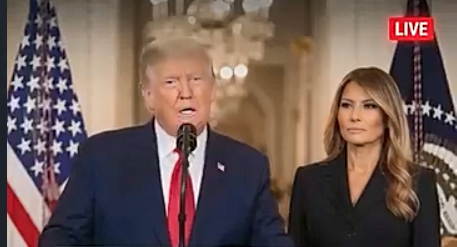
President Donald Trump delivered a major update on the confrontation with Iran as Washington and Tehran entered one of the most consequential periods of diplomacy since the outbreak of fighting. A fragile cease-fire, the future of Iran’s nuclear program and control of the Strait of Hormuz were all hanging over negotiations that could determine whether the conflict moved toward a settlement or returned to major military escalation. Trump’s comments came during an extraordinary stretch in April 2026, several weeks after war erupted between the United States and Iran and as officials on both sides prepared for direct negotiations in Islamabad, Pakistan.
The discussions represented the highest-level direct engagement between Washington and Tehran in decades. They were taking place against a backdrop of enormous distrust, disrupted energy markets and continuing disagreement over exactly what the temporary cease-fire required each side to do. Trump’s message was unmistakably confrontational. The president argued publicly that Iran was negotiating from a severely weakened military position and accused Tehran of using its influence over international shipping lanes as leverage. In one social-media message, Trump said Iran had “no cards” beyond the pressure it could create involving international waterways. He suggested that Tehran’s leaders had been given an opportunity to negotiate because the United States believed diplomacy was still possible.
The rhetoric highlighted the unusual combination of military pressure and diplomacy surrounding the negotiations. Even while American officials prepared to sit across from Iranian representatives, Trump continued emphasizing the damage U.S. and Israeli military operations had inflicted on Iran’s armed forces and infrastructure. His administration appeared determined to convince Tehran that continuing the confrontation would leave Iran in an increasingly difficult position.
Iranian officials, however, insisted that Washington would also have to make concessions if the United States wanted a lasting agreement. At the center of the immediate crisis was the Strait of Hormuz, the narrow waterway connecting the Persian Gulf with the Gulf of Oman and the Arabian Sea. It is one of the most strategically important shipping corridors in the world because a significant amount of internationally traded oil and natural gas traditionally passes through it. The fighting had severely disrupted normal traffic through the waterway. Fears of Iranian attacks, military activity and the possible presence of mines contributed to major uncertainty for commercial vessels.
The disruption quickly affected international energy markets, demonstrating how a regional military confrontation could create economic consequences thousands of miles away. Trump announced that the United States had begun taking steps intended to clear the Strait of Hormuz and establish safer passage through the area. He said the operation was important not only for the United States but also for countries that rely heavily on energy moving through the region. Trump specifically pointed to major economies in Asia and Europe, arguing that they had a substantial interest in seeing normal shipping restored.
American naval forces subsequently moved into the area as part of operations designed to create conditions for mine-clearing and safer navigation. The operation carried considerable risk, as Iranian forces continued warning that foreign military vessels operating near Iranian territory could face retaliation if Tehran considered their actions threatening. Trump also said Iranian vessels associated with mine-laying operations had been destroyed, and his administration presented that as evidence that Iran’s ability to threaten international shipping had been weakened.
But restoring normal traffic through one of the world’s most sensitive maritime routes was considerably more complicated than eliminating several military vessels. Commercial shipping companies still had to consider insurance costs, possible mines, Iranian military threats and the risk that fighting could suddenly resume. That uncertainty turned the Strait of Hormuz into much more than another battlefield. It became one of Iran’s most important remaining sources of leverage.
Even after suffering significant military losses, Tehran retained the ability to create uncertainty around global shipping. Iran did not necessarily need to physically stop every tanker entering the region. If shipping companies believed the route was dangerous enough, many could delay voyages, change routes or demand significantly higher insurance coverage. Those decisions alone could disrupt energy supplies and push global prices higher.
Trump publicly acknowledged the importance of the waterway while arguing that Iran would not be able to use it indefinitely as political leverage. The president also emphasized that the United States was less dependent on Persian Gulf energy than many countries in Europe and Asia. He argued that governments receiving large quantities of oil through the region should take greater responsibility for securing their own energy supplies, while also highlighting American energy production and portraying the United States as being in a stronger position than countries heavily dependent on imported oil.
The economic consequences of the conflict were already becoming impossible to separate from the military situation. Higher crude-oil prices threatened to increase gasoline prices, transportation costs and inflation, while airlines, shipping companies and manufacturers faced additional uncertainty. Governments dependent on imported energy were also forced to consider alternative supplies. Those economic pressures increased the incentive for both Washington and Tehran to explore diplomacy, even though each government continued blaming the other for the crisis.
The negotiations in Islamabad were therefore about far more than simply stopping airstrikes. Officials were confronting disagreements involving Iran’s nuclear program, economic sanctions, the Strait of Hormuz, regional military activity, frozen Iranian assets and possible security guarantees. The United States and Iran entered the negotiations with positions that remained far apart on several of those issues.
Vice President JD Vance led the American delegation alongside other senior U.S. representatives. Iran also sent senior officials, while Pakistan played an important role in attempting to bring the two governments together. The meeting itself was remarkable because of the depth of hostility that has defined relations between Washington and Tehran for decades. Direct negotiations at such a high level would have been significant even during a period of relative calm, but conducting them only weeks after major military confrontation made the discussions even more extraordinary.
American officials said Washington was willing to negotiate seriously if Iranian representatives approached the discussions in good faith. At the same time, the Trump administration warned that it would not accept negotiations merely designed to delay decisions while Iran rebuilt military capabilities. Iran arrived with demands of its own, including relief from economic sanctions and access to frozen funds.
Iranian officials also challenged American and Israeli interpretations of the temporary cease-fire. Those disagreements immediately raised questions about whether the cease-fire could survive long enough for negotiators to produce a broader agreement. The arrangement was better understood as a fragile pause in direct fighting than as a comprehensive peace treaty, with major disagreements still remaining over military activity, regional armed groups, maritime access and the responsibilities of each government.
That distinction was especially important when reports emerged concerning possible cease-fire violations. Washington, Tehran and Israel did not always agree about which military actions were actually covered by the understanding. One side could therefore characterize an operation as a violation while another insisted that it occurred outside the terms of the arrangement. Such ambiguity created an enormous risk, because a relatively limited confrontation could quickly become the event that triggered another round of direct military escalation.
Trump repeatedly portrayed Iran’s armed forces as significantly weakened. He said Iranian naval and air capabilities had suffered major damage and argued that Tehran’s missile and drone infrastructure had also been hit. The administration presented those losses as evidence that Washington entered negotiations from a position of strength. However, questions remained about the exact condition of Iran’s broader military and nuclear capabilities.
Those uncertainties were particularly important when discussing Iran’s nuclear program. Washington wanted guarantees designed to prevent Tehran from building a nuclear weapon over the long term. Iran has maintained that its nuclear activities are intended for peaceful purposes and has resisted demands it considers an infringement on its sovereign rights.
The challenge for American negotiators was converting military pressure into an agreement that could actually be monitored and enforced. Destroying military equipment and reaching a lasting nuclear settlement are very different things. Military operations can damage facilities, but a durable nuclear agreement requires decisions involving uranium enrichment, inspections, nuclear stockpiles, sanctions and verification. Those issues have frustrated American and Iranian diplomats for years.
The Islamabad negotiations demonstrated just how difficult bridging those differences could be. Officials spent hours attempting to find common ground, but the discussions ultimately ended without a comprehensive final agreement. Despite the failure to produce a deal, neither government immediately closed the door to additional negotiations. The willingness to continue communication suggested that both Washington and Tehran still believed diplomacy offered something they could not achieve solely through military action.
For Trump, the situation created a complicated political and strategic challenge. The president had argued that American military superiority gave Washington enormous leverage, but negotiating successfully with Iran also required acknowledging that Tehran still possessed tools capable of imposing significant costs. The Strait of Hormuz was one of those tools, while Iran’s relationships with armed groups across the region represented another.
Tehran also retained missiles and other military capabilities capable of threatening American allies and U.S. forces. That meant that even after extensive military operations, Washington could not simply dictate every detail of a future settlement without considering the possible consequences. The conflict demonstrated a familiar problem in warfare: battlefield superiority does not automatically produce a simple political solution.
Trump’s strategy appeared designed to keep military pressure and diplomacy available at the same time. Negotiations could continue as long as the administration believed a satisfactory agreement remained possible, while the threat of renewed American military action remained in the background. Iran followed a similar approach, participating in negotiations while warning that another major attack on Iranian territory would provoke retaliation.
Tehran also used the uncertainty surrounding the Strait of Hormuz to demonstrate that it still possessed meaningful leverage despite military losses. The result was an extremely unstable form of diplomacy in which every negotiating session occurred under the possibility that renewed fighting could begin if talks collapsed.
The question was no longer simply whether the United States and Iran wanted the war to stop. Both governments had reasons to avoid an indefinite conflict. The much more difficult question was whether either government was prepared to accept the conditions demanded by the other.
For Trump, Iran’s nuclear program remained a central concern. His administration wanted an agreement capable of preventing Tehran from developing a nuclear weapon not just temporarily but for the foreseeable future. Iran, however, expected meaningful benefits in return for major concessions. Those benefits included economic sanctions relief, access to frozen assets and changes to American military pressure.
The Strait of Hormuz became deeply connected to those negotiations. Iran could potentially offer safer commercial access through the waterway as part of a broader deal, while Washington could increase naval pressure if Tehran continued threatening commercial shipping. That created a complicated bargaining environment in which military, economic and diplomatic decisions constantly influenced each other.
Public rhetoric also became particularly important. Trump’s statements describing Iran as severely weakened were intended to strengthen Washington’s negotiating position, but Iranian leaders had powerful political reasons to reject the appearance that they were surrendering because of American pressure. Agreeing immediately to American demands after Trump publicly declared that Tehran had little leverage could create serious problems for Iran’s leadership at home.
Washington faced political pressure of its own. Making significant concessions after promising a tougher approach toward Iran could expose Trump to criticism from people who believed the United States should demand stronger terms. That dynamic helped explain why lengthy negotiations could take place without producing a comprehensive settlement. Both governments could understand the enormous dangers associated with another round of warfare while still disagreeing over what peace should actually look like.
Trump nevertheless continued expressing confidence that Washington possessed the stronger negotiating position. He argued that Iran had suffered military losses that would be difficult to replace quickly and suggested that Tehran should reach an agreement while diplomacy remained available. His administration also presented American naval operations as evidence that Washington intended to reduce Iran’s ability to use the Strait of Hormuz as leverage.
Iran rejected the idea that the United States could determine the future of the waterway on its own. Iranian military officials continued warning American naval forces operating in the region. That meant operations designed to reopen Hormuz could themselves become a possible trigger for new confrontation.
Commercial shipping companies were caught in the middle. Even if Washington announced that a particular shipping route was safe, vessel operators still had to consider whether Iranian forces would respect that route. The possibility of missiles, drones or mines was enough to make many companies cautious. Energy markets respond not only to actual shortages but also to the fear that future supplies might be interrupted, making uncertainty itself economically powerful.
Governments across Europe and Asia therefore watched every development closely. China, Japan and South Korea have major economic interests in stable Gulf energy supplies. European economies can also be affected significantly when global oil and gas prices rise, even when their supplies do not come directly through Hormuz.
Trump’s criticism of other countries reflected a broader argument that nations benefiting from American military protection should contribute more to protecting international shipping. But other governments faced difficult choices of their own. Joining American military operations could expose them to Iranian retaliation and could also transform countries trying to remain outside the war into direct participants.
That reluctance demonstrated another limitation facing Washington. The United States possessed overwhelming military resources compared with Iran, but maintaining broad international political support for an extended Middle Eastern conflict was a different challenge. The longer the confrontation continued, the more complicated those economic and diplomatic questions became.
The temporary cease-fire was therefore more than simply a break between airstrikes. It represented a narrow opportunity for diplomats to transform military pressure into something more permanent. Failure carried enormous risks. Renewed fighting could threaten American troops, Iranian civilians, Israeli cities, Gulf infrastructure and commercial shipping, while another severe disruption of Hormuz could send international energy markets into turmoil.
Success, however, required resolving questions that had resisted diplomacy for years. Those questions included Iran’s nuclear program, American sanctions, regional security and the fundamental issue of whether Washington and Tehran could trust each other enough to enforce an agreement.
The negotiations did not solve those problems. They did demonstrate that both governments were still prepared to communicate even after major military confrontation. That alone was important. During several stages of the conflict, rhetoric from both capitals had raised concerns that escalation could become increasingly difficult to control.
Direct negotiations at least provided a channel through which misunderstandings could potentially be addressed before turning into additional attacks. But the failure to reach a comprehensive settlement meant the situation remained extremely fragile.
Trump’s Iran update therefore should not be interpreted simply as an announcement that the crisis had ended. It was more accurately a declaration that Washington believed it was negotiating from a position of military strength. The president wanted Tehran to understand that American pressure could continue, while Iran wanted Washington to understand that it still possessed enough leverage to impose significant costs.
The rest of the world had an immediate interest in ensuring those competing strategies did not push the region back into a major conflict. The Strait of Hormuz captured those stakes better than almost anything else. A relatively narrow stretch of water had become a symbol of the larger confrontation between American military power and Iran’s ability to disrupt the global economy.
Trump said the United States was working to restore safe navigation, while Iran maintained that it retained an important role in determining what happened in waters close to its territory. Commercial shipping companies waited for conditions they considered safe enough, and diplomats searched for a compromise capable of preventing another round of warfare.
Those pressures remained unresolved following the negotiations. Despite dramatic headlines surrounding Trump’s comments, the reality was considerably more complicated. Direct communication represented progress, efforts to restore maritime traffic represented progress, and a temporary reduction in direct U.S.-Iranian fighting also represented progress. But there was no comprehensive peace agreement.
There was also no permanent resolution of the nuclear dispute, and the future of the Strait of Hormuz remained closely linked to negotiations involving sanctions, military security and regional power. The period therefore represented a crucial moment rather than a final resolution.
For Trump, the challenge was demonstrating that Washington could transform its military advantages into diplomatic results without allowing the conflict to become an open-ended war. For Iran, the challenge was preserving enough negotiating leverage to secure terms its leadership could accept while avoiding further military losses.
For American allies and the broader global economy, the immediate objective was simpler: preventing another escalation capable of disrupting international energy supplies and expanding the conflict.
What happened next depended less on dramatic public statements than on whether negotiators could resolve the political and technical disagreements separating Washington and Tehran. Trump had made clear that he believed time favored the United States. Iranian officials made equally clear that they would not simply accept American demands without concessions.
That left diplomacy operating along an extremely narrow path between two governments that had spent decades distrusting each other. The cease-fire created time, but it did not create trust.
The Strait of Hormuz also served as a powerful reminder that even after serious military losses, Iran retained ways of influencing both American strategy and the global economy. The negotiations ultimately ended without the comprehensive agreement officials had been seeking. However, the door remained open to additional communication.
That left the region suspended between two very different possibilities: a diplomatic process capable of gradually ending the confrontation, or another cycle of military escalation.
For Trump, the message remained that Tehran faced a choice. His administration argued that Iran could negotiate while an opportunity remained available or risk additional pressure if diplomacy collapsed. Iran’s leaders presented the situation differently, arguing that any lasting agreement would have to recognize Iranian demands as well as American ones.
That fundamental disagreement remained at the center of the crisis, and until those positions moved closer together, the fragile calm surrounding the conflict could not be considered a permanent peace.