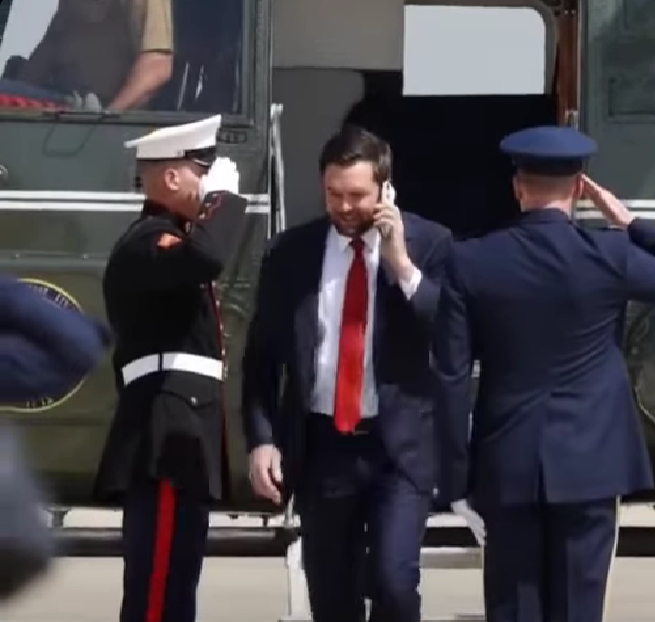
Vance’s presence at the White House was important because the administration was approaching a critical decision point. A temporary ceasefire had reduced direct hostilities, but its expiration was approaching rapidly, and major disagreements remained unresolved. Washington was demanding stronger guarantees concerning Iran’s nuclear program and regional activities, while Tehran objected to American military and economic pressure. Pakistan, acting as a mediator, was attempting to persuade both governments to continue negotiating before the situation returned to open confrontation.
CNN correspondent Alayna Treene reported that Vance had originally been expected to leave Washington that morning. Instead, sources said he would attend meetings at the White House concerning the administration’s policies and its plans for a possible peace agreement. Treene stressed that the journey had definitely been delayed, although it was not yet clear whether it had been completely canceled. The uncertainty reflected the rapidly changing diplomatic environment rather than a routine alteration to the vice president’s schedule. problem was Iran’s failure to confirm that its senior representatives would attend the proposed Islamabad meeting. Pakistan had prepared to host the delegations and had remained in communication with Iranian officials, but it was still waiting for a formal response. Sending the American vice president across the world without certainty that an equivalent Iranian delegation would be present would have created political and diplomatic risks for Washington.
Pakistan’s information minister, Attaullah Tarar, publicly acknowledged that confirmation from Iran had not arrived. He said Pakistani officials remained in constant contact with Tehran and continued to pursue diplomacy, but warned that a decision was urgently needed because the ceasefire was nearing its deadline. Pakistan regarded the proposed meeting as a crucial opportunity to keep the conflict from escalating and to preserve the possibility of a negotiated settlement. not necessarily mean the United States was abandoning diplomacy. Keeping Vance at the White House may have allowed President Donald Trump and his senior advisers to reassess the American position, discuss Iran’s hesitation and determine whether additional concessions, guarantees or pressure would be required. It also prevented the administration from committing its most senior negotiator before the Iranian side had clearly accepted the meeting.
However, the symbolism was difficult to ignore. Peace conferences depend heavily on confidence, preparation and the expectation that the participants have the authority to make decisions. When one delegation cannot confirm its attendance and another delays its departure, the entire process begins to appear unstable. Even when negotiations eventually take place, uncertainty over who will attend can weaken trust before the participants enter the room.
Vance had already played a central role in earlier negotiations with Iran. During a previous visit to Islamabad, he led the American delegation alongside special envoy Steve Witkoff and presidential adviser Jared Kushner. Those talks lasted for many hours but ended without a final agreement. The United States said Iran had declined to provide the kind of clear commitment Washington wanted regarding the development of nuclear weapons. earlier negotiations did not produce a breakthrough, the fact that high-ranking American and Iranian representatives participated was itself significant. Relations between the two countries had been defined by deep hostility, sanctions, military threats and decades of mistrust. Bringing senior officials into the same diplomatic process demonstrated that both governments recognized the dangers of allowing the confrontation to continue without limits.
The failure to reach an agreement also revealed how far apart the two sides remained. The United States wanted enforceable restrictions capable of preventing Iran from obtaining a nuclear weapon. Iran wanted relief from sanctions and military pressure while maintaining what it described as its sovereign rights. Questions surrounding regional security, maritime access, frozen assets, economic restrictions and verification measures further complicated the negotiations.
A broad statement promising peace would not have been enough. Washington wanted specific commitments that could be monitored and enforced, while Iranian officials were unlikely to accept terms they believed would leave their country vulnerable. Each government also had to consider domestic political pressure. Any agreement that appeared too generous could face criticism from lawmakers, military officials, political allies and sections of the public.
For Vance, the assignment represented one of the most serious foreign-policy responsibilities of his vice presidency. Vice presidents frequently travel abroad, represent the administration and participate in national-security discussions, but personally leading negotiations between hostile governments places a much greater burden on the office. Every public statement can influence financial markets, military calculations and the willingness of the opposing side to continue talking.
The decision to summon or retain Vance at the White House therefore suggested that the administration believed further coordination was necessary before he traveled. Senior officials may have needed to clarify the instructions he would carry, establish the limits of possible compromise and consider how the United States would respond if Iran rejected the talks. Although the precise content of the meetings was not made public, the timing indicated that the situation was being treated as an urgent national-security matter.
President Trump had publicly projected confidence that Iran would eventually accept a deal, arguing that Tehran faced strong incentives to negotiate. At the same time, he used forceful rhetoric and refused to rule out renewed military action. This combination of diplomatic invitations and warnings was intended to increase pressure on Iran, but it also made the talks more difficult. Iranian leaders repeatedly objected to negotiating while facing threats, sanctions or military restrictions.
Trump also expressed resistance to simply extending the ceasefire without obtaining a more permanent arrangement. In an interview conducted as the deadline approached, he indicated that he did not want another temporary delay that failed to resolve the underlying dispute. His position was that Iran could improve its international and economic situation by accepting a comprehensive agreement, but that time for negotiations was limited. perspective, extending the ceasefire repeatedly could allow Iran to avoid difficult decisions while reducing the urgency surrounding the negotiations. From the perspective of Pakistan and other mediators, however, extending the truce could provide the time needed to narrow the differences and prevent renewed violence. This created a basic diplomatic dilemma: pressure might encourage concessions, but too much pressure could destroy the process entirely.
Iran’s uncertainty about attending the Islamabad meeting may have reflected internal disagreements as well as dissatisfaction with American demands. Iranian political and military institutions do not always approach negotiations from identical positions. Some officials may see diplomacy as the best way to reduce economic and military pressure, while others may regard compromise with Washington as dangerous or humiliating.
Public statements from Iranian leaders added to doubts about the meeting. Iranian officials criticized the American approach and disputed descriptions of what had been agreed during earlier contacts. Harsh rhetoric directed at Trump and the United States suggested that Tehran was unwilling to appear as though it had been forced back to the negotiating table. Such language may have been intended partly for a domestic audience, but it made Pakistan’s mediation efforts more complicated.
Pakistan had strong reasons to continue trying. A wider conflict involving Iran, Israel and the United States could destabilize neighboring countries, disrupt transportation routes, increase energy prices and create new economic pressures across South Asia and the Middle East. Pakistan’s leaders therefore presented dialogue not merely as a favor to Washington or Tehran but as a necessity for regional stability.
Hosting the talks also gave Pakistan an opportunity to strengthen its position as an international mediator. Successfully bringing the United States and Iran together would demonstrate Pakistan’s diplomatic importance and its ability to communicate with governments that do not trust each other. Failure, on the other hand, could expose the limits of its influence and leave it facing the consequences of a conflict occurring close to its borders.
Pakistani officials continued speaking with both sides even as Vance’s departure was delayed. Deputy Prime Minister and Foreign Minister Ishaq Dar encouraged the United States and Iran to remain engaged and argued that diplomacy offered the only realistic route toward lasting stability. Pakistan also urged the parties to give negotiations more time rather than allowing the ceasefire to expire while basic arrangements for the next meeting were still unsettled. rried consequences far beyond the governments directly involved. Iran’s location gives it enormous strategic importance, particularly because of its proximity to major maritime routes used to transport oil and gas. Any confrontation affecting shipping in or near the Strait of Hormuz and the Gulf of Oman can influence energy prices, insurance costs, international trade and supply chains across the world.
Shipping companies respond quickly to military uncertainty. A threat against commercial vessels, the possibility of inspections or seizures, and the presence of warships can all make routes more expensive and dangerous. Companies may delay journeys, change destinations or suspend operations. Even without a major attack, fear of escalation can raise transportation and insurance costs that are eventually passed on to businesses and consumers.
American pressure on Iranian ports and shipping had already become a major issue in the negotiations. Washington viewed restrictions and naval enforcement as tools for weakening Iran’s military capabilities and compelling its leaders to accept stronger conditions. Tehran regarded such actions as unlawful coercion and argued that it could not negotiate freely while its economy and maritime access were being threatened.
This disagreement showed why the dispute could not be reduced to a single question about nuclear weapons. Nuclear restrictions were central, but the negotiations also involved sanctions, trade, shipping, regional alliances and security guarantees. Progress in one area could easily be undermined by confrontation in another. A diplomatic formula therefore had to address immediate military risks while creating a process for resolving longer-term issues.
Israel’s security concerns formed another essential part of the situation. Israeli leaders have long viewed Iran’s nuclear program and its support for armed groups in the region as major threats. Any American agreement with Tehran would be closely examined in Israel to determine whether it imposed meaningful and enforceable restrictions. An arrangement considered acceptable in Washington or Islamabad might still face intense opposition from Israeli officials.
At the same time, regional military activity could interfere with diplomacy even when the United States and Iran were prepared to talk. An attack, interception, missile launch or disputed ceasefire violation could rapidly change the political atmosphere. Leaders who had shown flexibility might suddenly face demands to retaliate. Negotiators might be recalled, and agreements that appeared possible one day could collapse the next.
The delayed Vance trip illustrated this vulnerability. Diplomatic schedules normally require extensive preparation, including security arrangements, transportation, meeting locations, delegation lists and agreed procedures. Yet all of that planning can become irrelevant when one government has not confirmed that it will participate. The delay was therefore both a practical response and a warning that the political foundation of the meeting remained weak.
The vice president’s return to White House policy discussions may also have reflected disagreements within the administration about the best strategy. Some officials could favor continued negotiation, believing that a verifiable deal would be less costly and dangerous than renewed conflict. Others might argue that Iran was using talks to delay action while refusing to make meaningful concessions. Trump had to balance those positions while deciding what instructions to give Vance.
The administration also needed to consider how the delay would be interpreted internationally. Allies wanted reassurance that Washington remained committed to preventing a wider war. Adversaries were watching for signs of confusion or division. Iran might interpret the delayed flight as evidence that the United States was reconsidering its demands, or it might see the decision as preparation for additional pressure.
Public communication was therefore extremely important. Describing the trip as delayed rather than canceled allowed the White House to preserve flexibility. It could still send Vance if Iran confirmed its participation, choose a lower-level delegation, move the talks to another date or location, or pursue indirect communication through Pakistan. A definitive cancellation would have been harder to reverse without appearing inconsistent.
For the Iranian government, formally agreeing to meet Vance would also carry symbolic consequences. It would recognize the vice president as the leading American negotiator and signal that Tehran believed direct or mediated engagement could still produce results. Refusing to attend could strengthen Iran’s image of resistance at home but increase the likelihood of renewed military and economic pressure.
The uncertainty placed Pakistan in the difficult position of trying to organize a conference before both delegations had fully committed. Pakistani officials continued to prepare while publicly urging Iran to respond. Their statements were carefully worded: they acknowledged the absence of confirmation but emphasized that communication continued. This allowed them to maintain hope without falsely claiming that the talks were guaranteed.
As the ceasefire deadline approached, every hour became more important. Temporary truces are often fragile because the parties may interpret their terms differently. One side may accuse the other of continuing prohibited activity, while the other argues that its actions fall outside the agreement. Without a mechanism to resolve disputes, even a relatively limited incident can become the justification for renewed hostilities.
A new round of talks could have created such a mechanism. Negotiators might have established communication channels, clarified the ceasefire’s terms and developed procedures for investigating alleged violations. Even without reaching a comprehensive peace agreement immediately, these steps could have reduced the risk that confusion or miscalculation would lead to another round of attacks.
Conversely, failed or abandoned negotiations could convince leaders that diplomacy had reached its limit. Trump’s warnings suggested that military action remained an option if Iran rejected American conditions. Iranian officials also indicated that their country was prepared to respond to additional pressure. When both governments emphasize their readiness to escalate, maintaining communication becomes even more important.
The potential human consequences should not be overlooked. Political discussions frequently focus on leaders, naval movements, sanctions and diplomatic strategy, but renewed warfare would affect ordinary people first. Civilians could face displacement, infrastructure damage, interrupted medical care, shortages, rising prices and the loss of family members. Communities across the region could suffer even if they had no influence over the decisions that caused the escalation.
Economic consequences would also extend globally. Energy-price increases can raise transportation and manufacturing expenses, intensify inflation and place additional pressure on countries that depend heavily on imported fuel. Developing economies are often especially vulnerable because they have fewer financial resources to absorb sudden price changes. A breakdown in diplomacy could therefore affect households thousands of kilometers from Iran.
The situation demonstrated the value and limitations of high-level diplomacy. Sending a vice president signals seriousness because the official has direct access to the president and can make decisions more quickly than a lower-level representative. However, even a powerful negotiator cannot produce an agreement when the other side does not attend or when the governments’ basic conditions remain incompatible.
Vance’s delayed departure was thus more than a scheduling story. It became a visible sign of the uncertainty surrounding the entire peace process. The aircraft remained grounded because the diplomatic destination itself was unclear. Islamabad was ready to host, Washington was preparing a delegation, but Tehran had not provided the confirmation needed to make the meeting viable.
The episode also showed how quickly expectations can change during an international crisis. One day, officials may speak confidently about an approaching summit. The next, travel is postponed and emergency policy meetings take place. Such changes do not always mean diplomacy has failed, but they reveal how dependent negotiations are on political signals, security developments and the willingness of leaders to accept risk.
For Trump, the question was whether keeping Vance in Washington would strengthen the American position or contribute to the collapse of the talks. Additional White House coordination could produce a clearer proposal and a more unified strategy. However, a prolonged delay might lead Iran to conclude that Washington preferred pressure over compromise.
For Iran, the decision was whether appearing in Islamabad would provide a genuine opportunity to protect its interests or simply expose it to further American demands. Tehran wanted to avoid appearing weak, but refusing negotiations could give Washington a justification for escalation. Its leaders had to weigh the political cost of attending against the potentially much greater cost of renewed conflict.
Pakistan continued trying to keep the diplomatic door open because it had the most to gain from a peaceful settlement and much to lose from regional escalation. Its role was not to erase the disagreements but to create enough trust and structure for the United States and Iran to address them without returning to warfare. That task became harder with every delay, hostile statement and disputed military action.
The most important fact was that the trip had been delayed, not initially declared impossible. Vance remained available to travel if the circumstances changed, and communication through Pakistani intermediaries continued. Diplomacy often survives periods of confusion, especially when all parties recognize that the alternative could be disastrous.
Still, the delay served as a serious warning. A peace process cannot continue indefinitely through tentative schedules and unconfirmed delegations. At some point, the governments involved must decide whether they are prepared to make concrete compromises, accept verification and create rules that reduce the danger of future confrontation.
The White House meetings gave Trump, Vance and their advisers another opportunity to make that decision. They could refine their proposal, reassess their pressure campaign and determine whether the United States was willing to provide Iran with incentives in exchange for enforceable security commitments. Iran faced a parallel choice about whether to participate and what it was prepared to offer.
For the international community, the hope was that the delayed flight represented a temporary pause rather than the end of negotiations. A short postponement could be corrected. A complete diplomatic breakdown would be much harder to reverse, particularly once military actions resumed and public positions became more rigid.
As Vance remained at the White House and Pakistan waited for Iran’s answer, the crisis stood at a crossroads. The coming decisions would determine whether the parties returned to a negotiating table or moved closer to renewed confrontation. The delay did not settle that question, but it made the stakes unmistakably clear.
Diplomacy remained possible, yet it was running short of time. The proposed Islamabad talks offered no guarantee of success, but they provided a channel through which the United States and Iran could test whether a peaceful settlement was still achievable. Vance’s postponed journey showed how fragile that opportunity had become and how urgently all sides needed to decide whether they were genuinely prepared to use it.