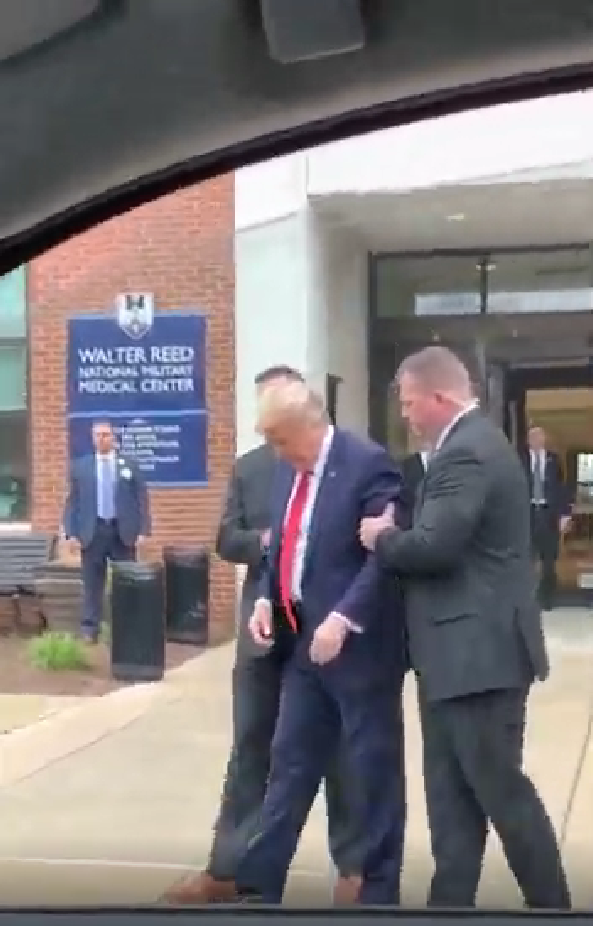
Speculation about President Donald Trump’s health spread rapidly across social media on Saturday, April 4, 2026, after the White House announced that he would make no further public appearances for the remainder of the day. Within hours, unsupported posts claimed that the president had been rushed to Walter Reed National Military Medical Center and suggested that officials were concealing a serious medical emergency. The rumours attracted widespread attention because they combined several details that can easily cause concern when presented without context: an unexpectedly quiet presidential schedule, a relatively early press “lid,” unverified reports of unusual activity near a military hospital and ongoing public interest in the health of an ageing president. However, the evidence available at the time did not establish that Trump had entered a hospital or experienced an emergency.
The speculation appears to have intensified after the White House Press Office called a full lid at 11:08 a.m. A press lid is a notification telling journalists that they should not expect additional public events or presidential movements that day. It does not necessarily mean the president has stopped working, left the White House or become unavailable to advisers. Presidents routinely hold private meetings, make telephone calls, review documents and conduct other business outside the view of television cameras. Nevertheless, because Trump was known for maintaining a highly visible public profile, some social-media users interpreted the early end to his public schedule as evidence that something unusual had happened. The linked article repeated that interpretation while acknowledging that officials had described the hospital claims as false.
The first important distinction is between a cancelled public appearance and a cancelled official duty. A president’s public calendar represents only the portion of the working day that the press or public is permitted to observe. It does not list every conversation, intelligence briefing, private meal, policy discussion or personal activity. When the White House says that no more public appearances are expected, the statement cannot automatically be translated into a medical emergency. The president may simply have no additional events requiring reporters to remain nearby. Without evidence such as a motorcade arriving at Walter Reed, confirmation from hospital officials or an announcement from the White House medical team, the schedule change alone was insufficient to support the claims circulating online.
White House communications director Steven Cheung responded by saying Trump had been working in the White House and Oval Office during the Easter weekend. The White House’s rapid-response account also rejected the rumours and criticised the assumption that a period without press contact meant the president was unwell. A CBS News White House correspondent reported seeing a Marine sentry at the West Wing entrance that afternoon, a sign traditionally associated with the president working inside. These statements came from administration officials and therefore were not independent medical evidence, but they directly contradicted the claim that Trump had secretly been admitted to Walter Reed.
The rumours were partly supported online by claims about possible road closures and restrictions in the airspace surrounding Walter Reed. Those reports were not accompanied by sufficient documentation showing that the measures occurred, that they were unusual or that they were connected to Trump. Roads can be restricted for many reasons, including construction, local emergencies, scheduled movements involving other officials or routine security activity. Temporary flight restrictions can also be misunderstood when screenshots are detached from their original dates and explanations. Before such observations can be used as evidence of a presidential hospital visit, journalists must confirm their authenticity, timing and relationship to an identifiable motorcade or aircraft.
The rapid spread of the story demonstrated how separate pieces of uncertain information can be assembled into a confident narrative. One person notices that the White House has called a lid. Another claims that roads near Walter Reed appear restricted. A third repeats a rumour that the president has been taken there. Soon, later posts cite the growing number of discussions as though repetition itself provides confirmation. In reality, many accounts may be repeating the same unsupported origin rather than offering independent evidence. The number of people sharing a claim does not reveal whether the initial source was accurate.
The strongest evidence against the hospital rumour came from Trump’s documented movements after it spread. On Sunday, April 5, the president departed the White House on camera at 9:19 a.m. and travelled to Trump National Golf Club in Virginia. He returned to the White House shortly after noon, with his departure and arrival again recorded as on-camera movements. The following day, April 6, he participated in the White House Easter Egg Roll and held an on-camera press conference. These appearances do not prove every statement made by officials about his health, but they show that the dramatic claims of an undisclosed emergency hospitalisation were not supported by his publicly recorded schedule.
It is theoretically possible for a person to visit a hospital briefly and appear publicly the next day, but no credible evidence emerged showing that Trump had done so on April 4. Responsible reporting must distinguish between what is imaginable and what is documented. Almost any unsupported claim can be defended by saying it remains technically possible. Journalism requires a higher standard: identifiable evidence, reliable sources and a timeline that can withstand independent examination. In this case, the publicly documented timeline supported the White House’s position that Trump remained in Washington and continued working rather than the online assertion that he had been rushed to Walter Reed.
The linked article also referred to an earlier MRI and visible marks on Trump’s hand, using those details to explain why the rumour attracted attention. Health concerns involving a president are legitimate matters of public interest, particularly when the president is older and responsible for decisions affecting national security, the economy and the operation of government. Yet individual observations should not be transformed into diagnoses by people who have not examined the patient. A photograph of a bruise, bandage or patch cannot establish a serious medical condition, and a change in the public schedule cannot reveal whether someone requires hospital treatment.
Public interest in a president’s health differs from ordinary curiosity about a celebrity. The president commands the armed forces, receives classified information and may be required to respond to emergencies at any hour. Citizens therefore have a legitimate interest in knowing whether the officeholder is physically and cognitively capable of performing those duties. At the same time, presidents retain some medical privacy, and not every test result or personal detail must necessarily be released. The continuing challenge is determining how much information is required to reassure the public without turning every minor condition into political entertainment.
The absence of detailed medical information can create an environment in which rumours flourish. When administrations offer only highly positive summaries, critics may suspect that unfavourable facts are being withheld. When officials delay responding to questions, the information gap may be filled by social-media accounts with no direct knowledge. Greater transparency can reduce that space, but transparency must include useful medical information rather than vague statements declaring a president to be exceptionally healthy. It should explain the purpose of examinations, identify significant diagnoses and describe whether any condition affects the president’s work.
Trump did make a confirmed visit to Walter Reed on May 26, several weeks after the April rumour. The White House described that later visit as preventive medical and dental checkups. Trump spent more than three hours at the medical centre and subsequently said that everything had checked out perfectly. The Associated Press reported that a written medical assessment was not released immediately following the visit, although the White House later published a physician’s memorandum dated May 29. That scheduled examination should not be confused with the unsupported claim that he had been secretly hospitalised on April 4.
Conflating the two events can create a misleading impression. A person may see a genuine headline about Trump visiting Walter Reed in May and assume that it validates the April rumour. It does not. Evidence that someone attended a hospital for a planned checkup on one date does not prove that the person was secretly treated there during an alleged emergency seven weeks earlier. Each claim requires its own evidence and timeline. Reusing accurate information from a later event to support an earlier unsupported story is a common way misinformation becomes more convincing.
The title “Is Trump in hospital?” was framed as a question rather than a direct statement, but question-based headlines can still create strong impressions. Readers may remember the association between Trump and hospitalisation even after learning that the story was unconfirmed. The headline can therefore spread suspicion without assuming full responsibility for asserting the claim. This technique is sometimes described as asking a dramatic question that the article cannot answer affirmatively. A more accurate title would have stated that the White House denied false hospital rumours following an early press lid.
A question mark does not remove a publisher’s responsibility to present proportionate evidence. If a headline asks whether the president has suffered a medical emergency, the article should explain immediately what evidence exists, where it originated and why it may or may not be credible. It should not place unsupported social-media posts on the same level as confirmed reporting. In the April episode, the most important facts were that no reliable evidence showed Trump entering Walter Reed, the White House said he was working inside the White House and he appeared publicly the following morning.
The public should also understand that presidential press lids are not rare or inherently alarming. A full lid can be called in the afternoon or evening when no more public movements are expected. Weekend schedules may contain fewer formal events than weekday calendars. An early lid may become newsworthy when it differs from previously announced plans, but it is not itself proof of illness, an emergency meeting or a secret journey. Context matters more than the phrase alone.
Social media often removes that context. A screenshot saying “full lid called” can be shared thousands of times without an explanation of what the term means. Users unfamiliar with White House reporting may interpret “lid” as a lockdown or an attempt to suppress information. The term actually belongs to the routine language used between the press office and journalists covering the president. Misunderstanding specialised language can transform an ordinary scheduling notice into the foundation of a conspiracy theory.
The speed of online platforms also discourages verification. Users are rewarded for posting first, expressing certainty and attracting engagement. A cautious message explaining that there is no evidence of hospitalisation may receive less attention than an alarming declaration that the president has been rushed to Walter Reed. By the time journalists check the schedule and request a response, the dramatic version may already have reached millions of people. Corrections rarely travel through exactly the same networks or receive the same level of interest.
Health rumours are particularly powerful because they involve fear, secrecy and the possibility of sudden political change. If a president were seriously incapacitated, questions would arise about constitutional authority, national security and succession. Audiences understand that such an event would be historically significant, so even a weakly supported claim can attract enormous attention. People who dislike the president may share it because they expect political consequences, while supporters may circulate it to condemn perceived misinformation. Both reactions increase the rumour’s visibility.
Political polarisation makes neutral evaluation more difficult. Trump’s critics may be inclined to believe reports suggesting declining health, while his supporters may reject even well-documented concerns as politically motivated. Reliable standards must apply regardless of the conclusion. Evidence should not be accepted merely because it damages a disliked politician, and official assurances should not be accepted automatically merely because they protect a favoured one. The goal is not to defend or attack Trump but to establish what the available information supports.
In this case, the administration’s denial was supported by observable events soon afterward. Trump’s on-camera departure from the White House on April 5, his return later that day and his public appearances on April 6 provided stronger evidence than anonymous posts. A responsible conclusion does not require claiming that every aspect of his health was known or that concerns about transparency were unreasonable. It requires saying that the specific hospitalisation rumour was unsupported and contradicted by the documented timeline.
That conclusion should not prevent journalists from asking legitimate questions about presidential health. Medical disclosures can be examined for completeness, and reporters may compare official claims with the president’s visible schedule and known diagnoses. They can consult qualified doctors about what types of examinations are normally recommended for someone of the president’s age, provided those experts do not pretend to diagnose a person they have not examined. They can also ask whether the White House plans to release full summaries after scheduled checkups.
There is a clear difference between scrutiny and speculation. Scrutiny begins with verified information and asks careful questions about its meaning. Speculation begins with missing information and treats imagination as evidence. Asking why the White House changed a schedule is reasonable. Claiming that the change proves the president was secretly hospitalised is not, unless additional evidence supports that conclusion. Reporting that Trump attended a scheduled medical examination is factual. Using that later examination to retroactively validate an earlier rumour is misleading.
The episode offers a useful lesson about evaluating breaking political claims. Readers should identify the original source rather than relying on accounts repeating one another. They should look for confirmation from journalists physically present at the White House, official schedules, pool reports and reputable news organisations. They should check the exact date because old videos of presidential motorcades travelling to Walter Reed can be recirculated as though they are current. They should also be cautious about artificially generated images and videos, which can make a fictional hospital arrival appear real.
A later fact-check found that an artificial-intelligence-generated video was shared as supposed evidence that Trump had been taken to Walter Reed after the April rumours. The existence of convincing fabricated footage makes source verification even more important. Viewers should examine whether a video was published by a recognised news organisation, whether multiple camera angles exist, whether press-pool reporters witnessed the movement and whether the visual details match the claimed date and location. An emotionally convincing image is not automatically an authentic one.
Publishers also have a responsibility to update stories when later evidence becomes available. Once Trump appeared publicly and his schedule documented his movements, an article centred on the hospital question should have clearly stated that the rumour was unsupported. Leaving a speculative headline unchanged can cause it to circulate weeks or months later, long after the immediate uncertainty has been resolved. Social-media algorithms frequently revive older stories without displaying their dates prominently, allowing readers to mistake historical speculation for a current emergency.
The linked page was published on May 1, almost four weeks after the April 4 rumour. By that date, Trump’s public activities on April 5 and April 6 were already documented. An accurate retrospective article therefore should not have left readers with the impression that his location remained an unresolved mystery. It could discuss why the rumour spread and why questions about presidential health receive attention, but it should make the verified outcome unmistakable.
The language used in health reporting also matters. Saying appearances were “cancelled” can suggest that numerous scheduled events were suddenly abandoned, while the available record primarily shows that the White House called a full lid and announced no further public activity for the day. Those descriptions are not identical. Journalists should establish which events had actually been announced, whether they were formally cancelled and what explanation was given. Dramatic wording can make a routine or limited schedule adjustment appear more extraordinary than it was.
Nothing in the evidence reviewed for the April 4 story showed that Trump was hospitalised that day. The White House denied it, a journalist observed the indicator that he was working in the West Wing, and Trump was publicly recorded leaving the White House the following morning. The confirmed May 26 examination was a separate, scheduled event. These facts do not settle every broader debate about Trump’s age, medical transparency or fitness for office, but they do answer the narrow question raised by the viral rumour.
The broader lesson is that uncertainty should not be treated as proof of the most alarming explanation. A quiet day at the White House may prompt reasonable questions, but those questions must remain questions until reliable evidence produces an answer. In this case, social media moved quickly from an early press lid to confident claims of an emergency hospital visit. The documented record moved in the opposite direction, showing a president who remained at the White House and returned to public view the following morning.
Public officials should communicate clearly, especially about matters affecting constitutional responsibilities. Journalists should challenge vague statements and seek meaningful medical information. Citizens should remain sceptical of both unsupported rumours and overly polished official claims. Those principles can coexist. Rejecting a false hospitalisation claim does not require abandoning scrutiny of Trump’s health, just as asking for transparency does not justify circulating unverified emergency reports.
The most accurate conclusion is therefore straightforward: Trump was not shown to be in hospital when the April 4 speculation spread. The claim emerged from an unusual but not conclusive schedule change and unverified online reports. Officials denied it, and the president’s public movements shortly afterward contradicted the idea that a serious hidden emergency had occurred. The episode became notable not because it revealed a secret hospitalisation, but because it demonstrated how quickly an information gap can be filled with a politically powerful rumour.
Another important issue raised by the episode is the difference between a president being temporarily unavailable to the press and being unable to perform the responsibilities of the office. Public visibility is not the same as presidential capacity. A president can remain fully engaged in government work without appearing before cameras, just as a president can participate in a public ceremony without revealing much about the private work taking place behind the scenes. Social-media speculation often collapses those distinctions. When audiences do not see the president, some assume that officials are hiding a crisis. When he appears again, others treat the appearance as complete proof that every concern was unfounded. Both conclusions can be too simplistic.
The constitutional questions surrounding presidential health make rumours especially sensitive. If a president became seriously incapable of performing official duties, the United States has established procedures concerning the temporary or permanent transfer of authority. However, those mechanisms are designed for genuine incapacity, not online speculation triggered by a quiet schedule. Suggesting that succession procedures might be necessary without credible medical evidence can create unnecessary public anxiety and potentially mislead foreign governments, financial markets and the wider population about the stability of the administration.