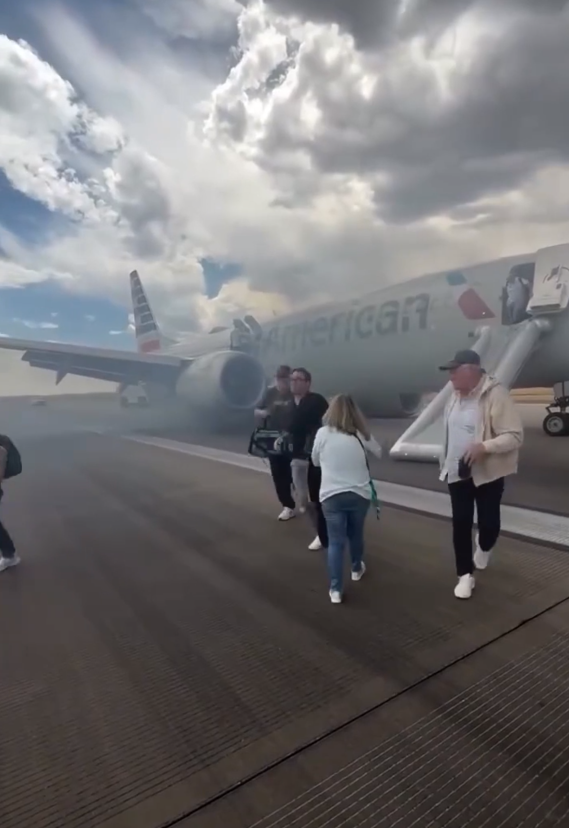
It was supposed to be routine. A short flight, barely more than an ho ur in the air, connecting Colorado Springs to Dallas—a route flown countless times without incident. Passengers boarded American Airlines Flight 1006 expecting nothing more than a standard journey: takeoff, a brief cruise above the clouds, and a smooth arrival in Texas. The aircraft, a Boeing 737-800, taxied into position under a sky that hinted at unsettled weather but nothing unusual for the region.
Inside the cabin, everything felt normal. Overhead bins clicked shut, seatbelts tightened, and the low murmur of conversation filled the space as the engines began to spool up. For the 172 passengers and 6 crew members onboard, there was no reason to expect anything out of the ordinary. Flights like this are so routine that they almost fade into the background of daily life—predictable, structured, safe.
But shortly after takeoff, something changed.
It wasn’t dramatic at first. No sudden jolt, no loud bang—just a subtle vibration, one that the average passenger might not even notice. But in the cockpit, where every sound and sensation is monitored with precision, it stood out immediately. The pilots began assessing the situation, scanning instruments, comparing readings, and trying to determine whether what they were experiencing was a minor irregularity or something more serious.
They contacted air traffic control, their tone calm and measured. At that point, it wasn’t declared an emergency—just a technical issue. Something wasn’t right with the engine, they explained, and they would need to slow down and divert. It was a controlled decision, the kind that reflects training and experience rather than panic.
For passengers, the announcement came in a reassuring voice. There had been a “technical concern,” they were told, and the flight would be diverted to Denver International Airport as a precaution. There was no urgency in the message, no sign of alarm. Most people remained calm, trusting the crew and assuming that whatever the issue was, it would be resolved safely on the ground.
Outside, the aircraft adjusted its course.
The skies over Denver were darker, heavier, with storm clouds building in the distance. The plane descended steadily, cutting through layers of turbulent air. Inside the cabin, a few passengers began to notice the change—the slight shaking, the subtle tension that creeps in when something feels just a little off. Still, there was no indication of what was truly unfolding.
From the cockpit’s perspective, the situation remained controlled but uncertain. Engine vibrations are not something to ignore. They can signal anything from minor mechanical imbalance to more serious internal issues. The pilots followed protocol, running checklists, communicating with controllers, and preparing for a safe landing.
At approximately 5:15 p.m., the aircraft touched down in Denver.
From the outside, it looked like any other arrival. The landing was smooth, controlled, almost routine. For many onboard, there was even a sense of relief. Whatever the issue had been, it seemed to be behind them now. The plane had landed safely. The hardest part, it appeared, was over.
But that assumption would prove dangerously wrong.
As the aircraft taxied toward the gate—toward what should have been the end of the journey—the real crisis was just beginning to take shape. Unseen beneath the surface, a far more serious problem was developing. What had started as a technical concern in the air was about to escalate into something far more urgent on the ground.
And in a matter of moments, the calm that had defined the flight would be replaced by chaos.
Taxiing toward Gate C38, the aircraft moved slowly across the tarmac under a darkening sky. To passengers, it felt like the final stretch—the part of the journey where people begin to relax, reach for their phones, and prepare to disembark. The tension from the diversion was already fading, replaced by the quiet assumption that everything was under control.
Then came the turning point.
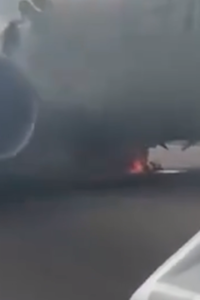
Somewhere within the right engine, fuel had begun to leak—unseen, unnoticed by those inside the cabin. According to early findings, the leak was caused by a maintenance issue, a small but critical error that allowed fuel to pool where it should not have been. And as the aircraft continued to taxi, that fuel ignited.
At first, the signs were subtle.
A faint smell.
A thin trace of smoke.
But within seconds, the situation escalated.
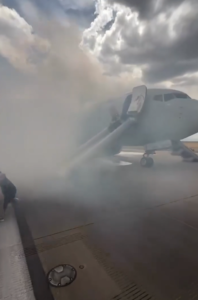
Smoke began seeping into the cabin, curling through the air, thickening with each passing moment. Passengers looked around, confused at first, trying to understand what they were seeing. Then someone shouted.
“Fire!”
The word spread instantly.
Panic followed.
Inside the aircraft, the atmosphere changed completely. What had been a calm, controlled environment just moments earlier became chaotic. People stood up, voices rising, some shouting, others frozen in place. The smoke grew denser, making it harder to see, harder to breathe.
In the cockpit, the pilots recognized the severity immediately.
This was no longer a routine situation.
This was an emergency.
A “Mayday” call was transmitted—clear, urgent, unmistakable. Ground crews were alerted. Emergency responders began mobilizing. But inside the aircraft, the passengers were already facing the reality of the situation unfolding around them.
The crew acted quickly.
Commands were shouted.
“Evacuate! Evacuate!”
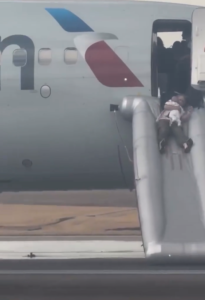
Emergency slides were deployed.
Or at least, most of them.
As doors opened and the evacuation began, one of the slides—the L2 slide—failed to deploy properly. It jammed in the doorway, blocking one of the primary exits. In an already chaotic situation, this created a bottleneck, forcing passengers to redirect toward other exits.
The pressure intensified.
People moved faster, urgency replacing hesitation. Some passengers climbed over seats, others pushed toward the nearest available door. Outside, the air was filled with smoke and the sharp scent of jet fuel, adding to the confusion and fear.
Those who reached the working slides were met with another challenge—the steep drop to the ground, the wind, the uncertainty of what awaited them below. Still, they went, one after another, sliding down into the hazy air, guided by instinct and the commands of the crew.
Others had no choice but to take a different route.
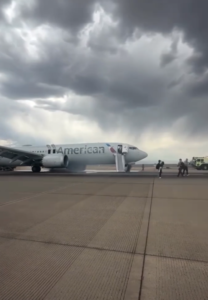
Because of where the smoke was concentrated, several exits became difficult to use. Passengers were directed onto the wings, climbing out of the aircraft and standing on the narrow surfaces, waiting for assistance. It was a surreal image—people lined up along the wings of a plane, surrounded by smoke, unsure of what would happen next.
Inside the cabin, the last remaining passengers moved as quickly as they could. The smoke continued to spread, reducing visibility, increasing urgency. Every second mattered.
Despite the chaos, something remarkable happened.
Everyone got out.
There were injuries—scrapes, bruises, the result of the frantic evacuation—but no lives were lost. Emergency responders arrived quickly, assisting those on the ground, helping passengers off the wings, ensuring that everyone was accounted for.
For many, it didn’t feel real.
One moment, they had been preparing to step off a plane.
The next, they were running for safety, surrounded by smoke and confusion.
In the immediate aftermath of the evacuation, the scene on the tarmac was a mixture of relief, confusion, and disbelief. Passengers who had just moments earlier been inside the aircraft now stood scattered across the concrete—some near emergency vehicles, others wrapped in blankets, many still trying to process what had just happened. The air carried a lingering smell of smoke and fuel, a sharp reminder of how quickly the situation had escalated. For a brief window of time, the focus was singular: ensure that everyone was safe, accounted for, and out of harm’s way.
Emergency responders moved with urgency but control. Fire crews positioned themselves around the aircraft, working to contain and extinguish the fire risk. Medical teams assessed passengers one by one, checking for injuries, assisting those who had fallen or been affected during the evacuation. While the number of injuries remained relatively low given the scale of the incident, the emotional impact was evident. Some passengers sat quietly, staring at the ground, while others spoke rapidly, recounting their experiences to anyone who would listen—each trying to make sense of the same sequence of events in their own way.
For many, the realization came in waves. At first, there was only the instinct to escape. Then came the recognition of what had happened. And finally, the understanding of what could have happened.
Inside the aircraft, the situation had unfolded in a matter of minutes. Outside, it would take much longer to fully comprehend.
As the area was secured and the immediate danger addressed, attention turned toward understanding the cause. Investigators from multiple agencies began their work, treating the aircraft and surrounding environment as a critical source of information. Every detail mattered—every component, every system, every record related to the flight. In aviation, incidents are not viewed in isolation; they are examined as part of a larger framework designed to identify not just what went wrong, but why.
The aircraft itself, a Boeing 737-800, became the focal point of this analysis. Investigators carefully inspected the engine involved, tracing the path of the fuel leak, examining the components that had allowed it to occur. Their findings would eventually point to a maintenance-related issue—specifically, a fuel fitting that had not been properly secured. It was a detail that, under normal circumstances, would have been checked, verified, and confirmed as part of routine procedures. But in this case, something had been missed.
This discovery shifted the narrative in a significant way.
What had initially appeared as an in-flight mechanical concern—the vibrations reported by the pilots—was now understood as the early warning sign of a deeper issue. The crew’s decision to divert the flight to Denver International Airport was not only appropriate but critical. It ensured that the aircraft was on the ground before the situation escalated further. Had the leak ignited while still in the air, the outcome could have been dramatically different.
This realization brought a renewed focus on the role of decision-making in aviation safety. The pilots’ response to the initial vibrations, their communication with air traffic control, and their execution of the diversion all became key elements in understanding how the situation was managed. These actions, guided by training and experience, played a significant role in preventing a far more serious outcome.
At the same time, the incident highlighted the importance of maintenance protocols and oversight. Aviation systems are designed with multiple layers of redundancy and verification, precisely to prevent issues like this from occurring. When those systems function as intended, they create a level of safety that allows millions of flights to operate without incident. But when a breakdown occurs—even a small one—it can expose vulnerabilities that must be addressed.
In the days following the incident, attention extended beyond the technical findings to the human experience of those involved. Passengers began sharing their stories, offering personal accounts of what it felt like to be inside the aircraft during those critical moments. Some described the initial confusion—the uncertainty about what the smell meant, whether it was serious, whether they should be concerned. Others spoke about the rapid escalation—the moment when confusion turned into urgency, when the realization of danger became undeniable.
The evacuation itself became a central theme in these accounts.
For those seated near functioning exits, the process was direct but intense. Instructions were shouted, movements were quick, and decisions had to be made without hesitation. Sliding down an evacuation chute is not something most people ever expect to do, and in that moment, it became a necessity rather than an option.
For others, the experience was different.
The malfunction of the L2 slide introduced an unexpected complication, forcing passengers to redirect and find alternative exits. This created moments of congestion, where individuals had to navigate through crowded aisles, moving toward whatever path was available. The presence of smoke added to the difficulty, reducing visibility and increasing the sense of urgency.
Those who exited onto the wings described a unique kind of uncertainty. Standing outside the aircraft, elevated above the ground, surrounded by smoke and emergency activity, they were in a position that felt both safe and exposed. They had escaped the cabin, but the situation was not yet fully resolved. They waited, watching responders approach, aware that the next step depended on coordination beyond their control.
Despite these challenges, the outcome remained remarkably positive.
All passengers and crew were evacuated successfully.
Injuries, while present, were limited to minor cases—bruises, scrapes, and the physical effects of a rapid evacuation. For an incident of this scale, the absence of severe harm was a testament to the effectiveness of the response.
As the investigation continued, the broader implications of the incident became clearer. It was not just about one flight, one aircraft, or one moment in time. It was about the systems that support aviation safety as a whole. Each finding contributed to a larger understanding, one that would inform future practices, improve procedures, and reduce the likelihood of similar events.
Regulatory bodies and airline operators began reviewing protocols, examining maintenance procedures, and ensuring that checks and balances were functioning as intended. These reviews are a standard part of the process, but in cases like this, they carry added urgency. The goal is not only to address the specific issue identified, but to strengthen the system overall.
For the passengers, however, the experience remained deeply personal.
Returning home, resuming daily routines, and reconnecting with normal life did not erase the memory of what had happened. For some, the incident became a story of survival—a moment where quick thinking and coordinated action made all the difference. For others, it served as a reminder of how quickly circumstances can change, even in environments designed to be as safe as possible.
There is a unique quality to near-miss events.
They do not result in the outcomes that define tragedies, but they reveal how close those outcomes can be. They provide a glimpse into what might have been, creating a sense of awareness that lingers long after the event itself.
Flight 1006 became one of those moments.
Not because of loss, but because of what was avoided.
The sequence of events—from the initial vibrations to the diversion, from the landing to the fire, from the evacuation to the investigation—formed a narrative that highlighted both risk and resilience. It showed how systems can be tested, how individuals respond under pressure, and how outcomes are shaped by a combination of preparation, decision-making, and circumstance.
For the aviation industry, it reinforced the importance of constant vigilance.
For the public, it offered a rare glimpse into the realities of air travel—beyond the routine, beyond the expectation of smooth journeys, into the moments where safety is actively maintained through action and response.
And for those who were there, it became something else entirely.
A memory.
A moment suspended in time, where everything changed, and then—just as quickly—everything was brought back under control.
Because sometimes, the most powerful stories are not about what happened.
They are about what almost did.