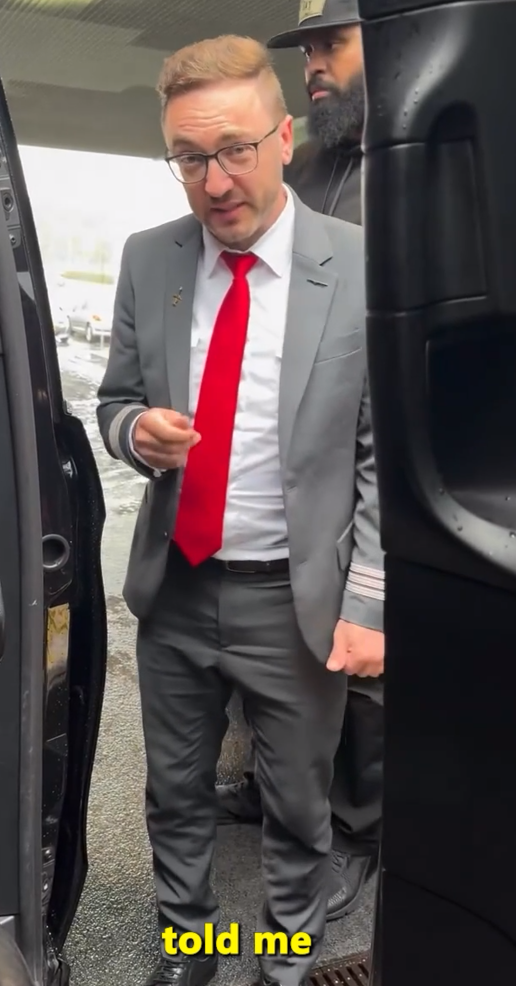
On May 25, 2024, a moment that began quietly at an airport in Amsterdam quickly transformed into one of the most widely discussed celebrity incidents of the year. Nicki Minaj, known for her commanding stage presence and global influence, was in the middle of a tightly scheduled international tour. Every movement, every departure, every arrival was carefully timed. There was little room for delay, and even less for uncertainty. Yet on that particular day, everything slowed down.
At Schiphol Airport, the weather matched the mood that would soon unfold. Rain fell steadily, coating the tarmac in a reflective sheen and muting the surroundings into shades of grey. The private terminal area—usually a space defined by efficiency and discretion—felt unusually still. Parked near the aircraft was a black luxury vehicle, its door open, as if frozen mid-transition between departure and delay.
Inside that vehicle sat Nicki Minaj.
She was not simply waiting—she was watching, processing, and questioning. The tone of the situation shifted the moment she realized that something was not proceeding as expected. Instead of boarding her private flight and continuing toward her next performance, she was being told to wait. And not by uniformed officers, but by someone she did not expect to be delivering such news.
Standing at the doorway was a man in a grey suit, red tie, and glasses. Calm, composed, but clearly caught in an uncomfortable position. At the time, many viewers assumed he was an airport authority figure. In reality, he was the pilot of her private chartered jet—relaying information from officials rather than acting on his own authority.
That detail alone added to the confusion.
Why was the pilot delivering this message?
Why weren’t the authorities speaking to her directly?
Why was her luggage—already loaded onto the aircraft—now being removed?
These questions, asked in real time, became the backbone of the viral moment. Nicki didn’t wait for explanations to come later. She documented everything as it happened, holding her phone steady, capturing the interaction, and in some moments, streaming it live. It was unfiltered, immediate, and impossible to ignore.
The pilot explained that authorities wanted to “offload all the luggage and search everything.” His tone remained measured, almost apologetic, as if aware that he was standing between a global artist and a situation he could not fully control. Behind him stood a member of Nicki’s security team, quiet but alert, observing the interaction without intervening.
Inside the vehicle, the tension was unmistakable.
Nicki’s voice carried frustration—not explosive, but focused. She questioned the logic of the situation, the timing, and the process itself. Her concern wasn’t just about the search—it was about the implications. Delays at that moment didn’t just mean inconvenience. They meant missed commitments, disrupted plans, and thousands of fans waiting for her arrival at the next destination.
And beyond that, there was something else.
A feeling of being watched.
Through the rain-streaked windows, figures moved in the distance—airport personnel, officials, people who seemed to be part of a process she was not fully included in. It created a sense of distance between her and the situation, as if decisions were being made around her rather than with her.
The more the moment unfolded, the clearer it became that this was not a routine delay.
Something bigger was happening.
And she was documenting all of it.
That decision—to film, to question, to share—turned what could have been a quiet incident into a global conversation. It wasn’t just about what was happening, but how it was being seen. For the first time, millions of people were witnessing a situation like this not through headlines or edited clips, but directly from the perspective of the person at the center of it.
As the interaction continued, the situation shifted from confusion to confrontation—not in an aggressive sense, but in the way that questions became sharper, more direct, and more urgent. The explanation given—that authorities wanted to search the luggage—did not fully resolve the concerns being raised. Instead, it opened the door to more questions.
Why now?
Why after the luggage had already been loaded?
Why was this being handled in this way?
From Nicki’s perspective, the timing felt significant. She was on a strict schedule, traveling as part of a major international tour. Delays weren’t just logistical—they were financial, professional, and deeply connected to the expectations of her audience. Every hour mattered, and every unexpected interruption carried consequences.
Authorities, later identified as the Royal Netherlands Marechaussee, were conducting what they described as a “random check.” According to their account, substances were found in her luggage that led to further inspection. The situation, from their perspective, followed established procedures.
But from Nicki’s perspective, it felt different.
In the video, she repeatedly questioned the process. She pointed out that the items in question did not belong to her directly, suggesting that they were connected to her team. This distinction became central to the unfolding narrative—who was responsible, and why she was being held in that moment.
At the same time, another layer of tension began to emerge.
The act of filming.
The pilot mentioned that authorities had become more suspicious because she was recording the interaction. This detail added a new dimension to the situation. What began as documentation now seemed to influence how the situation was being handled. It created a feedback loop—where filming led to more scrutiny, and more scrutiny led to further delay.
For Nicki, this only intensified the frustration.
She wasn’t just dealing with a search—she was dealing with a process that felt increasingly unpredictable. And as minutes turned into longer delays, the impact became more tangible. Her next destination wasn’t just another stop—it was a major performance, one that thousands of fans were already anticipating.
Behind the scenes, time was slipping.
The distance between Amsterdam and her next show location wasn’t just geographic—it was logistical. Flights, transfers, preparations—all of it depended on timing. And now, that timing was being disrupted.
This is where the situation took on a broader narrative.
Nicki began to express concerns that went beyond the immediate moment. She suggested that the delay might not be entirely coincidental. Through her social media, she introduced the idea that this could be intentional—a “sabotage” attempt designed to disrupt her tour and create financial loss.
Whether or not that claim could be proven, it added a powerful dimension to the story.
It shifted the conversation from procedure to possibility.
From routine check to potential interference.
And because the entire situation was being documented in real time, those ideas spread quickly. Fans, observers, and media outlets began discussing not just what was happening, but why it might be happening.
Inside the vehicle, however, the reality remained immediate.
She was still waiting.
Still questioning.
Still being delayed.
The rain continued outside, the pilot remained in position, and the sense of uncertainty persisted. It was a moment where time felt stretched—where each minute carried more weight than usual.
Eventually, the situation escalated further.
Nicki was taken into custody for questioning, transported to a police station, and held for several hours. The process moved from the airport to a more formal legal setting, where the situation could be addressed within official procedures.
For her, it marked a shift from delay to detention.
For the public, it marked a turning point in the story.
What had started as a confusing airport interaction had now become a legal matter, with real consequences and real implications for her schedule, her tour, and her public image.
When the immediate tension at the airport finally eased and Nicki Minaj was released from custody, the situation did not simply end—it transitioned. What had begun as a confusing delay at Schiphol Airport quickly evolved into a broader story with consequences stretching far beyond the tarmac. In many ways, the most significant chapter of the incident began after the cameras stopped rolling and the official procedures concluded.
The first realization was practical, immediate, and unavoidable: time had been lost.
In the context of a global tour, time is not flexible. Every hour is scheduled, every movement accounted for, and every delay has a domino effect. Flights are arranged to align with rehearsals, sound checks, venue preparations, and audience expectations. When one part of that chain is disrupted, the impact travels quickly through everything connected to it.
That is exactly what happened here.
The delay in Amsterdam extended long enough to interfere with her next performance, one of the most anticipated stops on her Pink Friday 2 World Tour. At the Co-op Live Arena in Manchester, thousands of fans had already arrived. The energy inside the venue was building, the anticipation growing with every passing minute. For many, this was not just another concert—it was an experience they had planned for, traveled for, and looked forward to for weeks or even months.
But as time passed, the reality began to settle in.
Something was wrong.
Behind the scenes, organizers faced a difficult decision. The delay was no longer manageable within the existing schedule. The show could not proceed as planned. Eventually, the announcement was made: the performance would be postponed.
For fans, the reaction was immediate and emotional. Confusion turned into disappointment, and for some, frustration. Social media filled with reactions—some expressing understanding, others demanding explanations. In moments like this, the gap between expectation and reality feels especially sharp. People had come prepared for a night of music and celebration, and instead found themselves navigating uncertainty.
For Nicki, the weight of that decision was significant.
This was not just about a missed performance—it was about the relationship with her audience. Artists on a global tour operate within a delicate balance of logistics and connection. Every show represents not only a professional commitment but also a personal one. Missing a performance, even under circumstances beyond control, carries emotional weight.
And yet, at the same time, the situation itself was still unfolding.
Authorities had completed their process, confirming that the matter involved what they described as a regulatory issue related to items found in her luggage. A fine was issued, and she was released after several hours. From a legal standpoint, the situation reached a resolution relatively quickly.
But the public narrative was only just beginning.
Because unlike many incidents that are reported after the fact, this one had been documented in real time. The footage she recorded—capturing her perspective, her questions, and her reactions—had already spread across platforms. Millions of people had seen the moment as it happened, forming impressions and opinions before official statements could even be issued.
This created a unique dynamic.
The story was not controlled by traditional reporting alone. It was shaped by direct observation, by interpretation, and by the ongoing conversation that followed. People were not just reading about what happened—they felt as though they had witnessed it themselves.
This immediacy changed the tone of the discussion.
Some viewers focused on the procedural aspects, examining how the situation was handled and whether it aligned with standard practices. Others were drawn to the emotional dimension—the frustration in her voice, the tension in the interaction, the sense of uncertainty that defined the moment.
And then there was another layer.
The idea of intention.
Through her own statements, Nicki suggested that the delay might not have been random. She introduced the possibility that the situation could have been influenced by external factors—what she described as a form of sabotage aimed at disrupting her schedule. While such claims are difficult to verify, they added a powerful narrative element, one that resonated with her audience and fueled further discussion.
This is where the story expanded beyond a single incident.
It became a conversation about control—who has it, who loses it, and how quickly it can shift. In a world where global travel, large-scale events, and public visibility intersect, situations like this highlight the complexity of managing both logistics and perception.
For industry observers, the incident raised important questions about the relationship between artists and the systems they navigate. Touring at an international level involves coordination across multiple countries, each with its own regulations, procedures, and expectations. While these systems are designed to function smoothly, moments like this reveal how quickly they can become complicated.
At the same time, the role of social media in shaping the narrative cannot be ignored.
The fact that Nicki documented the encounter herself marked a shift in how such events are shared. Traditionally, situations involving authorities are filtered through official statements or third-party reporting. Here, the primary perspective came directly from the individual involved, presented without editing or delay.
This approach has both strengths and challenges.
On one hand, it provides authenticity—a direct look at the moment as it unfolds. On the other, it invites interpretation, where viewers must piece together context from limited information. In this case, both elements were present, contributing to a story that felt immediate but also open to multiple perspectives.
As the days passed, the conversation began to stabilize.
More information became available. Official statements clarified aspects of the situation. The immediate tension gave way to analysis, where the focus shifted from what happened to what it meant.
For fans, the priority became clear: rescheduling, reassurance, and the eventual continuation of the tour. While disappointment remained, it was gradually replaced by understanding. Many recognized that the situation was not a simple cancellation, but the result of circumstances beyond direct control.
For Nicki, the focus returned to moving forward.
Resuming the tour, reconnecting with her audience, and maintaining the momentum of a global project that had been temporarily disrupted. In the world of live performance, resilience is essential. Delays, challenges, and unexpected events are part of the landscape, and the ability to adapt defines long-term success.
At a broader level, the incident serves as a case study in how quickly a moment can expand into something larger.
A delay at an airport becomes a viral video.
A viral video becomes a global discussion.
A global discussion influences perception, narrative, and memory.
What stands out most is not just the event itself, but the layers surrounding it—the logistical impact, the emotional response, the public interpretation, and the ongoing conversation. Each layer adds depth, transforming a single moment into a story that continues to evolve.
In the end, the situation in Amsterdam is remembered not just for what happened, but for how it was experienced.
From inside a vehicle on a rainy afternoon.
From the perspective of someone documenting their own reality.
From the viewpoint of millions watching in real time.
It is a reminder that in today’s world, moments do not remain isolated.
They expand.
They connect.
They resonate.
And sometimes, they become something far bigger than anyone could have anticipated when they first began.
As the weeks went on, another dimension of the incident became clearer—its lasting effect on how moments like this are perceived, both by the public and by those living inside them. What initially felt like a disruption tied to a single day began to take on a broader significance. It became part of a larger conversation about visibility, control, and how quickly narratives can form when information is shared instantly.
For many observers, one of the most striking aspects was not just what happened, but how it was revealed. The decision by Nicki Minaj to document the interaction herself shifted the usual balance between subject and storyteller. Instead of waiting for official accounts or edited reports, people were witnessing the moment through her lens—hearing her voice, seeing her reactions, and experiencing the tension in real time. This created a sense of immediacy that traditional reporting rarely captures.
That immediacy, however, also introduced complexity. Viewers were forming opinions based on a live moment, without the full context that often comes later. Some supported her perspective fully, emphasizing the frustration of being delayed under unclear circumstances. Others focused on the procedural side, noting that authorities were acting within their legal framework. The divide in reactions highlighted how the same moment can be interpreted in multiple ways, depending on what each viewer prioritizes—emotion, structure, or outcome.
For public figures, this dynamic presents a unique challenge. Every action, every word, every decision can be amplified instantly. There is little space to process events privately before they become public discourse. In this case, the situation unfolded in front of millions, creating a level of exposure that added pressure to an already tense moment. The experience serves as a reminder that visibility, while powerful, also comes with its own set of complications.
At the same time, the incident underscored the importance of communication during unexpected situations. Delays, inspections, and procedural checks are not uncommon in international travel, especially at high-security locations like Schiphol Airport. What often determines how these moments are perceived is not just what happens, but how clearly it is explained. When information feels incomplete or delayed, frustration can grow quickly, particularly when time-sensitive commitments are involved.
For the wider entertainment industry, the situation also highlighted how tightly coordinated global tours truly are. Events like the Pink Friday 2 World Tour operate on precision. Travel schedules, venue bookings, staffing, production setups—all of it depends on timing. A disruption in one location can ripple outward, affecting multiple teams and thousands of attendees. This level of coordination means that even a short delay can have significant consequences, making situations like this especially impactful.
Despite the disruption, there is also a sense of continuity that emerges in the aftermath. Tours continue, performances resume, and the rhythm of the schedule eventually stabilizes. What remains, however, is the memory of the interruption—the moment where everything paused, where uncertainty replaced routine, and where a simple departure turned into something far more complex.
In that sense, the incident becomes more than just a headline. It becomes a reference point—a moment that people return to when discussing how quickly circumstances can change, how narratives are formed, and how public figures navigate situations that unfold beyond their control. It reflects not only the unpredictability of travel and logistics, but also the evolving nature of how stories are told in real time.
And perhaps most importantly, it shows that even in a world built on planning and precision, there are moments that cannot be anticipated—only experienced, processed, and eventually understood through the perspective they leave behind.