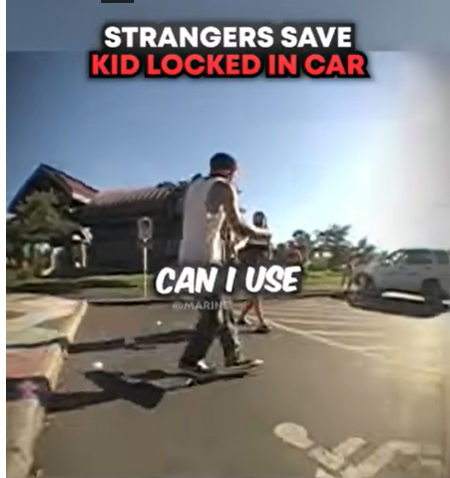
A dramatic parking lot rescue unfolded after a group of strangers came together to save two children who were trapped inside a locked vehicle. What began as a moment of panic quickly turned into a desperate effort involving bystanders, skateboarders, a 911 call, and eventually a heavy metal parking pole used to break the car window.
The video begins with a woman rushing toward a group of skateboarders in visible distress. She appears frantic as she explains that two children are locked inside a car and need help immediately. In that moment, there is no time for hesitation or long discussion. The woman asks to use one of the skateboards to break the window, hoping it will be enough to get inside the vehicle and free the children.
The skateboarders quickly respond. Instead of standing back or waiting for someone else to act, they move toward the car and begin trying to break the window. One of them repeatedly swings a skateboard against the glass, using as much force as possible. Another bystander appears to focus on calling 911, making sure emergency services are being alerted while others work to get the children out.
The first attempts, however, do not succeed. The skateboard strikes the window again and again, but the glass does not break. Car windows are designed to be strong, and even though the bystanders are using force, the skateboard is not enough. The situation becomes more tense with every failed hit because everyone understands that the children are still trapped inside.
The group does not give up. More attempts are made, with the skateboarders continuing to slam their boards against the window. The sound of repeated impacts adds to the urgency of the moment. The bystanders are not acting for attention or drama; they are trying to solve a frightening problem as quickly as possible with whatever they have available.
As the skateboards continue failing to break the glass, a shirtless man steps forward and changes the course of the rescue. Realizing that a stronger tool is needed, he grabs a heavy metal parking pole. The pole gives him more weight and force than the skateboards, and he begins striking the passenger-side window with it.
The first blows still do not immediately shatter the glass, but the man keeps going. He lifts the pole and slams it into the window multiple times. The effort is physical, forceful, and urgent. The people nearby watch and wait, hoping the glass will finally give way. After several strikes, the window breaks.
Once the glass shatters, the rescue moves quickly. A bystander reaches through the broken window, unlocks the door, and opens it. The children are finally freed from the locked vehicle. The moment brings relief after a tense and stressful effort by everyone involved.
The video stands out because it shows strangers acting together in an emergency. The woman who first raised the alarm did not try to handle the situation alone. She ran to nearby people and asked for help. The skateboarders did not ignore her. They immediately offered what they had and tried to use their boards to break the window. Another person called 911. Then, when those attempts failed, the shirtless man stepped in with a heavier object and managed to break through.
The rescue is a strong example of bystander action. In emergencies, people sometimes freeze, unsure of what to do or afraid of getting involved. In this case, the opposite happened. Several people reacted quickly, each doing something useful. Some used physical force to try to open the car. One person contacted emergency services. Others stayed close, watching for the moment they could help unlock the door.
The situation also shows how difficult it can be to break a car window without the right tool. Many people may assume that a hard object like a skateboard will easily break glass, but car windows can be surprisingly resistant. The skateboarders put real effort into their attempts, but the windows held up. It took a much heavier metal pole and repeated strikes before the glass finally shattered.
That difficulty likely made the rescue feel even more urgent. Every failed attempt meant more time passing while the children remained inside. In a locked vehicle, especially in warm conditions, bystanders may worry about heat, fear, and the inability of children to get out on their own. Even without knowing the exact temperature or how long the children had been inside, the people in the video clearly treated it as an emergency.
The woman’s panic at the beginning suggests that she understood the seriousness of the situation. Her first instinct was to find something strong enough to break the window. She did not calmly walk over or ask casually for help. She rushed to the skateboarders because they were nearby and had objects that might work. That urgency set the tone for the entire rescue.
The skateboarders’ response is also important. They could have hesitated, worried about damaging the car, or waited for police or firefighters to arrive. Instead, they recognized that there were children inside and acted. Their boards did not succeed, but their willingness to try helped keep the rescue moving. Their first attempts showed others that action was needed immediately.
The man with the metal pole eventually provided the breakthrough, but the rescue was not the work of one person alone. It was a group effort. The woman sounded the alarm. The skateboarders attempted the first break-in. The caller contacted 911. The shirtless man used the pole. Another bystander unlocked and opened the door. Each action mattered because each step brought the children closer to safety.
Moments like this can be chaotic because there is no perfect plan. People have to make fast decisions using whatever is around them. A skateboard becomes a tool. A parking pole becomes a way to break glass. A stranger becomes the person calling for help. In a crisis, ordinary objects and ordinary people can suddenly become part of a rescue.
The video also raises questions about how the children became locked inside in the first place. The summary does not explain whether it was an accident, whether the keys were lost, or whether the children had been left there. Whatever the cause, the bystanders’ focus was not on blame in that moment. Their priority was getting the children out.
That focus is one of the most powerful parts of the story. Instead of arguing about what happened or who was responsible, the group moved directly into action. The details could be sorted out later. In the moment, the only thing that mattered was opening the car.
The sound and movement of the rescue likely made the scene frightening for everyone nearby. A group of people smashing a car window in a parking lot is an intense sight. But the urgency of the situation made the damage necessary. When children are trapped inside and cannot open the door, breaking a window may become the fastest available option.
The bystander who called 911 played a crucial role as well. While physical action was happening at the car, emergency services still needed to be notified. Calling 911 helps bring trained responders to the scene and creates a record of what is happening. It also helps protect the bystanders by showing that their actions were connected to an emergency, not random damage.
The person who reached inside after the glass broke also had to act carefully. Once the window shattered, there may have been broken glass around the frame and inside the vehicle. Still, the bystander managed to reach in, unlock the door, and open it. That final step transformed the effort from breaking into the car to actually rescuing the children.
The relief after the door opens is easy to imagine. After repeated failed attempts, a stronger tool, and the sound of glass breaking, the children were finally accessible. For the people watching and helping, that moment would have brought a sudden release of tension. The goal had been clear from the beginning: get the children out. Once the door opened, that goal was finally achieved.
The incident is also a reminder that emergencies can happen in ordinary places. A parking lot is usually a routine setting where people shop, walk, skate, park, and go about their day. But in a matter of seconds, it became the scene of a rescue. People who may not have known each other were suddenly working together toward the same urgent purpose.
For the skateboarders, the moment likely began as a normal day. They may have been practicing tricks, hanging out, or simply standing nearby. Then a distressed woman approached them, and they were pulled into a serious situation. Their willingness to help shows how quickly people can step up when someone clearly needs assistance.
For the shirtless man, the decision to grab the metal pole showed quick thinking. He recognized that the current method was not working and looked for something stronger. That shift from one tool to another made the difference. Without the pole, the group may have had to wait longer for emergency responders to arrive, unless someone found another way to break the glass.
The video also highlights how strong modern vehicle glass can be. The skateboarders’ failed attempts may surprise viewers, but car windows are designed to resist impact. They are not impossible to break, but they often require the right kind of force or tool. That is why the metal pole worked where the skateboards failed. It offered a harder, heavier, more concentrated impact.
At the same time, the repeated attempts show determination. The group did not stop after one failed hit. They kept trying. When one method failed, another person tried a different method. That persistence is often what makes the difference in emergencies. Panic alone does not solve the problem, but action combined with persistence can.
The situation also shows the emotional pressure of trying to help children in danger. Adults often react strongly when children are involved because children may not be able to understand the situation fully or help themselves. The urgency becomes more intense because every second feels important. That emotional pressure likely pushed the bystanders to act faster and with more determination.
The woman who first asked for help may have felt helpless before finding the skateboarders. A locked car can feel impossible to open without keys, and waiting for help can feel too slow when children are inside. By asking nearby strangers for assistance, she turned her panic into action. That decision may have saved precious time.
The rescue also demonstrates how communities are sometimes formed in moments of crisis. These people may not have known one another, but for a brief time, they became a team. There was no formal leader, no prepared equipment, and no planned strategy. But there was a shared understanding that the children needed help immediately.
The man with the pole did not act alone in the broader sense. His action was made possible by the group’s urgency and the awareness created by the woman. The bystander calling 911 helped ensure official help was on the way. The skateboarders’ attempts kept pressure on the situation and showed that waiting was not enough. The person unlocking the door completed the rescue. It was a chain of actions, and each link mattered.