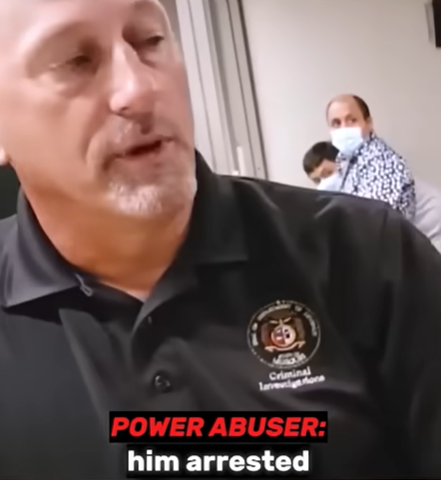
A tense confrontation inside an IRS office unfolded after a citizen filming an interaction became involved in a dispute with an agency official over personal space, physical contact, and whether a brief touch amounted to assault. What began as a disagreement about distance quickly escalated into a legal argument, with the official saying he intended to press charges and the cameraman insisting that his recording would show he acted only to protect his personal space.
The video centers on a moment where the IRS official appears to stand extremely close to the person filming. The cameraman repeatedly objects to how near the official is, explaining that he feels backed into a corner and that the official is only inches away from his face. His concern is not only that the official is close, but that the closeness feels unnecessary and intimidating. Because he is holding the camera and documenting the interaction, he appears to believe the official is using his physical presence to pressure him.
As the official remains close, the cameraman tells him to step back. The request is direct and repeated, but the situation does not immediately calm down. The cameraman says he has no room to move and that the official is crowding him. From his point of view, the official’s position leaves him with little choice. He believes his personal space has been invaded, and he wants the official to create distance.
The confrontation intensifies when the cameraman places his hand on the official’s chest. According to the cameraman, the action is meant to stop the official from coming any closer. He does not appear to describe it as an attack, but as a physical barrier. In his view, he is not trying to harm the official; he is trying to prevent the official from advancing into his space.
The IRS official sees the situation very differently. After being touched, he claims that the physical contact amounts to assault. He says there are witnesses present and indicates that he wants to press charges. The official’s reaction shifts the disagreement from a personal-space argument into a possible legal matter. What had been a tense verbal exchange now becomes a dispute over whether the cameraman crossed a line by putting his hand on the official.
The cameraman strongly disagrees with that interpretation. He argues that the official was the one who created the problem by standing too close. He maintains that he was cornered and that the official was inches from his face. From his perspective, placing a hand on the official’s chest was not an aggressive act but a response to being crowded. He believes the video recording will support his version of events and show that he acted defensively rather than violently.
A police officer eventually becomes involved and speaks to the cameraman about the physical contact. The officer advises him that he is not permitted to touch the official. This becomes another important part of the dispute. The officer’s position appears to be that regardless of the cameraman’s frustration, placing hands on another person can create legal problems. The cameraman, however, continues to argue that context matters and that the official’s behavior should also be considered.
The central issue in the video is the boundary between personal space and physical contact. The cameraman believes the official violated his personal space first. The official believes the cameraman escalated the situation by touching him. Both sides focus on different parts of the same moment. One side emphasizes the closeness and pressure. The other emphasizes the physical touch.
That difference is what makes the confrontation complicated. Many people understand the instinct to create distance when someone is standing too close, especially if they feel trapped or cornered. At the same time, touching another person during a heated exchange can quickly be interpreted as aggressive, even if the touch is brief or meant only to create space. The video captures that difficult gray area where emotions, body language, and legal concerns collide.
The cameraman’s recording plays a major role in the confrontation because he repeatedly refers to it as evidence. He appears confident that the footage will show the official standing too close and refusing to back away. For someone filming an encounter with a government official, the camera can serve as protection. It creates a record of what was said and done, especially when both sides later describe the situation differently.
The IRS official, however, also points to witnesses. By mentioning that others saw the contact, he seems to suggest that the cameraman’s recording is not the only evidence. In his view, the witnesses can confirm that the cameraman placed his hand on him. This creates a competing evidence issue: the cameraman believes the video shows why he acted, while the official believes witnesses can confirm that physical contact happened.
The responding officer’s involvement adds another layer. Police arriving at a tense scene often have to separate immediate emotions from legal questions. The officer appears to focus on the basic rule that the cameraman should not put hands on the official. That advice does not necessarily resolve the entire dispute, because the cameraman still insists that he was being crowded. But it does show how quickly physical contact can become the focus of a police response.
For the cameraman, the officer’s warning may have felt one-sided. He likely wanted the officer to acknowledge that the official’s closeness was also a problem. If someone is backed into a corner and another person keeps moving into their space, they may feel they are being intimidated. The cameraman’s frustration seems to come from the belief that his concern about personal space was not being taken seriously enough.
For the official, the contact may have felt like an unacceptable escalation. Government offices can be tense places, especially when people are frustrated, filming, or challenging employees. From the official’s perspective, once the cameraman touched him, the issue became about safety and control inside the office. He may have felt that allowing physical contact to go unchallenged could encourage further escalation.
The video also raises questions about how officials should behave when they are being filmed. Some public employees may feel uncomfortable or irritated when a citizen records them, but discomfort alone does not resolve the issue. If an official responds by standing extremely close, it can appear confrontational, especially if the person filming says they feel trapped. Maintaining distance can help prevent exactly the kind of dispute seen in the video.
At the same time, citizens filming public interactions also have to manage their behavior carefully. Even if they believe they are being treated unfairly, physical contact can weaken their position and create a new issue. A person may start out documenting what they believe is official misconduct, but if they touch someone during the encounter, the focus can shift away from the official’s behavior and onto the citizen’s actions.
That appears to be what happened here. The cameraman wants the attention to remain on the official’s closeness. The official wants the attention to move to the cameraman’s hand on his chest. The officer seems to respond most directly to the physical contact. As a result, the original complaint about personal space becomes tangled with a new accusation of assault.
The word “assault” carries serious weight, and its use immediately changes the tone of the confrontation. To the official, the touch may have been enough to justify that claim. To the cameraman, the word may have felt exaggerated, especially if he believed he was only stopping the official from crowding him. This disagreement shows how differently the same action can be interpreted depending on who is describing it.
The cameraman’s repeated statement that he was backed into a corner is important because it explains why he believes his action was necessary. Being cornered can make a person feel vulnerable, even if no strike or direct threat has occurred. When someone stands only inches away, the person being crowded may feel they cannot safely move or breathe without contact. That feeling can trigger a defensive response.
The official’s position, however, is that feeling uncomfortable does not give someone permission to touch him. That is likely why he emphasizes witnesses and his intention to press charges. He wants the physical contact to be treated as the key event, not as a minor detail. In his view, the cameraman crossed from verbal objection into physical action.
The confrontation shows how quickly a tense encounter can escalate when neither side creates distance. If the official had stepped back after the first objection, the situation may have cooled down. If the cameraman had kept his hands to himself and continued verbally objecting, the official may have had a harder time claiming assault. Instead, both sides became locked into a moment where each believed the other was responsible for escalating the conflict.
The office setting also matters. An IRS office is not a casual public space; it is a government environment where people may already feel stressed. Citizens may be dealing with financial issues, paperwork, taxes, penalties, or disputes. Officials may be used to frustrated visitors. That kind of atmosphere can make confrontations more likely, especially when someone begins recording.
Recording government employees can be controversial in practice, even when a person believes they have the right to document an interaction. Some officials may see filming as disruptive. Some citizens see it as necessary accountability. When those two attitudes meet, the interaction can become tense before anyone even discusses the actual issue that brought the person into the office.
In this case, the filming appears to be central to the official’s behavior and the cameraman’s concerns. The official is aware he is being recorded, and the cameraman repeatedly refers to the video as proof. The camera is not just observing the confrontation; it becomes part of the confrontation. It affects how both sides speak and act.
The presence of witnesses also increases the pressure. The official says there are people present who saw what happened. The cameraman seems to believe the recording will be more important than witness statements because it captures the full context. This difference matters because witnesses may remember the hand on the chest, while video may show how close the official was standing before the touch occurred.
The police officer’s response may be seen by some viewers as practical. From a law enforcement perspective, the simplest instruction is often to avoid touching anyone, especially during an argument. That advice reduces the chance of further escalation. The officer may not be trying to decide every detail of who was right or wrong in the moment, but rather trying to stop the situation from becoming physical again.
Still, the cameraman’s argument is that personal space is also a safety issue. If someone is close enough to make another person feel trapped, telling only the trapped person not to touch may feel incomplete. A more balanced response might involve separating both parties and making sure there is enough distance. The video summary suggests the cameraman wanted exactly that: space.
The confrontation also highlights the importance of body language. Standing inches from someone’s face can be interpreted as intimidation, even if no direct threat is spoken. A hand placed on someone’s chest can be interpreted as defensive or aggressive, depending on the context. In tense situations, body language can speak as loudly as words.
The cameraman’s confidence in his recording suggests that he believes the full scene will show he was not the aggressor. He appears to believe that viewers will see the official crowding him and understand why he reacted. The official’s confidence in the assault claim suggests that he believes the touch itself is enough to support his position. Each person expects the evidence to favor them.
This is what makes the incident so contentious. There is no disagreement that contact occurred. The disagreement is over what the contact meant. Was it an assault, as the official claims, or was it a reasonable attempt to maintain personal space, as the cameraman argues? That question depends heavily on details such as distance, movement, tone, whether the cameraman could leave, and whether the official ignored requests to step back.
The confrontation eventually becomes less about the IRS and more about the limits of personal boundaries during official interactions. Citizens may feel they should not be physically crowded by government employees. Officials may feel they should not be touched while doing their jobs. Both expectations are reasonable in the abstract. The problem arises when both sides believe their boundary was violated first.
The video also offers a broader lesson about de-escalation. When a situation is already tense, distance is one of the easiest ways to reduce conflict. A few steps back can make both people feel safer and lower the emotional temperature. Standing close, especially after someone has asked for space, can make the other person feel threatened. Physical contact, even light contact, can then push the situation into a more serious category.
If either side had de-escalated earlier, the confrontation may not have reached the point of an assault accusation. The official could have stepped back and continued the conversation from a safer distance. The cameraman could have kept repeating his objection without touching the official. The officer could have separated the two and addressed both concerns. Instead, the situation moved into a legal dispute.
For viewers, reactions may be divided. Some may sympathize with the cameraman, believing no official should stand inches away from a citizen who is backed into a corner. Others may agree with the official that touching another person is not acceptable, even if the person is standing too close. Many may see fault on both sides, arguing that the official should have respected personal space and the cameraman should have avoided physical contact.
The incident is also a reminder that video evidence can be powerful, but it does not always end debate. A recording can show what happened, but people may still disagree about how to interpret it. One viewer may see a defensive gesture. Another may see unwanted physical contact. One may see intimidation by proximity. Another may see someone overreacting. The facts may be visible, but the meaning of those facts can still be argued.
The official’s threat to press charges shows how quickly a workplace confrontation can become a legal issue. Whether charges would actually be filed would depend on the full circumstances, local law, and how authorities interpret the contact. The video summary does not establish the legal outcome. It only shows that the official believed the contact was serious enough to report and that the cameraman believed the footage would clear him.
The cameraman’s statement that the video will “fully back up” his version of events reflects a common reason people record public encounters. They want an objective record in case the story is later disputed. In this case, the recording may be especially important because the conflict depends on small details: how close the official stood, whether he moved forward, whether the cameraman had room to leave, and how the hand contact happened.
The situation also illustrates how quickly a person’s original purpose for visiting a government office can be overshadowed. Whatever the cameraman came to discuss may no longer be the central issue. Instead, the interaction becomes about personal space, filming, touching, witnesses, police involvement, and possible charges. A single moment of escalation can completely redirect the entire encounter.
The presence of the police officer creates a final shift in authority. At first, the conflict is between the citizen and the IRS official. Once the officer intervenes, the cameraman is being advised by law enforcement, not just challenged by the official. That can make the situation feel more serious and may increase the pressure on the cameraman to defend his actions carefully.
The officer’s advice that the cameraman cannot touch the official is simple, but the cameraman’s response shows that he does not believe the issue is simple. He sees the touch as a reaction to being physically crowded. He wants the officer and anyone watching to consider what happened before the contact. In his view, the official’s closeness is not a minor detail; it is the reason the contact happened at all.
The confrontation ends as a dispute with no easy resolution in the summary. The official claims assault and points to witnesses. The cameraman claims self-protection and points to his video. The police officer warns against touching. Each person leaves the situation with a different focus and a different understanding of who crossed the line.
At its core, the video is about boundaries. It shows what can happen when one person feels their personal space has been invaded and another feels they have been physically touched without permission. It also shows how quickly public filming, government authority, and personal discomfort can combine into a heated confrontation.
The larger lesson is that distance matters. In tense interactions, especially inside official buildings, both citizens and officials benefit from maintaining enough space to avoid misunderstandings or defensive reactions. Words may be sharp, disagreements may happen, and filming may make people uncomfortable, but physical closeness and physical contact can turn a dispute into something far more serious.
The cameraman believed the video would prove that he was cornered and pressured. The official believed witnesses would prove that he had been assaulted. Between those two positions lies the central question of the confrontation: when someone feels crowded and trapped, what response is acceptable, and when does that response go too far? The video does not offer a simple answer, but it clearly shows how one brief moment of contact can transform a personal-space dispute into a legal argument.