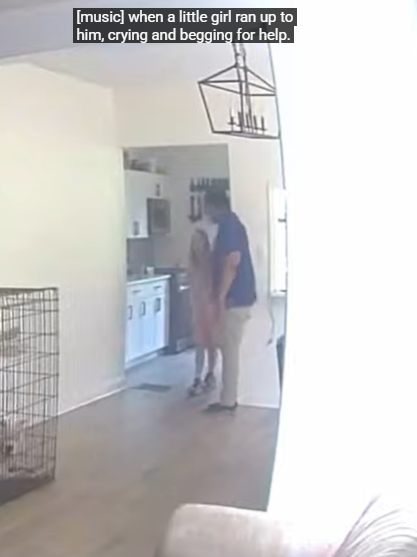
The video shows a frightening home security incident where a young girl appears to run to a stranger’s house for help, and the homeowner quickly steps in to protect her. The footage begins inside or near the entrance of a home, showing an ordinary domestic space that suddenly becomes the scene of an emergency. A man is about to enter or is already near the doorway when a distressed child comes to the porch crying and begging for help. In that moment, the homeowner has very little time to understand the full situation, but he recognizes enough to know that the child is scared and needs immediate protection.
The most important part of the video is the homeowner’s quick reaction. He does not ignore the girl, question her harshly, or leave her outside while trying to figure everything out. Instead, he brings her into the house and moves her away from whatever danger she is trying to escape. That decision matters because children in fear may not be able to explain everything clearly right away. They may cry, panic, or struggle to find the right words. A responsible adult’s first priority in that moment is to get the child somewhere safer and call for help.
Once the girl is inside, the homeowner calls 911. This is the correct response because he cannot know the full background on his own. He does not know whether the girl is lost, being followed, involved in a family dispute, or in immediate danger. By contacting emergency services, he brings trained responders into the situation and creates an official record of what is happening. He also avoids making himself the sole decision-maker in a situation involving a child and an unknown adult.
The tension rises sharply when another man enters the house after the girl. According to the description, this man is identified as the girl’s mother’s boyfriend. He claims that the girl is a runaway, but the way he enters the home raises immediate concern. Even if he believes he has a reason to retrieve her, he does not have the right to force his way into someone else’s house. The homeowner’s home becomes a protective space, and the intruder’s decision to come inside without permission turns the situation into a confrontation.
The homeowner immediately stands his ground. He does not allow the man to take control of the situation or intimidate the child. He repeatedly tells the man to get out of the house, making it clear that the man is not welcome inside. This moment is powerful because the homeowner is not only protecting his property; he is protecting a frightened child who came to him for help. His firm response creates a boundary between the child and the person who followed her.
The man’s claim that the girl is a runaway does not automatically resolve the situation. In emergencies involving children, adults sometimes give explanations that sound simple, but the child’s fear still needs to be taken seriously. A child running to a neighbor or stranger while crying and begging for help is a serious warning sign. The homeowner cannot verify the man’s claim in the moment, and it would be unsafe to simply hand the child over without police present. His decision to keep the child inside and wait for authorities is careful and responsible.
The video is especially tense because everything happens in a normal home environment. The viewer sees a house, a doorway, a kitchen area, and ordinary furniture. Then suddenly, that familiar setting becomes a place of protection and confrontation. This contrast makes the situation feel even more real. Emergencies do not always happen in dramatic public spaces. Sometimes they happen at a front door, with only seconds to decide what to do.
The homeowner’s behavior shows the importance of trusting signs of distress. The girl did not calmly knock and ask for directions. She reportedly ran up crying and begging for help. That kind of urgency matters. Even if the adult following her had an explanation, the child’s emotional state gave the homeowner enough reason to pause and involve police. In child safety situations, it is better to be cautious and let authorities sort out the facts than to dismiss a child’s fear too quickly.
The incident also shows how important it is for adults to keep control of the space when a child seeks help. The homeowner does not let the man dominate the room or pressure him into releasing the girl. He gives clear commands and keeps repeating them until the man backs away. This repetition matters because someone entering a home in a heated situation may try to argue, explain, or push past boundaries. The homeowner keeps the message simple: leave the house.
The man entering the home after the child creates a serious escalation. If he had stayed outside and waited for police, the situation may have remained calmer. By coming inside, he makes himself appear more threatening, regardless of his explanation. A homeowner has a right to keep unwanted people out, especially when a frightened child has just entered seeking help. The homeowner’s protective reaction is understandable.
The 911 call is also important because it prevents the situation from becoming one person’s word against another’s without immediate help on the way. The dispatcher can hear what is happening, send officers, and possibly advise the homeowner on what to do next. If the intruder continues arguing or refuses to leave, police are already being notified. If the child needs medical attention or child protective support, emergency responders can help arrange that as well.
The video also reflects the importance of community awareness. The homeowner may not have known the girl personally, but he still responded. Children in danger may run to the nearest safe-looking adult, and that adult’s reaction can make a major difference. In this case, the homeowner appears to understand that the child’s safety comes before inconvenience, confusion, or fear of getting involved. His decision to help may have prevented the situation from becoming worse.
The girl’s presence inside the home likely creates fear and confusion for everyone involved. She may not know whether she is safe yet. She may still hear the man outside or inside. She may be worried about what will happen next. The homeowner’s firm voice toward the intruder may help show her that someone is taking her seriously and trying to protect her. For a child in distress, that can be incredibly important.
The man’s claim that the girl is a runaway may also be an attempt to regain control of the narrative. By labeling her as a runaway, he suggests that she is the problem and that he is simply trying to bring her back. But the homeowner cannot rely on that claim alone. Children may run from unsafe situations, not just from rules. Police need to determine what happened, why she fled, and whether returning her immediately would be safe.
The video’s emotional force comes from the homeowner’s refusal to be passive. Many people might freeze in a situation like this. Some might feel unsure whether to get involved in what appears to be a family matter. But the homeowner recognizes that a child asking for help is not something to ignore. He opens the door, brings her in, calls for help, and confronts the adult who follows her. Each step shows quick judgment under pressure.
The incident also highlights why “family matter” explanations should not automatically stop outside intervention. If a child is scared enough to seek help from someone else, the situation deserves attention. Police and child welfare professionals are better equipped to investigate family relationships, custody issues, safety concerns, and whether the child can safely return home. A random homeowner cannot solve all of that, but he can keep the child safe until help arrives.
The home security footage gives the viewer a limited but powerful window into the event. The camera does not provide every detail of what happened before the girl arrived or what happened after police were called. It only captures the critical middle: the child seeking help, the homeowner acting, and the man entering after her. That limited view is enough to show why the situation was urgent, but it also reminds viewers that the final facts would need to be determined by authorities.
The homeowner’s repeated command for the man to get out is direct and necessary. He does not spend time debating the man’s explanation because the immediate problem is that the man is inside without permission. The homeowner keeps the focus on removing the threat from the home. Once the man is outside and police are on the way, the details can be sorted out more safely.
The video may also make viewers think about what they would do in the same situation. A child running to your door for help creates a heavy responsibility. The safest general response is to keep the child in a visible, safe area, call 911 immediately, avoid sending the child away with any adult until police arrive, and avoid escalating physically unless absolutely necessary for safety. The homeowner appears to follow that basic principle by protecting the child and contacting authorities.
The fact that the man follows the girl into the house makes the homeowner’s decision even more justified. If the child had simply been lost, an adult might calmly explain from outside. Forcing entry into a stranger’s home suggests urgency, anger, or lack of respect for boundaries. That behavior gives the homeowner more reason to believe the child should not be handed over without police involvement.
The video also shows how quickly protective instincts can take over. The homeowner may not know the child, but once she is inside and crying, he treats her safety as his responsibility. He becomes a barrier between her and the man who followed her. That kind of intervention can be risky, but it can also be lifesaving when a child has no one else nearby to turn to.
The incident is also a reminder that children need to know how to seek help in emergencies. Running to a nearby home, asking an adult for help, and getting to a place where 911 can be called may be the only option a child can think of in a frightening moment. While children should be taught to be careful with strangers, they also need to know that in an emergency, they can seek help from safe adults, neighbors, store employees, or emergency responders.
The homeowner’s calm enough decision to call 911 is important because emotion alone is not enough. He could have only shouted at the man, but involving emergency services gives the child a better chance of real protection. Police can investigate the man’s identity, the child’s home situation, the mother’s role, and whether any immediate protective action is needed. The homeowner protects the child in the moment, but authorities must handle the broader situation.
The video’s title and description frame the homeowner as quick-thinking, and that seems accurate based on the summary. He does not wait for perfect information. He acts on the clear sign in front of him: a crying child begging for help. In emergencies, waiting too long for certainty can be dangerous. The homeowner chooses safety first and lets the facts be sorted out after the child is protected.
The man backing away after being confronted shows that the homeowner’s firm boundary worked, at least in that moment. He does not allow the man to take the child or remain inside. That creates time for 911 to respond. In situations involving vulnerable children, even a few minutes of protection can matter.
The footage also shows how home security cameras can capture important evidence. The recording may help police understand the sequence of events: the girl’s arrival, her distress, the homeowner’s response, the man entering, and the commands to leave. This kind of evidence can be useful later if anyone disputes what happened. It protects the homeowner as well, showing that he acted to help a child and remove an unwanted adult from his home.
The strongest takeaway from the video is that the homeowner recognized the seriousness of the child’s fear and did not ignore it. He did not let the adult following her define the situation. He did not allow the man to enter freely or take control. He created safety, called for help, and held the line until the intruder backed away.
Ultimately, the video shows a frightening but powerful moment of intervention. A young girl runs to a home crying and asking for help. The homeowner brings her inside and calls 911. When a man follows her into the house and claims she is a runaway, the homeowner refuses to hand her over or accept the explanation without authorities present. He confronts the man firmly and repeatedly orders him out until he backs away. The scene is tense because the homeowner has only seconds to react, but his response shows exactly what matters most in that moment: protect the child first, call emergency services, and do not allow a frightened child to be taken away before police can determine what is truly happening.
The situation also highlights how important it is for adults to respond with both compassion and caution. The homeowner does not know the girl’s full story when she arrives, but he does not need every detail to understand that something is wrong. A child crying, running to a stranger, and begging for help is enough to justify immediate concern. At the same time, he does not try to solve the entire situation by himself. He brings her inside, creates distance from the person following her, and calls 911. That balance is exactly what makes his response strong.
One of the most frightening parts of the incident is how quickly the man follows the girl into the home. If he had simply stayed outside and explained himself calmly, the situation might have felt less threatening. But entering someone else’s house after a distressed child has just run inside makes his behavior appear aggressive and urgent. It also places the homeowner in a position where he must defend both the child and his own home. The homeowner’s repeated command for the man to leave is not an overreaction; it is a necessary boundary in a moment that could have become even more dangerous.
The man’s claim that the girl is a runaway may have been intended to make the homeowner doubt himself. By presenting the child as disobedient or difficult, he attempts to shift attention away from her fear and toward her behavior. But the homeowner does not allow that label to decide the outcome. A child can be called a runaway and still be running from a real danger. A child can be accused of misbehaving and still need protection. The homeowner understands that the safest choice is not to judge the child instantly, but to keep her safe until police arrive.
This is also why the 911 call is so important. Without police, the situation could easily turn into a dangerous argument between two adults, with the child trapped in the middle. Emergency responders can verify identities, contact the child’s mother, assess whether there are signs of danger, and decide what protective steps are needed. The homeowner’s role is not to investigate the family history. His role is to protect the child long enough for trained authorities to take over.
The video also shows why adults should be careful about sending a scared child back with someone just because that person claims to know them. In many unsafe situations, the person creating fear may also be someone familiar to the child. A child may be running from a parent’s partner, relative, neighbor, or household member, not a stranger. That makes the situation more complicated, because the adult following the child may sound confident and may try to make the child look unreasonable. The homeowner avoids that trap by refusing to release her without official help present.
The home itself becomes a temporary shelter. It is not a police station, school, or child protection office, but in that moment, it is the safest place the girl can reach. The homeowner’s willingness to let her in transforms the home from a private space into a protective barrier. The doorway becomes the line between the child and the person she is afraid of. The homeowner’s voice and presence reinforce that line.
The incident also reminds viewers that helping does not require knowing exactly what to say. The homeowner does not give a perfect speech or perform a complicated rescue. He acts simply: come inside, call 911, get out of my house. Those basic actions are enough to stabilize the moment. In emergencies, simple decisions can matter more than perfect wording. The child needed safety, and the homeowner gave her that first.
There is also a lesson here about trusting children enough to pause and listen. Children do not always explain danger in a calm, organized way. They may cry, panic, contradict themselves, or use only a few words. If an adult dismisses them because their story is incomplete, the child may lose their chance to get help. The homeowner appears to take her distress seriously even before he knows all the facts. That does not mean assuming every detail immediately; it means treating the situation as serious until police can investigate.
The man’s behavior after entering the home also becomes part of the evidence. His decision to follow her inside, his claim that she is a runaway, and his reaction to being ordered out could all help authorities understand the situation. The home security footage preserves those moments. If later someone claims the homeowner misunderstood or overreacted, the recording can show the child’s distress and the man’s entry. That is another reason the footage is important beyond the immediate rescue.
The girl’s emotional state is central to the story. She was not calmly asking for a ride or directions. She was crying and begging for help. That level of fear should never be brushed off. Even if there is a complicated family explanation, a child’s panic is still a real event that needs care. The homeowner’s response likely gave her the first feeling of safety she had in that moment. Being believed, even temporarily, can matter deeply to a frightened child.
The incident also shows the danger of adults trying to control the narrative before authorities arrive. The man appears to quickly explain that the girl is a runaway, but the homeowner keeps the focus on immediate safety. This is important because explanations can be used to pressure bystanders into handing a child back too quickly. A confident adult voice can sometimes overpower a scared child’s voice. In this case, the homeowner does not allow that to happen.