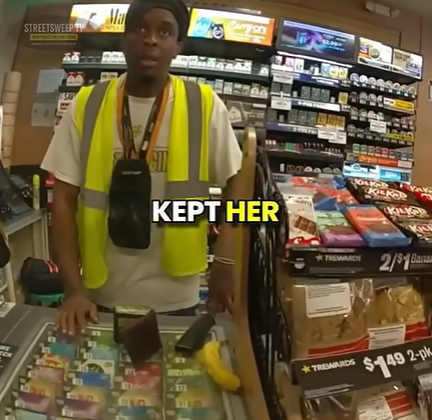
The video shows a chaotic police response inside a convenience store after an altercation between a store employee and a woman who says she was there to pick up an Uber Eats order. The footage begins with Orlando Police entering the store and immediately finding a tense scene already in progress. A male employee wearing a high-visibility vest is on top of a distressed woman, pinning her to the floor while she cries and struggles. The officer quickly orders the employee to get off her, making it clear that whatever happened before police arrived, the situation cannot continue with the woman being held down in that way.
The woman appears frightened and upset as soon as officers intervene. She tells police that the employee punched her twice and hit her in the head with a handheld scanner. Her account suggests that what started as a possible misunderstanding over whether she was allowed inside the store turned into a physical confrontation. She says she was not there to cause trouble; she was there as an Uber Eats delivery driver, trying to pick up an order. From her perspective, she entered the store for work, looked for someone at the counter, and then found herself being attacked and held down.
The employee gives a very different explanation. He tells the officer that the store was closed and that no one was supposed to be inside. He appears to believe that the woman entered an area where she did not belong, and he repeatedly tells the officer to check the store’s surveillance cameras. His defense is that he was doing his job and responding to someone being inside the store after closing. But the officer challenges that immediately, pointing out that even if the store was closed, tackling someone and pinning them to the floor is not the proper way to handle the situation.
That exchange becomes the heart of the video. The employee seems focused on why the woman should not have been inside. The officer is focused on how the employee responded. Those are two different issues. A person entering a closed store may need to be asked to leave. Staff can call police, keep distance, lock doors, or report trespassing. But physically attacking or restraining someone without proper justification can create a separate legal problem. The officer makes it clear that being an employee does not give someone unlimited authority to use force.
The woman’s version adds more urgency. She says she entered because she was trying to pick up an Uber Eats order. Delivery drivers often arrive at restaurants, convenience stores, and fast-food locations at odd hours, sometimes when the front counter is quiet or when staff are in the back. It is easy for confusion to happen if a store appears open through an app but employees believe the location is closed. That kind of confusion should normally be handled through communication. In this case, according to the woman, she walked in looking for the order and was suddenly confronted physically.
She also tells officers that the employee sat on her and made it difficult for her to breathe. That detail explains why she appears so shaken when police arrive. Being held down by someone larger or stronger can be terrifying, especially when the person feels they cannot move or breathe normally. The officer’s first command for the employee to get off her shows that police recognized the immediate need to separate them. Before sorting out who was right about the store being closed, officers had to stop the physical restraint.
The employee continues insisting that officers should check the cameras. This may be his attempt to prove that the woman entered the store improperly or that he had a reason to confront her. But video evidence could cut both ways. Surveillance might show the woman entering, where she walked, whether she ignored signs or locked doors, how the employee approached her, and whether he used force first. In situations like this, cameras become extremely important because both sides describe the same event very differently.
The officer appears unwilling to accept the employee’s explanation as a complete defense. Even if the woman entered after closing, the officer seems to believe the employee’s physical response was excessive. That is an important distinction. A person can have a legitimate complaint and still respond in an unlawful or unreasonable way. The employee may have been frustrated, surprised, or concerned about someone being inside the store, but the officer’s point is that he should have called police rather than taking the situation into his own hands.
The woman expresses a clear desire to press charges. That matters because she is not simply asking for an apology or a report. She wants the employee held accountable for what she says happened to her. Officers then need to investigate whether there is probable cause for an arrest. Her statements, her emotional state, possible injuries, the employee’s own admissions, witness accounts, and surveillance footage would all matter. The bodycam captures the beginning of that process.
The employee’s attitude becomes another issue as the encounter continues. He remains defensive and repeatedly says he was only doing his job. From his perspective, he may feel that police are ignoring the fact that the woman was inside the store after closing. But officers are looking at his actions as well. The more defensive and uncooperative he becomes, the more the situation shifts away from simply taking statements and toward controlling him as a suspect.
The situation escalates further when officers attempt to retrieve the employee’s identification. Instead of calmly providing it or following instructions, he continues arguing and resisting the direction of the officers. At that point, the officers appear to decide that he is no longer simply a witness or reporting party. He is being treated as someone who may be arrested. They move in, order him to get on the ground, and use force to take him down and place him in custody.
That reversal is one of the most dramatic parts of the video. When police first arrive, the employee is the one physically controlling the woman on the floor. He seems to believe he is the person enforcing the rules of the store. But within minutes, officers are telling him that his actions were not appropriate and then taking him into custody. The person who claimed to be doing his job becomes the person being arrested.
The video also shows how quickly a workplace confrontation can become a criminal matter. Store employees may deal with difficult customers, late-night delivery drivers, theft concerns, and people entering at the wrong time. But there are limits to what employees can do. Physical force can only be justified in narrow situations, such as self-defense or preventing immediate harm. If someone is simply inside the store when they should not be, the safer response is to call police and avoid direct confrontation. The officer’s response reflects that principle.
The Uber Eats context also matters. Delivery drivers rely on app instructions and store availability. Sometimes an app may send a driver to a location that staff consider closed, or the driver may believe the order is ready because the app says it is. That can create frustration on both sides. Employees may be tired, closing registers, or dealing with end-of-shift tasks. Drivers may be trying to complete an order quickly so they can earn money. But those pressures do not justify violence or physical restraint.
The woman’s distress is central to the footage. She is crying, accusing the employee of hitting her, and describing how she was pinned down. Her emotional reaction gives the officers reason to take her complaint seriously. At the same time, police still have to gather evidence. Her desire to press charges does not automatically decide the case, but it signals that she views herself as a victim of an assault rather than someone simply involved in a mutual argument.
The employee’s repeated insistence that the store was closed may be true, but the officer’s response shows that truth alone may not protect him. A closed store does not become a place where employees can use any level of force they choose. If the woman entered mistakenly or even improperly, there are still procedures. The employee could have told her to leave, called police, or kept distance until officers arrived. Tackling and pinning someone down creates a separate legal issue.
The handheld scanner mentioned by the woman is also important because it is an ordinary work tool that she says was used against her. In many stores, scanners are used for inventory, pricing, or order management. If one was used during the physical confrontation, officers would likely need to locate it, document it, and determine whether it matches her statement. Again, the article does not need graphic details to show the seriousness. The key point is that she says a workplace device became part of the assault.
The officer’s statement that the employee’s actions were not proper procedure is a reality check. Employees may sometimes think they are protecting the business by physically stopping someone. But businesses usually have policies that discourage staff from using force because it creates danger and liability. Even loss prevention staff are typically trained to follow specific rules. A regular employee physically restraining a delivery driver can expose the employee and the business to serious consequences.
The bodycam footage captures the officer trying to separate emotion from procedure. The employee is upset and defensive. The woman is crying and demanding charges. The officer must decide what can be established immediately. He knows that the woman was pinned down when he arrived. He hears her allegations. He hears the employee’s explanation. He also sees the employee’s ongoing resistance to instructions. All of that shapes the decision to arrest.
The employee’s arrest also shows how refusing to cooperate with police can make a bad situation worse. If he had calmly stepped back, provided identification, and let officers review the cameras, the investigation may have continued in a more controlled way. His refusal or defensiveness appears to push officers toward a more forceful response. Once officers order someone to the ground, continued resistance usually leads to physical control.
The video leaves viewers with a strong lesson about boundaries. The woman may have crossed a boundary by entering a store that staff considered closed. But the employee appears to have crossed a much more serious boundary by using force and holding her down. The officer’s response suggests that one boundary violation does not justify another. The proper response to a possible trespass is not an uncontrolled physical confrontation.
The presence of security cameras becomes a key unresolved factor. The employee wants the officer to check them, likely believing they will support his version. The woman’s account may also be supported by the same footage if it shows the employee attacking or restraining her. Cameras can reveal whether she was aggressive, whether he gave warnings, whether she tried to leave, and how the physical contact began. In a case with conflicting stories, surveillance may become the most important evidence.
The convenience store setting also adds to the intensity. These stores are often tight spaces with counters, aisles, displays, and limited room to move. A confrontation inside can become dangerous quickly because people can fall into shelves, counters, or equipment. If the employee pinned her near the front or in an aisle, there may have been little room for her to move away. That kind of environment makes physical escalation especially risky.
The employee’s high-visibility vest makes him look like someone with authority inside the store, but the officer’s actions show that workplace authority has limits. He may have been responsible for closing the store, protecting property, or managing orders. But that role does not make him law enforcement. He cannot punish someone, detain someone without proper grounds, or use force beyond what is legally reasonable. The officer makes that distinction clear.
The woman’s statement that she wanted to press charges also creates accountability beyond the store’s internal process. If this were handled only as a workplace incident, the employee might face discipline. But once police believe a crime may have occurred and the woman wants prosecution, it becomes a criminal investigation. The employee’s job status or claim of doing his duty does not prevent that.
The video likely feels shocking because the first image police see is the woman being held down. Officers arriving to that scene must act quickly because they do not know whether the person on the floor is injured, whether the employee is still a threat, or whether there are other people involved. The first priority is separation. Only after that can they begin sorting through the story.
The employee may have believed that holding her there was necessary until police arrived. But the officer’s reaction suggests that whatever his reasoning, the method was not acceptable. Holding someone down can create fear, injury, and legal exposure. If the person is not actively attacking or posing immediate danger, restraint may be viewed as excessive. That seems to be the officer’s concern.
The woman’s claim that she had trouble breathing while pinned adds to why officers take the restraint seriously. Being held down can create panic and potential medical risk. Officers likely need to ask whether she wants medical attention, document her condition, and include her statements in the report. Even if visible injuries are not obvious on camera, her account matters.
The employee’s demand that officers check the cameras may also reflect confidence that the woman entered improperly. But the officer’s response suggests that the real question is not only entry. The real question is proportional response. A person can be wrong for entering, and another person can still be wrong for how they respond. This is often where people misunderstand the law. Being right about one part of the story does not automatically excuse everything that follows.
The arrest of the employee becomes a form of accountability for taking matters too far. The officer appears to decide that the employee’s actions and lack of cooperation require arrest. The physical takedown of the employee mirrors the earlier restraint of the woman in a striking way. At first, he is the one using force. Later, officers use force on him because he does not comply. The difference is that officers are acting under legal authority during an arrest, while the employee’s authority is what is being questioned.
The video also highlights the importance of staying calm during police investigations. The employee might have had a stronger chance of explaining his side if he had immediately stepped back, remained calm, provided his ID, and allowed officers to review footage. Instead, his defensiveness and resistance made him look less cooperative. In police encounters, attitude does not determine guilt, but cooperation can affect how the situation unfolds.
The woman’s role as a delivery driver also shows how gig workers can end up in unpredictable situations. They often enter unfamiliar businesses, deal with different closing procedures, and rely on app information that may not match what employees expect. This can create conflict if staff are not prepared for late pickups or if the driver does not know where to go. Clear communication between stores and delivery platforms is important to avoid misunderstandings.
The officer’s response is also a reminder that employees should call police before a situation becomes physical, not after. If the employee believed someone was trespassing, he could have called 911, kept distance, and waited. Once he physically confronted her, the case became more complicated. Police arriving afterward had to investigate not only why she was there, but also what he did to her.
The video ends with the employee being taken down and arrested, but the larger case would likely continue with reports, surveillance review, statements, and possible charges. The woman’s statement, the employee’s defense, the officer’s observations, and the store footage would all matter. If the scanner was involved, that would likely be documented too. The bodycam shows the most dramatic moments, but the final legal outcome would depend on the evidence collected after the clip.
The strongest takeaway is that taking the law into your own hands can backfire. The employee may have believed he was protecting the store, but officers saw a woman pinned to the floor and heard allegations that he struck her. The officer made it clear that a closed store does not justify tackling or restraining someone in that manner. When the employee then refused to cooperate, he became the focus of the arrest himself.
Ultimately, the video shows a convenience store dispute that escalated far beyond a simple Uber Eats pickup confusion. A woman says she entered to collect an order, could not find anyone at the counter, and was attacked by an employee who then held her down. The employee says the store was closed and that no one should have been inside, urging police to check surveillance footage. But the officer challenges his response, explaining that even if she should not have been there, physically pinning her down was not proper procedure. As the employee grows defensive and refuses to cooperate with identification, officers move in and arrest him, turning the person who claimed he was just doing his job into the one facing consequences.
The incident also shows how fast a misunderstanding can become dangerous when both sides feel justified. The woman believed she was working and simply trying to complete a delivery order. The employee believed the store was closed and that she had no right to be inside. Those two beliefs collided in a small, high-pressure space, and instead of the situation being solved through words, it turned physical. That is what makes the officer’s response so important: he separates the original disagreement from the force used afterward.
For the woman, the encounter likely felt terrifying because she entered expecting a normal pickup and ended up on the floor, crying and asking for help. Delivery drivers often work alone, move quickly between locations, and depend on stores to have orders ready. If she entered a store that appeared accessible or had an active order waiting, she may not have expected anyone to treat her as a threat. Her request to press charges shows that she saw the employee’s actions not as a misunderstanding, but as an assault.
For the employee, the situation may have felt like a security issue. He may have thought he was protecting the business, especially if the store was closed or if he believed the woman ignored boundaries. But the officer’s reaction makes clear that employees must use proper procedures. A worker can ask someone to leave. A worker can call police. A worker can preserve video evidence. What they cannot do is escalate into violence unless there is an immediate and lawful reason to defend themselves or others.
The officer’s decision to arrest the employee also sends a broader message about proportionality. Even if someone enters a business at the wrong time, the response must match the situation. A mistake, confusion, or possible trespass does not automatically justify punching, striking with an object, or pinning someone down. The law looks at whether the force used was reasonable under the circumstances, and the officer clearly appears to question that.
By the end, the video becomes less about an Uber Eats order and more about accountability. The store cameras, the officer’s bodycam, the woman’s statement, and the employee’s own explanation all become part of the record. The final legal outcome would depend on the full evidence, but the scene shows one clear lesson: when a workplace dispute turns physical, claiming “I was just doing my job” may not be enough.