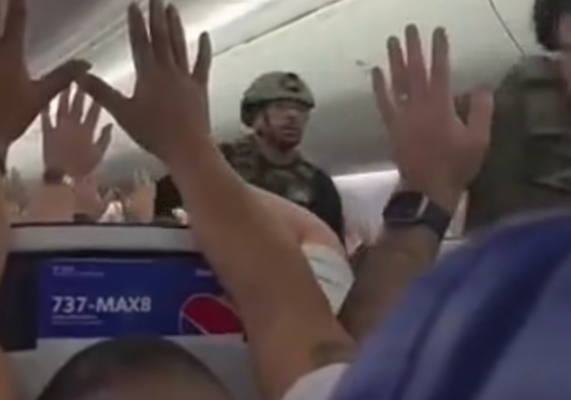
A routine Southwest Airlines flight travelling from Nashville, Tennessee, to Fort Lauderdale, Florida, became the centre of a frightening security response on Friday, March 6, 2026, after the aircraft was unexpectedly diverted to Atlanta. Passengers who had expected an ordinary evening journey suddenly found themselves surrounded by uncertainty as the crew changed course and prepared to land at Hartsfield-Jackson Atlanta International Airport. The flight, identified as Southwest Flight 2094, landed safely in Atlanta at approximately 9:06 p.m. following what the airline described as a possible security matter involving a passenger. Although early headlines and social-media posts referred broadly to a security threat, federal investigators later determined that no credible threat existed. No injuries were reported, and the individual removed from the aircraft was not charged.
The incident attracted widespread attention largely because of dramatic video recorded inside the cabin. The footage showed passengers remaining still with their heads lowered and their hands raised while heavily equipped police officers moved through the aircraft. An unidentified male passenger was taken from his seat, handcuffed and escorted off the plane as the other travellers watched in silence. For anyone seeing only the short video clip, the scene appeared deeply alarming. Armed officers inside a commercial aircraft, passengers holding their hands in the air and a person being removed in handcuffs naturally created the impression that authorities were responding to an immediate and potentially serious danger. However, the information released after the investigation presented a less dramatic conclusion than the images initially suggested.
Southwest Airlines said the flight had diverted so that authorities could respond to a possible security concern. The airline did not publicly describe the exact actions, words or circumstances that caused the crew to become concerned. Atlanta police assisted federal authorities by removing the passenger once the aircraft had safely landed. The Federal Bureau of Investigation and the Atlanta Police Department then interviewed the individual and examined the available information. By the following day, the FBI announced that investigators had found no credible threat and that no charges would be filed. This conclusion is important because it separates the precautionary response from the final result of the investigation. The diversion was real, the police operation was real and the fear experienced by passengers was real, but authorities ultimately did not find evidence of an actual danger.
The event began while Flight 2094 was still travelling towards South Florida. Most passengers apparently did not know precisely why the aircraft was changing direction. On a commercial flight, travellers generally receive only the information that the crew believes is safe and appropriate to provide at that moment. When an uncertain security issue is developing, crew members may avoid announcing details that could cause panic, interfere with their response or alert the person at the centre of the concern. As a result, passengers may notice changes in the behaviour of flight attendants, quiet conversations between crew members or an unexpected announcement from the cockpit without immediately understanding what has happened.
That lack of information can make a diversion especially unsettling. Passengers may begin looking around the cabin, trying to interpret the expressions and movements of the people nearby. Some may wonder whether there is a mechanical problem, a medical emergency, dangerous weather or a security concern. Others may send messages to relatives or search flight-tracking information on their phones. Even when the cabin remains physically calm, uncertainty can produce intense fear because the people on board have little control over the aircraft’s destination or the response taking place around them.
The crew’s priority in such circumstances is to protect the aircraft and everyone inside it. Pilots do not necessarily need proof that a threat is genuine before choosing to divert. They must make decisions using the limited information available while the aircraft is in the air. Waiting for absolute certainty could create unnecessary risk if the concern later proves serious. Diverting to a suitable airport allows the aircraft to land, places passengers closer to emergency assistance and gives law-enforcement officers an opportunity to investigate in a controlled environment. The safe landing of Flight 2094 demonstrates how a precautionary diversion can work even when the concern later turns out not to be credible.
Atlanta was a practical location for the response because Hartsfield-Jackson is a major airport with extensive emergency and law-enforcement resources. Before the aircraft arrived, authorities could prepare personnel and decide how to approach the plane. Once Flight 2094 was safely on the ground, officers boarded and removed the individual connected to the reported concern. Passengers were instructed to remain in place while the intervention occurred. The video suggests that officers treated the initial report seriously and attempted to maintain control of the cabin until they could determine whether anyone was in danger.
For passengers, the arrival of tactical officers may have been both reassuring and terrifying. Their presence showed that authorities were responding quickly, but it also made the situation appear more dangerous. Travellers who had not been told the exact reason for the diversion suddenly saw officers moving through the aisle and ordering everyone to follow strict instructions. Some may have worried that a dangerous object was on board or that another person was involved. Others may have feared that the confrontation could become violent. The cabin of a passenger aircraft is a confined environment, and even a controlled police operation can feel overwhelming when dozens of people are seated close together with limited room to move.
The viral footage captured only a small part of the event. It did not show everything that happened before the diversion, the private communications between crew members and the cockpit, the information sent to authorities on the ground or the interviews conducted after landing. This is one reason dramatic clips must be viewed carefully. A video can accurately show what happened during a particular moment while still failing to explain why it happened or what investigators eventually discovered. In this case, the video showed a forceful law-enforcement response, but it could not establish whether the original concern was credible.
Some online posts reportedly characterised the incident as a bomb threat. Officials, however, did not publicly confirm that description, and the exact nature of the original report was not released. Repeating the bomb-threat claim as an established fact would therefore go beyond the verified information. The responsible description is that the flight diverted because of a possible security matter, a passenger was removed and interviewed, and investigators concluded that no credible threat existed. This wording may sound less sensational, but it more accurately reflects the available evidence.
The difference between a reported threat and a credible threat is significant. A reported concern is the information available before investigators have fully examined it. A credible threat is one supported by evidence or circumstances indicating a genuine risk. Airline crews must react to the first category because they cannot safely assume that a concerning report is false. Law-enforcement agencies then investigate to determine whether the second category applies. Flight 2094 illustrates that process: the report triggered a serious response, but the later investigation found no credible danger.
This outcome does not mean the crew made the wrong decision by diverting. Safety decisions are judged according to what was known at the time, not only by what investigators discover afterwards. If a captain receives information suggesting that a passenger or object may pose a risk, continuing towards the original destination without further action could be irresponsible. A diversion creates delays and inconvenience, but those consequences are less serious than failing to respond to a genuine emergency. The fact that no threat was ultimately found can be seen as a successful precaution rather than proof that the response was unnecessary.
Commercial aviation relies heavily on cautious decision-making. Pilots, flight attendants, airline dispatchers, air-traffic controllers, airport officials and law-enforcement agencies each have different responsibilities. A flight attendant may first notice or receive a report of concerning behaviour. The information can then be passed to the captain, who evaluates the situation while continuing to operate the aircraft. The airline may coordinate with authorities and airport personnel, while air-traffic controllers help arrange a safe and efficient route to the diversion airport. Police officers and federal agents can then take over the investigation after landing.
The presence of the FBI was not unusual simply because the incident happened aboard an aircraft. The bureau investigates crimes and serious incidents connected to air travel, including conduct occurring on commercial flights. The FAA also investigates unruly-passenger incidents reported by airline crews, while federal law prohibits passengers from interfering with the duties of crew members. Local airport police, federal investigators and aviation authorities may therefore have related but separate roles when a flight is diverted because of passenger behaviour or a possible security issue.
In the Flight 2094 case, the FBI and Atlanta police interviewed the person who had been removed. Their investigation ended without criminal charges. That conclusion means the dramatic removal seen in the video should not be treated as proof that the passenger committed a crime. Being detained, questioned or removed from a flight is not the same as being convicted, charged or even formally accused in court. Authorities sometimes need to separate an individual from other passengers while they determine what happened, particularly when the original information is unclear or potentially serious.
This distinction also matters when identifying the passenger. The individual’s name was not released in the reliable reports, and there is no public criminal charge requiring identification. Publishing rumours about the person’s identity, religion, nationality, motives or mental state would risk spreading misinformation and could unfairly damage someone who was ultimately released without charges. The verified facts support describing the person only as an unidentified passenger who was removed and interviewed during the investigation.
After the police response, the disruption continued for the remaining travellers. Southwest arranged for passengers to continue to Fort Lauderdale on another aircraft. Their replacement flight arrived shortly before 3:30 a.m., several hours later than originally expected. For travellers with family members waiting in Florida, hotel bookings, connecting transport or plans scheduled for the following morning, the delay would have caused considerable stress. Nevertheless, the passengers ultimately reached their destination safely, and Southwest apologised for the disruption while praising the professionalism of its flight crew.
The airline’s decision to use another aircraft would also have allowed authorities and operational teams to complete any necessary checks without placing passengers back on the original plane immediately. When a security concern is reported, officials may need time to inspect the cabin, review luggage, speak to witnesses and establish a reliable timeline. Even after investigators decide that there is no credible threat, the airline must still determine whether the aircraft and crew are ready to continue operating. Re-accommodating passengers can sometimes be the fastest or most practical method of completing the journey.
For those on board, however, the emotional effects may last longer than the delay itself. A passenger who sees tactical officers enter an aircraft may continue replaying the scene even after being told there was no danger. Some travellers may become anxious during future flights, especially when they hear unexpected announcements or notice crew members speaking privately. Others may feel relief and gratitude towards the crew. People respond differently to uncertain situations, and the absence of physical injuries does not mean the experience was insignificant.
The incident also demonstrates how quickly aviation stories spread online. A passenger can record a video, upload it before an official statement is released and reach thousands or millions of viewers within a short period. The earliest posts often receive the greatest attention, even though they are created when the least information is available. Viewers may add their own assumptions, dramatic captions or claims about what caused the incident. News pages may then repeat those claims in headlines, making speculation appear confirmed simply because it has been widely shared.
In this case, the visual intensity of the video made it particularly vulnerable to sensational presentation. A headline mentioning an emergency landing, an onboard threat and a passenger being dragged away is likely to attract attention. Yet such wording can leave readers believing that authorities stopped an actual attack. The FBI’s later finding changes that interpretation. The event was a security scare that prompted a precautionary diversion, not a confirmed attack or proven plot. Accurate reporting must include both the initial alarm and the final investigative result.
The expression “emergency landing” should also be used with care. The aircraft did make an unplanned landing following a possible security matter, but the public information does not indicate that the plane itself was damaged or unable to fly safely. The more precise aviation description is a diversion or precautionary landing. To passengers, the experience may certainly have felt like an emergency, and the law-enforcement response was serious. Still, precision helps readers understand that the aircraft landed safely and was not reported to have suffered a mechanical failure.
No dangerous item was publicly confirmed, no injuries were reported, and no charges were filed. These facts deserve the same prominence as the frightening footage. Without them, viewers could continue believing that the passenger posed a proven danger. Including the outcome does not minimise the crew’s response or the passengers’ fear. Instead, it provides the complete story: a concern arose, the crew acted cautiously, the aircraft diverted, police intervened, investigators examined the situation, and the feared threat was not substantiated.
The incident can also serve as a reminder that passengers should report genuine concerns to flight attendants rather than attempting to investigate or confront another traveller themselves. Cabin crew members can assess information, communicate discreetly with the cockpit and decide what action is appropriate. Direct confrontation between passengers can escalate confusion, create additional danger and make it harder for the crew to understand what is happening. At the same time, reports should be based on observable behaviour rather than assumptions about a person’s appearance, language, culture or beliefs.
False assumptions can have serious consequences in aviation because crews are required to take potential threats seriously. A misunderstanding may result in a diversion, police response, missed connections and fear for everyone involved. This does not mean people should ignore suspicious behaviour. It means reports should be as specific and objective as possible. Describing exactly what was seen or heard gives the crew better information than making conclusions about another person’s intentions. Investigators can then evaluate the facts without relying on rumours.
The FAA’s approach to disruptive passenger behaviour reflects the importance of protecting crew members while they perform safety duties. Threatening, intimidating or interfering with a flight crew can result in civil enforcement and, where warranted, criminal investigation. The FBI and FAA have also worked together on incidents that may justify federal prosecution. In Flight 2094’s case, however, investigators concluded that prosecution was not warranted because there was no credible threat and no charges would be filed.
The lack of charges should remain central when discussing the passenger. Video of a person in handcuffs often creates an assumption of guilt, but handcuffs can be used temporarily while officers secure a scene and investigate an uncertain report. The public was not given the full context behind the initial concern, and investigators did not announce evidence of criminal conduct. It would therefore be misleading to label the individual a criminal, attacker or terrorist.
The flight crew, meanwhile, had to manage several difficult responsibilities at once. They needed to keep the cabin calm, protect access to sensitive areas, communicate with the cockpit and prepare passengers for landing. They also had to avoid making announcements that might worsen the situation. Flight attendants are often the first people required to respond when behaviour inside a cabin raises concern, yet they must continue monitoring ordinary safety issues at the same time. Their actions can influence whether a tense situation remains controlled.
The pilots faced their own decisions. They had to assess the report, communicate with airline operations and air-traffic control, choose an appropriate airport and land safely. A diversion changes fuel planning, routing, ground arrangements and the expected workload in the cockpit. The pilots must complete those tasks while receiving updates from the cabin. The safe arrival at Atlanta shows that the aircraft’s operation remained under control despite the uncertainty.
Law-enforcement officers then had to respond without knowing with complete certainty what they would find. Their equipment and tactics reflected the possibility that the original report might be genuine. Once inside the plane, they had to locate the person involved, control the cabin and remove the individual without creating further danger. The operation seen in the video appeared forceful, but it ended without reported injuries. The subsequent interviews allowed investigators to move from precaution to evidence-based conclusions.
The story’s ending is therefore far less frightening than its opening. A plane was diverted, but it landed safely. A passenger was removed, but no charges followed. A possible security matter triggered a major response, but the FBI determined that no credible threat existed. Passengers experienced a long and stressful delay, but they continued to Fort Lauderdale and arrived safely during the early hours of Saturday morning.
For the travelling public, the incident may provide some reassurance about how seriously airlines treat uncertain reports. Even when a concern turns out to be unfounded, the system is designed to favour caution. Crews can divert, airport police can respond, and federal investigators can determine whether a genuine crime or threat occurred. That process can be disruptive and frightening, but it is intended to prevent an uncertain situation from becoming a disaster.
At the same time, the case demonstrates why official updates matter. The first dramatic video did not tell viewers that investigators would later find no credible threat. Early articles could describe only an unfolding security scare. Once the FBI completed its initial investigation, responsible coverage needed to be updated. Readers who see only the original alarm may never learn that the person was not charged or that the feared danger was not confirmed.
The most accurate account of Southwest Flight 2094 is therefore not simply that a plane was forced to make an emergency landing because of a security threat. It is that a flight from Nashville to Fort Lauderdale made a precautionary diversion to Atlanta after a possible security concern was reported. Police removed and questioned a passenger, investigators found no credible threat, and no criminal charges were filed. The passengers later continued their journey on a replacement aircraft.
What appeared online as a terrifying airborne emergency ultimately became an example of precaution, investigation and the danger of drawing conclusions from incomplete video. The footage captured a genuine moment of fear, but fear alone does not establish that a threat was real. The final determination by the authorities provides the necessary context: the aircraft was safe, the passengers were unharmed and the investigation did not uncover a credible danger.
For those aboard the plane, the experience will likely remain memorable. Their ordinary journey was interrupted by an unexplained change of course, an intense police response and hours of delay. Yet the outcome was the one every aviation safety procedure is designed to achieve. The aircraft landed without incident, the concern was investigated on the ground and everyone was able to continue safely once authorities had completed their work.
The incident is also a reminder that the calmest ending can follow the most frightening images. Social media showed raised hands, lowered heads, tactical officers and a handcuffed passenger. The completed investigation showed something different: no credible threat, no charges and no reported injuries. Both parts belong to the story, but the second part is essential to understanding the first.
In the end, Flight 2094’s diversion was not evidence that commercial air travel had suddenly become unsafe. It was evidence of how aviation authorities respond when uncertainty arises thousands of feet above the ground. The crew did not wait for the situation to become more serious. They brought the plane safely to Atlanta, allowed trained officers to investigate and ensured that passengers eventually reached Fort Lauderdale. The night was undoubtedly frightening and exhausting for the people involved, but it ended safely, without the disaster that many initially feared.