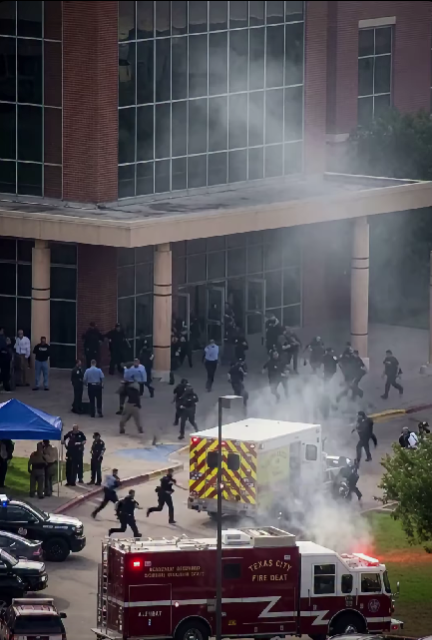
A disturbing headline claiming that at least four people were killed and ten others injured in a mass shooting at a school has been circulating across social media, causing alarm among readers who may believe that another deadly attack has just taken place. However, the linked article does not identify the school, city, state or country where the supposed incident occurred. It does not give the date or time of the alleged attack, name the police department handling the investigation, quote a school official or provide information about the victims. Instead, the page contains a broad discussion of school violence, prevention, emergency response and community trauma. Although the page was published on 5 June 2026 and carries the word “BREAKING” in its title, its body does not contain evidence confirming a new shooting with four deaths and ten injuries.
The absence of these essential details is extremely important. During a genuine breaking-news emergency, some information may remain uncertain, but reliable reports normally identify at least the approximate location of the event and the authority providing the casualty figures. Police departments, school districts, hospitals, mayors, governors or emergency-management agencies usually release updates as the situation develops. A report claiming multiple deaths without identifying a school or citing an official source should not be treated as confirmed merely because its headline appears dramatic or because it has been shared repeatedly.
The exact casualty figures used in the headline—four people killed and ten injured—closely match a real but historical school attack that occurred at Lindhurst High School in Olivehurst, California, on 1 May 1992. During that incident, an armed former student entered the school, killed one teacher and three students, injured ten other people and held dozens of students hostage during a lengthy stand-off before surrendering. The California Supreme Court’s later account confirmed that four people were killed, several others were wounded and approximately 80 to 90 students were held hostage for around eight hours.
There is no proof on the linked page that its headline was intended to describe the Lindhurst attack. The page does not mention Lindhurst, Olivehurst, California or the year 1992. Nevertheless, the identical casualty numbers raise the possibility that an old event has been separated from its original date and location and presented in a way that makes it appear recent. This practice is common in misleading online posts. A dramatic photograph or video may be paired with an incomplete caption, while phrases such as “breaking”, “just happened” or “see more” encourage people to click before checking when and where the event actually occurred.
The distinction between a newly developing emergency and a historical tragedy is not a minor technicality. Families with children at school may see such a headline and immediately fear that the attack happened in their community. Students may send the post to classmates, parents may contact schools and local emergency services may receive anxious calls about an incident that has not occurred. Even readers living far from the alleged event may experience unnecessary distress, especially when the headline deliberately withholds the location.
Responsible reporting should therefore begin with what can be confirmed. The linked page presents no verified evidence that four people were recently killed in a school shooting. It contains no original reporting about a particular attack and no statement from law enforcement. Its article is instead a general examination of school shootings in the United States, discussing possible contributing factors, physical security, threat assessment, mental-health support, emergency communication and the effects of violence on communities. Those are serious subjects, but they do not confirm the specific breaking-news claim in the headline.
If the headline was based on the Lindhurst High School tragedy, describing it as breaking news in 2026 would be profoundly misleading. The attack happened more than three decades ago. Court records show that the person responsible was convicted of four murders, multiple attempted murders, hostage-taking and other offences. The California Supreme Court reviewed the case and affirmed the judgement in 2012. The historical record is well established, but nothing about those facts makes the event a newly occurring school attack.
The Lindhurst tragedy remains significant because it devastated a school community years before attacks such as Columbine became widely associated with school violence in the United States. What began as an ordinary school day ended with students and staff facing an extraordinary emergency. One teacher and three students lost their lives, ten other people were seriously injured and many more endured hours of uncertainty while being held inside the school. The attack affected not only those physically present but also parents, emergency workers, educators and residents throughout the surrounding area.
For the people who lived through that day, the numbers in the headline were never merely statistics. Each death represented a person with family members, friends, plans and a place within the school community. Each injury affected another student or teacher whose life was suddenly changed. The many students who were not physically injured still faced the emotional consequences of witnessing violence, fearing for friends and waiting for the crisis to end. When casualty figures are reused as clickbait without names, dates or context, the real human suffering behind those figures can be reduced to a tool for attracting attention.
This is one reason ethical reporting on school violence should avoid treating tragedy as entertainment. Headlines should inform the public rather than create confusion. Reports should make clear whether information is preliminary, whether authorities have confirmed it and whether the event is current or historical. When casualty figures change during an investigation, updates should explain who supplied the new information. Images should also be labelled accurately so that readers are not shown footage from an unrelated country, year or emergency.
The language used in the circulating headline creates several warning signs. The word “breaking” suggests urgency, yet the article gives no urgent information. The word “school” is cut off, while “shooting” is written with numbers replacing letters. The phrase “See more” encourages readers to click without telling them where the event occurred. Such formatting is often designed to avoid automated moderation systems or to increase curiosity. It does not prove that a post is false, but it should encourage readers to pause and verify the claim before sharing it.
A reader attempting to verify a genuine emergency should first look for basic information: the school’s full name, its location, the date of the incident and the organisation reporting the casualty count. The next step is to check whether the school district or local police have issued a statement. Multiple reputable news organisations should normally be reporting an event involving several deaths. If every post repeats the same vague headline but none identifies the school, that is a strong indication that the information may be incomplete, recycled or misleading.
The speed of social media makes this problem more difficult. A dramatic claim can be copied hundreds of times within minutes, often with identical wording. Each new share may make the claim look more credible because readers see it appearing on multiple accounts. In reality, all the posts may trace back to one unsupported source. Repetition is not verification. Ten pages repeating the same unidentified claim do not equal ten independent confirmations.
Algorithms may further reward posts that generate shock, fear or anger. A calm correction explaining that an event is old or unconfirmed may receive less attention than the original dramatic headline. By the time accurate information becomes available, the misleading version may already have reached a much larger audience. Some people will remember the alarming claim but never see the correction. This creates a lasting false impression that another school attack occurred, even when no such current incident was established.
School communities are especially vulnerable to this form of misinformation. Parents and students understandably react strongly to any suggestion that children may be in danger. A vague headline can spread through community groups before administrators have an opportunity to respond. Schools may then need to reassure families, investigate whether the post refers to their campus and communicate with local authorities. Resources that should be devoted to education and genuine safety concerns can be redirected towards correcting an unsupported rumour.
False or misleading claims can also interfere with coverage of real emergencies. When readers repeatedly encounter exaggerated stories, they may become less likely to trust genuine warnings. This is sometimes described as alarm fatigue. People may begin assuming that every urgent post is clickbait, which could cause them to overlook accurate safety information. Trust is difficult to build and easy to damage, making responsible communication essential during any crisis involving schools.
At the same time, uncertainty should not be used as an excuse to ignore credible warnings. Schools and law-enforcement agencies must take specific reports of threatening behaviour seriously. The difference lies in using evidence-based assessment rather than panic or profiling. The United States Secret Service has promoted behavioural threat-assessment approaches intended to identify concerning conduct, evaluate the circumstances around it and connect students with appropriate interventions. The purpose is not to predict violence based on someone’s personality or background, but to examine behaviour, communication, access, planning and changes that may indicate an escalating risk.
Threat assessment works best when students, parents and staff have safe ways to report concerns. A student may notice a threatening message, an alarming statement or behaviour suggesting that someone is in serious distress. Reporting that information to a trusted adult allows trained professionals to evaluate it. Students should not attempt to investigate a suspected threat themselves, publicly accuse another person or spread screenshots through social media. Doing so may increase fear, expose private information and interfere with an official assessment.
An effective response also needs to distinguish between a person experiencing difficulties and a person who poses an actual danger. Most people dealing with mental-health challenges are not violent, and mental illness alone should never be treated as an explanation for school attacks. Simplistic claims can stigmatise students who need support and discourage them from asking for help. Assessment should focus on behaviour and circumstances while ensuring that counselling, family support and other services are available when a student is struggling.
Physical security is another part of school safety, but no single device or policy can eliminate every risk. Controlled entrances, functioning locks, visitor procedures, communication systems and carefully designed emergency plans may help schools respond to danger. The US Cybersecurity and Infrastructure Security Agency recommends layered security planning based on the needs and vulnerabilities of each school rather than relying on one universal solution. Its guidance encourages schools to assess their buildings, procedures and available resources as part of a wider safety strategy.
Schools must balance security with the need to remain supportive places where children can learn. Turning every campus into an intimidating environment may increase anxiety without addressing the factors that lead to violence. Cameras and locked doors can play a role, but they cannot replace trusted relationships, accessible counsellors, trained staff and communication between schools and families. Students are more likely to report concerns when they believe adults will listen carefully, protect their privacy and respond fairly.
Emergency drills also require thoughtful planning. Students and staff need to understand what to do during a serious incident, but drills should not be designed to frighten children or imitate violence realistically. Age-appropriate preparation can explain procedures without creating the impression that an attack is expected to occur. Parents should be informed about the purpose of drills, and schools should consider the emotional needs of students who may have experienced previous trauma.
When a real emergency occurs, clear communication becomes crucial. Authorities must first protect people at the scene, but they should also provide families with verified information as soon as it is safe to do so. Early statements may be brief because investigators are still confirming facts. It is better for officials to say that information is unknown than to release an inaccurate casualty count, name the wrong person or speculate about a motive.
News organisations face the same responsibility. Reporters should identify whether a number comes from police, hospitals, witnesses or an unnamed source. They should avoid presenting rumours as established facts and should update articles when information changes. The date and location should be prominent, particularly when older stories may begin circulating again. A historical report should never be republished in a format that makes readers believe the event happened today.
The identity and personal history of an attacker should not dominate the story. Excessive attention can overshadow victims and communities while potentially encouraging people who seek notoriety. Coverage can explain relevant investigative findings without turning the person responsible into a celebrity. The focus should remain on verified facts, the people affected, the response and the steps communities can take to reduce future harm.
The linked article itself briefly acknowledges the danger of sensationalised coverage and imitation, yet its headline demonstrates the very problem it discusses. It uses a shocking casualty claim without supplying the details needed to verify that claim. This contradiction illustrates why readers should evaluate not only what an article says about media responsibility but also how the article presents its own information.
Communities recovering from genuine school violence require long-term support. The public’s attention may move elsewhere within days, but students, educators and families can continue experiencing grief, anxiety, difficulty concentrating and fear about returning to school. Teachers may feel pressure to appear strong for students while managing their own emotions. Parents may struggle between reassuring their children and acknowledging that something terrible occurred.
Recovery cannot be reduced to a single memorial service or a temporary increase in security. Schools may need additional counsellors, flexible attendance policies, academic support and spaces where students can speak honestly. Some people will want to discuss the event, while others may prefer privacy. There is no single correct way to respond to trauma, and recovery may take different forms for different individuals.
Emergency workers and journalists can also be affected. Police officers, paramedics, hospital staff and dispatchers may encounter intense situations while trying to protect others. Reporters may spend days interviewing grieving families and reviewing upsetting information. Organisations should recognise these effects and provide access to appropriate support rather than assuming that professional training makes someone unaffected by tragedy.
The Lindhurst community’s experience demonstrated how schools, families and local institutions may need to work together after an attack. Former district administrators later described the importance of coordinating school and community resources following the deaths of three students and a teacher, the injuries to ten people and the lengthy hostage crisis. Their account emphasised that recovery involved much more than reopening the building.
Historical tragedies should be remembered accurately and respectfully. Remembering what happened at Lindhurst does not require reproducing disturbing details or repeatedly displaying the attacker’s image. It means recognising the lives that were lost, learning from the emergency response and understanding how the community continued afterwards. Accuracy is part of that respect. Changing the date, removing the location or presenting the tragedy as a mysterious new event damages the historical record.
Readers can help limit the spread of misinformation by opening articles before sharing them. In this case, anyone who reads beyond the headline will discover that the page does not report the alleged breaking event. The body contains no paragraph beginning with a location, no quotation from police and no description of what occurred at a particular school. This mismatch between headline and content is one of the clearest reasons not to share the post as a confirmed current story.
People should also examine publication dates carefully. A recently published page can still describe an old event, repeat an unsupported claim or contain no event-specific reporting at all. The date printed at the top tells readers when the webpage was posted, not necessarily when the incident occurred. Headlines using words such as “today” or “breaking” require additional confirmation rather than less.
Reverse-image searches and searches using exact casualty figures may sometimes reveal the original event behind a recycled post. The combination of four deaths and ten injuries leads to records of the 1992 Lindhurst High School attack. That similarity is meaningful, but it does not prove why the website selected those figures. The correct conclusion is therefore limited: the linked article fails to verify a new shooting, and its casualty claim matches a documented historical incident. It would be irresponsible to invent a location or claim certainty about a connection the page itself never makes.
This careful approach may seem less dramatic than the viral headline, but it protects readers from being misled. Journalism is not simply the process of producing an emotional story that fits a title. It requires confirming what happened, distinguishing evidence from speculation and correcting the record when a claim is unsupported. When children, deaths and community safety are involved, the need for accuracy becomes even greater.
The most honest account is that an alarming headline claiming four deaths and ten injuries at a school is circulating, but the article linked beneath it does not document such a current event. The page offers a general discussion of school shootings rather than a breaking-news report. Its casualty figures correspond to the historical Lindhurst High School attack of 1 May 1992, although the website does not identify that tragedy as its source. Readers should therefore avoid presenting the post as proof that a new mass shooting has occurred.
The concern generated by the headline is understandable. School violence is real, and every confirmed attack deserves serious, sensitive reporting. That reality makes fabricated, recycled or unsupported claims especially harmful. They exploit genuine fear, disrespect past victims and make it harder for the public to identify reliable information during a real emergency.
The appropriate response is neither to dismiss every report nor to believe every alarming headline. It is to pause, verify and look for accountable sources. A confirmed report should answer basic questions about where and when the event happened and who supplied the information. Until those facts are available, casualty claims should be described as unverified rather than repeated as certainty.
Behind every real school tragedy are students, teachers, families and communities whose experiences deserve more than a vague clickbait headline. Their stories should be told with context, dignity and care. In the case of this circulating post, the evidence currently supports a warning about misinformation, not an announcement that another school has suffered an attack. The responsible conclusion is clear: there is no verified new incident contained in the linked page, and the “breaking” claim should not be shared as fact.