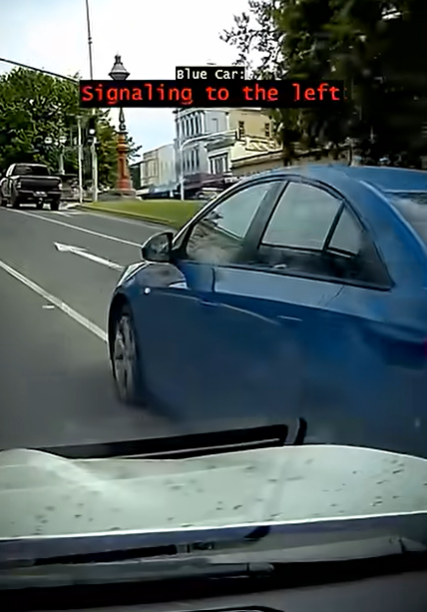
The video opens with a simple traffic scenario that quickly takes a turn for the worse, setting the stage for a perfect example of “instant karma.” It begins with a blue sedan signaling left but then sideswiping the vehicle filming the encounter, which immediately sets off a chain of events. The blue car’s sudden and aggressive maneuver is a clear indication that the driver is either distracted or impatient, failing to properly execute the turn and causing an impact with the POV driver’s vehicle.
In the aftermath of the collision, the blue car doesn’t just continue its journey but instead pulls in front of the POV driver, coming to a complete stop in the middle of the road. This unnecessary stop not only disrupts traffic but also seems to indicate the blue car’s intent to escalate the situation further. The sudden halt serves as a power play, possibly to intimidate the POV driver, or perhaps to prevent the situation from being documented. As the camera continues rolling, it’s evident that the confrontation is far from over.
The situation takes another dramatic turn as the man and an older woman exit the blue car to inspect the damage. This is where things begin to get more heated, as the man (who is soon referred to in the video as “Mama’s boy”) aggressively lunges toward the camera while the POV driver attempts to photograph the license plate for insurance purposes. The man’s reaction is completely disproportionate, considering the relatively calm nature of the situation. Instead of acknowledging the error, he seems enraged, possibly feeling guilty for the collision or unwilling to take responsibility for his actions. His decision to approach the camera in such an aggressive manner only escalates the tension, turning what should have been a simple exchange of information into a confrontation.
The older woman in the blue car tries to step in and mediate, checking the car to assess the situation. However, her efforts are futile as the tension remains high. The confrontation feels like it’s on the verge of spiraling into something much worse, with both parties standing on edge, not fully able to control their emotions. The woman, perhaps trying to calm the situation down, may not have anticipated how aggressively her passenger would react, nor the subsequent escalation.
The most dramatic turn of events, however, comes at the end of the video, where “instant karma” delivers its perfect payoff. As the occupants of the blue car attempt to drive off, likely thinking they can escape the situation without consequences, a police van suddenly pulls up with sirens blaring. The officers, arriving at the perfect time, effectively block the blue car from fleeing, ensuring that the driver faces the consequences of the hit-and-run attempt. The timing of the police van’s arrival could not have been more impeccable, and it serves as a satisfying resolution to a situation that was threatening to turn ugly.
The officers’ swift intervention brings an end to the standoff, preventing the blue car from escaping without being held accountable. This moment serves as the perfect illustration of how things can quickly take a turn for the worse when one person’s aggressive actions are met with the unforeseen consequences of law enforcement stepping in at just the right moment.
The outcome of the incident highlights how, in some situations, people who try to act with disregard for the rules or the safety of others are eventually confronted with the consequences of their actions, often in a way they didn’t see coming. In this case, the blue car’s occupants thought they could get away from the collision and avoid accountability, but they were stopped in their tracks by the arrival of the police. The video, in its short run-time, encapsulates an entire narrative arc, showing how an unfortunate and frustrating encounter can sometimes lead to the perfect example of karmic justice.
As the video unfolds, we see how quickly an ordinary traffic incident can escalate when one party decides to act out of frustration or negligence. The blue sedan’s initial failure to make a proper left turn—sideswiping the POV driver’s vehicle—serves as a perfect example of how a small mistake can spiral into something much more serious. It’s important to note that, in situations like these, what starts as an inconvenient or even minor error on the road can easily turn into a confrontation that could have far-reaching consequences for everyone involved.
The initial collision itself is a clear example of why drivers must remain vigilant and respectful of those around them. While the mistake itself—drifting into another vehicle’s lane while signaling for a turn—was likely unintentional, it was still an action that had the potential to cause significant damage or even injury. Drivers who become complacent or fail to signal correctly create a risk for other road users. This is a stark reminder that everyone on the road has a shared responsibility to follow traffic rules and act with caution. Unfortunately, the blue sedan driver’s failure to safely complete the maneuver sets the stage for the unfortunate escalation that follows.
After the collision, the blue sedan pulls directly in front of the POV driver and comes to a stop. This action is somewhat unexpected, as it goes beyond the typical response to a minor accident, where drivers often pull over to the side of the road to exchange information. Instead, the driver of the blue car seems to be asserting control over the situation by stopping in the middle of the road, possibly in an attempt to assert dominance or prevent the POV driver from photographing the damage. This aggressive move is a clear attempt to shift the power dynamic. It’s a response that signals an unwillingness to take responsibility for the accident and may be indicative of a deeper sense of entitlement or anger, whether the driver feels cornered by the situation or simply frustrated by the disruption to their day.
As the woman and man exit the blue car to inspect the damage, the viewer is led to believe that this is a simple exchange of information. However, the situation quickly escalates when the male passenger, referred to as “Mama’s boy” in the video, reacts aggressively toward the POV driver. The POV driver’s attempt to photograph the license plate for insurance purposes—an entirely reasonable action in this context—is met with hostility. The man’s quick and irrational reaction to the camera demonstrates a common human impulse: the desire to avoid accountability. This emotional outburst may not be uncommon in situations where individuals feel cornered by their actions. The man’s response to the camera—lunging at it in a fit of rage—seems like an overreaction to what is, in reality, a standard part of the post-collision process.
The term “Mama’s boy” used in the video to describe the man adds another layer to his character. It suggests a certain level of immaturity or lack of self-awareness. He is portrayed as someone who, when faced with a challenge or a potential consequence, resorts to aggression rather than accepting responsibility or trying to resolve the situation calmly. It’s not difficult to imagine that, in a moment of heightened stress, the man felt a sense of embarrassment or fear of what might happen next. However, this defensive response only made things worse, and he played a significant role in escalating an otherwise manageable situation.
The older woman’s attempt to mediate is also noteworthy. She is seen attempting to inspect the car and perhaps calm the situation down. It’s clear that she’s trying to restore order and perhaps avoid further confrontation. However, her presence is largely overshadowed by the man’s aggressive behavior. Her role in the confrontation seems to be that of a passive mediator, someone who is caught between two men—one trying to de-escalate and the other attempting to assert his dominance. Her actions seem to be motivated by a desire to resolve the situation amicably, but unfortunately, the man’s aggression prevents her from having any meaningful impact.
In a broader context, the video highlights the complexities of human interaction in moments of stress. The dynamics between the individuals in this video—specifically the way the man reacts to the perceived threat of having his actions documented—serve as a reflection of how some people respond when faced with the consequences of their actions. Rather than acknowledging the accident and accepting responsibility, the man becomes defensive and aggressive, demonstrating a reluctance to confront the reality of the situation. The woman’s role in attempting to mediate, on the other hand, represents a more calm and rational approach, but she is clearly unable to bring the situation under control due to the intensity of the man’s response. This contrast in behavior—calm mediation versus aggressive outburst—further adds to the tension of the scene.
What happens next, however, is perhaps the most satisfying part of the entire incident: the arrival of the police. Just as the blue car’s occupants attempt to drive off and avoid accountability, the sirens of a police van fill the air, signaling the arrival of law enforcement at precisely the right moment. This timing is crucial. Had the police arrived just seconds later, the blue car could have escaped the scene, leaving the POV driver to deal with the aftermath of a hit-and-run accident. The police van’s arrival not only stops the blue car from leaving the scene but also serves as a form of karmic justice. The occupants of the blue car, who thought they could avoid responsibility, are now confronted by the legal authority they had hoped to evade.
The police intervention represents the immediate consequences of actions that are driven by aggression and avoidance. The blue car’s occupants likely believed they could get away from the collision and avoid dealing with the consequences. However, their attempt to flee the scene is thwarted by law enforcement, ensuring that they are held accountable for the hit-and-run. The timing of the police’s arrival couldn’t have been better. Their presence serves as a reminder that even in moments when people think they can get away with their actions, there is often a higher force—whether it’s law enforcement or something else—that ensures justice is served.
This moment also speaks to the role of karma in everyday life. For those who believe in karma, the idea that people receive what they deserve based on their actions is an essential principle. In this case, the blue car’s occupants were trying to avoid the consequences of their reckless driving and aggression, but they were ultimately caught. The police van’s arrival was not just a coincidence—it was the universe or the system of law working to restore balance. The video serves as a modern example of how actions often have consequences, whether they are immediate or delayed, and how those who try to avoid accountability often find themselves facing it when they least expect it.
Furthermore, the incident highlights a broader societal issue: the importance of holding individuals accountable for their actions, particularly when those actions affect others. In this case, the blue car’s occupants attempted to avoid taking responsibility for their behavior, but the timely arrival of law enforcement ensures that they are held accountable for the hit-and-run. This not only serves as a reminder to the individuals involved but also sends a message to others who may be watching: avoiding responsibility for one’s actions will eventually catch up with you. The police intervention and the subsequent accountability reflect the values of justice and responsibility that are essential to maintaining order in society.
The video also raises questions about human behavior when confronted with authority or consequences. The blue car’s occupants, particularly the male passenger, reacted aggressively when faced with the potential consequences of their actions. This defensive response is not uncommon when individuals feel threatened or embarrassed by their behavior. However, this overreaction only serves to escalate the situation and draw attention to their actions. It is a powerful reminder of how our behavior in stressful or confrontational situations can have lasting consequences.
For the POV driver, the video serves as both a moment of frustration and a form of satisfaction. The frustration is evident in the way the blue car’s occupants attempted to flee the scene, trying to avoid taking responsibility for their actions. The satisfaction comes when the police van arrives, perfectly timed to ensure that the situation is resolved and the offenders are held accountable. It’s a feeling that many people can relate to—the desire for justice when one has been wronged, and the sense of relief when that justice is finally served.
This incident also highlights the challenges law enforcement faces in handling traffic-related disputes and incidents. Police officers must navigate situations where people are not always cooperative, where emotions run high, and where individuals may attempt to avoid responsibility. The police officers in this video, while not actively involved in the altercation, played a crucial role in bringing the situation to a close. Their presence was the turning point in the incident, and their ability to quickly respond to the situation ensured that the blue car’s occupants were held accountable for their actions.
The officers’ arrival also reflects the broader societal role that law enforcement plays in maintaining order and upholding justice. In many cases, individuals may try to avoid the consequences of their actions, but law enforcement ensures that accountability is enforced. This role is vital in maintaining the social contract, ensuring that people follow the rules, and holding individuals accountable when they fail to do so. The video serves as a reminder that while people may try to evade justice, the system is there to ensure that their actions do not go unchecked.
In conclusion, this video encapsulates a range of emotions and lessons about human behavior, justice, and accountability. It begins with a simple traffic incident, escalates into a confrontation, and culminates in the arrival of law enforcement just as the offenders attempt to escape. Through this sequence, we see the importance of maintaining control, the unpredictability of human behavior, and the inevitability of facing consequences for one’s actions. The video also highlights the role of law enforcement in upholding justice and ensuring that individuals are held accountable for their behavior, no matter how hard they try to avoid it. The timely arrival of the police van is a satisfying reminder that, in the end, actions have consequences—and those who attempt to evade responsibility will eventually face the consequences of their behavior.
As we continue to reflect on the events captured in the video, it’s important to dive deeper into the broader societal implications of the situation. The unfolding drama between the POV driver and the occupants of the blue sedan highlights many fundamental aspects of human nature, the law, and the way individuals respond to conflict. In a world where many people may be quick to act impulsively or aggressively, this incident exemplifies the consequences of such behavior and the role that accountability plays in maintaining order within society.
The immediate reaction of the blue car’s occupants—particularly the aggressive response from the male passenger—demonstrates how emotional reactions can quickly escalate a situation. Rather than taking responsibility for the accident and working through the situation calmly, the man immediately shifted to hostility, lunging toward the camera as the POV driver attempted to document the scene. This overreaction may stem from a feeling of guilt or embarrassment, common emotions when someone knows they are in the wrong but refuses to accept responsibility. Instead of owning up to the mistake, the man attempts to divert attention from his own wrongdoing by becoming defensive and confrontational. This is an instinctual reaction many people may experience when their actions are called into question, but it often only makes matters worse.
In this moment, the woman in the blue car, who appears to be trying to mediate, is almost drowned out by the man’s rage. Her attempt to calm the situation further highlights the contrast between two very different approaches to conflict resolution. She may have hoped that by engaging in a more measured, calm way, she could defuse the situation, but the male passenger’s aggression overshadowed any efforts she made. This is a poignant example of how difficult it can be to resolve conflicts when one party refuses to engage in good faith or allow space for peaceful dialogue. Her frustration is likely compounded by the man’s behavior, as the escalation of emotions makes it even harder to find a resolution.
As the male passenger becomes increasingly agitated, the power dynamics at play become even more apparent. He wants to control the narrative, possibly because he realizes that his actions were reckless and the consequences could be serious. Instead of accepting the responsibility for his behavior, he attempts to exert control over the situation by confronting the POV driver and preventing them from documenting the incident. This aggression, however, does not go unnoticed. It only serves to fuel the tension and make the situation feel increasingly unsafe for everyone involved.
The video’s turning point comes when the blue car’s occupants, perhaps thinking they can avoid further complications, prepare to drive away. At this point, the situation seems to be on the verge of being swept under the rug, with the offenders hoping they can escape without facing the consequences of their actions. However, in a move that underscores the beauty of “instant karma,” the police van pulls up just in time to block the car’s path, effectively preventing the driver from fleeing. This is the perfect example of how, no matter how much someone tries to escape accountability, the consequences of their actions will often catch up with them when they least expect it.
The timing of the police van’s arrival is not just a coincidence. In fact, it serves as a reminder of how law enforcement plays a crucial role in ensuring that individuals are held accountable for their actions, especially in cases where people try to avoid responsibility or evade justice. The intervention of the police van was the perfect moment of “instant karma,” where those attempting to avoid the fallout of their behavior were confronted with the consequences they had hoped to escape. In a sense, the video captures the essence of fairness—that no one can escape the consequences of their actions forever. Law enforcement, in this case, acted as the great equalizer, ensuring that the offenders couldn’t simply walk away from their wrongdoing.
But beyond the satisfaction of seeing justice served, the incident also highlights the difficulties that law enforcement faces in dealing with people who are determined to avoid the consequences of their actions. In this case, the blue car’s occupants were likely under the impression that they could escape with no further repercussions. Yet, the intervention of the police demonstrates that even when individuals attempt to run from their mistakes, the system of law is there to make sure they cannot simply slip away without facing their consequences.
The officers who arrived in the police van are a reminder of the unpredictable nature of justice. In many cases, people may believe they can get away with their actions, thinking that they will not be held accountable. But when law enforcement steps in at the right moment, as we see here, individuals who think they are beyond the reach of justice are suddenly confronted with their wrongdoing. The blue car’s occupants likely assumed they could leave the scene without facing any consequences, but the officers’ timely intervention shattered that illusion, making sure they were held accountable for the hit-and-run.
There’s also an important reflection here on how people react when they believe they are being watched or held accountable. When the blue car’s occupants first engage in the confrontation with the POV driver, there’s an immediate attempt to avoid being documented. The man’s aggressive reaction toward the camera, his attempt to block the license plate from being photographed, reflects a fear of being held accountable. This instinct to avoid responsibility is not uncommon, but it does highlight a fundamental aspect of human nature: when people feel they are caught in the act, they may go to great lengths to avoid the consequences of their actions. This behavior—evading responsibility, hiding from the consequences—is often what leads to further conflict and, in some cases, legal trouble.
The fact that the police arrived just as the blue car’s occupants were attempting to leave the scene suggests that sometimes the system of justice works in ways that individuals cannot predict. The police didn’t need to chase down the offenders or spend time gathering evidence. The offenders essentially walked right into the law’s grasp. This is the kind of karmic justice that many people secretly hope for when others try to escape the consequences of their actions. It’s a reminder that, while we can’t always control what happens, the truth and the consequences of our actions often have a way of catching up with us, even when we least expect it.
From a societal perspective, this event serves as a reminder of the importance of accountability. In our everyday lives, we are constantly faced with situations where we must decide how to respond to conflict, mistakes, and the actions of others. Do we take responsibility for our behavior, or do we attempt to avoid it? Do we confront those who harm us, or do we allow them to escape unscathed? This video is a perfect illustration of the latter option: the blue car’s occupants chose to flee, attempting to escape without facing the consequences of their actions. But in the end, they were stopped by law enforcement, and justice was served.