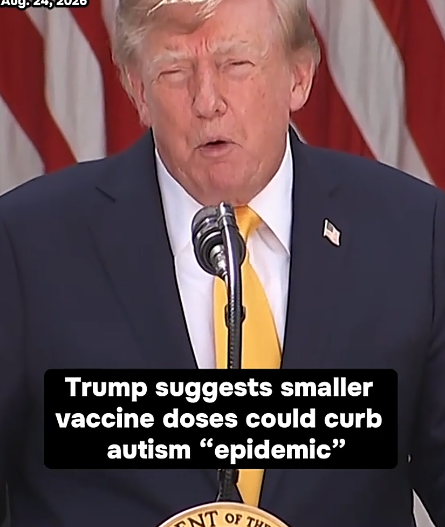
@cbsnews President Trump urged parents to request smaller doses of vaccines from doctors for their children, suggesting it could lower rates of autism at a back-to-school event on Monday in the White House Rose Garden. Trump signed an executive order in August recommending new childhood vaccine guidelines and limiting the number of vaccines recommended for children. The order does not mention autism, although Trump has repeatedly referenced it. Earlier in August, the American Academy of Pediatrics called the order “dangerous.”
President Donald Trump has once again placed childhood vaccines and autism at the center of a national debate, urging parents to consider asking doctors about smaller vaccine doses and spacing vaccinations across multiple visits. His comments have attracted renewed attention because they connect the way vaccines are administered with what he has repeatedly described as an “epidemic” of autism. However, medical experts and scientific research do not support the claim that childhood vaccines cause autism, nor is there evidence that giving standard vaccine doses in smaller amounts would prevent autism.
The remarks come as the Trump administration continues to pursue significant changes to federal childhood vaccination recommendations. Earlier this month, Trump signed an executive order directing federal agencies to promote what the administration calls “Gold Standard Childhood Vaccine Recommendations.” The order calls for reducing the number of diseases for which vaccines are routinely recommended for all children, separating the combined measles, mumps and rubella vaccine into individual shots, and administering vaccines during separate medical visits whenever feasible.
The policy has generated an intense response from physicians, public-health experts, vaccine researchers and parents. Supporters argue that families should have greater choice over medical decisions involving children and say that the government should reconsider the number and timing of childhood vaccinations. Critics, however, warn that changing a long-established vaccination schedule without strong scientific evidence could create confusion, increase the number of medical appointments required and leave children vulnerable to serious infectious diseases.
Trump’s latest comments add another layer to the controversy because his argument is not limited to vaccine scheduling. He has repeatedly suggested that changing the quantity and timing of vaccines could reduce autism rates. During remarks connected to the administration’s vaccine policy, he described giving children smaller portions of vaccines and spacing them over multiple visits, saying he believed the approach could have a major impact on autism. A transcript of his remarks shows Trump discussing a plan in which children would receive vaccines across several doctor visits rather than receiving them according to the standard schedule.
The claim has a long history. Trump has expressed concerns about vaccine dose sizes and the timing of childhood vaccinations for more than a decade. In previous comments, he argued that children should receive smaller doses over a longer period. Those statements have repeatedly drawn criticism from medical professionals because the proposed connection between vaccine administration and autism has not been supported by credible evidence.
The distinction is important because parents may hear the phrase “smaller doses” and assume that reducing the amount of vaccine given to a child is a medically established way to reduce health risks. It is not. Vaccine formulations and doses are developed through clinical research and regulatory review to produce an appropriate immune response. Altering the amount or schedule without medical guidance can change the protection a child receives and is not an established strategy for preventing autism.
FactCheck.org has specifically addressed Trump’s claims about vaccine dose sizes and combinations, noting that children do not receive the enormous quantities of vaccine material described in some of his remarks. Routine childhood vaccine doses are very small, and there is no evidence that the amount of vaccine material administered under established vaccination schedules causes autism.
The autism question itself is equally important.
Autism is a complex neurodevelopmental condition. Researchers have studied possible contributing factors for decades, and vaccines have been among the most extensively investigated potential explanations. The scientific evidence has not demonstrated that routine childhood vaccines cause autism. Fact-checkers and medical organizations have repeatedly noted that numerous studies involving large populations have failed to establish a causal relationship.
The persistence of the vaccine-autism claim can be traced in part to a now-discredited study that was published in the late 1990s and later retracted after serious problems were uncovered. Despite the collapse of that research, concerns about vaccines and autism continued to circulate publicly and eventually became part of political debates.
Trump has returned to the subject repeatedly.
During the administration’s recent vaccine announcements, he again referenced what he considers an increase in autism and argued that changes to childhood vaccination practices could reverse that trend. A transcript of his August remarks shows him comparing the number of vaccines children receive today with those given in earlier generations and suggesting that the difference helps explain modern autism rates.
That argument has been challenged because changes in autism diagnoses over time cannot simply be attributed to the number of vaccines children receive. Diagnostic definitions have changed, awareness has increased, screening has improved and more people have access to evaluations that previously may not have been available. Researchers continue studying autism’s causes and risk factors, but there is no scientific basis for saying that reducing vaccine doses will cause autism rates to fall.
The administration’s broader vaccine policy is nevertheless moving forward.
On August 10, Trump signed the executive order calling for the new “Gold Standard” recommendations. According to the White House, the order recommends routine immunization against 11 diseases and moves some other vaccines into a category involving shared clinical decision-making rather than recommending them universally for all children. It also calls for the combined MMR vaccine to be separated into individual measles, mumps and rubella shots and encourages vaccines to be administered during separate medical visits.
The White House has presented the policy as an effort to increase parental choice and align U.S. recommendations with what the administration considers better approaches used by other developed countries.
But critics have challenged that framing.
FactCheck.org reported that Trump’s statements surrounding the new policy included multiple misleading or false claims about the number of vaccines children receive, vaccine ingredients, the childhood immunization schedule and autism. The organization noted that children are not receiving the extraordinary number of vaccine doses suggested by Trump and that there is no evidence linking vaccine schedules or dose sizes to autism.
The controversy has also intensified because the United States is currently experiencing a serious measles resurgence. Reuters reported on August 25 that Pennsylvania recorded the first U.S. measles deaths of 2026, while the country had recorded more than 2,700 confirmed measles cases. Vaccination coverage has fallen in some communities, and health officials have warned that declining immunization rates can make outbreaks easier to sustain.
That context has made the debate over vaccine recommendations particularly consequential.
Measles is highly contagious. When vaccination rates remain high, communities benefit from population-level protection that makes it difficult for the virus to spread widely. When vaccination coverage declines, outbreaks become more likely, particularly in communities where vaccination rates fall below levels needed to maintain strong protection.
The timing of the policy changes therefore worries many public-health specialists.
The issue is not simply whether parents should have questions about vaccines. Parents have every right to ask physicians about benefits, risks, timing and possible side effects. The concern among medical professionals is that political claims unsupported by evidence may lead families to delay or refuse vaccines that protect children from dangerous infections.
The difference between asking questions and following an unsupported medical theory is significant.
Parents can discuss vaccination schedules with pediatricians. Doctors can consider individual circumstances, including medical conditions, allergies, previous reactions and other factors that may affect vaccine decisions. But deliberately altering a vaccine dose because of a belief that it will prevent autism is not supported by current evidence.
Trump’s comments have nonetheless resonated with some parents who have become increasingly skeptical of government health recommendations.
The broader “Make America Healthy Again” movement has called for greater scrutiny of vaccines, pharmaceutical products and federal health agencies. Health and Human Services Secretary Robert F. Kennedy Jr. has also spent years promoting vaccine skepticism and has made vaccine safety a major focus of his tenure.
Reuters reported on August 24 that Trump’s frustration with the administration’s progress on autism research contributed to the executive order issued earlier in the month. According to officials cited by Reuters, Trump believed the administration was not moving quickly enough to address what he views as possible contributors to autism. Kennedy and allies within the administration have continued pursuing studies into vaccines and autism despite the lack of established evidence that vaccines cause autism.
The disagreement is therefore occurring at the intersection of politics, public health and scientific research.
For parents, however, the issue is much more personal.
A vaccination decision concerns an individual child.
Parents must decide whether to follow a recommended schedule, whether to ask questions about individual vaccines, and how to respond when politicians, physicians and online commentators offer conflicting messages.
That makes clear and evidence-based information particularly important.
Vaccines are not risk-free, just as no medical intervention is completely without risk. Some people experience temporary reactions such as soreness, fever or fatigue, while serious adverse events can occur rarely. Medical professionals therefore monitor vaccine safety and continue studying potential risks.
But acknowledging that vaccines can have side effects is different from claiming that they cause autism.
Those are separate questions.
The scientific evidence supporting vaccine safety is based on large amounts of research, ongoing monitoring and decades of experience. The autism claim has repeatedly failed to demonstrate a causal relationship.
FactCheck.org noted that many studies have examined whether vaccines are associated with autism and found no connection. It also explained that the apparent increase in autism diagnoses over time cannot simply be interpreted as evidence that vaccines are causing more autism.
This distinction becomes especially important when discussing the word “epidemic.”
Trump has used the term to describe autism rates and has suggested that the increase must have been caused by something introduced into children’s lives. But describing autism as an epidemic in the same sense as a contagious infectious disease can be misleading.
Autism is not a contagious illness that spreads through a population in the way measles does.
The number of people identified as autistic has increased substantially over the decades, but researchers attribute much of the increase to factors including broader diagnostic criteria, greater awareness, improved screening and identification of people who may previously have gone undiagnosed.
There is ongoing scientific research into genetic, developmental and environmental factors associated with autism. But that research does not provide evidence that standard childhood vaccination causes autism.
The vaccine debate also involves the question of combination vaccines.
Trump’s executive order calls for separating the MMR vaccine into individual measles, mumps and rubella shots. The administration argues that parents should have greater choice regarding how vaccines are administered.
Public-health experts have raised concerns about the practicality and consequences of that approach.
The MMR vaccine has been used as a combination vaccine for decades. Its purpose is to protect children against three different diseases with fewer injections and fewer medical appointments. Separating the components would require additional shots and potentially additional appointments.
The practical consequences could be significant.
The Associated Press reported that bringing back separate versions of vaccines that have not been widely used in the United States for decades could require manufacturers to develop or revive production systems and obtain regulatory approvals. The report also noted that separating MMR into three vaccines could increase the number of medical visits required.
More appointments can create additional barriers for families.
Parents may need to take time away from work.
They may need transportation.
They may have difficulty finding appointments.
Children may become anxious about repeated injections.
And some families may simply fail to return for later doses.
That is one reason pediatricians worry that spacing vaccines too far apart could unintentionally reduce vaccination rates.
The issue is particularly significant for diseases such as measles, which can spread quickly among people who are not adequately protected.
Reuters reported that two unvaccinated Pennsylvania residents died from measles in 2026, the first measles deaths recorded in the state in 35 years. Nationally, confirmed cases had climbed above 2,700 by August 20.
The outbreak provides an important backdrop to the political discussion.
For decades, vaccines dramatically reduced the burden of diseases that once caused large numbers of childhood illnesses and deaths. Measles, in particular, had become uncommon in the United States because vaccination coverage was high.
Now, as vaccination rates decline in certain communities, the disease is returning.
This does not mean every decline in vaccination is directly caused by Trump’s statements or policies. Many factors influence vaccine decisions, including misinformation, distrust of institutions, access to health care, political beliefs and local outbreaks.
But public-health specialists argue that national leaders have an important role in communicating accurate information.
When a president suggests that changing vaccine doses could reduce autism, the statement can influence how parents understand medical risks.
That is why experts have emphasized the importance of distinguishing political opinion from medical evidence.
Trump himself has acknowledged that he is not a physician when discussing some of these claims. A transcript from his August remarks records him describing his statements as his own opinion rather than medical advice.
That distinction matters.
Parents should not treat a political statement as a substitute for individualized medical advice.
A pediatrician can explain which vaccines a child needs, why a particular dose is recommended, what side effects are expected, and whether a child’s medical history calls for a modified schedule.
The same principle applies to children with special medical circumstances.
Some children genuinely do require individualized vaccination plans. Physicians may delay or modify certain vaccines for specific medical reasons. But those decisions are based on established clinical considerations rather than a general theory that smaller doses prevent autism.
The idea that smaller doses are inherently safer also misunderstands how vaccines work.
A vaccine dose is not simply a quantity of liquid that can be reduced without consequences. It contains components designed to stimulate an immune response. The dose is established through research to achieve an appropriate level of protection.
Reducing a dose without evidence could mean that the immune system does not receive the intended stimulus.
That is why vaccine formulations and dosing schedules are carefully studied.
The debate over vaccine size also reflects a common misunderstanding of what is physically administered to children.
Trump has repeatedly used imagery suggesting that babies receive huge quantities of vaccine material. FactCheck.org has pointed out that routine vaccine doses are actually very small, generally around a fraction of a teaspoon rather than the “vat” or large volume Trump has described.
The visual image of a large amount of liquid being injected into a baby can understandably sound alarming.
But the image does not reflect the actual volume of routine vaccine injections.
The question of how many vaccines children receive also requires careful explanation.
Trump has referred to very large numbers of “vaccines” or “jabs,” but those figures can mix together vaccines, doses and recommendations in ways that make the schedule sound much larger than it actually is. FactCheck.org has noted that children do not receive the number of doses suggested by some of Trump’s public statements.
The administration’s new policy is therefore not simply about “smaller shots.”
It involves a much broader restructuring of how childhood immunizations are recommended.
The August 10 executive order seeks to reduce the number of diseases for which vaccines are routinely recommended for all children and place some vaccines under shared clinical decision-making. It also directs agencies to review vaccine timing and sequencing.
HHS has subsequently sought public input on possible changes.
On August 21, the department requested feedback on childhood vaccination recommendations following Trump’s executive order. The proposal includes consideration of whether some vaccines should be recommended in different categories or at different stages of childhood. Public comments are being solicited from parents, health professionals and other stakeholders.
That means the policy debate is still developing.
The executive order itself does not instantly rewrite every state vaccination requirement or force every doctor to administer vaccines in a new way. State governments have their own laws and requirements, and the federal government has historically played a major role in developing recommendations rather than directly controlling every medical decision.
California, for example, has continued defending its existing school vaccination requirements despite the federal changes. State health officials have warned that the federal announcements could create confusion among families.
Other states are also assessing what the changes could mean.
That creates another layer of uncertainty for parents.
A federal recommendation is not necessarily the same thing as a state school requirement.
A physician’s recommendation is not necessarily the same thing as a legal mandate.
And a political statement is not necessarily the same thing as medical evidence.
Parents navigating the issue therefore need to distinguish between these different levels of information.
The political debate is likely to continue.
Trump has made childhood vaccines a recurring issue, and Kennedy has made vaccine safety a central part of his administration’s health agenda.
The administration says it wants to give parents more control and improve confidence in the medical system.
Critics argue that the changes could undermine confidence in vaccines by suggesting that established recommendations are unsafe without providing convincing evidence.
Both sides recognize that trust is a major part of the issue.
If parents do not trust public-health institutions, they may hesitate to follow recommendations.
If they believe politicians are exaggerating risks, they may ignore warnings.
If medical experts dismiss parents’ concerns without explaining the evidence clearly, distrust can grow.
The challenge is therefore not simply to tell people what to believe.
It is to provide understandable information about what is known, what is uncertain and what has been thoroughly studied.
On autism and vaccines, the evidence is much clearer than the political debate suggests.
The available research does not establish that vaccines cause autism.
There is also no established evidence that reducing vaccine doses or spacing them out prevents autism.
FactCheck.org’s review of Trump’s August statements specifically concluded that there was no evidence supporting the idea that splitting MMR or changing vaccine dose sizes would reduce autism.
That does not mean researchers have answered every question about autism.
They have not.
Autism remains an active field of research, and scientists continue studying genetics, development, environmental influences and other potential contributors.
But uncertainty about some causes does not automatically make every proposed explanation equally plausible.
A hypothesis must be tested.
It must be supported by reproducible evidence.
And claims involving medical treatments must be evaluated carefully because changing treatment can have consequences.
This is especially true for children.
A delayed vaccine may mean a child remains susceptible to an infectious disease for longer.
That risk has to be weighed against the claimed benefit of changing the schedule.
If the claimed benefit is preventing autism but there is no evidence that the schedule causes autism, then the rationale for delaying protection becomes weak.
The measles outbreak illustrates why timing matters.
Children who are not vaccinated remain vulnerable to infection, particularly when they are exposed during an outbreak.
Measles can cause serious complications, including pneumonia and inflammation of the brain. Reuters reported that the United States was experiencing its highest number of measles cases in more than three decades in 2026.
That makes the current vaccine discussion more than an abstract political argument.
It is happening while a vaccine-preventable disease is causing serious illness and deaths.
For parents, the safest approach is to discuss concerns directly with a qualified pediatrician or other health professional who can consider the child’s individual circumstances.
Parents can ask about ingredients.
They can ask about side effects.
They can ask whether vaccines can be administered at different visits for legitimate medical reasons.
They can ask what happens if a dose is delayed.
And they can ask how a child’s medical history affects the recommended schedule.
But they should be cautious about changing vaccine doses based solely on claims made in political speeches or social media videos.