The $34 Hamburger Dispute: How an Airport Restaurant Confrontation Turned Into a Police Matter
Introduction
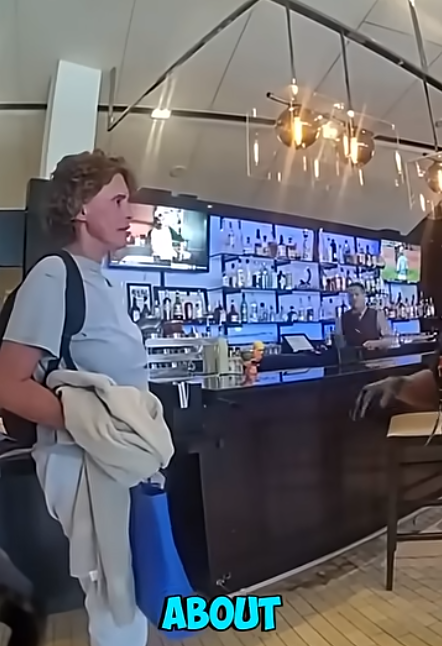
A short video showing a tense confrontation inside an airport restaurant has drawn attention because it captures a situation that begins with something ordinary: a restaurant bill. What appears at first to be a minor dispute over a $34 hamburger quickly becomes a larger conflict involving restaurant staff, a passenger who refuses or is unable to pay, and police officers arriving to intervene. The incident is striking not only because of the amount of money involved, but because of the way the passenger argues that the situation should not be treated as a criminal matter.
The video appears to show a passenger at an airport restaurant after ordering food and failing to provide valid payment. According to the exchange described in the scene, the passenger had apparently claimed that the bill could be charged to a hotel room or guest room connected to the airport facility. However, staff members inform the passenger that the room they named is empty. When asked to provide another form of payment, the passenger admits that they do not have one. From that moment, the restaurant staff treats the matter as a refusal to pay, while the passenger frames it as a billing issue that can be settled later.
What makes the confrontation especially dramatic is the passenger’s confidence. Rather than appearing apologetic or attempting to find a practical solution, the passenger challenges the staff member’s authority and insists that no one can be arrested simply because of a hamburger. The passenger argues that the restaurant should provide a bill, allow time for payment, and handle the matter like an ordinary debt. The staff member rejects that interpretation, making clear that the restaurant cannot simply allow a customer to leave after consuming food without payment. As the exchange intensifies, staff members warn that police will be called.
The situation then moves from a customer service dispute into a possible law enforcement matter. Police arrive, and the passenger continues arguing their theory of the situation while officers begin giving instructions. The passenger is told to put down their backpack, a command that often signals officers are preparing to control the scene more firmly. The video appears to move toward an imminent arrest, with the issue no longer centered only on the price of the hamburger but on the passenger’s refusal to settle the bill and comply with instructions.
This incident raises questions about personal responsibility, public behavior, airport security, restaurant policies, and the misunderstanding many people have about unpaid bills. It also illustrates how quickly a small conflict can escalate when one side believes the matter is merely civil and the other side believes a crime may have occurred. In an airport, where security concerns are heightened and police presence is common, such a dispute can develop faster and more seriously than it might in an ordinary restaurant on a city street.
A Simple Meal Becomes a Public Confrontation
The starting point of the confrontation is a restaurant meal, reportedly involving a hamburger priced at $34. Airport food is often expensive, and many travelers complain about the high cost of meals in terminals. A $34 hamburger may sound excessive to many viewers, and that detail is likely one reason the video attracts attention. However, the price of the meal does not change the basic expectation of a restaurant transaction. A customer orders food, receives the food, consumes it, and then pays the amount owed.
In the video, the passenger seems to believe that the restaurant should treat the situation with flexibility. They appear to suggest that since the bill is not huge in the broader sense, and since it involves food rather than a luxury item, the staff should simply issue a bill and give them a deadline to pay. The passenger’s argument depends on the idea that nonpayment is a temporary financial problem rather than a deliberate refusal. From their perspective, the restaurant should not involve police over something as small as a hamburger.
The staff member, however, views the matter differently. Restaurants operate on immediate payment unless an approved billing arrangement exists in advance. A customer cannot generally decide after eating that payment will be made later. If the passenger claimed to be staying in a room and that room was empty, staff would reasonably see that as a failed payment attempt. Once the passenger admitted they had no other form of payment, the situation became more serious. The restaurant had already provided the food, and there was no confirmed way to collect the money.
The public setting also matters. Airport restaurants serve travelers who may leave the location quickly, board flights, and become difficult to contact. A restaurant outside an airport might still face difficulty collecting an unpaid bill, but an airport setting increases the risk that the customer will disappear. A passenger who is waiting for a flight or moving through a terminal is not in the same position as a local resident who can easily return the next day. This makes immediate payment even more important.
The confrontation becomes public because neither side backs down. The staff member insists that the bill must be settled. The passenger insists that the staff cannot treat the issue as grounds for arrest. The disagreement is not just about money anymore. It becomes a clash over rules, authority, and consequences.
The Failed Room Charge and the Question of Payment
One of the central details in the incident is the passenger’s claim that the meal could be charged to a room. The staff reportedly checks the room and finds that it is empty. This is a critical turning point because it suggests that the passenger may have attempted to use a payment method that was not valid. Whether the passenger misunderstood their room status, provided the wrong room number, or knowingly gave false information is not clear from the description alone. However, for the staff member, the result is the same: the bill remains unpaid.
A room charge is not a casual promise. It is usually connected to an established account, a registered guest, and a method of payment already on file. Hotels and airport hospitality services typically require guests to provide a credit card or deposit before allowing charges to be added to a room. When a restaurant allows room charging, it does so because the business expects the hotel or account system to guarantee payment. If the room is empty or inactive, the restaurant cannot rely on that method.
Once the staff tells the passenger that the room is empty, the staff member asks for another form of payment. This is a normal step. The restaurant is not immediately assuming the worst; it is giving the customer an opportunity to resolve the issue. The passenger could provide a credit card, debit card, cash, digital wallet, or another approved payment method. Instead, the passenger admits that they do not have another form of payment available.
That admission changes the tone of the exchange. It is one thing for a card to decline or for a room charge to fail temporarily. It is another thing for a customer to state that they have no way to pay after the food has already been served. At that point, the staff may suspect that the customer ordered food without the ability or intention to pay for it. Even if the passenger did not intend to steal, the restaurant cannot simply ignore the unpaid bill.
The passenger’s response suggests that they believe lack of payment should create a debt, not a criminal matter. They seem to think the restaurant should record the amount owed and allow them time to pay later. That may sound reasonable to someone who views the restaurant as a creditor and the passenger as a debtor. However, restaurants are not required to extend credit to customers who have not arranged it beforehand. A business that sells food for immediate payment can refuse to convert an unpaid meal into a private loan.
This is the heart of the dispute: the passenger sees the bill as something that can be delayed, while the staff sees payment as due immediately. The difference between those two interpretations drives the confrontation forward.
The Passenger’s Legal Theory
The passenger’s most memorable argument is that no one can be arrested over a hamburger. This statement likely resonates with viewers because it sounds both humorous and defiant. A hamburger is a common item, and $34 is not a massive sum compared with many other airport expenses. The passenger seems to use the smallness of the item to argue that the response is excessive. In their view, calling police over a meal is unreasonable.
However, the issue is not simply the hamburger itself. The issue is whether the passenger obtained a service or product and then refused or failed to pay for it. In many places, leaving a restaurant without paying can be treated as theft of services, defrauding an innkeeper, or a similar offense, depending on local law. The exact legal label can vary, but the general concept is familiar: a person cannot knowingly receive food, lodging, transportation, or another service and then avoid payment.
The passenger’s argument appears to rely on a misunderstanding of the difference between a civil debt and a potentially criminal act. A civil debt usually arises when one party owes another money under a contract or agreement. For example, if someone borrows money, receives an invoice, or fails to pay a bill after services are provided under agreed terms, the remedy may be a civil lawsuit or collection process. But when someone obtains goods or services under circumstances suggesting deception or refusal to pay, the matter may cross into criminal territory.
The staff member’s response, described as “that is not how this works,” captures the restaurant’s position. The restaurant is not offering an installment plan. It is not accepting the passenger’s promise to pay later. It is demanding payment for food already consumed. If the passenger cannot pay, staff may call law enforcement and report the situation.
The passenger’s legal theory also overlooks the importance of intent and circumstances. A person who accidentally leaves a wallet at home and immediately offers a credible solution may be treated very differently from someone who gives invalid room information, admits they have no payment, dismisses staff concerns, and refuses to cooperate. The video description suggests that the passenger does not simply explain an honest mistake. Instead, they challenge the staff and insist that the restaurant lacks authority to involve police.
This confidence may make the passenger appear bold, but it may also make the situation worse. When a customer refuses to acknowledge the seriousness of nonpayment, staff members have fewer reasons to trust that the matter will be resolved voluntarily. A calm apology and a practical offer might de-escalate the situation. A combative legal lecture can do the opposite.
The Staff Member’s Position
The restaurant staff member is placed in a difficult position. On one hand, the amount of money is not enormous. On the other hand, the staff member has a responsibility to enforce the restaurant’s policies and protect the business from losses. If staff allow one customer to eat without paying, they may encourage others to do the same. Restaurants operate on narrow margins, and unpaid meals are not harmless simply because the bill seems small to outsiders.
The staff member also has limited options. They cannot force the passenger to produce money. They cannot personally detain the passenger without risk. They cannot simply accept an uncertain promise to pay later unless the business authorizes that arrangement. Calling police may be the most practical option when a customer refuses or cannot pay and no immediate solution exists.
The staff member’s warning that police will be called is not necessarily a threat in the emotional sense. It is a statement of consequence. The restaurant has provided a product, the customer has consumed it, and payment has not been made. If the customer cannot resolve the matter, staff may involve law enforcement. This is especially likely in an airport, where police or security personnel are nearby and are responsible for maintaining order.
From the staff member’s perspective, the passenger’s claim that they should simply be billed later is not acceptable. Businesses generally choose when and how to extend credit. A customer cannot unilaterally decide that payment terms have changed after receiving the meal. If that were allowed, restaurants would constantly be forced into debt collection over small bills, a process that would be inefficient and unfair.
The staff member’s insistence that “that is not how this works” reflects a basic principle of everyday commerce. When a person orders food at a restaurant, payment is expected according to the restaurant’s rules. If the restaurant accepts payment after the meal, that does not mean it accepts payment days later. If the restaurant accepts room charges, that does not mean it accepts charges to empty rooms. If the customer cannot pay, the staff is not required to treat the incident as a harmless misunderstanding.
The staff member also has to consider safety and professionalism. Confronting a customer can be uncomfortable and risky. Staff members are often trained to avoid physical escalation and call security or police when a dispute becomes serious. In this case, the staff member appears to rely on official intervention rather than attempting to handle the matter alone.
Why Airport Settings Make Conflicts More Serious
An airport is not an ordinary public place. It is a controlled environment where security, identification, travel schedules, and law enforcement presence all shape how incidents are handled. A dispute that might be resolved casually in a neighborhood café can become more serious inside an airport terminal because passengers are transient and security protocols are strict.
Travelers are often stressed, tired, rushed, or frustrated. They may be dealing with delays, cancellations, long lines, missed connections, or expensive purchases. Airport restaurants are also high-pressure environments. Staff must serve large numbers of customers quickly, often while dealing with people who are watching the clock. This creates conditions where small disagreements can escalate quickly.
The passenger in the video may have believed the restaurant had little leverage. They may have thought that because the bill was small, staff would eventually let the matter go. But in an airport, staff can call police or airport security almost immediately. Officers are often stationed nearby, and response times may be short. The presence of law enforcement changes the balance of the confrontation.
Airports also have a strong interest in preventing disorder. A person refusing to comply with staff and arguing loudly in a terminal restaurant can draw attention, disrupt other travelers, and create uncertainty. Security personnel may not know at first whether the person is merely argumentative or potentially dangerous. That is one reason officers often give clear commands, such as instructing someone to put down a backpack. A backpack could contain ordinary travel items, but officers do not know that until the scene is controlled.
The instruction to put down the backpack suggests that police are moving beyond discussion and toward command presence. They may be preparing to detain the passenger, search for identification, or ensure that the person does not reach into a bag during the encounter. Whether or not an arrest happens immediately, such a command indicates that the situation has become serious.
For the passenger, continuing to debate legal theory at that point is risky. Once police arrive and begin giving instructions, the focus shifts from the restaurant bill to compliance. A person may still explain their side, but ignoring commands or continuing to argue can create additional problems. Even a minor original incident can lead to more serious consequences if the person refuses to cooperate with officers.
Theft of Services and the Misunderstanding of “Small” Offenses
Many people assume that police will not get involved in a dispute over a small amount of money. This assumption is understandable but not always accurate. The law often distinguishes between levels of offenses based on value, but low-value incidents can still be crimes. A small theft may be a minor offense, but it can still result in citation, arrest, court appearances, fines, or other penalties.
The phrase “theft of services” generally refers to obtaining services without paying for them. Restaurants provide both goods and services: food, preparation, seating, staff attention, and hospitality. When a customer consumes a meal and then refuses to pay, the business may treat the incident as more than a simple unpaid invoice. The key issue is whether the customer knowingly avoided payment or used deception to obtain the meal.
In this incident, the passenger reportedly claimed to be connected to a room that was later found to be empty. If that claim was false or unsupported, staff may interpret it as deception. Even if the passenger believed the room charge would work, they still had a responsibility to provide valid payment when it did not. Their admission that they had no other payment method leaves the restaurant without a solution.
The passenger’s argument that the restaurant should provide a bill and a timeframe to pay later misunderstands the nature of consent in business transactions. A creditor relationship requires the business to agree to delayed payment. Without that agreement, the customer has no right to impose payment terms. The restaurant is entitled to say that payment is due now.
Small offenses also matter because they affect public order and business operations. If people believed they could avoid paying restaurant bills by arguing that the amount was too low for police involvement, restaurants would face constant abuse. The legal system may treat low-value offenses differently from high-value theft, but it does not necessarily ignore them.
The passenger’s attitude may also influence how the situation is handled. A person who shows remorse and tries to solve the problem may be treated with patience. A person who mocks the staff, challenges their authority, and insists there can be no consequences may invite a firmer response. Law enforcement often considers not only the underlying act but also the person’s behavior during the encounter.