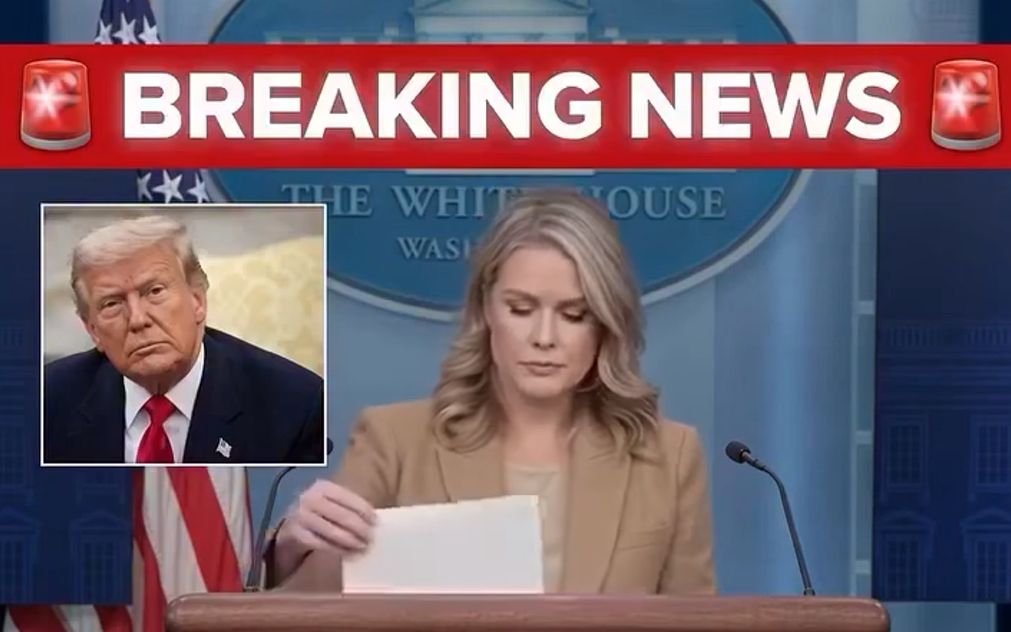
White House Press Secretary Karoline Leavitt has placed herself at the center of a major debate over who should be allowed to question the president and how access to the nation’s most powerful political institution should be distributed. Her argument is straightforward: the American media landscape has changed dramatically, but the White House press system has not changed enough with it. Millions of people now obtain political information through podcasts, independent websites, newsletters, streaming programs, social-media accounts and other digital platforms rather than relying exclusively on television networks and major newspapers. Leavitt says the White House must recognize that transformation by opening its doors to a broader range of journalists and content creators.
The proposal initially sounded like an effort to make presidential coverage more inclusive. Regional reporters, independent journalists and emerging digital organizations have often struggled to obtain the same opportunities available to large Washington-based institutions. The limited number of seats in the White House briefing room has historically favored organizations with the money and personnel necessary to maintain permanent operations in the capital. A local newspaper, small online publication or independent reporter may serve a significant audience without having the resources to compete for daily access.
Leavitt argued during her first formal briefing in January 2025 that Americans, especially younger audiences, increasingly consume news through nontraditional sources. She announced that independent journalists, podcasters, bloggers, influencers and other creators producing news-related material could apply for White House credentials. She also introduced a designated “new media” seat near the front of the James S. Brady Press Briefing Room, with participants selected after an application review and the necessary Secret Service screening.
The announcement gave the administration an opportunity to present itself as responsive to technological and cultural change. A person recording a political podcast from a home studio can now reach an audience larger than that of some local television stations. A digital publication can publish breaking news within seconds, while independent reporters can develop expertise in subjects neglected by major organizations. From Leavitt’s perspective, excluding those voices simply because they do not belong to the traditional Washington press establishment would preserve an outdated system.
Her case also relied on declining public confidence in established media. Trust in journalism has become increasingly divided along political lines, and many Americans believe national news organizations approach political events with predetermined ideological assumptions. Trump supporters have frequently accused major networks and newspapers of treating the president more aggressively than Democratic leaders. By giving access to outlets that speak to audiences distrustful of conventional media, Leavitt argued that the White House could communicate with people who might otherwise ignore or reject its message.
Supporters praised the plan as a form of media democratization. They argued that the briefing room should not operate as a private club controlled by a small number of companies. New media personalities may ask questions that established correspondents overlook, use language that feels more accessible to ordinary viewers and focus on issues important to audiences outside Washington. Greater variety could prevent political coverage from being shaped entirely by the priorities of a relatively narrow professional class.
There is genuine value in expanding participation. A reporter from a rural newspaper may ask how an agricultural policy will affect family farms. A journalist serving a border community may approach immigration from a different perspective than a national television correspondent. A technology publication may ask detailed questions about artificial intelligence, cybersecurity or digital privacy. An independent financial journalist may examine the practical consequences of taxes, tariffs and government spending. These questions can make presidential communication more relevant to a wider public.
The modern media environment also makes rigid distinctions between “real journalism” and “new media” increasingly difficult to maintain. Some respected reporters publish primarily through newsletters or podcasts. Former newspaper journalists have created independent subscription-based publications capable of supporting detailed investigative work. Nonprofit newsrooms produce important regional reporting, while specialized digital outlets often understand technical subjects better than general-interest organizations. A fair access system should not assume that professional journalism can exist only inside an old institution.
Yet the controversy surrounding Leavitt’s policy is not primarily about whether independent journalists deserve opportunities. Many critics agree that the White House press corps should include more regional, digital and nontraditional voices. Their concern is about who controls the selection process and whether an administration can use the language of inclusion to reward friendly coverage while reducing access for organizations that ask difficult questions.
That concern became more serious when the White House announced that its own communications team would take greater control over the small presidential press pool. The pool is different from the full briefing room. Because spaces such as the Oval Office, Air Force One and certain motorcade locations cannot accommodate every credentialed journalist, a rotating group of reporters enters on behalf of the wider press corps. Pool reporters then distribute observations, presidential comments and other information to colleagues who could not attend.
For decades, the White House Correspondents’ Association played an important role in organizing that rotation independently of the administration being covered. The arrangement was imperfect, but it created distance between the government and the process of deciding which reporters would stand closest to the president. When Leavitt announced that the White House would determine pool participation, critics argued that the executive branch was gaining the power to choose the journalists responsible for scrutinizing it.
Leavitt defended the decision by saying a small group of established organizations should not permanently control access. She maintained that the administration wanted to give additional outlets an opportunity to participate and that the president’s communications team had the authority to decide who entered restricted government spaces. From that viewpoint, control by the correspondents’ association was not a constitutional requirement but an inherited custom that could be reconsidered.
The practical argument has some force. No journalist has an unlimited right to enter every room occupied by the president. Security requirements, physical capacity and scheduling constraints make restrictions unavoidable. Even the largest media organizations cannot expect every reporter and photographer to attend every meeting. Someone must create rotations, enforce safety rules and determine how many people can enter.
The harder question is whether those unavoidable restrictions are administered according to neutral and transparent standards. If access depends on available space, security clearance and a fair rotation, the policy can be defended as a practical necessity. If access depends on whether the administration approves of an outlet’s language, tone or editorial decisions, it becomes a possible instrument of retaliation.
The confrontation between the White House and The Associated Press demonstrated why that distinction matters. The dispute began after President Donald Trump directed federal agencies to use the name “Gulf of America” for the body of water historically and internationally known as the Gulf of Mexico. The AP decided to continue using the longstanding name while also acknowledging Trump’s decision in its reporting. The organization explained that it serves an international audience and that countries outside the United States were not required to recognize the new terminology.
The White House responded by restricting AP reporters from certain presidential events. Leavitt defended the administration’s position, arguing that access to the Oval Office was a privilege rather than an automatic right. She said the White House could decide which reporters entered the room and criticized outlets that refused to adopt the administration’s preferred geographical name.
For the administration, the dispute involved accuracy and recognition of an official presidential action. For the AP, it involved editorial independence and the government’s ability to punish a news organization for refusing to use government-approved language. The organization argued that public officials cannot condition journalistic access on agreement with the administration’s terminology or political viewpoint.
The disagreement moved into federal court. A district judge initially ruled that once the White House opened certain events to selected journalists, it could not exclude an organization because of its protected editorial choices. The decision did not require the president to admit every reporter to every event, but it said the government could not use viewpoint discrimination when distributing access among comparable journalists.
The legal situation became more complicated on appeal. In June 2025, a divided federal appeals panel allowed the administration to maintain restrictions involving locations such as the Oval Office and Air Force One while the case continued, although the ruling treated access to some larger spaces differently. The full appeals court later declined to remove those restrictions at that preliminary stage. The decisions did not settle every underlying constitutional question, but they demonstrated the uncertainty surrounding presidential control of limited-access spaces.
The AP controversy transformed an abstract argument about media modernization into a concrete dispute over government power. Expanding access to independent voices sounds democratic when additional journalists are being welcomed. It appears less democratic when an established news organization loses access after making an editorial decision the administration dislikes. Both developments can occur simultaneously: new voices can be added while critical voices are placed at a disadvantage.
This is why the number of admitted journalists cannot be the only measure of openness. An administration might credential hundreds of creators and still avoid meaningful accountability if it consistently selects friendly participants, refuses follow-up questions or excludes reporters known for challenging officials. Access is valuable only when journalists remain free to use it independently.
The role of a White House reporter is not simply to help distribute the president’s preferred message. Press secretaries naturally want to explain policies, defend decisions and highlight achievements. Journalists have a different responsibility. They must test official claims, identify contradictions, ask for evidence and examine the consequences of government action. The tension between those functions is not a defect in democratic communication. It is one of its essential features.
Leavitt’s description of the policy occasionally emphasized the goal of taking Trump’s message to as many people as possible. That is a legitimate communications objective for a presidential administration, but it is not identical to the public interest in independent reporting. A content creator invited primarily because of an ability to reach a supportive audience may behave differently from a reporter whose organization expects persistent questioning and verification.
This does not mean traditional outlets are always independent, fair or rigorous. Large news organizations can make serious mistakes, follow fashionable assumptions, overemphasize political conflict or devote excessive attention to stories that generate clicks and television ratings. Their reporters can also become too close to official sources. Long experience and institutional reputation do not guarantee perfect journalism.
However, established news organizations often possess resources that remain important. They employ legal teams, fact-checkers, editors, investigative reporters, foreign correspondents and specialists capable of examining complicated government programs. They can pursue lawsuits for public records, protect confidential sources and continue expensive investigations for months. Replacing those institutions with creators who have large audiences but little editorial support could weaken scrutiny rather than improve it.
The strongest press system would therefore combine the advantages of both worlds. It would preserve experienced correspondents and wire services while creating meaningful opportunities for independent, regional and specialized reporters. It would not treat new media as decoration, but neither would it use new media to displace organizations regarded as politically inconvenient.
Clear written standards could reduce suspicion. The White House could explain which qualifications applicants must meet, how often participating outlets rotate, how decisions are reviewed and what behavior can result in suspension. Security requirements should be separated from editorial judgments. An outlet should not receive favorable treatment merely because its coverage pleases the president, and it should not lose access simply because officials dislike its terminology or conclusions.
A fair system would also include a method for challenging decisions. When a reporter is excluded, the White House should provide a specific explanation. The journalist should have an opportunity to correct factual misunderstandings or respond to allegations. Decisions based on safety or disruption should rely on documented conduct rather than political criticism. Procedural safeguards would protect both the administration and the press by reducing claims of arbitrary treatment.
Transparency is especially important because the government possesses enormous informational advantages. The president and senior officials decide when meetings occur, which documents are released and when policies are announced. Reporters already depend on the administration for access to many events. Allowing the same officials to select participants without visible rules increases the risk that the public will receive a carefully controlled picture rather than a complete account.
The press pool serves a vital function in limiting that control. When a pool reporter accompanies the president, the journalist is not reporting solely for one employer. The observations are shared with the broader press corps, allowing many organizations to inform their audiences. Pool reports may record remarks that were not included in official transcripts, identify who attended a meeting or describe an unexpected interaction. Reducing the independence of the pool could affect news coverage far beyond Washington.
Wire services such as the AP and Reuters have historically been especially important because their reports reach thousands of newspapers, broadcasters, websites and financial organizations. A local newsroom that cannot afford a permanent White House correspondent may rely on wire reporting to cover the presidency. Restricting a wire service therefore affects not only one company but potentially a vast network of smaller outlets.
Leavitt and her supporters respond that old arrangements also concentrated power. A small collection of national organizations could dominate daily questioning and decide which developments deserved immediate attention. Reporters outside that system might receive credentials but rarely obtain a question. From this perspective, changing the pool and briefing-room practices challenges an entrenched hierarchy rather than attacking journalism itself.
That criticism should not be dismissed. Media institutions sometimes defend their own privileges while describing them as universal press freedom. A permanent front-row position offers commercial value and prestige, and organizations naturally resist losing it. Reforms that introduce fair competition and broader representation may be justified even when existing participants object.
The decisive word, however, is “fair.” An independent association dominated by large outlets may require reform, but transferring complete control to the political officials being covered creates another conflict of interest. A better solution might involve a mixed structure in which traditional correspondents, new-media representatives, regional journalists and neutral administrators participate in designing the rotation.
The White House could reserve places for different categories without selecting individual participants according to political friendliness. One position might rotate among wire services, another among television networks, another among local newspapers, another among radio organizations and another among digital or independent outlets. Published schedules could show how organizations are chosen and how often they participate.
Such a system would support Leavitt’s stated objective of expanding access while responding to fears of retaliation. It would acknowledge that journalism has changed without discarding the principle that the government should not choose its preferred questioners. It would also encourage new outlets to develop professional standards because access would depend on consistent rules rather than personal relationships with administration officials.
Professional standards do not require new-media journalists to copy traditional organizations. Independent reporters may have clear political views, use a conversational style or serve a particular community. The essential requirements should be honesty about their identity, responsible handling of information, correction of serious errors and a willingness to distinguish reporting from promotion.
Traditional outlets should be judged by the same expectations. A network should not receive permanent privileges merely because it has existed for decades. Its reporters should also correct errors, disclose relevant conflicts and maintain independence from political campaigns. The debate should not be reduced to an assumption that legacy media are automatically trustworthy while digital media are automatically irresponsible, or the reverse.
Leavitt’s communication strategy reflects Trump’s broader understanding of modern politics. Trump has long preferred direct communication through rallies, social platforms, friendly interviews and extended conversations with media personalities. His campaigns recognized that podcasts and online programs can reach audiences who rarely watch traditional political broadcasts. Bringing those outlets into the White House continues the same approach after the election.
Politically, the strategy offers clear advantages. A long podcast conversation may allow administration officials to explain policies without the rapid confrontation of a televised briefing. Influencers can distribute short clips to millions of followers, while sympathetic hosts can frame administration announcements positively. The White House can reach demographic groups that may not read national newspapers.
The democratic value of those conversations depends on whether they supplement scrutiny or replace it. There is nothing wrong with officials appearing on friendly programs, just as politicians have always granted interviews to outlets whose audiences they want to reach. The danger arises when favorable access is combined with punishment for journalists who ask unwelcome questions or publish information that contradicts official claims.
Previous administrations also tried to manage media coverage. Presidents from both parties have selected interviewers strategically, limited access to sensitive meetings, complained about negative stories and used emerging technologies to communicate around the press. The Obama administration developed sophisticated digital messaging, while the Biden administration faced criticism from reporters who believed access was limited and public appearances were tightly managed.
Those comparisons provide useful context but do not resolve the present argument. Past restrictions do not automatically justify new ones. Each administration should be judged according to whether its policies increase public understanding, preserve independent scrutiny and apply neutral standards. Press freedom can be weakened gradually when each government cites the behavior of its predecessor as permission to go further.
Leavitt is an effective advocate for the administration’s position because she presents the changes as a conflict between an old establishment and a more representative modern public. That framing resonates with Americans who believe national media organizations have ignored or misrepresented their views. It also places critics in the uncomfortable position of appearing to defend exclusive institutional privileges.
Critics counter that the central issue is not whether podcasters belong in the room. It is whether the White House can decide that favorable podcasters belong while an independent news agency does not. They argue that expanding the range of media should be welcomed, but that inclusion loses credibility when it occurs alongside viewpoint-based exclusion.
Both sides are discussing real problems. The traditional White House press structure has not always represented the full diversity of American communities or modern news consumption. At the same time, government control over journalistic access can threaten the independence necessary for meaningful accountability. Recognizing one problem does not require ignoring the other.
The debate also reveals a broader transformation in the meaning of journalism. In the past, access to mass audiences generally required a printing press, broadcast license or large corporate organization. Today, one person with a microphone and internet connection can produce national political coverage. Institutional barriers have fallen, but traditional systems for establishing credibility have weakened as well.
Audiences now have more choices but also face more difficulty determining which sources are reliable. Some independent creators perform careful research and correct their mistakes. Others mix unverified claims with entertainment, partisan promotion or advertising. Large organizations also vary widely in quality. White House credentialing cannot solve the entire credibility problem, but its criteria inevitably send a signal about what the government considers legitimate news activity.