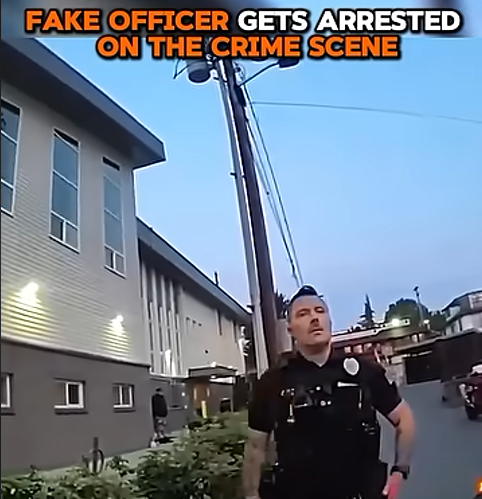
A Badge, a Gun, and a Story That Starts to Collapse
Few things create more immediate tension at a police scene than an armed man claiming authority that may not be real. In moments where officers are already managing uncertainty, the appearance of someone presenting himself as law enforcement changes the entire risk structure instantly. Authority matters at scenes like this, but false authority can be even more dangerous than open noncompliance because it is designed to bypass scrutiny before scrutiny has a chance to do its job.
That is what makes this encounter so compelling from the start.
A man identified as Mezi Scalleta is at the scene, armed, and presenting himself not as a bystander, not as a civilian, but as someone with law enforcement credentials. He claims he is working off-duty security for the Salvation Army. He claims prior work at KRM. Most importantly, he claims to be a retired Baltimore City police officer with 24 years of service behind him.
On its face, that kind of claim carries weight.
It signals institutional legitimacy.
Experience.
Authority.
It tells everyone in earshot that the man is not simply armed—he is armed with the implied credibility of a career in law enforcement.
And in police settings, that distinction matters immediately.
Because an armed civilian creates one kind of concern.
An armed man claiming police identity creates another entirely.
Why Claimed Authority Changes the Risk Instantly
The moment someone identifies himself as law enforcement—especially former law enforcement—the entire encounter changes.
That is because police scenes run on hierarchy, recognition, and trust. Officers make decisions in fast-moving environments based in part on who belongs there, who has legitimate authority, and who can be safely interpreted as part of the law enforcement structure around them.
A person claiming to be a retired officer inserts himself into that structure instantly.
That claim carries implications:
- he understands police procedure,
- he understands command presence,
- he understands scene discipline,
- and he may have legitimate reasons to be armed and engaged.
That is why false claims of law enforcement identity are uniquely dangerous.
They are not just lies.
They are operational disruptions.
A fake claim to police authority is an attempt—whether deliberate or instinctive—to borrow trust from the institution in order to reduce scrutiny from the people who depend on that trust most.
That is what makes the lie more serious than ordinary deception.
It is not just false biography.
It is false authority in a space where authority directly shapes risk.
Why Officers Move to Control the Weapon First
One of the most important details in the encounter is that officers do not begin by debating the man’s story.
They begin by controlling the gun.
That response is immediate, practical, and telling.
Because regardless of who the man claims to be, one fact matters before all others: he is armed.
That is the first problem officers solve.
They place him on the car and direct him to keep his hands visible while they sort out who he is and whether any part of his story is true. This is one of the clearest examples of how police manage uncertainty under pressure. They do not resolve identity first.
They resolve access to force first.
That sequence matters.
Because credentials can be checked.
Stories can be verified.
Background can be investigated.
But an armed person standing unsecured at a live scene creates a risk that cannot wait for biography to be sorted out.
So officers do what trained officers are supposed to do in moments like this:
secure the immediate threat variable,
then investigate the narrative.
That alone says a great deal about how police prioritize uncertainty when the person creating it is armed.
The Most Dangerous Lie Is the One That Sounds Plausible
What makes this encounter especially interesting is that the man’s story is not wildly unbelievable at first. It is specific, structured, and delivered with the kind of detail that makes it sound plausible enough to delay immediate rejection.
That is what makes false authority effective.
He does not make vague claims.
He gives institutional anchors.
He names the Salvation Army.
He references prior work at KRM.
He claims retirement from Baltimore City Police after 24 years.
These are not random assertions. They are the kind of details designed to create credibility through familiarity and specificity. The more grounded the lie sounds, the more social friction exists around challenging it immediately.
That is what makes plausible deception dangerous in police settings.
A weak lie collapses fast.
A strong lie buys time.
And when the person telling it is armed, time matters.
Why Police Start Testing the Story Instead of Accepting It
The moment officers begin asking about his background in detail, the interaction shifts from temporary control to active verification.
That is the point where the claim stops being provisionally tolerated and starts being tested.
This is where trained skepticism becomes visible.
Officers do not simply accept the institutional language at face value. They begin probing for continuity, history, and contradiction. That is what makes the questioning about prior incidents so important.
They ask about 2015.
They ask about Baltimore.
They ask about his history during the riots.
And this is where the interaction starts to change shape.
Because the questions are no longer about who he says he is.
They are about whether his past behaves like the past of the person he claims to be.
That is a much harder thing to fake.
Anyone can tell a plausible story.
It is much harder to survive detailed scrutiny once someone starts checking whether the story holds under pressure.
The Collapse Begins With Contradiction
The most revealing part of encounters like this is rarely the initial claim. It is the first contradiction.
That is where credibility begins to fracture.
The man presents himself as a veteran retired officer. He speaks with the authority of someone who expects that identity to carry weight. But once officers begin probing deeper, the narrative begins to split.
He denies being arrested.
That denial matters because it is not a small factual error.
It is a credibility hinge.
A person may exaggerate.
A person may inflate.
A person may obscure.
But denying arrest history in a context where officers already appear to know otherwise is not just omission.
It is collision.
And once the denial meets contradictory background information, the structure of the entire story begins to fail.
That is the moment the encounter stops being about verification and starts becoming exposure.
Why the 2015 Incident Changes Everything
The reference to the 2015 Baltimore unrest is not just a background detail. It is the point where the man’s claimed institutional identity collides directly with a documented incident serious enough to reshape how officers interpret him in real time.
According to the account raised during questioning, he was involved in a SWAT incident, barricaded himself in a building, and was arrested.
That changes everything.
Because this is no longer a question of résumé inflation.
It is no longer about whether he embellished a professional history.
It becomes a question of whether the man invoking police legitimacy is in fact someone with a serious criminal and tactical history directly at odds with the identity he is using to shield himself.
That is not a small discrepancy.
That is a total inversion of the role he is claiming.
He is not simply overstating credibility.
He appears to be borrowing institutional legitimacy from the very system that once treated him as a threat.
That is what makes the reveal so severe.
False Authority Is More Dangerous Than Open Suspicion
There is a reason encounters like this are treated with such seriousness.
Open suspicion is easier to manage than false legitimacy.
An openly suspicious armed civilian is at least legible as a potential threat.
A person falsely presenting as law enforcement is harder to process because the claim itself is designed to reduce scrutiny at the exact moment scrutiny is most necessary.
That makes impersonation uniquely dangerous in law enforcement environments.
It exploits professional trust.
It weaponizes familiarity.
It asks officers to lower skepticism not by force, but by institutional recognition.
That is what makes the deception so operationally dangerous.
The threat is not only the firearm.
It is the false authority wrapped around it.
Why the Gun Changes the Stakes of the Lie
Without the firearm, this would still be serious.
With the firearm, it becomes something else entirely.
The weapon changes the stakes because it turns false authority into armed false authority.
That is a very different risk category.
An armed man falsely claiming police identity is not simply lying about who he is.
He is pairing illegitimate authority with lethal capability.
That combination is what makes the scene so volatile.
Because the lie is no longer abstract.
It is attached to a loaded weapon, a public scene, and a claim to institutional legitimacy that officers must disprove before they can safely decide what kind of threat they are actually dealing with.
That is what makes the encounter so tense.
The officers are not just confronting deception.
They are confronting armed deception under color of false authority.
Why the Detention Becomes Inevitable
By the time the contradictions surface, detention is no longer just precautionary.
It becomes inevitable.
At that point, the officers are no longer dealing with a man whose identity is merely unclear.
They are dealing with an armed subject whose authority claim appears false, whose criminal history appears concealed, and whose credibility has begun collapsing under direct questioning.
That combination leaves very little room for discretion.
The gun already required control.
The false identity requires investigation.
The contradiction requires detention.
By then, the encounter has moved far beyond simple clarification.
It has become an active credibility failure attached to a weapon and a false claim of police legitimacy.
A Story About More Than One Lie
In the end, what makes this encounter so compelling is that it is not just about a man lying to police.
It is about what kind of lie he chose to tell.
He did not simply lie about where he worked.
He did not simply lie about experience.
He chose to borrow the authority of law enforcement itself while armed at an active scene.
That is what makes the situation so serious.
Because this is not just a story about deception.
It is a story about false legitimacy, institutional impersonation, and the danger created when someone armed with a loaded weapon attempts to inherit the trust of an institution he may never have had the right to claim.
And once that story begins to collapse, the arrest stops being surprising.
It becomes the only outcome the scene can sustain.