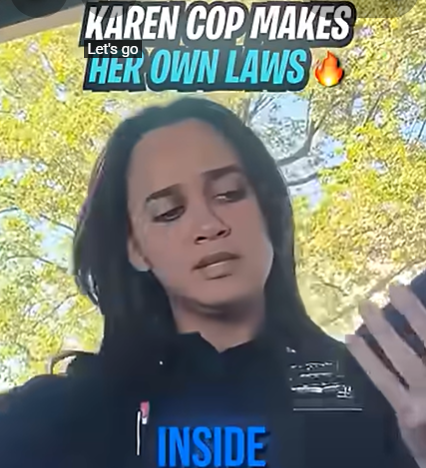
This video captures a tense and very familiar kind of modern confrontation: a person filming in or near a police facility, an officer trying to assert control over the area, and both sides arguing over rights, authority, and the meaning of “public space.” The clip centers on an interaction between a person identified by the watermark as “Good Guy Activism” and a police officer identified as Officer Acevedo. At first, the situation seems simple. The officer tells the individual they need to come inside for questioning because they were reportedly seen looking into cars. But very quickly, the interaction becomes less about that original suspicion and more about whether the person has to answer questions, whether they are allowed to remain in the parking lot, and whether the officer has the authority to make them leave.
The tone of the video is tense from the beginning because neither side appears willing to back down. The officer approaches with a clear position: the individual has drawn attention by looking into vehicles, and she wants them to come inside and answer questions. The person filming immediately pushes back, asserting that they do not have to answer questions and asking for the officer’s name and badge number. That request is a common feature in police accountability videos, where the person recording wants to establish who they are speaking to and create a clear record of the encounter. Officer Acevedo provides that information, which keeps the interaction from immediately escalating over identification, but the disagreement continues because the two sides do not agree on the basic rules of the place where they are standing.
The first major issue is questioning. The officer says the person needs to come inside because they were recorded looking into cars. From the officer’s perspective, that behavior may raise suspicion. Looking into vehicles in a police parking lot could be viewed as unusual, especially if the vehicles belong to employees, officers, or official personnel. Police facilities often have security concerns, and officers may treat behavior around vehicles more seriously than they would in an ordinary store parking lot. From the individual’s perspective, however, being suspicious is not the same as being legally required to answer questions. They appear to understand that a person generally has the right to remain silent and does not have to voluntarily submit to questioning simply because an officer asks.
That difference is at the heart of many police-citizen encounters. Officers may ask questions as part of an investigation, but a person may not always be legally required to answer. The question becomes whether the officer is making a request or giving a lawful order. Those two things can sound similar in the heat of the moment, but they are very different. A request can be refused. A lawful order may carry consequences if ignored. In this video, the individual appears to treat the officer’s attempt to bring them inside as voluntary questioning, while the officer seems to treat the situation as something requiring immediate compliance. That mismatch creates tension.
The second and larger issue is the parking lot itself. Officer Acevedo repeatedly says that the area is a private precinct parking lot and tells the individual to leave. The person filming argues that the lot is open to the public, lacks clear restrictive signs, and therefore should be treated as a public area. This is where the video becomes more than a simple police interaction. It turns into a debate about access, property, and how ordinary people are supposed to know where they are allowed to stand.
The individual’s argument depends heavily on what the space looks like. They say the lot is “wide open,” meaning there are no gates, barriers, or obvious signs telling people they cannot enter. They also point out the absence of signs such as “Personnel Only,” “Authorized Vehicles Only,” or “No Trespassing.” Their position is that if a government-controlled parking lot is physically open and not clearly marked as restricted, then a person should not be removed simply for standing there or filming. In their view, public access and the lack of warning signs make the officer’s order questionable.
The officer’s position is different. She appears to treat the lot as private or restricted because it belongs to the precinct and is connected to police operations. From that perspective, the absence of a closed gate may not automatically make the space public. A police station can include public areas, semi-public areas, employee areas, secured areas, and restricted zones. A lobby may be open to the public, while offices, garages, vehicle lots, and employee parking areas may not be. The officer seems to be saying that this particular parking lot is not a place where the individual has a right to remain, even if it is physically accessible.
This is why the disagreement becomes so difficult. Public property does not always mean unrestricted public access. A city-owned building can have areas where the public is allowed and areas where the public is not allowed. A courthouse, school, government office, police station, or military installation can all be publicly owned while still having restricted spaces. At the same time, the public should not have to guess where restrictions begin. Clear signage, barriers, and consistent rules help prevent exactly this kind of confrontation. When a space is open and unmarked, people may reasonably believe they are allowed to be there. When officers believe the area is restricted but there is no obvious sign saying so, conflict becomes much more likely.
The presence of filming adds another layer. The person behind the camera appears to be engaging in a form of police auditing or activism, where individuals record public officials and test whether they respect constitutional rights. These videos often focus on public buildings, sidewalks, parking lots, and police stations because those are places where the boundaries between public access and official control can become contested. Supporters of this kind of filming often argue that it promotes transparency and accountability. Critics argue that some auditors intentionally provoke confrontations, create tension, or push boundaries for views. This video fits into that broader online category, where the legal disagreement is also part of the content.
The officer may be reacting not only to the person’s physical presence but also to the behavior that led to the contact. If the person was allegedly looking into cars, that can make the situation more serious from a security standpoint. A person filming a building from a sidewalk is one thing. A person walking through a police parking lot and looking into vehicles may be treated differently. Vehicles could contain equipment, personal belongings, documents, or law enforcement tools. Even if the individual had no bad intent, the officer may see the behavior as suspicious enough to investigate. The person filming, however, appears to reject the idea that suspicion alone gives the officer authority to force questioning or remove them from a space they believe is public.
The video also demonstrates how quickly an encounter can become a power struggle. The officer wants compliance: come inside, answer questions, leave the lot. The individual wants recognition of rights: provide your name, explain your authority, show why this space is restricted, do not treat a public area as private. Once both sides settle into those positions, the conversation becomes repetitive. The officer repeats that the lot is private. The individual repeats that it is open and unsigned. Neither side persuades the other. The officer’s authority is challenged, and the individual’s presence is challenged. That is why the clip feels tense even without physical force.
The request for the officer’s name and badge number is an important moment because it shows the individual trying to create accountability. In many jurisdictions, officers are expected to identify themselves during public interactions when asked, depending on department policy and circumstances. Officer Acevedo providing that information is a stabilizing moment because refusal could have become another point of conflict. But after identification, the disagreement returns to the space itself. The individual is not satisfied by knowing who the officer is; they want to know why they must leave.
The phrase “wide open” becomes symbolic in the video. To the person filming, openness means permission. To the officer, openness does not cancel the precinct’s control over the property. This is one of the most common sources of confusion in public-space disputes. People often assume that if they can physically enter a place, they are allowed to be there. But many properties rely on signs, rules, or implied limits rather than locked barriers. A parking lot behind or beside a police station may look accessible while still being intended for employees or official vehicles. The problem is that without clear markings, enforcement can feel arbitrary.
The officer’s use of the word “private” also creates confusion because a police precinct is usually a public institution, not a private business. When an officer says “private parking lot,” they may mean restricted or non-public rather than privately owned in the ordinary sense. The individual may hear “private” and reject it because the property is connected to government. Better wording might have reduced the argument. If the officer had said, “This is a restricted employee parking area, not open to the public,” and pointed to a policy or sign, the interaction might have been clearer. But if no sign existed, the individual would still likely challenge the order.
This video also raises a broader issue about transparency around police facilities. Police departments often want to protect secure areas, but they also operate in public buildings and must expect some level of public observation. Citizens generally have an interest in recording public officials performing public duties, especially in areas where they are lawfully present. At the same time, police departments have legitimate security concerns. The challenge is drawing the line clearly. If a person is on a public sidewalk filming the exterior of a station, the legal and practical considerations are different from someone walking through a vehicle lot and looking inside cars. The exact location and behavior matter.
The individual’s refusal to leave becomes the final point of tension. They insist they are in a public space and dismiss the officer’s authority to remove them. This is the kind of moment where an encounter can go in several directions. The officer could disengage, call a supervisor, issue a trespass warning, make an arrest if she believes the law allows it, or attempt to physically remove the person. The individual could leave under protest, continue recording, ask for a supervisor, or remain and risk arrest. Videos like this often end at the moment of defiance because that is where the conflict feels unresolved. The viewer is left asking who is right.
The honest answer is that the video description alone does not settle the legal question. Whether the person was lawfully allowed to remain in the lot would depend on details not fully clear from the summary: local law, department policy, property boundaries, signage, whether the lot is designated for employees, whether there were prior warnings, whether the person entered restricted areas, and what exactly they were doing around the vehicles. The individual may be correct that a lack of signage makes the restriction unclear. The officer may be correct that the lot is not open to the public. Both positions can sound plausible depending on facts not shown.
What the video clearly shows, however, is the importance of clear communication. If police departments do not want people entering certain lots, the simplest solution is visible signage and barriers. A clear “Authorized Personnel Only” sign removes much of the ambiguity. It gives officers a stronger basis for asking someone to leave, and it gives members of the public notice before they enter. Without signage, officers may still have authority in some situations, but the encounter becomes harder to explain and easier to challenge. Clarity protects both sides.
The video also shows the importance of tone. The officer appears to be asserting authority, while the individual appears to be asserting rights. When authority and rights are framed as opposing forces, the interaction can become combative. A calmer approach might involve the officer explaining the security reason for the restriction and asking the person to move to a clearly public sidewalk or lobby. The individual could continue recording from that location while still preserving their argument. But police-auditing videos often thrive on the refusal to compromise, because the conflict itself is the proof the auditor wants to capture.
The individual’s behavior also deserves balanced analysis. Asking for a name and badge number, asking whether one is detained, and refusing voluntary questioning are common rights-based responses. But looking into cars in a police lot, if that happened as described, can understandably trigger concern. A person who wants to test public access may still be responsible for avoiding behavior that appears invasive or suspicious. Recording public officials is one thing; looking into vehicles can be interpreted differently, especially around a police facility. Even if the individual believes they are within their rights, they should understand why the officer views the behavior as concerning.
The officer’s behavior also deserves balanced analysis. She has a legitimate interest in securing the precinct lot and responding to suspicious behavior. But if she is ordering someone to leave, especially from a place that appears open, the clearest and strongest approach is to explain the legal basis, identify the boundary, and provide a clear alternative location. Simply repeating that the area is private may not be enough to convince someone who believes government property is public. Stronger explanation could reduce the chance of escalation.
The video’s larger theme is the conflict between public access and institutional security. Government buildings belong to the public in one sense, but that does not mean every inch is open for unrestricted use. Police departments especially must manage that tension because they are both public-facing agencies and security-sensitive operations. The lobby may be public. The sidewalk may be public. The vehicle lot may be restricted. The problem comes when the boundaries are invisible. In that gray zone, confrontations like this become almost inevitable.
The clip also reflects the modern reality that almost every police encounter can become content. The person filming is not only documenting the incident; they are shaping it. The questions asked, the refusal to leave, the challenge to authority, and the focus on signage are all part of a style of activism designed to test limits. The officer, whether she wants to or not, becomes part of that video. That can make officers feel provoked, but it also means their professionalism is being publicly measured. The camera changes the encounter because everyone knows the footage may be judged later by thousands of viewers.
For viewers, the video can be interpreted in different ways depending on their assumptions. Some will see the individual as standing up for rights and refusing to be bullied out of a public space. Others will see them as intentionally provoking police by entering a lot connected to official vehicles and refusing a reasonable request to leave. Some will see Officer Acevedo as protecting a secure area. Others will see her as overstepping by calling an open lot private without clear signage. That split reaction is exactly why these videos spread. They are not only records of events; they are invitations to argue.
The safest takeaway is not to oversimplify the encounter. Rights matter. Police authority has limits. Public filming is often lawful when done from a lawful place. But restricted areas also exist, and suspicious behavior around vehicles can justify police attention. The key issue is not whether one side should always win. The key issue is whether the boundary is clear, whether the officer can explain the authority behind the order, and whether the individual is willing to recognize that not every open-looking area is automatically open to the public.
The video ends with the individual refusing to leave and insisting the space is public. That unresolved ending leaves the central question hanging: who gets to define the space in that moment? The officer says the precinct lot is private or restricted. The individual says the open access and lack of signage make it public. Without more information, the viewer cannot fully decide the legal answer, but the emotional answer is clear: both sides feel certain, and certainty is what keeps the confrontation alive.
In the end, this video is less about one parking lot and more about the friction between citizens who want to test government authority and officers who are responsible for securing their workplace. It shows how a simple question—“Can I stand here?”—can become a full confrontation when the space is unclear and trust is low. It also shows why clear signage, calm explanations, and respect for legal boundaries matter. If the area is restricted, the public should be clearly told. If the area is public, officers should not remove people simply because filming is uncomfortable. The entire conflict lives in that gray area, and that is why the video feels so tense, frustrating, and relevant.
What makes the encounter linger is that it represents a larger problem in everyday public accountability: people often do not know where their rights begin and where restricted access starts. A person may see open pavement, no gate, and no warning sign, then reasonably believe they are allowed to stand there. An officer may see the same space as part of a secure police facility, even if it does not look clearly restricted to the public. When both interpretations collide, the conversation stops being about simple cooperation and becomes a test of authority.
The officer likely sees the individual’s behavior as suspicious because police parking lots are not ordinary parking lots. They may contain personal vehicles, official vehicles, equipment, case materials, or officers coming and going from duty. From a security point of view, someone looking into cars near a precinct can raise concerns quickly. Even if the person filming believes they are doing nothing illegal, the officer has a reason to ask questions. The disagreement begins when the officer’s concern turns into a demand and the individual refuses to treat that demand as legally binding.
The person filming, on the other hand, appears focused on principle. Their position is not only “I want to stand here,” but “You cannot remove me without a lawful reason.” That is why they keep returning to the lack of signage and the open nature of the lot. They are challenging the officer to prove that the space is restricted. In activist-style videos, that challenge is often the whole point. The person filming wants to see whether the officer can clearly explain the law, respect the right to record, and avoid using authority simply because the recording is inconvenient.
The most useful lesson from the video is that both public agencies and citizens benefit from clarity. If a police department wants to keep people out of a parking lot, clear signs and barriers are the simplest answer. If an area is public, officers should be trained to recognize that filming alone is not a reason to remove someone. And if a citizen wants to assert their rights, they should do so carefully, without creating unnecessary suspicion around vehicles or secure areas.
Ultimately, the confrontation feels tense because it is not only about one officer and one person with a camera. It is about trust. The officer does not trust the person’s reason for being there, and the person filming does not trust the officer’s claim of authority. Without clear boundaries, both sides dig in. That is why the video works as a larger reminder: rights, security, and public access need to be clearly defined before a small disagreement becomes a public confrontation.